International Financial Management: Market, Credit, and Inflation Risk
Document from University about International Financial Management. The Pdf explores key concepts and hedging strategies for market, credit, and inflation risks in a global context. This University-level material in Economics, produced in a schematic and discursive style, is ideal for self-study.
See more64 Pages


Unlock the full PDF for free
Sign up to get full access to the document and start transforming it with AI.
Preview
Preliminary Comments on International Financial Management
Challenge : grow business abroad through export sales (international trade) or direct foreign investment BECAUSE economy has become a global market (for consumers, industrial goods and financial products/services) > how to implement a proper financial strategy in order to deal with the various risks and matters associated with doing business in an international environment ? Global real economy AND the various financial markets are connected (proof : Brexit, sub-prime crisis, collapse of Internet bubble, financial scandals, ... ) THUS they affect the financial management of every business independently of its size/geography/ ... Finance as such is less interesting than international finance because all concepts in finance are great in theory but are applied in a different way in real life THUS international finance incorporates different aspects of finance theory and brings it together in real life [ex : payments and cash management, risk management, working capital financing, capital expenditure financing, investing decision, M&A decision, capital structure and dividend policy are affected by foreign exchange rates, counterparty and country risks, credit spread and interest rates, inflation, foreign local market regulations, ... ] International finance enables to really understand the environment what the concepts on its own don't do BUT concepts are needed to understand the environment
Chapter 1 About International Financial Management
What is International Finance Management?
International Finance Management (IFM) = extension of Domestic Finance that integrates the reality of managing financial and treasury matter in a globalized economical and financial markets environments > based on theories which address the various fundamental questions of modern finance (time value of money, IRR, YtM, K structure and WACC, ... ) IFM should take into account and address amongst others :
- Global and local economic environments, financial markets environments, global and local political environments
- Foreign exchange risk (= risk that foreign currency profits may evaporate in euro terms due to unanticipated unfavourable exchange rate movements)
- Counterparty risk
- Country/political risk (because governments have the right to regulate the movement of goods, capital and people across their borders and those laws sometimes change in unexpected ways-
- IT technology applied to finance, treasury and banking practices
- International funding considerations
- Market imperfections (transaction & shipping costs, legal restrictions, movements of goods, ... )
- Tax arbitrage
- Corporate governance
Scope of International Financial Management
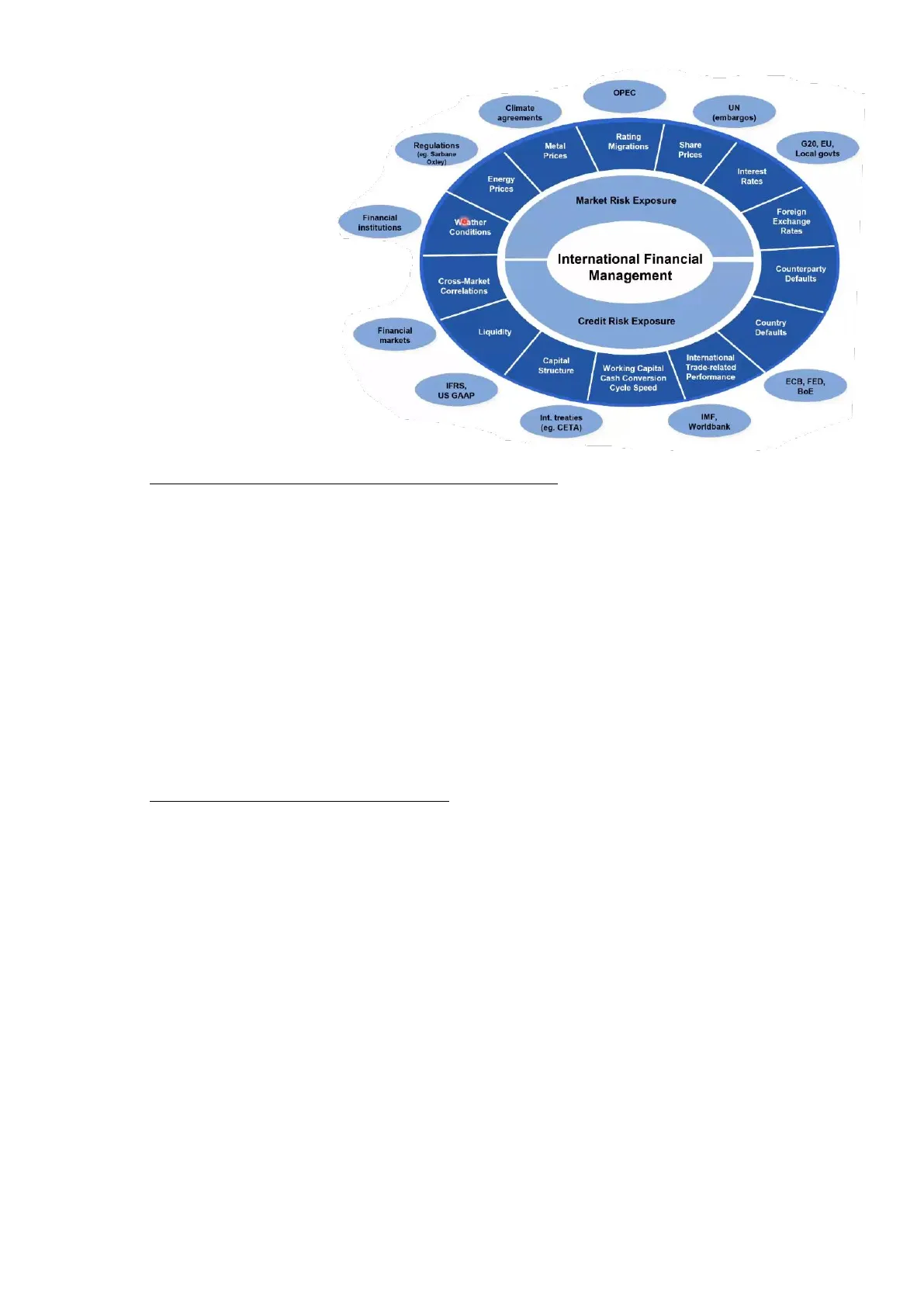
When managing an international company, you should look into various key elements having a (in)direct impact on the company (see figure) > this exercise should be done having in mind all stakeholders ST and LT objectives (shareholders, personnel, clients & suppliers, environment) OPEC Climate agreements UN (embargos) Regulations (eg. Sarbane Oxley) Metal Prices Share Prices G20, EU, Local govts Energy Prices Market Risk Exposure Financial institutions Weather Conditions Foreign Exchange Rates International Financial Management Counterparty Defaults Cross-Market Correlations Credit Risk Exposure Country Defaults Financial markets Liquidity Capital Structure International Trade-related Performance IFRS, US GAAP Working Capital Cash Conversion Cycle Speed ECB, FED, BoE Int. treaties (eg. CETA) IMF. Worldbank
i) Going international, you can 1st face Market Risk Exposure Ex for weather conditions : you own a ski resort but imagine that in the next year the ski period shift because there's no more snow in the winter > this will brings major changes in the money coming in Ex for metal prices : your iphone is made of lots of different metals that have a price on the market changing every minute (so even in you think you're not an international company because you're a small French company producing phones, you still depend on the international shifts for the prices of your components) Ex for energy prices : if you're working for a plane company, you need to be expert in the oil fluctuation price ii) BUT you can also face Credit Risk Exposure > need to have enough cash, quality, good results to be able to repay if things go bad Ex : the way you handle things in your account could change the results Ex for country defaults : in some parts of the world, there are some countries more difficult to handle because of political regimes for examples 2 Rating Migrations Interest Rates
Chapter 2 International Financial and Economic Environment
The World We're Living In
In the last 40 years, countries have evolve a lot and the centre of gravity of IB has changed :
- many emerging economies have emerged and can now be considered as developed economies (despite the fact that domestic growth is still unequally distributed between various layers of population)
- developed economies such as Europe are now facing new challenges connected with ageing of population, public debt lowering, business competitiveness because of fast growing economies
- most economies had to face the consequences of global crisis (ex: sub-prime crisis or European debt crisis) and regional crisis (ex: southeast Asian crisis or Russian debt crisis)
World GDP Growth Trends
1980 : growing parts of the world were Brazil and South East Asia BUT the US and Canada weren't big countries > BUT still people wouldn't have gone to China because frontiers aren't safe, it's a different culture, ... 2000 : China has made a big boom ! > need to be everywhere because everything is booming > Everyone goes to China 2009 : except for South East Asia, all others regions of the world are suffering a lot 2022 : Africa looks to be the place to be (and China is investing in Africa for the last 7 years) > even if Africa still has a lot of poverty, when they'll have technology, everything will change from a growth perspective > 1st thing : need to know where the grow will be located in 5 to 10 years to know where to implement !! (consequences of today's decisions will arrive in several years)
World Economic and Financial Crisis Evolution
MSCI index = index that measure the equity market performance of developed markets (consists of the following 24 developed market country indices) VIXX index = represents approximatively the future movements in the S&P500 index over a period of 30 days (calculated by the Chicago Board Options Exchange) Crisis are now more and more global (especially since years 2000 BUT already with Wall Street Crash in 1929 and oil crisis in 1973) > they hurt the international environment and therefore businesses The sub-prime crisis and the Greek sovereign debt crisis have also emphasized the fear of a financial and economic systemic collapse 31600 1400 1200 1000 End 1994 Coluose of Mexican peso Octobre 1987 « Black Monday » Wall Street Crash 1992 Guf crisis (Aug) . Russian crises 1998 Russian deet crisis + currency Covakasbon 600 1997 400 1992 Southeast Asian courtnes (« The Asian Tigers ») currency depreciation 200 Speculators attack weak European currencies (Italy. Scandinavia. UK, etc) 0 1986 1987 1988 1989 1990 1991 1992 1993 1994 1995 1996 1997 1998 1999 1987 : markets are crashing 1990 : Gulf and Russian crisis + French real estate crisis (prices for buildings are too high so everyone sell their property) 1994 : collapse of Mexican peso 1997 : Southeast Asian countries currency depreciation 1998 : Russian debt crisis + currency devaluation 2000 : more globalized world (price of travelling goes \ : tourism, companies go international, terrorism becomes international, internet develop) > internet bubble crash > impact stock market 2001 : World Trade Centre attack 2003 : markets have lost +- 65% since the beginning of the crisis but then begin to increase again !! 2007 : Chinese stock market crash + beginning of subprime crisis / Lehman Brothers bankruptcy 2008 : state's rescue intervention 2010 : start European debt crisis + DJIA flash crash 2011 : Greek and European debt crisis 2015 : Chinese equity markets crisis 2020 : covid-19 > the market lost a lot in a couple of days > The word is changing fast and you need to have a look on that to stay tuned !!
About Global Firms and Global Banks
MNC (= Global Firms or Global Banks in finance) = company that has a legal and business presences in >1 country (most of them buy raw materials in 1 country, produce goods in another and sell finished goods worldwide) 4 about 60 000 MNC in the world If you compare the GDP of country and the revenues of global firms (= sales), you realise that some MNC have become bigger than countries (which is a normal consequence of being able to trade freely in the market) 4 they fund themselves on international capital markets (equity and/or debts) 4 they tend to centralize to the maximum extent possible the financial management (OR decentralize it when they can take advantage of any financial and/or tax arbitrage) BUT thus when things happens to those companies, governments are not able to intervene anymore Examples : i) Financial crisis in 2008 : to avoid bankruptcy, some countries gave money to help stabilize BUT if you need to allocate to your country budget such a great amount, you cannot do it > consequence for savers that lose their money THUS problem for the whole society ii) Pollution event with Shell (in Mexico and Florida) : it cost millions to repair the problem THUS important question : can you let companies grow so big from a finance and data perspective ? (ex : Amazon) > they control money, raw materials, ... Aug 2015 1800 July 2007 Beginning of subprime crisis Chinese equity markets crises Of price tumties April 2000 1600 Dot com internet NASDAQ crash Feb 2007 Chinese stock market crash LEHMAN BROTTRIES July 2007 Letman Brothers berkrugtcy 3 March 2011 Worsening Greek and European debt crisis M 1000 2010 Start European debt crisis . DIA flash crash 800 AIG FannieMae 600 March 2003 Markets have lost # 6550 Since bagning of crisis - Sep-Oct 2008 Saate's rescue wervenben Tiredlie 400 2000 2001 2002 2003 2004 2005 2006 2007 2008 2009 2010 2011 2012 2013 2014 2015 2016 1400 Sep 2001 World Trade Cortar stack 1200 D 1990-1996 French real estate criss 4
Can’t find what you’re looking for?
Explore more topics in the Algor library or create your own materials with AI.
