International Organizations in America, Africa, and Asia
Slides from Universidade Da Coruña about International Organizations. The Pdf provides an overview of regional international organizations in America, Africa, and Asia, covering key aspects for each. The Presentation is suitable for University Law students.
See more64 Pages


Unlock the full PDF for free
Sign up to get full access to the document and start transforming it with AI.
Preview
Regional Organizations in America
Organization of American States (OAS)
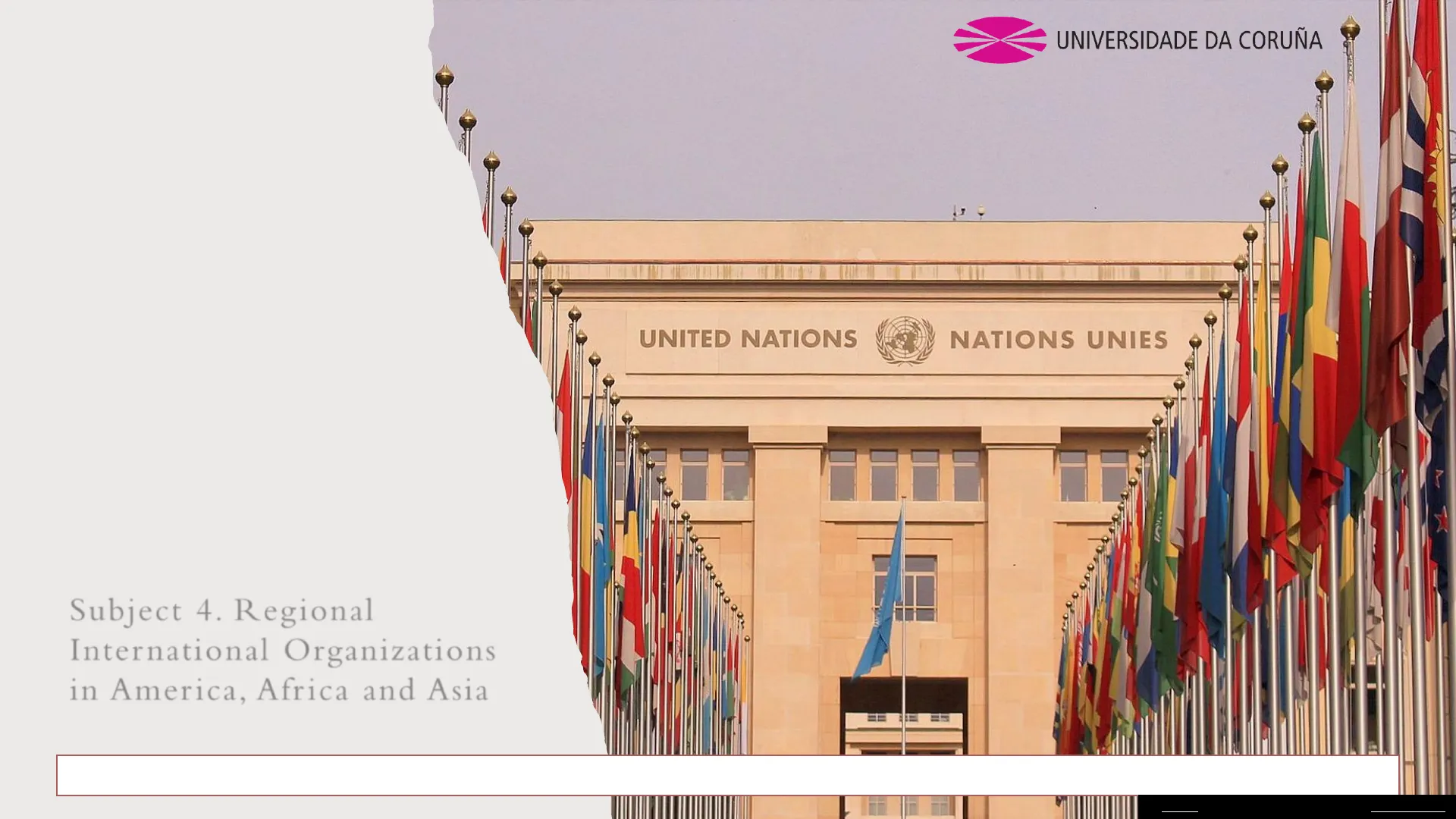
UNIVERSIDADE DA CORUÑA UNITED NATIONS NATIONS UNIES INTERNATIONAL ORGANIZATIONS Subject 4. Regional International Organizations in America, Africa and Asia 710G05012 - International Organizations Christoph R. Schreinmoser Esta foto de Autor desconocido esta bajo licencia CC BY-NC-NDUNIVERSIDADE DA CORUÑA CONTENT A. REGIONAL ORGANIZATIONS IN AMERICA 1. Organization of American States (OAS) 2. Central American Integration System (SICA) 3. Southern Common Market (MERCOSUR) 4. Andean Community B. REGIONAL ORGANIZATIONS IN AFRICA 1. African Union (AU) 2. East African Community (EAC) 3. African Economic Community (AEC) 4. Economic Community of West African States (ECOWAS) C. REGIONAL ORGANIZATIONS IN ASIA 1. Association of Southeast Asian Nations (ASEAN) 2. League of Arab States International Organisations| Christoph R. Schreinmoser| c.r.schreinmoser@udc.esUNIVERSIDADE DA CORUÑA A. REGIONAL ORGANIZATIONS IN AMERICA International Organisations| Christoph R. Schreinmoser| c.r.schreinmoser@udc.esUNIVERSIDADE DA CORUÑA 1. ORGANIZATION OF AMERICAN STATES (OAS)
- Regional international organization
- Mission: promote peace & security in the Americas
- Seat: Washington, D. C.
- 32 Member States
- Establishment: 30 April 1948 - Charter of the Organization of American States
- Secretary General: Luis Almagro
International Organisations| Christoph R. Schreinmoser| c.r.schreinmoser@udc.esUNIVERSIDADE DA CORUÑA 1. PURPOSES PURPOSES (ART. 2):
- Strengthen peace & security of the continent
- Promote and consolidate representative democracy, with due respect for non-intervention
- Pacific settlement of disputes among MS
- Provide for common action in case of aggression against a MS
- Seek solution for political, juridical & economic problems
- Promote cooperation for economic, social and cultural development
- Erradicate extreme poverty
- Limitation of conventional weapons OAS = generalist international organization OAS = regional arrangement in sense of Chapter VIII UNCh
- Art. 1(2): OAS "has no powers other than those expressly conferred upon it by this Charter"
International Organisations| Christoph R. Schreinmoser| c.r.schreinmoser@udc.esUNIVERSIDADE DA CORUÑA 1. MEMBERSHIP (I)
- Admission: 1 "Membership in the Organization shall be confined to independent States of [America] that were Members of the United Nations as of December 10, 1985, and the nonautonomous territories mentioned in document OEA/Ser. P, AG/doc.1939/85, of November 5, 1985, when they become independent" (Art. 8) 2 Indication of desire to become MS through note to SG (declaration of willigness to ratify Charter & accept obligations inhterent to membership) (art. 6) 3 Affirmative vote in General Assembly upon recommendation by Permanent Council (art. 7) Two-thirds majority of MS required in both organs
International Organisations| Christoph R. Schreinmoser| c.r.schreinmoser@udc.esUNIVERSIDADE DA CORUÑA 1. MEMBERSHIP (II)
- Suspension (art. 9): suspension from exercise of the right to participate in bodies of the OAS
- Cause: forceful overthrow of the democratically constituted government of a MS
- May only be exercised when diplomatic efforts to restore democracy fail
- GA vote with two-thirds majority of MS (also for lifting of suspension)
- Withdrawal (art. 143): MS may denounce treaty at any time
- Effectiveness: two years after receival of denounciation by SG
International Organisations| Christoph R. Schreinmoser| c.r.schreinmoser@udc.esUNIVERSIDADE DA CORUÑA 1. INSTITUTIONAL STRUCTURE (I) Article 53 The Organization of American States accomplishes its purposes by means of: a) The General Assembly; b) The Meeting of Consultation of Ministers of Foreign Affairs; c) The Councils; [Permanent Council & Inter-American Council for Integral Development] d) The Inter-American Juridical Committee; e) The Inter-American Commission on Human Rights; f) The General Secretariat; g) The Specialized Conferences; and h) The Specialized Organizations. There may be established, in addition to those provided for in the Charter and in accordance with the provisions thereof, such subsidiary organs, agencies, and other entities as are considered necessary. International Organisations| Christoph R. Schreinmoser| c.r.schreinmoser@udc.esUNIVERSIDADE DA CORUÑA 1. INSTITUTIONAL STRUCTURE (I) GENERAL ASSEMBLY (ARTS. 54-60)
- "Supreme organ" of the OAS
- Comprises delegations of all MS
- Meets annually (rotation system)
- Powers: - Decide policy of OAS - Coordinate activities of organs - Coordinate with UN & other IOs - Approve Budget
- Voting: - One State, one vote - Generally absolute majority Organ Organi. Organis Organiza os Americ America Américain in States anização do os Americ 45 amble Washingt Esta foto de Autor desconocido está bajo licencia CC BY-NC-ND International Organisations| Christoph R. Schreinmoser| c.r.schreinmoser@udc.esUNIVERSIDADE DA CORUÑA 1. INSTITUTIONAL STRUCTURE (I) PERMANENT COUNCIL (ARTS. 70-92)
- Conducts day-to-day governance
- Directly responsible to GA
- Each MS represented by ambassador
- Functions and powers: - Maintanin friendly relations among MS - Carry out decisions of GA - Act as preparatory committee of GA - Receive reports from OAS bodies - Perform all other functions assigned to it by Charter 3 4 5 Esta foto de Autor desconocido está bajo licencia CC BY-NC-ND International Organisations| Christoph R. Schreinmoser| c.r.schreinmoser@udc.esUNIVERSIDADE DA CORUÑA 1. INSTITUTIONAL STRUCTURE (I) GENERAL SECRETARIAT (ARTS. 107-121)
- "Central and permanent organ" of OAS
- Administrative body
- Headed by SG - Currently: Luis Almagro - Elected by GA (5 year term, one reelection possible)
- Functions and powers: - Promote economic, social, juridical, educational, scientific & cultural relations among MS (art. 111) - Assist & prepare work of organs of OAS (art. 112) OEA OEA DEA SECRETARIO GENERAL ACA Esta foto de Autor desconocido está bajo licencia CC BY-SA
International Organisations| Christoph R. Schreinmoser| c.r.schreinmoser@udc.esUNIVERSIDADE DA CORUÑA 1. THE INTERAMERICAN HUMAN RIGHTS SYSTEM (I)
- OAS Charter contains few references to human rights, BUT: establishment of interamerican human rights system = principal achievements of OAS
- Within framework of OAS, several human rights treaties have been negotiated/approved - American Convention on Human Rights (Pact of San José), 1969 - San Salvador Protocol on Economic, Social and Cultural Rights, 1988 - Protocol relating to the abolition of the death penalty, 1990 - Inter-American Convention to Prevent and Punish Torture, 1985
- Inter-American Commission on Human Rights (IACHR):
- Created in 1959/1960 as an organ of the OAS
- 7 members elected by GA, serving in individual capacity
- Powers:
- Receives individual petitions in which violations of human rights are alleged by any OAS MS
- Observes & reports on general human rights situations in OAS MS
- Carries out country visits to conduct in-depth analysis
International Organisations| Christoph R. Schreinmoser| c.r.schreinmoser@udc.esUNIVERSIDADE DA CORUÑA 1. THE INTERAMERICAN HUMAN RIGHTS SYSTEM (II)
- Conventional system of the American Convention on Human Rights: - Only aplicable to States Parties to the ACHR free modalities: periodic reports, state communications, individual ommunications Inter-American Commission on Human Rights - Analyses periodic reports - Hears & estimates individual communications - Transmits (confidential) proposals & recommendations to the respective State - If State does not comply with recommendations, IACHR may - Issue its (public) conclusions on the matter; or - Refer the case to the Inter-American Court of Human Rights (if State accepts jurisdiction) Inter-American Court of Human Rights (IACtHR) - Judicial organ of the ACHR (Seat: San José, Costa Rica) - 7 Judges (elected by OAS GA) - Considers cases submitted by IACHR or States Parties - Jurisdiction according to art. 62 ACHR (20 OAS MS) - Judgements of the IACtHR are final and binding - Additional role: advisory opinions for MS/organs of OAS (art. 64 ACHR) International Organisations| Christoph R. Schreinmoser| c.r.schreinmoser@udc.es Double nature of IACHR
Central American Integration System (SICA)
UNIVERSIDADE DA CORUÑA 2. CENTRAL AMERICAN INTEGRATION SYSTEM (SICA)
- Regional integration organization
- Mission: achieve Central American integration
- Seat: San Salvador, El Salvador
- 8 Member States
- Establishment: 13 December 1991 - Protocol to the Charter of the Organisation of Central American States (ODECA) (Protocol of Tegucigalpa) DESARROLLO N E A PAZ SISTEMA DE L ROAMERICANA LIBERTAD SICA DE RACIA Esta foto de Autor desconocido está bajo licencia CC BY-NC-ND
International Organisations| Christoph R. Schreinmoser| c.r.schreinmoser@udc.esUNIVERSIDADE DA CORUÑA 2. BACKGROUND
- During colonial period, today's Costa Rica, El Salvador, Guatemala, Honduras & Nicaragua formed part of a single colonial dependency ( Capitanía General de Cuatemala)
- 1821: independence
- 1823-1841: United Provinces/Federal Republic of Central America
- 1903: independence of Panamá from Colombia
- 14 October 1951: Organisation of Central American States (ODECA) - Objective: creating an economic-political community among its MS . 13 December 1991: Protocol of Tegucigalpa -> Establishment of SICA
International Organisations| Christoph R. Schreinmoser| c.r.schreinmoser@udc.esUNIVERSIDADE DA CORUÑA 2. PURPOSE
- Art. 2: "The Central American Integration System is the institutional framework of the regional integration of Central America."
- Art. 3: "The [SICA] has as its fundamental objective the realization of the integration of Central America, to constitute it as a Region of Peace, Freedom, Democracy and Development."
- For this purpose, its aims are, inter alia: - Consolidate democracy - Create a new model of regional security (holistic approach) - Achieve a regional system of wellbeing & economic and social justice - Achieve an economic union & strengthen the region as an economic bloc - Promote economic, social, cultural, political development of MS
International Organisations| Christoph R. Schreinmoser| c.r.schreinmoser@udc.es
Can’t find what you’re looking for?
Explore more topics in the Algor library or create your own materials with AI.
