Costumer Behavior: Analyzing Purchase Process and Influencing Factors
Document about Costumer Behavior. The Pdf explores consumer behavior, covering topics such as the phases of the purchasing decision process, influencing factors, and group dynamics. This University-level material in Economics is presented in a schematic style, useful for quick review or to supplement lessons.
See more17 Pages


Unlock the full PDF for free
Sign up to get full access to the document and start transforming it with AI.
Preview
Costumer Behavior Introduction
Costumer Behavior
INTRODUCING
Costumer behavior > the actions, decisions, and preferences of people when they interact with products or services.
Costumer behavior = emotional marketing
Is a process
- > stages before and after
- Need of recognition
- Research for information
- Evaluation of alternatives
- Purchase (compra)
- Post- Purchase
Why Study Costumer Behaviour?
WHY STUDY COSTUMER BEHAVIOUR?
- Consumer differentiation - Groups consumers to tailor marketing strategies.
- Retention of customers - Ensures customer satisfaction and loyalty.
- Designing relevant marketing programs - Creates targeted campaigns.
- Predicting market trends - Identifies shifts to stay ahead.
- Understanding competition - Analyzes rivals and market gaps.
- Staying relevant in the market - Adapts to changing consumer preferences.
Consumer and Marketer Perspectives
CONSUMER'S PERSPECTIVE
MARKETER'S PERSPECTIVE
Prepurchase Issues
PREPURCHASE
ISSUES
How does a consumer decide that
he/she needs a product?
What are the best sources of information
to learn more about alternative choices?
How are consumer attitudes toward
products formed and/or changed?
What cues do consumers use to infer
which products are superior to others?
Purchase Issues
PURCHASE
SSUES
s acquiring a product a stressful or
pleasant experience? What does the
purchase say about the consumer?
How do situational factors, such as time
pressure or store displays, affect the
consumer's purchase decision?
Postpurchase Issues
POSTPURCHASE
ISSUES
Does the product provide pleasure or
perform its intended function?
How is the product eventually disposed
of, and what are the environmental
consequences of this act?
What determines whether a consumer
will be satisfied with a product and
whether he/she will buy it again?
Does this person tell others about his/her
experiences with the product and influence
their purchase decisions?
Module 1: Foundations of Consumer Behaviour
Consumer Identity and Marketers
MODULE 1: FOUNDATIONS OF CONSUMER BEHAVIOUR
Consumer Identity as an Aid to Marketers
- Consumers are segmented by demographics and psychographics.
- They are partly understood based on their consumption communities and reference groups.
- Brands target them using market segmentation strategies.
- Consumers may choose brands that align with their identity.
Costumer Behavior for Marketers
COSTUMER BEHAVIOR:
Marketers must understand the wants and needs of different consumer segments.
Segmenting Costumers
SEGMENTIG COSTUMERS:
- Geographic - Groups customers based on location, region, climate, and urban/rural areas.
- Demographic - Segments consumers by age, gender, occupation, and socio-economic group.
- Behavioral - Focuses on buying habits, loyalty, and benefits sought.
- Psychological - Classifies consumers based on personality, lifestyle, attitudes, and interests.
Consumer-Brand Relationships
CONSUMER-BRAND RELATIONSHIPS
- Role Theory:
- Self-concept attachment: The product helps to establish the user's identity
- Nostalgic attachment: The product serves as a link with a past self
- Interdependence: The product makes part of the user's daily
- Love: The product has a strong emotional bond with the user
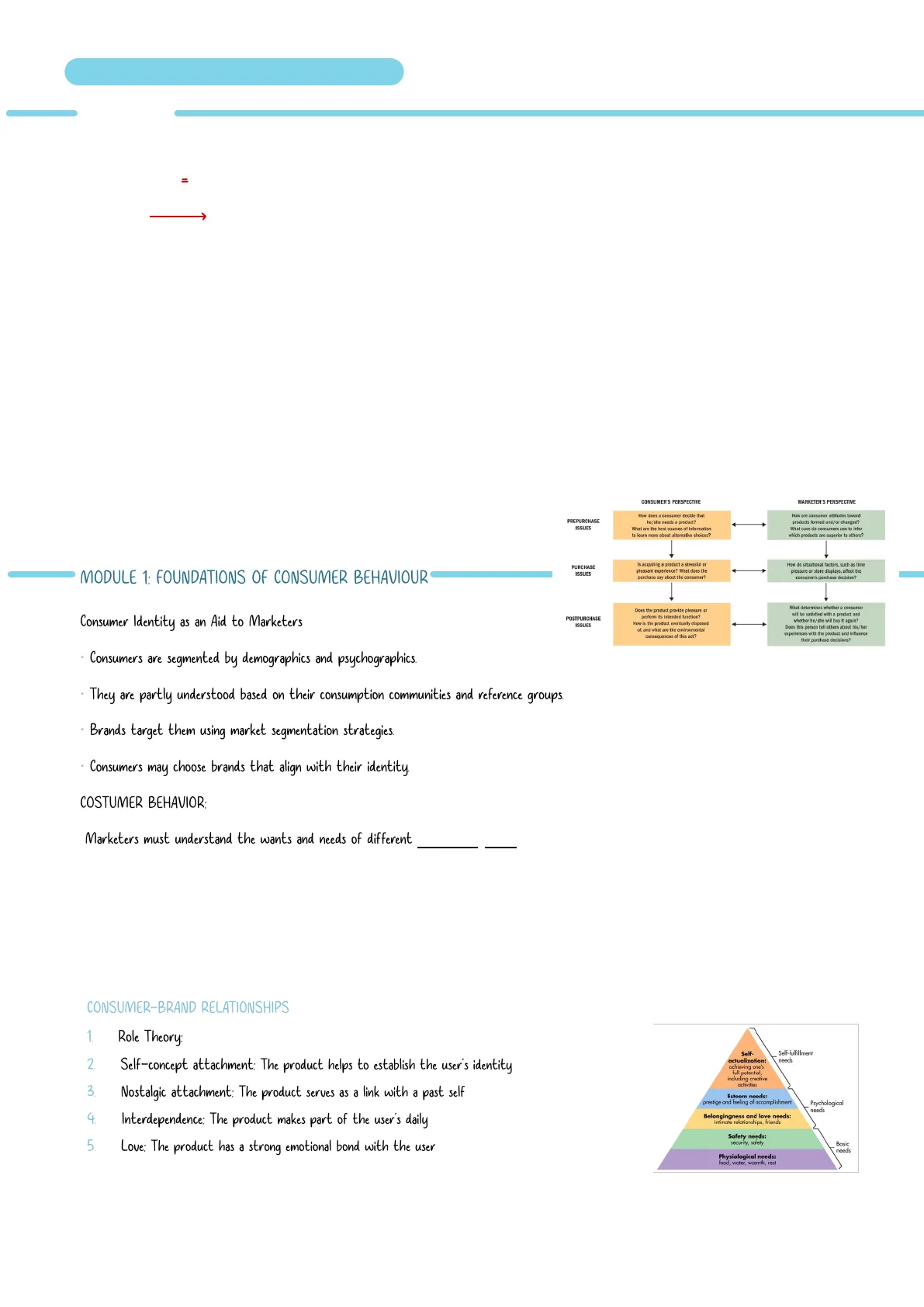
Maslow's Hierarchy of Needs
Self
actualization:
achieving one's
full potential,
including creative
activities
Self-fulfillment
needs
Esteem needs:
prestige and feeling of accomplishment
Psychological
needs
Belongingness and love needs:
intimate relationships, friends
Safety needs:
security, safety
Basic
needs
Physiological needs:
food, water, warmth, restDifference between needing something and wanting it
- Need Something a person must have to live or achieve a goal
- Want: A manifestation of a person's need. It is determined by her personal and cultural factors
Changes in Population and Digital Natives
Changes in the population
- Most people live in urban centers
- Diversity is becoming the norm
Digital Natives - Those consumers who interacted with digital technology since they were born
Digital Revolution and IoT
Digital revolution
- Technology is everywhere from companies to homes
- People are connected 24/7: Communicating. learning. buying, etc.
Internet of Things (IOT) - Interconnected devices that communicate among them
- Recent discipline started only a few decades ago
- Very interdisciplinary: Experimental psychology. microeconomics, demography, anthropology, etc.
CB Researchers' Workplaces
Where do CB researchers work?
- Manufacturers, retailers, marketing research firms, governmental agencies, nonprofit organizations, universities
UNIT2: Costumer and Social Well Being
Ethical Business and Marketing Ethics
UNIT2: COSTUMER AND SOCIAL WELL BEING
Ethical Business and Marketing Ethics
T
Business ethics guide marketplace conduct.
T
Ethical standards vary across cultures.
Marketing Manipulation Concerns
Marketing manipulation concerns: (Preocupaciones)
- Encourages materialism.
- >Materialismo
- Targets vulnerable groups (e.g. children).
- Capitalizes on fear (e.g., health crises, food contamination).
Miedo:
- Companies exploit digital footprints for targeted advertising.
- > Productos adictivos.
- Some brands create addictive products.
Do Marketers Create Needs?
Do marketers create needs?
Marketing reveals needs rather than creating them.
Needs = biological
Wants = shaped by society.
- Advertising helps consumers by reducing search time for information.
Marketers' Obligation for Safe Products
Marketers' Obligation to Provide Safe Products
-> Companies must ensure products are
functional
safe
-> False advertising cases highlight deceptive marketing.
Complaining (voice response).
quejas
-> Consumers can respond to unethical practices by:
Sharing dissatisfaction (private response).
compartir su insatisfacción
Seeking third-party intervention.
intervención de terceros
Corporate Social Responsibility & Social Marketing
Corporate Social Responsibility (CSR) & Social Marketing
- CSI: Encouraging businesses to have a positive impact.
- Social marketing: Promotes positive behaviors, discourages harmful ones.
- Cause marketing: Aligning businesses with social causes.
Impact of Consumer Behavior on Public Policy
Impact of Consumer Behavior on Public Policy
Consumer behavior influences regulations to protect.
privacy
the environment
safety.
Consumer choices can drive positive changes in businesses or worsen social and environmental issues.
Harmful Consumer Behavior
Harmful Consumer Behavior
Social media addiction.
Adicción a las redes
- Addictive consumption:
Phantom vibration syndrome.
Síndrome de la vibración fantasma.
Compulsive buying.
Compra compulsiva
Dark Side of Consumer Behavior:
Illegal activities: Theft, fraud, counterfeiting.
Anticonsumption: Acts against brands (e.g. boycotts, sabotage).
UNIT3: Perception
Perception Process
UNIT3: PERCEPTION
Perception -> The process by which individuals select, organize, and interpret stimuli to create meaning.
2
The process by which individuals select, organize, and interpret stimuli to create meaning.
Stages of the Perceptual Process
The Stages of the Perceptual Process
Exposición
- Exposure: Sensory thresholds (absolute and differential). subliminal perception.
Atención - Attention Factors that capture attention, sensory overload, selective perception.
Interpretación - Interpretation: Stimulus organization, Gestalt principles (closure, similarity. figure-ground).
Thresholds and Subliminal Perception
Absolute threshold: The minimum level of stimulation needed to be detected.
>Differential threshold: The smallest difference between two stimuli that can be
perceived. Example: subtle changes in product size or price.
Subliminal perception: Information received without conscious awareness.
Sensation and Sensory Marketing
Sensation and Sensory Marketing
Types of Sensation:
-Vision (colors, branding. "trade dress").
-Smell (scent marketing, memory associations with scents).
-Sound (audio branding. watermarking, sound symbolism).
método que traduce las emociones del usuario en atributos concretos del producto.
-Touch (endowment effect. Kansei engineering).
-> las personas valoran más aquello que poseen.
-Taste (how flavor influences consumption).
Audio watermarking is a technique that inserts an imperceptible digital signal
into audio content to identify, authenticate, and track it, reinforcing the
brand's identity
Sound symbolism is the influence of a word's sound on the perception of its
attributes.
.
Sensory Marketing -> Companies think carefully about the impact of sensations on our product experience.
Sensation -> The immediate and direct response of the sensory organs to stimuli
Sensory Marketing
When companies use the senses to create messages, shopping experiences, and products that connect better
with consumers and influence them stronger (this type of messages are more effective)
Sensation Vision
SENSATION VISION
Marketers use many visual elements in advertising, store design, and packaging (Size, position, contrast, movement,
and color ).
Colors influence our emotions:
. Red > Emotion arousal and stimulates appetite.
. Green -> Relaxing and helps for concentration.
Our brain finds it easier to recall colors than words. Sometimes, color preferences depend on gender and age.
typically, women pay more attention to colors and have a richer palette than men, older people prefer white
Sensation Sound
SENSATION SOUND
Music and other sounds affect people's feelings and behaviors.
Memory of music lasts for a very long time and is among the last to disappear.
- Some brands have their own jingle and use it in their commercials and stores to identify the brand and distinguish it from the competition.
When creating a brand name, some companies pay attention to the sound symbolism.
UNIT 4: Learning and Memory
Behavioral Learning Theories
UNIT 4: LEARNING AND MEMORY
Behavioral Learning Theories
Classical Conditioning (Paulov)
1. Classical Conditioning (Paulov) -> Based on the association between a neutral stimulus and one that naturally generates a response.
Example: An advertisement linking a soft drink with happiness creates a positive emotional response.
Key concepts:
. Unconditioned Stimulus (UCS): naturally triggers a response (e.g. food causes salivation).
>Respuesta natural
Principalmente no respuesta, pero al asociarse con UCS si lo hace
· Conditioned Stimulus (CS): initially does not trigger a response, but after association with the UCS. it does (e.g. the sound of a bell).
· Conditioned Response (CR): learned reaction to the CS (e.g. salivating at the sound of the bell).
Marketing applications:
refuerza la asociación entre el producto y el mensaje publicitario.
- Repetition: strengthens the association between a product and an advertising message.
> respuestas similares a estímulos parecidos - Stimulus Generalization: similar stimuli elicit the same response (e.g. private-label brands mimicking national brands).
Aconsumidores aprenden a distinguir entre marcas similares. - Stimulus Discrimination: consumers learn to differentiate between similar brands.
Instrumental Conditioning (Skinner)
2. Instrumental Conditioning (Skinner) -Learning occurs through rewards and punishments that shape behavior.
Types of reinforcement in marketing:
· Positive reinforcement: a reward strengthens behavior (e.g. loyalty points, discounts).
· Negative reinforcement: removing an unpleasant stimulus to encourage behavior (e.g. money back guarantee).
Castingo
· Punishment: negative consequences discourage behavior (e.g. late fees for service cancellations).
. Extinction: if reinforcement stops, learned behavior disappears (e.g. customers stop using a product if they no longer receive benefits).
Marketing applications:
· Loyalty programs: rewarding frequent purchases.
· Gamification: turning routine tasks into engaging experiences.
Cognitive and Observational Learning
Cognitive and Observational Learning
These theories focus on mental processes rather than automatic responses.
Cognitive Learning
1. Cognitive Learning
Views consumers as problem-solvers who actively seek and process information.
> Instead of passively responding to stimuli, consumers analyze, compare, and make informed
decisions.
Observational Learning
2. Observational Learning
Consumers learn by watching others and replicating behaviors if they
see positive outcomes.
Example: An influencer using a product encourages their followers to
buy it .
Conditions for observational learning:
- The consumer must pay attention to the model (e.g. influencer, celebrity, expert)
- They must remember the behavior.
- They must convert the observation into action (purchase the product).
- They must be motivated to act
Can’t find what you’re looking for?
Explore more topics in the Algor library or create your own materials with AI.
