Topic 1: Japanese Culture and History, University Presentation
Slides about Japanese Culture and History. The Pdf, a presentation for university-level History, explores the geography, climate, population, and key historical periods like Heian and Tokugawa, along with religious and artistic aspects.
See more9 Pages

Unlock the full PDF for free
Sign up to get full access to the document and start transforming it with AI.
Preview
Japanese Culture and History Characteristics
Geography of Japan
Surrounded by countries with a totally different system:
- RUSSIA: totally different system
- CHINA: economically have a good relationship, but when it comes to political and population terms, they have not.
- NORTH KOREA: we don't know anything about its system, but it is obviously not a democracy and market system
- SOUTH KOREA: both are democracy, market, but they have not a good relationship because of its history
3.900 islands -> The 4 main ones: Hokkaido, Honshu, Shikoku, Kyushu.
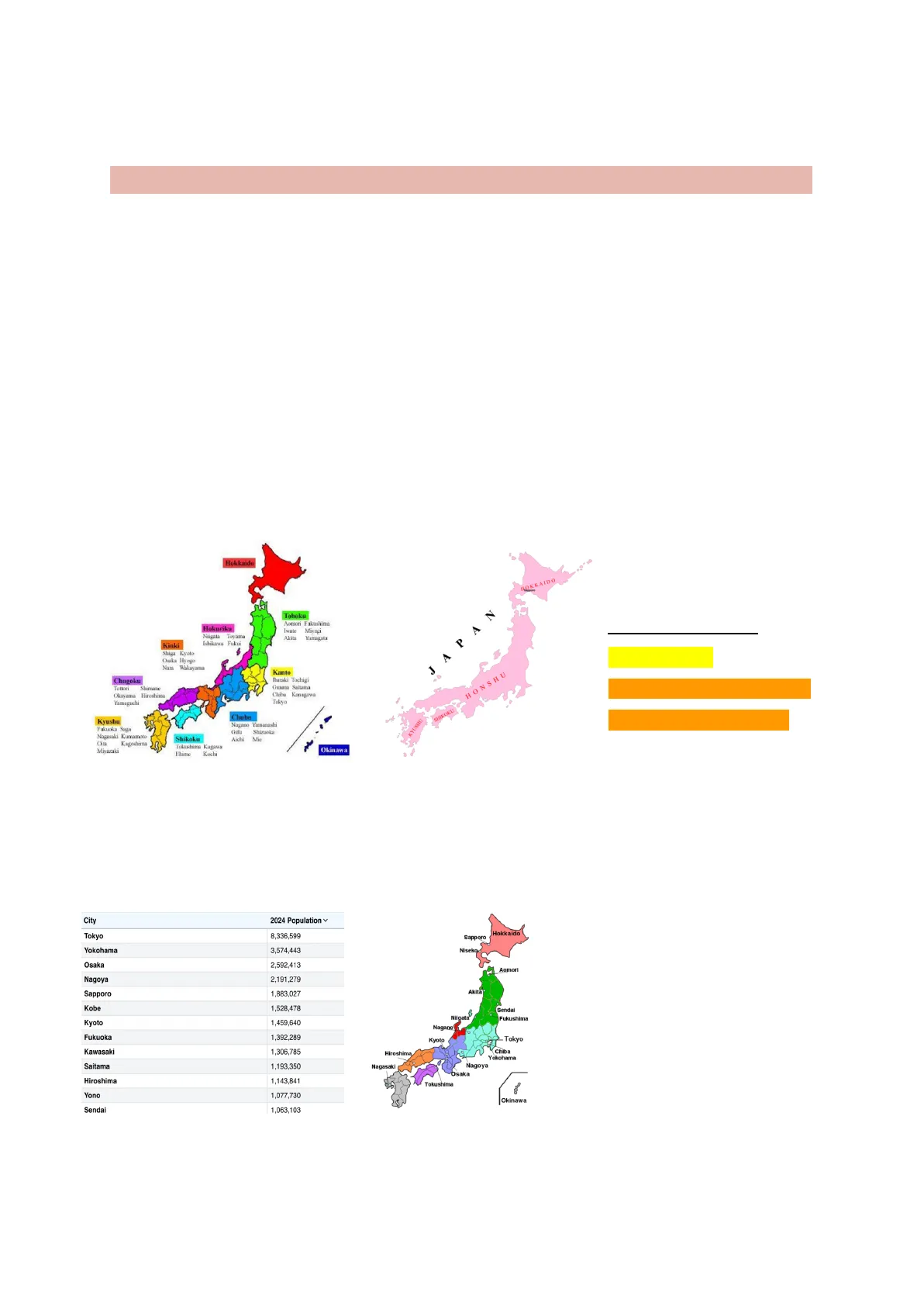
Hokkaido HOKKAIDO Tohoku Aomori Fukushima Iwate Akit Miyagi Yamagata Kinki Shiga Kyoto Osaka Hyogo Nara Wakayama Kanto Chugoku Ibaraki Tochigi Gunma Saitama Chiba Kanagawa Tokye Kinki: Osaka (the richest area during the 80's) and Kyoto
Population Density and Trends
Cities are not so big, thus the population is not as concentrated as China. Most inhabitants live in the greater Tokyo -> 35% density of population
City 2024 Population v Tokyo 8,336,599 Sapporo Niseko Osaka 2,592,413 Aomori Nagoya 2,191,279 Sapporo 1,883,027 Akita Kobe 1,528,478 Sendal Fukushima Kyoto 1,459,640 Nagano'S Fukuoka 1,392,289 Kyoto - Tokyo Kawasaki 1,306,785 Hiroshima Chiba Yokohama Saitama 1,193,350 Nagasaki Nagoya Hiroshima 1,143,841 Tokushima Yono 1,077,730 Okinawa Population is decreasing: 1868 Meiji Restoration -> 33 million people 2020 -> 126 million people 2023 -> 125,6 million people Sendai 1,063,103
Important Regions of Japan
KYUSHU Fukuoka Saga Nagasaki Kumamoto Oita Kagoshima Miyazaki Shikoku Nagano Yamanashi Gifu Shizuoka Aichi Mis Tokushima Kagawa Fhime Koch Okinawa IMPORTANT REGIONS Hokuriku Niigata Toyama Ishikawa Fukui JAPAN Kanto -> Tokyo Tottori Shimane Okayama Hiroshima Yamaguchi Chube Kyushu SHIKOKU O HONSHU Hokkaido Yokohama 3,574,443 Niigata Osaka
Climate and Topography
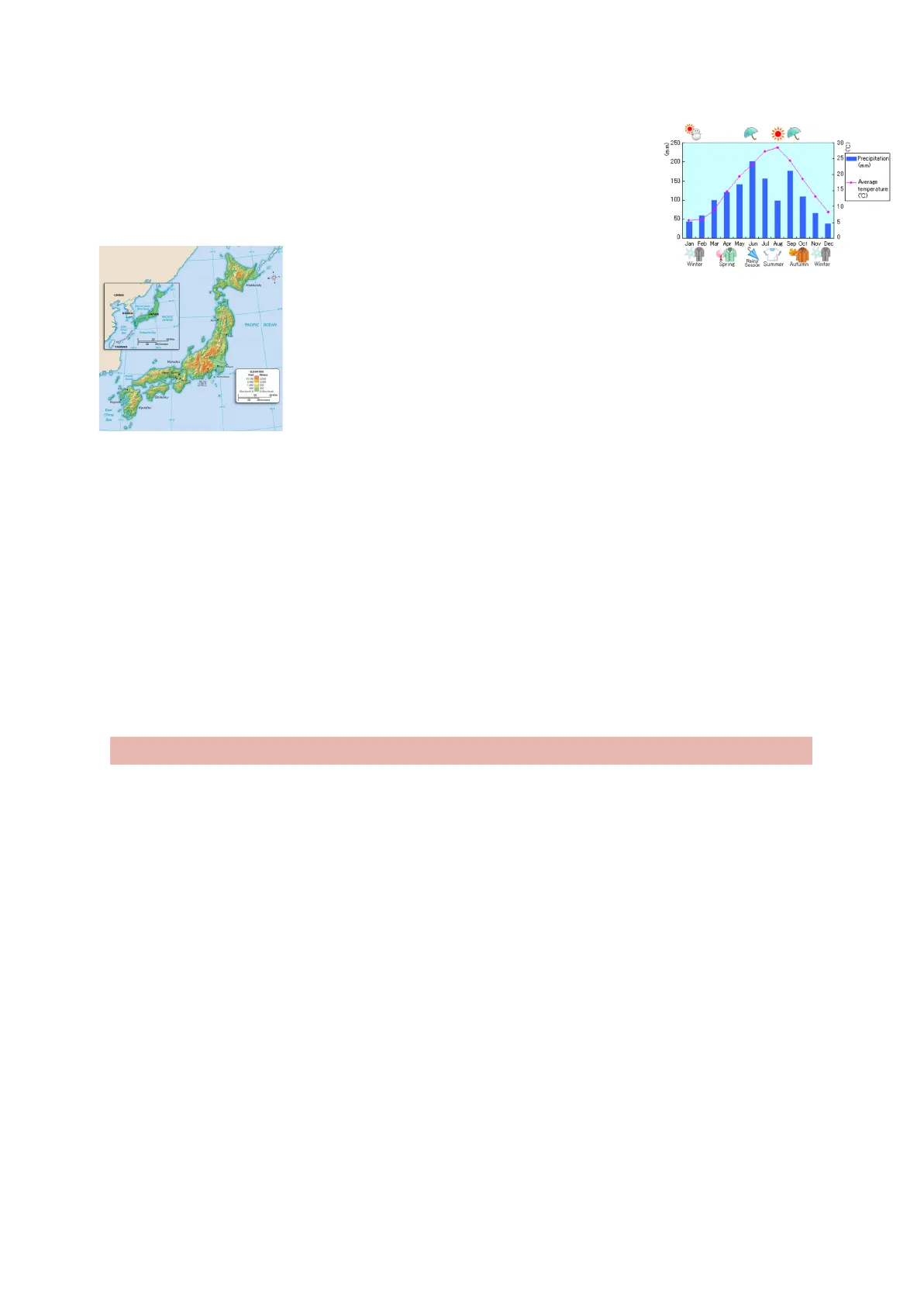
Moderate climate, except June and September (rainy season)
TOPOGRAPHY Hokkaido CHINA e KOREA JAPAN PACMVC PACIFIC OCEAN TAIWAN Monsh 6.500 2.000 Shioku Kyushu Southeast Asian mountain range: long, rocky coast. 72% is mountainous. Mont Fuji is the most important mountain -> 3,776 meters 67 active volcanoes: many earthquakes (detected by cats and dogs) and hot springs (onsen -> ritual they must follow)
Nature's Role in Japanese Culture
NATURE PLAYS A CRUCIAL ROLE IN JAPAN CULTURE
30 250 25 Precipitation 200 (mm. 20 150 - Average temperature 100 10 50 5 0 0 Jan Feb Mar Apr May Jun Jul Aug Sep Oct Nov Dec Winter Spring Rainy Season Summer Autumn Winter
Religion in Japan
Philosophy: CONFUCIANISM -> moral concepts and precepts of benevolence, good faith, knowledge, justice, property, hierarchy (Originated from China and Korea but practiced in Japan). Two main religions:
- SHINTO: Japan's earliest religion (only can be found in Japan) -> well being of community, Kamis (gods), traditional doors (entrance to shintos) , temple of shine, nature festivals.
- BUDDHISM: (6th century) rooted in the Heian period, practice of the upper classes. Different sects.
Heian Period: Kyoto (784-1185)
Introduction to the Heian Period
It was a 400-year period in which the capital moved to Heian-kyo (modern-day Kyoto), meaning "capital of peace and tranquility". The period is characterized by:
- The Emperor delegated power to regents and aristocratic families, mainly the Fujiwara clan.
- Cultural flourishing and literary advancements which influenced the aristocracy and Japan's identity.
Land Ownership and Decline of Imperial Influence
LAND PASSED INTO PRIVATE HANDS A cultural boom occurred largely influenced by Buddhism (theater, music, meditation innovations). The imperial court struggled financially as it was unable to sustain its lifestyle, so they began to sell part of their lands to rich people (Buddhist temples and aristocrats from outside Kyoto. As a result, powerful regional lords emerged and the Heian court's influence declined.
Rise of the Samurai Class
PROBLEMS: SAMURAI CLASS These land acquisition made families form clans to protect their estates and establish independent power. They created their own military power, leading to the rise of the Samurai class composed by the landlords (Daimyo) and their warrior vassals.
Feudal System Development
FEUDAL SYSTEM This led to a feudal system with a lord-vassal relationship: landlords creating militias and warrior vassals serving them in exchange for protection and land. Power shifted from the imperial court to regional military leaders. It begins Japan's feudal era.
Samurai System: Shogunate
SAMURAI SYSTEM: SHOGUNATE Clans fought for power, leading to small wars. The Minamoto clan gained control over eastern Japan and established a military dictatorship, the Shogunate, in which the power is centralized under a Shogun, not the Emperor. Martial arts became crucial for maintaining order and controlling landlords, consolidating the samurai's role in the performance of Japan.
Emperor and Court in Kyoto
BUT WHAT HAPPENED WITH THE EMPEROR AND THE COURT IN KYOTO? In Kyoto, the imperial family became just a symbol, with the Emperor serving as a ceremonial figurehead. A 700-year dual system (1185 - 1868) emerged, with the Emperor as the official head of state, but real power was held by the Shoguns, who governed the country.
Samurai Culture and Bushido
SAMURAI CULTURE Samurai culture, centered around Bushido (Way of the Warrior), a code of honor promoting virtues like loyalty, courage, and self-control, was a highly skilled warrior system in medieval Japan. Samurai were skilled warriors (servants) in combat and killing, and their service was rewarded with land and tax collection rights.
Seppuku Ritual
SEPPUKU: Seppuku is a Japanese ritual suicide practiced by samurai to preserve honor, avoid disgrace, and ensure peace. It involves deep mental preparation, often through Zen meditation, and is often seen as an alternative to execution. The act can weaken the enemy and ensure a peaceful treaty.
Zen Buddhism in Japan
ZEN: THE MAIN SCHOOL OF BUDDHISM IN JAPAN Zen, the main Japanese Buddhist school, originated from Indian monk Bodhidharma, who founded the Chan school in China in the 6th century. Zen emphasizes meditation, aiming to achieve sudden enlightenment through releasing thoughts and mental activity. It integrates various practices like archery, calligraphy, gardening, painting, tea ceremony, and budo for spiritual insight.
Art and Aesthetics
ART: Emphasizes simplicity, spontaneity, and mindfulness, often capturing nature and life's essence through minimalistic techniques. The goal is not aesthetic beauty, but the artist's inner state and connection to the present moment.
Tea Ceremony Traditions
TEA CEREMONY: Traditional ritual centered around the preparation and consumption of matcha. It emphasizes harmony, respect, purity and tranquility. Participants enter through the nijiri (small door), symbolizing equality by setting aside status (samurais remove their weapons). Sweets are served before tea to balance flavors and turning the tea bowl twice is a sign of respect.
Noh Drama Performance
NOH DRAMA: 14th-century Japanese theater form, explores life and death themes through symbolic performances. Originally staged outdoors near shrines, it incorporates unique elements like the Hashi Jakari bridge and white pebbles (rocks). Key features include mask-wearing actors, precise movements, and earthenware pots for sound amplification.
Famous Temples and Villas
TEMPLES: KINKAKU: Golden pavilion, 1397 GINKAKU: Silver pavilion, 1489 IMPERIAL VILA KATSURA (Kioto) (1620) RYOANJI TEMPLE GARDEN (Karesansui)
Christianity and Weapons in 14th Century
CHRISITANITY AND WEAPONS (XIV) During this period, two key foreign influences were Christianity and modern weapons. Some Daimyo (samurai) accepted Christianity mainly to secure trade, especially in weapons. However, the policy toward Christianity was inconsistent, with periods of persecution involving the torturing and execution of Chrisitans.
End of the 16th Century Conflicts
END OF THE 16TH CENTURY During the 16th century, Japan experienced the Age of Warring States, characterized by intense conflict between warlords, which led to a waste of money and lives and the division of the country into principalities. Consequently, Japan was centralized into a strong feudal leadership in 1600.
Tokugawa Shogunate: Edo "Tokyo" Period (1600-1867)
Unity and Isolation Policies
UNITY AND INSOLATION Before 1600, Japan was divided among various clans. After 1600, Japan unified but adopted isolationist policies, restricting entry to outsiders.
Dual System of Government
DUAL SYSTEM Under the dual system of government, Japan's emperor was kept as a symbolic figure focusing on ceremonies, while real power lay elsewhere. The country became a police state with strict travel controls and severe punishments for crimes (torture and execution).
Honne and Tatemae Social Harmony
HONNE AND TATEMAE: reflect Japan's emphasis on maintaining harmony. During the period of the dual system, it was crucial for groups (villages) to appear harmonious, which shaped Japan's strong sense of social responsibility. The era also led to a rigid, caste-like class system, limiting social mobility. There were 4 main classes (in descending order of power): daimyo (samurai), peasants, artisans, merchants.
Isolation Policy Implementation
INSOLATION Japan implemented an isolation policy to prevent regional daimyo from gaining too much power through international trade and to prevent Christianity (specially priests from Spain and Portugal), from undermining the existing power structure, leading to foreign control. Despite being largely isolated, Japan maintained limited contact with Europe through an annual trade agreement with the Dutch on Dejima Island and an extensive trade network with China.
Economic Expansion and Merchants
ECONOMY: SUBSTANTIAL ECONOMIC EXPANSION, MERCHANTS During the period of economic expansion, Japanese merchants grew wealthy, leading to major commercial hubs in Edo, Kyoto, and Osaka. This prosperity centered around the "Ukiyo" (floating world), celebrating pleasure and luxury, contrasting with the austere Bushido values of samurai. Merchant families like Mitsui and Mitsubishi expanded into banking and trade, while Sumitomo focused on mining. As daimyo and samurai faced financial difficulties, merchants became lenders, marking the origins of modern Japanese banks.
Women's Status and Social Roles
WOMEN During this period, male inheritance was limited, and adultery allowed husbands to kill wives. Marriages were arranged by fathers, and Confucian ideals encouraged veneration of husbands. In cities, social pressure was less strict, where geishas provided entertainment in districts of brothels and teahouses.
Cultural Developments: Haiku, Ukiyo-e, Kabuki
CULTURE HAIKU - POETRY: Traditional Japanese poetic for of 17 syllabes, capturing moments in nature encouraging mindfulness ans reflection. UKIYO-E - PAINTING: 17th-19th century Japanese art genre known for woodblock prints and paintings, focusing on everyday life and landscapes. KABUKI - THEATRE: 17th-century Japanese theater known for its blend of music, dance, performance, literature, and visual arts. Was initially criticized for its corrupting influence (most female actors were prostitutes), leading to the Shogunate prohibiting female actors. However, female characters are now portrayed by male actors. Kabuki explores historical events and moral conflicts, providing insight into Japan's cultural heritage. Performances are accompanied by traditional instruments, elaborate costumes, distinctive makeup (kumadori) and unique acting techniques. Kabuki includes various role types, including female, aragoto, and soft roles.
Can’t find what you’re looking for?
Explore more topics in the Algor library or create your own materials with AI.
