Interleukin-1 System and the Discovery of the Inflammasome
Document from Chiara Fiorentino Guido Poli about Interleukin-1 (IL-1) System and the Discovery of the Inflammasome. The Pdf explores the IL-1 system and inflammasome, discussing pro-inflammatory cytokines like TNF and IL-1, and anti-inflammatory ones such as IL-10 and TGF-beta, relevant for University Biology students.
See more18 Pages

Unlock the full PDF for free
Sign up to get full access to the document and start transforming it with AI.
Preview
Basic Mechanisms of Diseases GP6
Chiara Fiorentino
Guido Poli
03/10/2023
Basic Mechanisms of diseases GP6
Interleukin-1 (IL-1) System and the Discovery of the
Inflammasome
When we met on Friday, we introduced the theme of cytokines, the general feature,
and we started discussing about the pro-inflammatory cytokines, and particularly the TNF and
TNF family members.
Just as a recap of the last lesson, I remind you that the TNF members are essentially
subdivided into two groups:
- The one which mimics the oro-apoptotio effect of TNF, which are the receptors which
have the "death domain" in the inter-cytoplasmic tail. - The ones that mimic more the NFKB inductive part of TNF, and therefore their role is
linked to cell proliferation, activation, and so on.
Now I introduce you to the topic that we're still discussing, in order to establish whether the
dominant cytokine inflammation is indeed TNF or interleukin-1 system.
Nobel Prize in Physiology and Medicine
Before we go into the lesson, let me share with you the real sense of gratitude
and happiness for the Nobel Prize, as you heard about yesterday, for the announcement
for the Nobel Prize in Physiology and Medicine to Drew Weissman and Katalin Karikò, who
have been recognized as the two investigators at the basis of their research the platform from
which the mRNA-based vaccine had been developed.
Their seminal paper is a paper published in 2005 in Immunity, which is a top journal,
that was not immediately perceived by the scientific community as a breakthrough.
Indeed, after years of attempts, they have been able to find out the way that mRNA could be
introduced to cells without unveiling the sensors that normally are triggered by the introduction
of a foreign nucleic acid into a cell.
Just by substituting one of the amino acids with a pseudo-uracil, we were able to bypass the
NAID system.
And before we were able to make cells expressing the desired genes, I thought to introduce
this apparently simple approach.
The scientific implications were not immediately understood or appreciated by the scientific
community but were understood by two individuals who were respectively the founders of
Moderna and of BioNtech, the two biotech companies that ultimately developed the anti-
COVID mRNA vaccine.
Interleukin-1 (IL-1)
By understanding how the interleukin-1 was studied, we will see that there are different
molecules with different features that were xecovered by studying IL-1, and the second major
aspect which is bound to interleukin 1 is the inflammasome) its discovery and everything we've
learned since then.
We have INF-alpha and NF-beta, that were originally named
cachectin and wymphotoxin and they more or less do the same
thing and interact with the same receptor.
In the case of Interleukin-1, we also have Interleukin-1Alpha
andinterleukin-1Betaaz
Although both cytokines induce the same effect and interact
with the same receptor, they are completely different at the
level of regulation of expression and release from cells.
Pro-IL-1B
IL-1a
1Chiara Fiorentino
Guido Poli
Basic Mechanisms of diseases GP6
03/10/2023
Synthesis and Secretion of IL-1
The diversification in this case regards how they are synthesized and secreted,
or excreted.
None of the two proteins has a leader sequence, so none of them were supposed to be
secretory proteins, which makes a complex problem in biology: how does a non-secretory
standard protein get released from a cell?
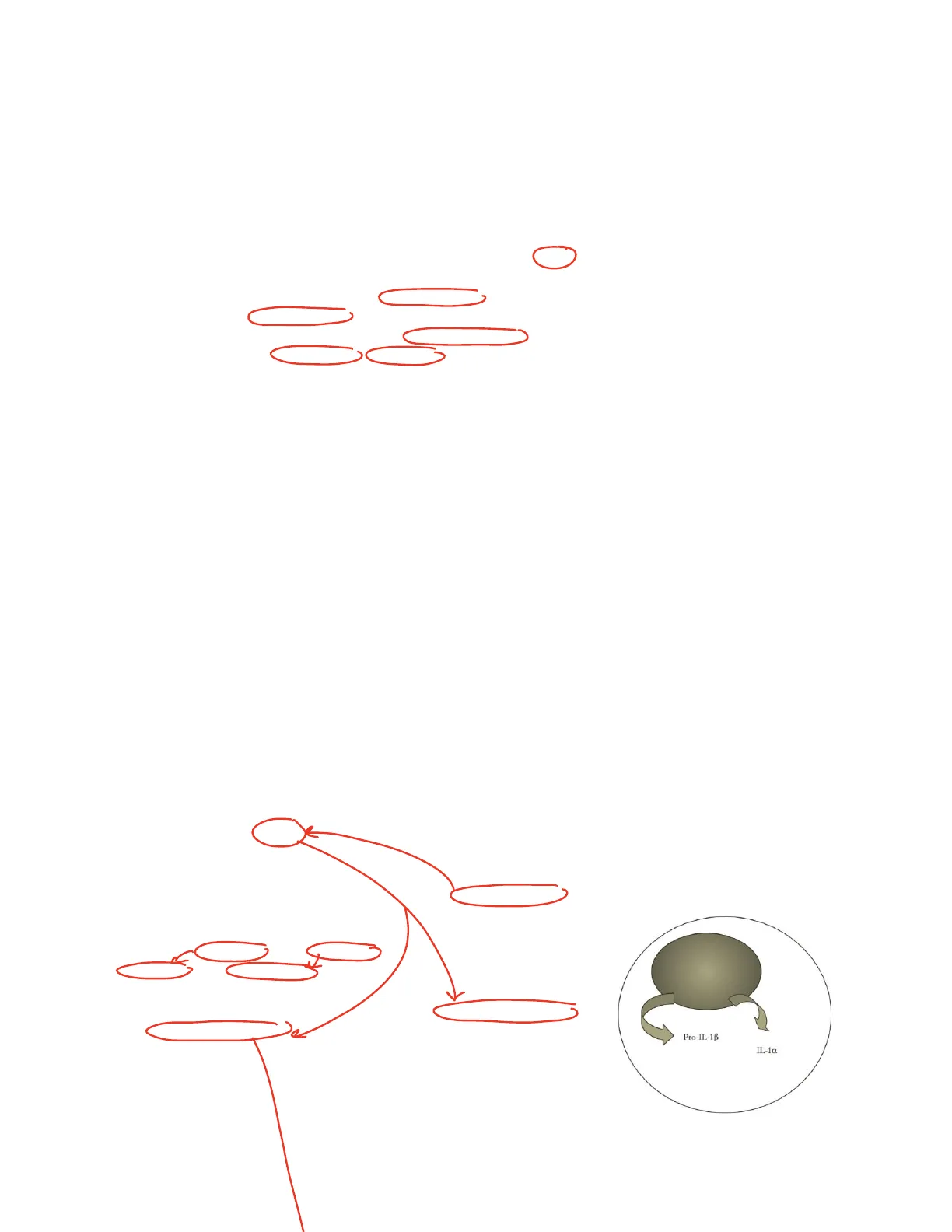
In the case of Interleukin-1Beta, it was known that there
was an enzyme that was essentially located at the plasma
membrane, that originally was called (CE )interleukin-1-
converting enzyme).
Then it was understood that ICE was actually a Caspase,
Caspase 1) a proteolytic enzyme that cleaves the
precursor of Interleukin-1Beta called Pro-IL-1Beta which
is the protein synthetized by the cell. Once a portion of
Pro-IL-1beta is cleaved, k-1Beta is released and exerts its
effect.
Caspasel
IL-18
Pro-IL-16
"Inflammasome"
IL-1a
?
Activation of Caspase1 and Inflammasome Discovery
How do we go from Pro-IL-1Beta to
IL-1Beta, how is Caspase1 activated?
For many years this was essentially a mystery, or at least something not understood,
until the discovery of the @flammasome,
Secretion of Interleukin-1Alpha
The second unsolved issue was about Interleukin-1Alpha, because again, it biologically has
the same effect of Interleukin-1Beta, but it wasn't clear how it got secreted from the cell. This
was because biologically the cytokine had the same effects of IL-13, but it wasn't clear how it
got secreted from the cell. For IL-16 it was clear that it required a non-conventional cleavage at
the plasma membrane level before the secretion, but for IL-1a the issue remained unsolved.
It was then understood that IL-1a did not get secreted and was actually supposed to remain
intracellularly. So, interlukin-1d was defined as an intra-kine, which means a cytokine that is
retained within the cell and is released only when the cell is damaged, or the cell is dying by
necrosis. Upon cell damage, IL-1a will then be Released and promote the pro-inflammatory
cause. This is one major difference between the two cytokines.
Interleukin-1 Receptors
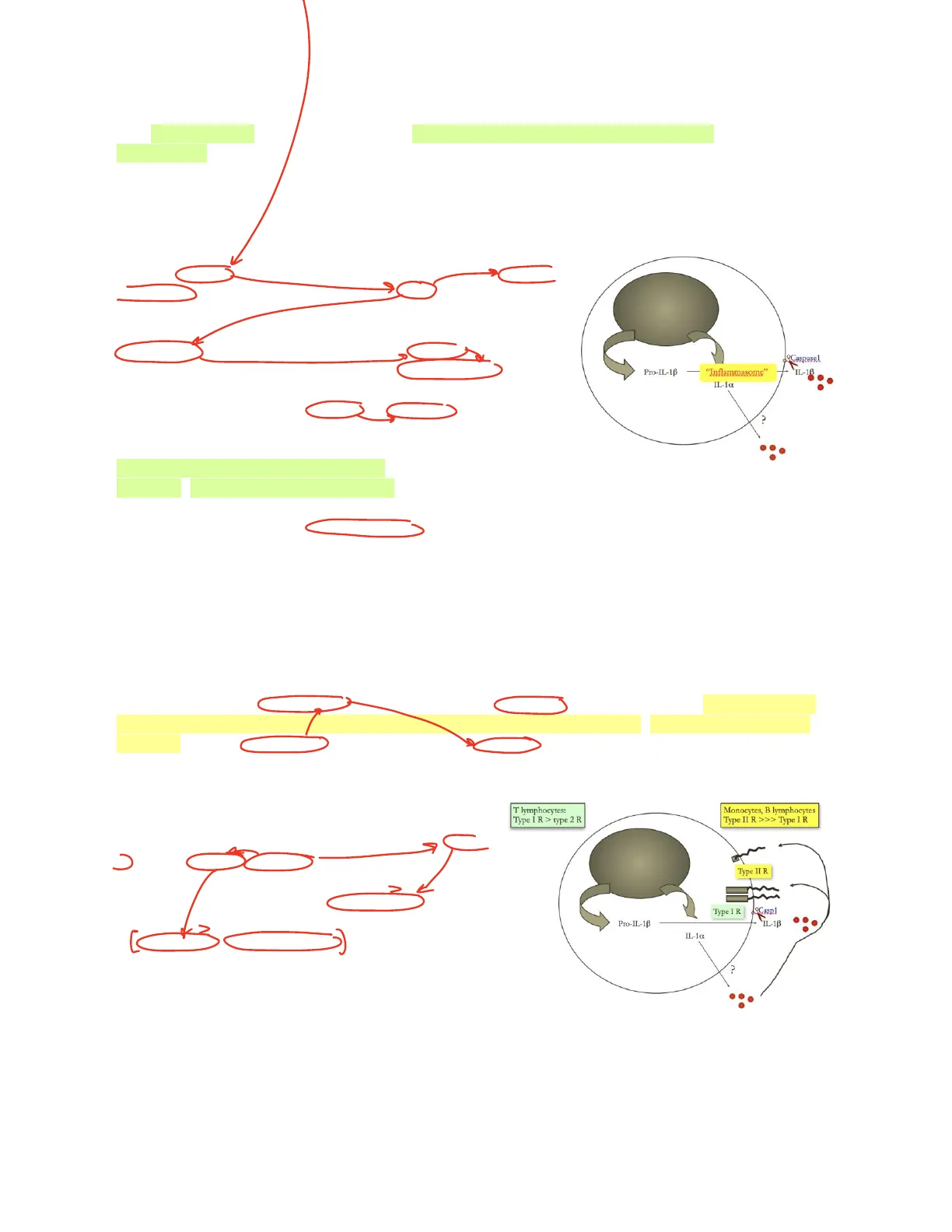
Then, there was the issue of the receptors. It was
known that we have two types of receptors for
both IL-1Alpha and IL-1Beta, so called the Cvpe
Dand the Type Xreceptor.
What was known was that the Type 1 receptor
was essentially abundant indymphocytes,
whereas the Type 2 receptor was more abundant
Type I R
&Casp
Pro-IL-16
IL-18
in monocytes, 3-lymphocytes and other cells.
IL-1a
So, the most straightforward interpretation that
led to hundreds of papers of publication in this
?
regard was that the signaling for the downstream
effect of stimulation by Interleukin-1
in T cells was going through the Type 1 receptor, whereas in monocytes, B-lymphocytes and
other cell types were going through the Type 2 receptor.
T lymphocytes:
Type IR > type 2 R
Monocytes, B lymphocytes
Type II R >>> Type I R
Type II R
2Chiara Fiorentino
Guido Poli
03/10/2023
Basic Mechanisms of diseases GP6
Structural Understanding of Receptors
Then this receptor became more understood from a structural point of view: Type 1 receptor
had a relatively ong intracytoplasmic tail, and, as we have seen already for TNF and for other
molecules, you need it to bind to adaptor proteins, kinases, etc.
cannot bind to anut
The Type 2 receptor instead just had a few amino acids (around 3 or 4), too few to connect to
any signaling system but just enough to hold'the receptor in the membrane.
1
So, what was understood, was that all the signaling by Interleukin-1 was mediated through
the Type 1 receptor, even when the most abundant receptor was the Type 2 receptor, as you
can see from this paper here. The first author of this
paper is Marta Muzio, who is a scientist in our
> Science. 1997 Nov 28;278(5343):1612-5. doi: 10.1126/science.278.5343.1612.
institute, and she published several very important
IRAK (Pelle) family member IRAK-2 and MyD88 as
proximal mediators of IL-1 signaling
M Muzio 1, J Ni, P Feng, V M Dixit
papers in Science, about the proximal signaling by
Interleukin-1.
Type 2 Receptor as a Decoy Receptor
About the Type 2 receptor, studies conducted in Alberto Mantovani's lab at the time,
demonstrated that the Type 2 receptor binds to Interleukin-1Alpha or Beta,
but does not signal at all, it acts as a sort of a buffer system to bind and biologically (nactivate
Interleukin-1.
2
Mantovani, in the mid-90s called them deceptors (decoy receptors).
Going back to the definition, the original definition of areceptor is: a deceptive substance, such
as a molecule, which is capable of finding a digand
with high affinity and induces signaling
downstream. Whereas the decoy receptor
RECEPTOR ("receptive substance", Langley, XIX cent.):
still binds with ligh affinity to the molecule,
· Ligand recognition with high affinity -> signaling!
but does not lead to signaling. It leads to
trapping, internalization, and degradation of
DECOY RECEPTOR (DECEPTOR)
the ligand. In other words, it's a buffering
· Ligand recognition -> trapping/degradation
system.
Regulation of the IL-1 Decoy Receptor
Regulation of the KL-1 Decoy Receptor
One of the implications of this concept was that the regulation
of this decoy receptor should be different from that of the
other kind of receptor.
Indeed, the regulation of gene expression for the Type 2
receptor for laterleukin-1 demonstrated that a number of anti-
inflammatory signa's, such asglucocorticoids and cytokines
with anti-inflammatory properties like Interleukin-& and 13
upregulated the Type 2 receptor. Whereas pro-inflammatory
signals such as endotoxin and interferon gamma
(IFNgamma), will downregulate it.
1
REGULATION OF
GENE EXPRESSION
LPS
IFNy
MMP (TACE ?
L-AI
+
GC
IL-4
IL-13
Myelomonocytic
cells
(Mantovani et al TRENDS IN
1
REGULATION OF
GENE EXPRESSION
REGULATION OF SHEDDING
2
CHEMOATTRACTANTS
ROI, TNF, LPS
LPS
IFNY
MMP (TACE ?)
+
GC
IL-4
IL-13
Myelomonocytic
cells
(Mantovani et al TRENDS IN IMMUNOL, 2001)
Here is also indicated the fact that there is another
enzyme on the cell surface, which is a metalloprotease
called TACE, which cleaves the Type 2 receptor. After
that it will be solubilized in a stoichiometric complex with a
ratio 1:1 with interlukin-1alpha and beta.
Then, again, the regulation of shedding is promoted by a
variety of signal.
3Chiara Fiorentino
Guido Poli
03/10/2023
Basic Mechanisms of diseases GP6
Complexity of Cytokine Systems
Once you discover one particular molecule with a given effect you look for others. This
broadening of the signaling molecule in the cytokine field is not limited to the Interleukin-1
system, but it is also present for other cytokines, including the TNF family member.
More or less most of the cytokine systems have receptors which can function by producing a
signal, but also receptors which work as "capture" molecules to buffer the cytokines.
This already gives us a good level of understanding of the complexity of the Interleukin-1
system.
IL-1 Receptor Antagonist (IL-1ra)
(L-1 receptor antagonist (IL-1ra)
Toward the end of the 90s, another molecule was
discovered: IL-1 receptor antagonist, or IL-1ra.
IL-1 receptor antagonist is expressed by genes
completely different from Interleukin-1, and it
produces a molecule in great abundance that has
the only function of bindiby with high affinity to the
Type 1 receptos for interleukin->
Soluble
Type II R
Type II R
Type I R
PCasp1
By binding to the Type 1 receptor, it will compete
Pro-IL-1B
IL-18
and quench or prevent interleukin-1 signaling
IL-1α
and cell activation
IL-1 receptor
antagonist
(IL-1ra)
As a postulate, it was conceived that the Interleukin-
Intra-cellular
?
IL-1ra
IL-1ra
1 receptor antagonist will not bind to the Type 2
2.
receptor because if the IL-1ra would bind to the Type 2 receptor you would have two negative
molecules contributing to quenching the Interleukin-1 effect, essentially cancelling each others
out.
2
The IL-1 system has two natural inhibitors of its action: one is the Type 2 receptor, which binds
one-to-one on a stoichiometrical level with the Interleukin-1 molecule, and the second one is
the (L-1ra) which binds to the recepto) for interleukin-1.
Since this is a competitive binding in order to prevent the signaling by Interleukin-1 you need
to saturate approximately 99% of all receptors available in the cell surface, because if you just
leave a small percentage of these receptors, that would be enough for the cell to sense the
presence of Interleukin-1.
If you measure in biological fluids (like plasma, urine, or human or animal) the levels of
Interleukin->, you find them in inflammatory conditions (under fever) into a low nanomolar
range. Whereas in the case of IL-1ra, you find it in the micromolar range, so it is 1000 times
more concentrated than Interleukin-1.
If you take Interleukin-1ra and inject it into animals, even in incredibly high amounts, you don't
have any effect.
So, this molecule has been evolutionarily selected exclusively to limit and compete with
Interleukin-1, it does not have additional biological effect.
This molecule is already a natural drug, a biological. Indeed, there is a natural drug, which is
calledanakinra, which is essentially the molecule of (-1ra with just a few amino acid's that
have been modified, simply for reasons of industrial production, not for biological reason. So, it
is an anti-inflammatory drug we basically synthetize in our body.
4
Can’t find what you’re looking for?
Explore more topics in the Algor library or create your own materials with AI.
