Digestion and Absorption of Carbohydrates, Pentose Phosphate Pathway
Document from Dr. Kola-ajibade about Digestion and Absorption of Carbohydrates. The Pdf details the digestion and absorption of carbohydrates, including the pentose phosphate pathway, for university-level Biology students.
See more12 Pages


Unlock the full PDF for free
Sign up to get full access to the document and start transforming it with AI.
Preview
Digestion and Absorption of Carbohydrates
Carbohydrate Digestion Sites
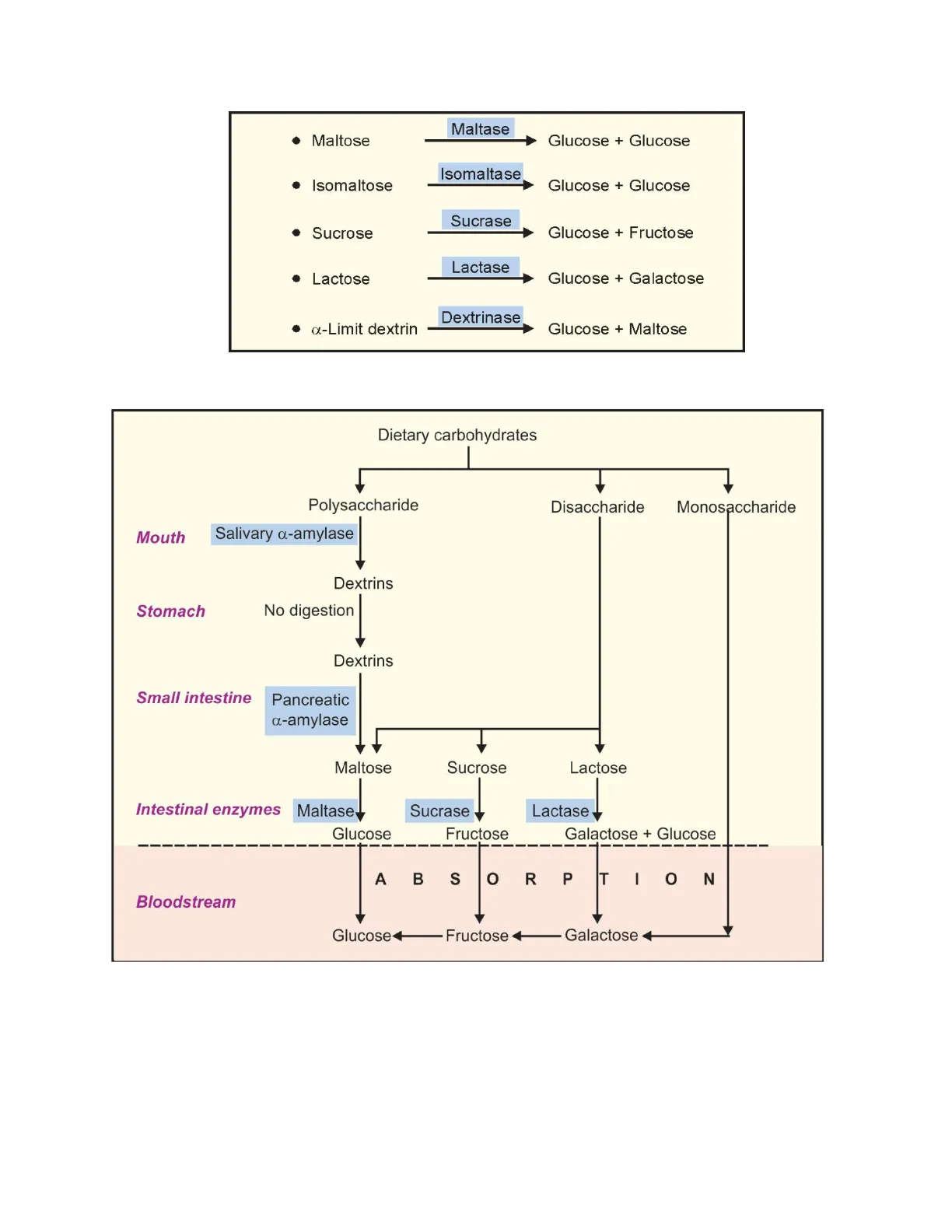
The principal sites of carbohydrate digestion are the mouth and small intestine. The dietary carbohydrate consists of:
- Polysaccharides: Starch, glycogen and cellulose
- Disaccharides: Sucrose, maltose and lactose
- Monosaccharides: Mainly glucose and fructose.
Monosaccharides need no digestion prior to absorption, whereas disaccharides and polysaccharides must be hydrolyzed to simple sugars before their absorption.
Carbohydrate Digestion Process
Mouth Digestion
Mouth- The digestion of carbohydrates begins in the mouth. Salivary glands secrete a-amylase (ptylin), which initiates the hydrolysis of a starch. During mastication, salivary a-amylase acts briefly on dietary starch in random manner breaking some a-(1 -> 4) bonds, a-amylase hydrolyzes starch into dextrins.
Stomach Digestion
Stomach- Carbohydrate digestion halts temporarily in the stomach because the high acidity inactivates the salivary a-amylase.
Intestine Digestion
Intestine- Further digestion of carbohydrates occurs in the small intestine by pancreatic enzymes. There are two phases of intestinal digestion.
- Digestion due to pancreatic a-amylase
- Digestion due to intestinal enzymes: sucrase, maltase, lactase, isomaltase.
The function of pancreatic a-amylase is to degrade dextrins further into a mixture of maltose, isomaltose and a-limit dextrin (The a-limit dextrins are smaller oligosaccharides containing 3 to 5 glucose units). Enzymes responsible for the final phase of carbohydrate digestion are located in the brush-border membrane. The end products of carbohydrate digestion are glucose, fructose and galactose which are readily absorbed through the intestinal mucosal cells into the bloodstream.Maltase
- Maltose
Glucose + Glucose Isomaltase
- Isomaltose
Glucose + Glucose Sucrase
- Sucrose
Glucose + Fructose Lactase
- Lactose
Glucose + Galactose Dextrinase
- a-Limit dextrin
Glucose + Maltose Dietary carbohydrates Polysaccharide Disaccharide Monosaccharide Mouth Salivary a-amylase Dextrins Stomach No digestion Dextrins Small intestine Pancreatic a-amylase Maltose Sucrose Lactose Intestinal enzymes Maltase Sucrase Lactase Glucose Fructose Galactose + Glucose ABS o R P TIO N Bloodstream Glucose- Fructose + Galactose Figure 1- digestion and absorption of dietary carbohydrates
Absorption of Carbohydrates
Monosaccharide Absorption
Carbohydrates are absorbed as monosaccharides from the intestinal lumen. There are three monosaccharide products of carbohydrate digestion-glucose, galactose, and fructose. They are absorbed by the small intestine in a two-step process:
- Their uptake across the apical membrane into the epithelial cell
- Their coordinated exit across the basolateral membrane
Two mechanisms are responsible for the absorption of monosaccharides:
- Active transport against a concentration gradient, i.e. from a low glucose concentration to a higher concentration.
- Facilitative transport, with concentration gradient, i.e. from a higher concentration to a lower one.
The Na/glucose transporter 1 (SGLT1) is the membrane protein responsible for glucose and galactose uptake at the apical membrane. The apical step of fructose absorption occurs by the facilitated diffusion of fructose through GLUT5. A single transporter (GLUT2) is responsible for the movement of both monosaccharides across the basolateral membrane.
Glucose, Galactose and Fructose Absorption
The uptake of glucose across the apical membrane through SGLT1 (secondary active transport,) because the glucose influx occurs against the glucose concentration gradient Glucose uptake across the apical membrane is energized by the electrochemical Na+ gradient, which, in turn, is maintained by the extrusion of Na+ across the basolateral membrane by the Na- K pump. The apical step of fructose absorption occurs by the facilitated diffusion of fructose through GLUT5. Facilitated diffusion utilizes a carrier protein to achieve transport at rates greater than simple diffusion and does not rely on concentration gradients. GLUT-5 is present on the apical membrane of the brush border throughout the small intestine with increased density in the proximal small intestine. Little fructose is metabolized in the cell. Both GLUT-2 and GLUT-5 are present at the basolateral membrane to transport fructose to the portal circulation. Fructose malabsorption can be minimized by simultaneous glucose administration suggesting there is another glucose responsive system in the enterocytes.C ABSORPTION OF MONOSACCHARIDES Lumen SGLT1 Epithelium Interstitial space Galactose Glucose > Glucose GLUT2 2 Na +3 Na · 2 K+ Fructose -GLUT2 GLUT5 Fructose
Glycolysis
Glycolysis Overview
In glycolysis (from the Greek glykys, "sweet" or "sugar," and lysis, "splitting"), a molecule of glucose is degraded in a series of enzyme catalyzed reactions to yield two molecules of the three- carbon compound pyruvate. During the sequential reactions of glycolysis, some of the free energy released from glucose is conserved in the form of ATP and NADH.An Overview: Glycolysis Has Two phases:
Preparatory Phase of Glycolysis
The preparatory phase
- The breakdown of the 6-carbon glucose into 2 molecules of the 3- carbon pyruvate occurs in 10 steps, the first 5 of which constitute the preparatory phase.
- Glucose is first phosphorylated at the hydroxyl group on C-6.
- The D-glucose 6 phosphate thus formed is converted to D-fructose 6-phosphate
- This is again phosphorylated, this time at C-1, to yield D-fructose 1,6 bisphosphate. For both phosphorylations, ATP is the phosphoryl group donor.
- Fructose 1,6-bisphosphate is split to yield 2 three-carbon molecules, dihydroxyacetone phosphate and glyceraldehyde 3-phosphate; this is the "lysis" step that gives the pathway its name.
- The dihydroxyacetone phosphate is isomerized to a second molecule of glyceraldehyde 3-phosphate, ending the first phase of glycolysis.
Note that two molecules of ATP are invested before the cleavage of glucose into 2- three- carbon pieces.
Pay-off Phase of Glycolysis
The pay-off phase
- Each molecule of glyceraldehyde 3-phosphate is oxidized and phosphorylated by inorganic phosphate (not by ATP) to form 1,3 bisphosphoglycerate.
- Energy is then released as the two molecules of 1,3-bisphosphoglycerate are converted to two molecules of pyruvate (steps 7 through 10).
- Much of this energy is conserved by the coupled phosphorylation of four molecules of ADP to ATP.
- The net yield is two molecules of ATP per molecule of glucose used, because two molecules of ATP were invested in the preparatory phase. Energy is also conserved in the payoff phase in the formation of two molecules of the electron carrier NADH per molecule of glucose.
- Fate of pyruvate- Pyruvate is oxidized, with loss of its carboxyl group as CO2, to yield the acetyl group of acetyl-coenzyme A; the acetyl group is then oxidized completely to CO2 by the citric acid cycle.6 HO-CH2 5 0 H H H 4 OH H HO OH 3 2 H OH first priming reaction hexokinase 6 ADP P-O-CH2 5 0 H H H 4 OH H HỘ OH 3 72 OH phosphohexose isomerase 6 1 CH2-OH Fructose 6-phosphate 5 2 V OH 4 3 second priming reaction phospho- fructokinase-1 OH H ADP D-O-CH, 0 CH2-0-P Fructose 1,6-bisphosphate 5 2 H HO H OH 4 4 13 OH H aldolase 0 Glyceraldehyde 3-phosphate PO-CH2-CH-C + OH Dihydroxyacetone phosphate 5 P-O-CH2-C-CH2OH triose phosphate isomerase 0 (b) Payoff phase (2) Glyceraldehyde 3-phosphate (2)-0-CH2-CH-C H OH 2P 6 2NAD+ glyceraldehyde 3-phosphate dehydrogenase oxidation and phosphorylation 2 NADH + 2H+ (2) P-O-CH-CH (a) Preparatory phase Phosphorylation of glucose and its conversion to glyceraldehyde 3-phosphate Glucose 1 ATP Glucose 6-phosphate 2 H P-O-CH H HO H 3 ATP cleavage of 6-carbon sugar phosphate to two 3-carbon sugar phosphates Oxidative conversion of glyceraldehyde 3-phosphate to pyruvate and the coupled formation of ATP and NADH H(b) Payoff phase Oxidative conversion of glyceraldehyde 3-phosphate to pyruvate and the coupled formation of ATP and NADH (2) Glyceraldehyde 3-phosphate (2) P-O-CH2-CH TH OH 2P 6 2NAD+ glyceraldehyde 3-phosphate dehydrogenase 0 2 NADH + 2H+ (2) P-O-CH2-CH-C 0 P (2) 1,3-Bisphosphoglycerate OH first ATP-forming reaction (substrate-level phosphorylation) 2ADP 7 0 2 ATP (2)P-O-CH2-CH-C 0 (2) 3-Phosphoglycerate 8 phosphoglycerate mutase (2) CH2-CH-C 0 (2) 2-Phosphoglycerate OH 0 P 2H2O 99 enolase (2) CH2=C-C (2) Phosphoenolpyruvate O second ATP-forming reaction (substrate-level phosphorylation) 2ADP pyruvate kinase 2 ATP (2) CH3-C (2) Pyruvate 0 0 Figure 3: the glycolytic pathway.
The net equation for the overall process is: Glucose + 2NAD+ + 2ADP + 2P; > 2 pyruvate + 2NADH + 2H+ + 2ATP + 2H2O
Gluconeogenesis
Gluconeogenesis Pathways
Gluconeogenesis is the term used to include all path ways responsible for converting noncarbohydrate pre cursors to glucose or glycogen. The major substrates are the glucogenic amino acids and lactate, glycerol, and propionate. Liver and kidney are the major gluco neogenic tissues. Gluconeogenesis meets the needs of the body for glucose when carbohydrate is not available in sufficient amounts from the diet or from glycogen reserves. A supply of glucose is necessary especially for the nervous system and erythrocytes. Failure of gluco neogenesis is usually fatal. Hypoglycemia causes brain dysfunction, which can lead to coma and death. Glu cose is also important in maintaining the level of inter mediates of the citric acid cycle even when fatty acids are the main source of acetyl-CoA in the tissues.
oxidation and phosphorylation phosphoglycerate kinase - OH -0 10CAMP (glucagon) Phosphoenolpyruvate + ADP O PYRUVATE KINASE wwwwwwww Alanine GDP + CO2 ATP PHOSPHOENOLPYRUVATE CARBOXYKINASE Pyruvate Lactate Citrate GTP NADH + H+ NAD+ CYTOSOL Oxaloacetate MITOCHONDRION Pyruvate + Acetyl-CoA -NADH + H+ CO2 + ATP Mg2+ PYRUVATE CARBOXYLASE NAD+ ADP + P; + NADH + H+ Oxaloacetate NAD+ Malate Malate Citrate VVVV Citric acid cycle a-Ketoglutarate 1 + Fumarate Succinyl-CoA Propionate Figure 4: Major pathway of gluconeogenesis
Gluconeogenesis Steps
Steps:
- Mitochondrial pyruvate carboxylase catalyzes the carboxylation of pyruvate to oxaloacetate, an ATP-requir ing reaction in which the vitamin biotin is the co- enzyme.
- Biotin binds CO2 from bicarbonate as carboxybiotin prior to the addition of the CO2 to pyruvate.
- Phosphoenolpyruvate carboxykinase, catalyzes the decarboxylation and phosphorylation of oxaloacetate to phosphoenolpyruvate using GTP (or ITP) as the phosphate donor.
- In the rat and the mouse, the enzyme is cytosolic. Oxaloacetate does not cross the mi tochondrial inner membrane; it is converted to malate, which is transported into the cytosol, and converted back to oxaloacetate by cytosolic malate dehydrogenase.
- Formation of one molecule of glucose from pyruvate requires 4 ATP, 2 GTP, and 2 NADH; it is expensive.
Fatty acids PYRUVATE DEHYDROGENASE -
Can’t find what you’re looking for?
Explore more topics in the Algor library or create your own materials with AI.
