Oscar Wilde (1854-1900) and The Picture of Dorian Gray Presentation
Slides about Oscar Wilde (1854-1900). The Pdf, a presentation for high school Literature students, offers a concise overview of Wilde's life and an in-depth analysis of "The Picture of Dorian Gray", covering its main themes, moral, and narrative style.
See more13 Pages


Unlock the full PDF for free
Sign up to get full access to the document and start transforming it with AI.
Preview
Oscar Wilde's Life and Works
Life of Oscar Wilde
- Born in Dublin in 1854.
- He became a disciple of Walter Pater, the theorist of Aestheticism, accepting the theory 'Art for Art's Sake'.
- He became a fashionable dandy for his extraordinary wit and extravagant way of dressing.
- In 1881 he held some lectures about the Pre-Raphaelites and the Aesthetes during a tour in the United States.
- His remarks appeared in the most fashionable London magazines.
Later Life and Downfall
- After publishing his first and only novel, he developed an interest in drama.
- He was one of the most successful playwrights of late Victorian London and one of the greatest celebrities of his time.
- He suffered a dramatic downfall because of his intimate association with the young Lord Alfred Douglas, 'Bosie'.
- He was imprisoned after been convicted of 'gross indecency' for homosexual acts.
- He died of meningitis in Paris in 1900.
Works by Oscar Wilde
- Poetry: Poems (1881), The Ballad of Reading Gaol (1898), originally published under his prison identity, C.3.3.
- Fairy tales: The Happy Prince and other Tales (1888), The House of Pomegranates (1891), written for his children.
- Novel: The Picture of Dorian Gray (1891).
- Plays: Lady Windermere's Fan (1892), A Woman of No Importance (1893), Salomé (1893), The Importance of Being Earnest (1895).
Oscar Wilde's Wit and Aestheticism
A Clever Talker: Wilde's Quotations
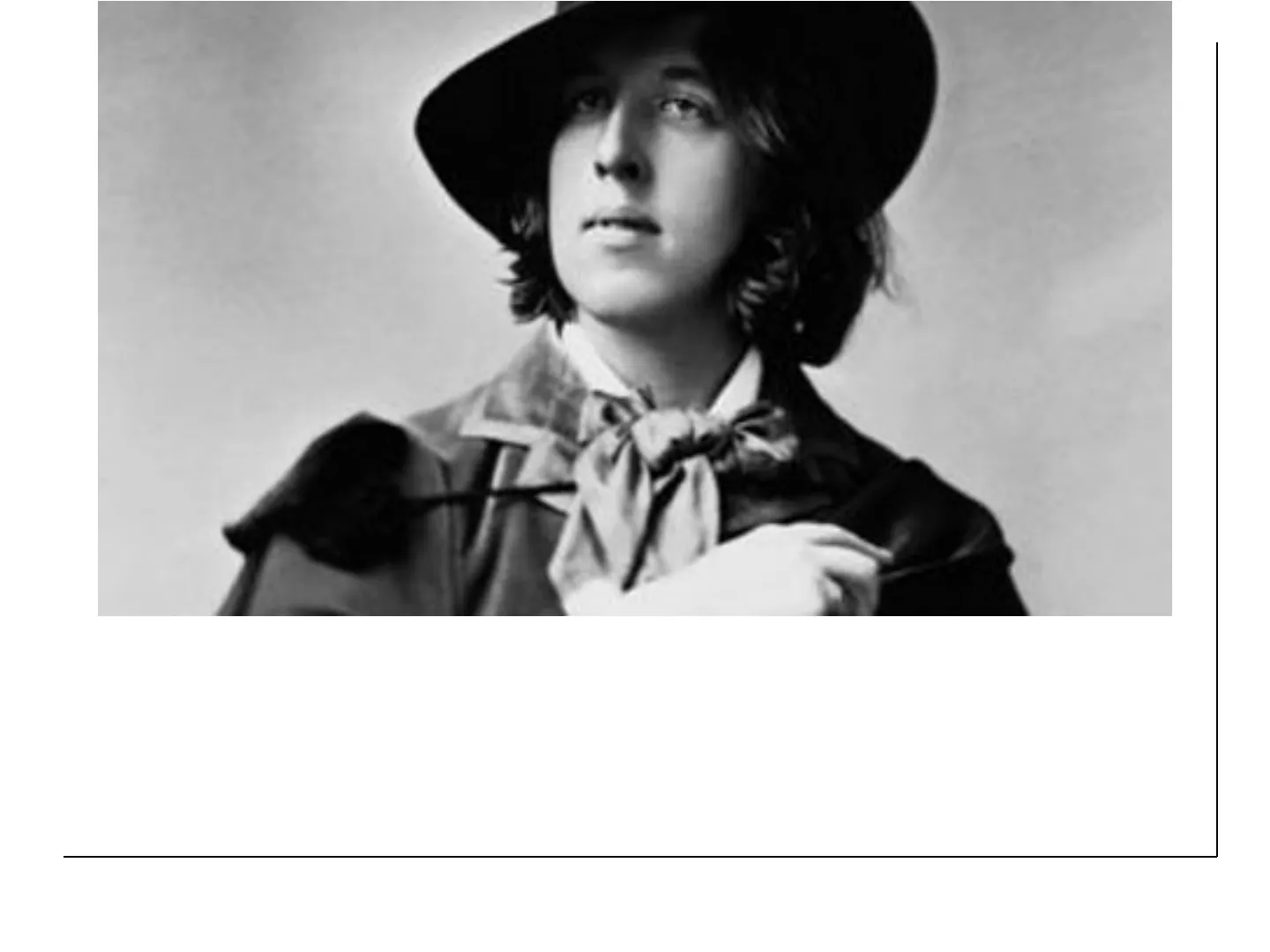
Some of Wilde's famous quotations: Oscar Wilde, 1889. 'I have nothing to declare except my genius.' 'Experience is simply the name we give our mistakes.' 'A man can be happy with any woman as long as he does not love her.' One should always be in love. That is the reason why one should never marry.' 'Art is the most intense mode of individualism that the world has known.'
Wilde's Aestheticism
Oscar Wilde adopted the aesthetical ideal: he affirmed 'my life is like a work of art. His Aestheticism clashed with the didacticism of Victorian novels.
- The artist > the creator of beautiful things.
THE PICTURE OF DORIAN GRAY OSCAR WILDE PENGUIN READERS
- Art -> used only to celebrate beauty and the sensorial pleasures.
- Virtue and vice -> employed by the artist as raw material in his art: 'No artist has ethical sympathies. An ethical sympathy in an artist is an unpardonable mannerism of style.' ('The Preface' to The Picture of Dorian Gray)
The Picture of Dorian Gray
Publication History
1890 > first appeared in a magazine. 1891 - revised and extended.
- It reflects Oscar Wilde's personality.
- It was considered immoral by the Victorian public.
Plot and Setting
- Set in London at the end of the 19th century.
- The painter Basil Hallward makes a portrait of a beautiful young man, Dorian Gray.
- Dorian's desires of eternal youth are satisfied.
- Experience and vices do not appear on Dorian but on the portrait. THEN DOY
Dorian's Downfall and Death
- Dorian lives only for pleasure.
- When the painter discovers Dorian's secret, he is killed by the young man.
- Later Dorian wants to free himself of the portrait; he stabs it but in so doing he kills himself.
- At the very moment of death, the portrait returns to its original purity and Dorian turns into a withered, wrinkled and loathsome old man.
Characters in the Novel
MIME
- Dorian represents the ideal of youth, beauty and innocence.
- Lord Henry Wotton, a brilliant talker and an amoral aesthete, expresses sharp criticism of institutions.
- Basil Hallward is an intellectual who falls in love with Dorian's beauty and innocence. When he tries to guide Dorian towards good moral conduct, he is killed by Dorian.
Themes of the Novel
- The importance of beauty and appearance.
- A Faustian pact involves the portrait as a means of keeping ageless beauty and youth.
- The picture is Dorian's double: it stands for the dark side of Dorian's personality.
The Moral of the Novel
- Every excess must be punished and no one can escape reality.
- When Dorian destroys the picture, he cannot avoid the punishment for all his sins death.
- The horrible, corrupting picture could be seen as a symbol of the immorality and bad conscience of the Victorian middle class.
- The picture, restored to its original beauty, illustrates Wilde's theories of art: art survives people, art is eternal.
Style of The Picture of Dorian Gray
THE PICTURE OF DORIAN GRAY OSCAR WILDE
- The story is told by an obtrusive third- person narrator.
- The perspective adopted is internal since Dorian's apparition is in the second chapter.
- Brilliant paradoxes, witty dialogue > the most important features of the language.
- The characters reveal themselves through what they say or what other people say of them, a technique which is typical of drama.
Can’t find what you’re looking for?
Explore more topics in the Algor library or create your own materials with AI.
