Spain: The End of the Ancient Regime and the 1812 Constitution
Document from University about Spain: The End of the Ancient Regime. The Pdf explores the crisis of the Ancient Regime in Spain, focusing on the Napoleonic invasion and the War of Independence, including the 1812 Constitution, for University History students.
See more13 Pages


Unlock the full PDF for free
Sign up to get full access to the document and start transforming it with AI.
Preview
Spain: End of the Ancient Regime
UNIT 5 SPAIN: THE END OF THE ANCIENT REGIME In Spain, the Ancient Regime reached crisis point at the end of the reign of Charles IV coinciding with the occupation of the Iberian Peninsula by Napoleon's army. The French invasion and the Independence War brought along the spread of new liberal ideas over Spain and society changed as a consequence of political and economic changes.
- Activity: elaborate a scheme about the Bourbons in Spain until Charles IV.
War and Revolution
Independence War 1808-1814
King Charles IV left the government affairs in the hands of the Prime Minister Godoy. Relations with France had different phases:
. When the king of France was beheaded, Spain took part in the first anti- French coalition to defend the Ancient Regime.
.In 1795 this policy changed. In France, a new and moderate period had started. From this moment, some decisions that finally led to the war were taken:
- San Ildefonso Treaties: Spain would help France in his attempt to invade Great Britain. The result was the great disaster of Trafalgar in 1805.
- Fontainebleau Treaty: in 1807 Godoy allowed Napoleon to pass through Spanish territory with his troops. They were supposed to have the intention of invading Portugal, the British ally.
- A courtesan group opposed to Godoy was born against the policy towards France. The king's son himself, Ferdinand VII, took part in this conspiracy against his father. It was called El Escorial Conspiracy.
- Godoy tried to take the royal family to America in order to protect them from Napoleon troops. This provoked the Aranjuez Mutiny: Godoy was removed from office and Charles IV had to give up the crown in favour of his son Ferdinand.
- Charles IV and Ferdinand VII were taken to Bayone (France) and had to abdicate in favour of Napoleon, who passed the crown to his brother, Joseph I.
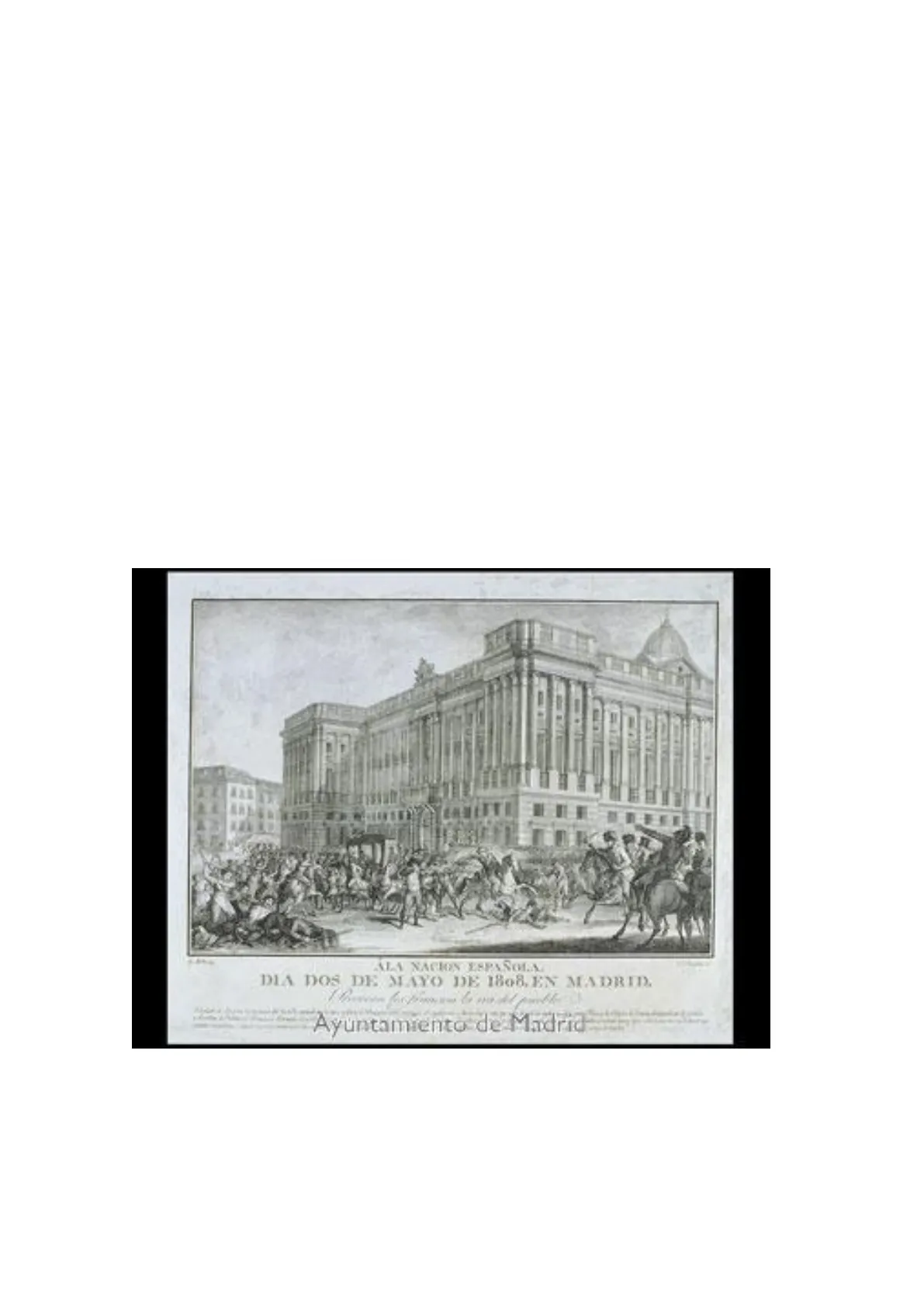
The war started on 2 May 1808, when the population of Madrid revolted against the French troops. The movement was strongly repressed by the French Army but it spread all over Spain.
ALA NACION ESPAÑOLA DIA DOS DE MAYO DE 1808. EN MADRID. Ayuntamiento de Madrid
After the revolt against the French troops in Madrid, similar riots happened in the rest of provinces. Local and provincial assemblies elected by the people were created. Then, a Central Assembly was born to coordinate all of them. This Assembly had to organize the war against the French Army.
The Spanish Army (led by General Castaños) defeated Napoleon troops (led by General Dupont) in Bailen (July 1808) for the first time. Then, Napoleon himself came to Spain with 250.000 men. They could control almost the whole country though some cities, such as Zaragoza and Girona showed a great resistance.
Siege of Zaragoza
The city, defended by Palafox, was besieged twice a year and had finally to give in. In this event, Agustina de Aragón became the great heroine of the war.
Siege of Girona
This city was besieged three times. The population, exhausted because of hunger and epidemic, had to surrender.
The Spanish Army wasn't as powerful as the French one. A new way of fighting appeared then, as a typical Spanish phenomenon: the guerilla. Armed spontaneous groups (generally peasants), supported by the rest of the population, who knew perfectly well their territory, attacked by surprise the rearguard of the enemy.
In 1812, with the help from the British Army led by Wellington, Napoleon was defeated in Arapiles. The Anglo-Spanish army entered Madrid, Joseph I goes to Vitoria. One year later, after being defeated in Vitoria and San Marcial battles, the French Army must leave Spain and finally, Ferdinand VII comes back to Spain.
Cortes of Cadiz and the Constitution of 1812
The Central Assembly had to lead the war against Napoleon troops, as we have said before, but it became also the real government while Spanish monarchs were in France, since many Spanish people didn't accept Joseph Bonaparte. In Cádiz, protected by the British Army, the Cortes were convened in 1810. Different groups were represented:
- LIBERAL Influenced by the Enlightenment thinking and the French Revolution.
- ABSOLUTIST .They wanted the return of absolutism. .They wanted to abolish Absolutism All the powers for the king. and the privileges of the Ancient Regime. .They wanted a monarchy controlled by the Cortes.
Most of the deputies were liberal and, after more than one year, the first Spanish Constitution was promulgated on 19 March 1812 (this is why it was called 'La Pepa'): the monarch lost his absolute power and some liberal principles appeared for the first time in Spain.
- National sovereignty.
- Separation of powers.
- Universal male suffrage.
- Religion: catholic.
*Activity: compare the Declaration of rights of the independence of the USA and the one of the French Revolution with some of the articles of the Spanish Constitution of 1812. Where can you find the same principles?
Reign of Ferdinand VII (1814-1833)
II .- THE REIGN OF FERDINAND VII .- 1814-1833. King Ferdinand VII came back to Spain in 1814 and he was received with a great joy by Spanish people, they had recovered the legitimate king after their fighting against Napoleon. That's why he was called "The Desired'.
Absolutist Six-Year Period (1814-1820)
a) The absolutist six-year period: 1814-1820. Both absolutist and liberal groups desired the king's return. Liberal groups believed that the king would accept the new Constitution and the spirit of the Cortes of Cadiz, so that a constitutional monarchy would be established in Spain. But they were wrong: supported by absolutist deputies, he decided to abolish the constitution, to keep nobility and clergy's privileges and not to renounce to their absolute powers. The liberal revolution had been stopped.
- Activity: when Ferdinand VII came back to Spain, a group of absolutist deputies presented him a document called ' El Manifiesto de los Persas'. What's that document? Why was it called that way?
Liberal Three-Year Period (1820-1823)
b) The Liberal three-year period: 1820-1823. Soon, in different cities, liberal groups provoked revolts in order to restore the constitution. One of the most important 'pronunciamientos' was the one led by Riego in 1820: from Cabezas de San Juan (Seville) the troops that were to fight in America (the fight for independence of the Spanish America had already started) revolted in favour of the Constitution. The insurrection succeeded and a short period of liberalism started. Ferdinand VII was obliged to accept the situation and pronounced his famous sentence:'Marchemos francamente y yo el primero por la senda constitucional'.
- Question: can you explain the meaning of this sentence?
But Ferdinand VII continued to conspire against liberalism to restore the absolute system and asked the European powers for help. The Holly Alliance intervened sending troops ('Los Cien Mil hijos de San Luis') to invade Spain and absolutism was restored in 1823. Riego was hanged and many liberal supporters had to leave Spain to avoid persecution.
Return to Absolutism (1823-1833)
c) The return to absolutism: 1823-1833. Ferdinand VII abolished all the liberal reforms. New revolts happened and the reaction was harsh: Torrijos was shot and Mariana Pineda (accused of having embroided a liberal flag) was executed. This absolute decade lasted till the king's death in 1833. When the king died, a new problem appeared: who had the right to be the succesor? His daughter Elisabeth or his brother Carlos María Isidro? Here we have the origin of the Carlist wars.
Economy in the 19th Century
III .- ECONOMY .- At the beginning of the 19th century, Spain was a prosperous country due to the reforms carried out by the Bourbons in the 18th century. But the economic development was stopped because of:
- The wars against France and Britain: the consequence was the decrease of trade. The lack of products provoked the rise of prices.
- Agricultural production decreased as a consequence of the Independence War and because of several bad harvests. This situation got worse due to the independence of the American colonies, where many products used to be sent. Nevertheless, agriculture continued to be the main economic activity in the country.
- Crisis of traditional industry (guilds) because of the competition of the new capitalist industry.
- Trade was harmed since Spain lost the trade monopoly after the independence of the colonies.
Society and Social Structure
IV .- SOCIETY .- As a result of the economic changes, the social structure changed too and a new society started to appear: the classes society.
- In the rural world, landowners (most of them belonging to nobility) got great benefits while labourers got poorer and tenants had to suffer the consequences of the rise of the rent prices.
- In urban areas, the number of industrial workers increased. At the same time, artisans lost importance. The situation of the civil servants got worse due to the State crisis.
Independence of Spanish America
Causes of Independence
V .- THE INDEPENDENCE OF SPANISH AMERICA .- a) Causes .- The main causes of this process are:
- French Revolution ideas and the example of the USA.
- The Creole bourgeoisie wanted to hold the top public office, usually held by the Spaniards.
- The help from Britain and the USA, since they wanted to control American trade.
- International weakness of Spain. All its forces had to be devoted to fight in the Independence War against Napoleon.
Facts and Protagonists of Independence
b) Facts and Protagonists .- The first one to face the Spanish government was Francisco de Miranda in 1805. In Mexico in 1810, the priest Hidalgo led a revolt carried out by Indians and mestizos against Spanish authorities. In 1815 the decisive phase of the independence started. The most important leaders were Simón Bolívar and José de San Martín.
General Iturbide proclaimed the independence of Mexico in 1821. It was a peaceful process, since Spain didn't send troops there. In the same way and in the same year the countries of Central America got their independence.
In South America, Bolívar, from the north, and San Martín, from the south, got important victories that led to the independence of almost the whole Spanish America: Chacabuco (Chile 1817), Carabobo (Venezuela 1821) and Ayacucho (Perú 1824). Only Cuba and Puerto Rico (together with Pilipines) remained as Spanish colonies until 1898.
*Question: why didn't Spain send troops to Mexico? Pay attention to the date to find the answer. *Activity: Find information about Bolívar and San Martín.
Can’t find what you’re looking for?
Explore more topics in the Algor library or create your own materials with AI.