The Classification of Living Organisms
Document about The Classification of Living Organisms. The Pdf provides an overview of living organism classification, focusing on the five kingdoms and binomial nomenclature. It details prokaryotic and eukaryotic cells, and the Monera and Protista kingdoms, useful for high school Biology students.
See more14 Pages

Unlock the full PDF for free
Sign up to get full access to the document and start transforming it with AI.
Preview
The Classification of Living Organisms
20:24 Tue 3 Jun 17%
Introduction to Classification
SECTION 1
- The natural world contains a huge variety of living organisms.
- In order to make them easier to study, biologists divide organisms into groups. This is known as classification.
- The first person to try to classify organisms was a Swedish naturalist called Carolus Linnaeus, in 1735.
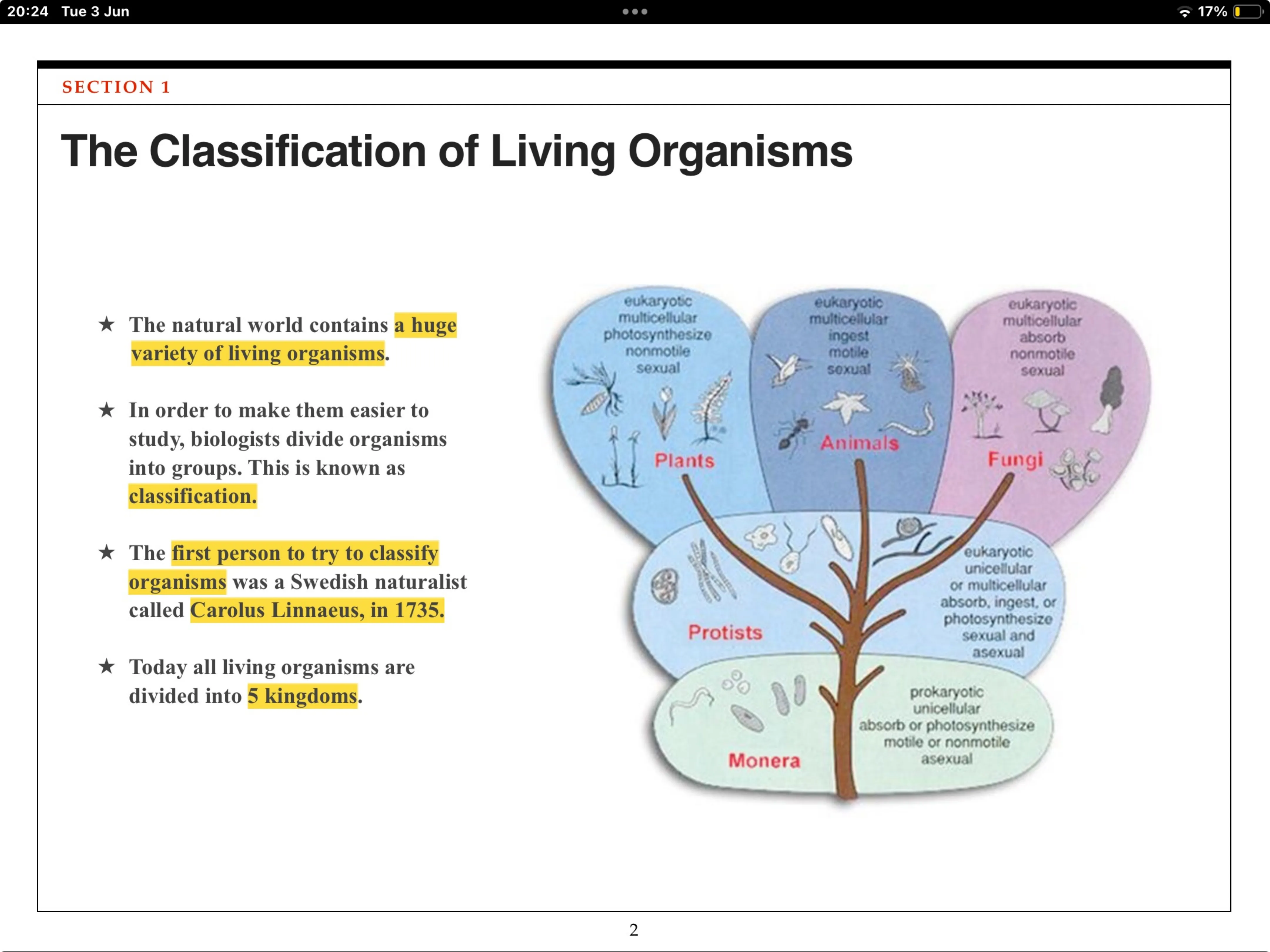
- Today all living organisms are divided into 5 kingdoms.
eukaryotic multicellular photosynthesize nonmotile sexual
eukaryotic multicellular ingest motile sexual
eukaryotic multicellular absorb nonmotile sexual
Animals Plants Fungi
Protists eukaryotic unicellular or multicellular absorb, ingest, or photosynthesize sexual and asexual
prokaryotic unicellular absorb or photosynthesize motile or nonmotile asexual
Monera
The Five Kingdom Classification System
220:24 Tue 3 Jun 17%
Classification is when organisms are placed into groups based on similarities or common characteristics.
- Living organisms are divided into five kingdoms.
- All other kingdoms are termed eukaryotic.
- The members of one kingdom, the monerans are called prokaryotic.
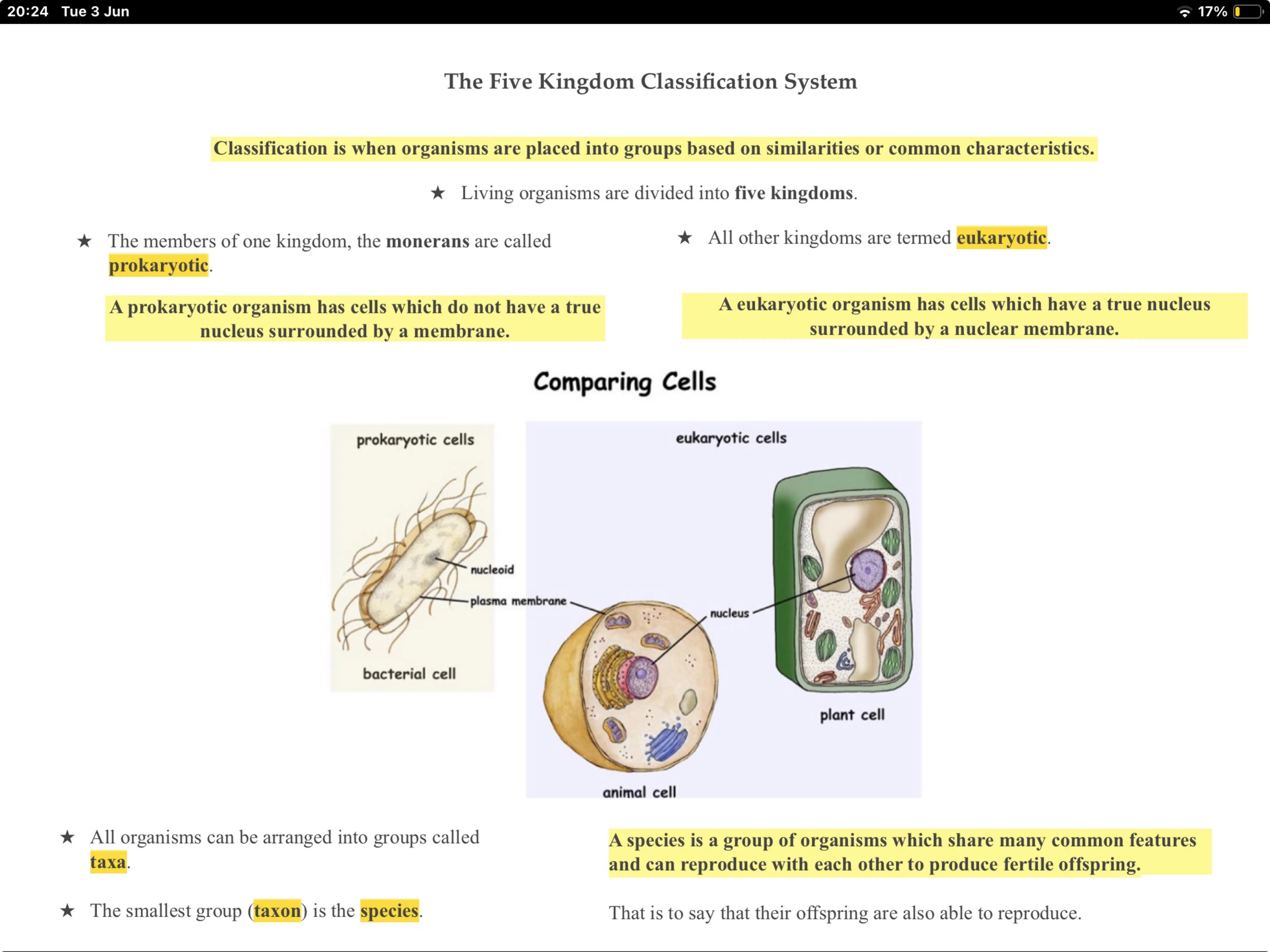
A prokaryotic organism has cells which do not have a true nucleus surrounded by a membrane.
A eukaryotic organism has cells which have a true nucleus surrounded by a nuclear membrane.
Comparing Cells
prokaryotic cells eukaryotic cells
nucleoid -plasma membrane nucleus bacterial cell plant cell animal cell
- All organisms can be arranged into groups called taxa
- The smallest group (taxon) is the species. A species is a group of organisms which share many common features and can reproduce with each other to produce fertile offspring. That is to say that their offspring are also able to reproduce.
Five Kingdom Classification Details
20:24 Tue 3 Jun 17%
Fungi Protista
- The basic unit from which they are made is usually a thread-like hypha
- Multicellular
Animals
- Microscopic, unicellular life forms
- Prokaryotic cells
- Are divided into :-
- Eukaryotic cells
- Cell walls made out of an animal-like chitin not cellulose like in plants
- Autotrophic and feed by photosynthesis
Divided into .-
- Vertebrates
- Invertebrates
- Feed heterotrophically like animals
Some are :-
- Saprophytes and feed on dead organic matter
- Biotrophs and feed on living organic matter
- Do not show locomotion like plants
Plants Monerans
- Microscopic, unicellular life forms
- Eukaryotic cells
- A collection of hypha make up a mycelium
- Cell walls made of cellulose
- Eukaryotic cells
- Heterotrophic
- Have cell walls
- Protozoa
- Large fluid-filled vacuoles in their cells
- Show locomotion
- Single celled algae
- Were the first forms of life to evolve on Earth!
- Some protists actually show the characteristics of both animals and plants
- No chlorophyll so can't do photosynthesis.
- Do not show locomotion
- Multicellular
- Eukaryotic cells
Humans as Special Animals
20:24 Tue 3 Jun 17%
- Humans are classified as vertebrates because we have a vertebral column made of vertebrae.
- Humans are classified as mammals because we have :-
- Mammary glands to feed our young
- Fur/hair
- External ears
- Sweat glands and sebaceous glands (produce a waxy sebum)
- Most possess a placenta during pregnancy
- Endothermic (constant body temperature)
- Diaphragm (which is used to help to breathe)
- Humans are classified as primates because we have :-
- Excellent eyesight, with eyes at the front of our head giving good judgement of distance.
- A large brain
- Opposable thumb - gives ability to grasp objects, so allowing the full use of tools
- Finger nails rather than claws
- Few offspring produced
- Humans have :-
- A lack of body hair
- Large cerebral hemispheres allowing learning, reasoning and language development
- Bipedalism - ability to walk on two legs
Classification of Humans
20:24 Tue 3 Jun 17%
Click here Movie 1.1 Classification
LIVING THINGS CAN BE ORGANISED INTO CATEGORIES BY GROUPING TOGETHER ORGANISMS WITH SIMILAR FEATURES
Movie 2.2 Five Kingdoms
Species Genus Family Order Class Phylum Kingdom
Homo sapiens Members of the genus Homo with a hightforehead and thin skull bones.
Homo Hominids with upright posture and large brains.
Hominids Primates with relatively flat faces and three-dimensional vision.
Primates Mammals with collar bones and grasping fingers.
Mammals Chordates with fur or hair and milk glands.
Chordates Animals with a backbone.
Animals Organisms able to move on their own.
Movie 2.3 Kingdoms of Life XXL Click here Movie 2.4 Chimps - our closest relative kukg Hominidae Movie 2.5 Clever Thumbs Tuk RR Click here
Naming Living Organisms
20:24 Tue 3 Jun 17%
- Linnaeus wanted to make sure that scientists all over the world could communicate about living organisms even though they spoke different languages.
- As most educated people in those days could read and write Latin that was the language he chose.
- Linnaeus gave each organisms two names, so his system is called the binomial system, and the name is called binomial.
SCIENTIFIC NAME COMMON NAME GENUS SPECIES
Human Homo sapiens
Domestic Cat Panthera catus
Lion Panthera leo
1 1
Starts with a capital letter Starts with a small letter
The first name is the name of the genus to which the organism belongs and is given a capital letter.
The second name is the name given to the species and it given a small letter.
The whole name is written in italics or underlined.
it is important that we are able to identify organisms exactly, because common everyday names are :-
- different in different languages :- cat - chat- gato
- often based on superficial resemblances between organisms For example :- There is an animal living in the sea called the sea mouse. But it isn't a mouse at all. It is a relative of the earthworm! It got its name simply because it looks hairy and reminded someone of a mouse !.
Kingdom Monera
17% 20:24 Tue 3 Jun
Bacteria and Cyanobacteria
Bacteria Cyanobacteria
- Bacteria (singular bacterium) are the most abundant living things on Earth.
- Bacteria are unicellular and they can only be seen under the high power of a light microscope.
- The cell is prokaryotic which means that it does not have a true nucleus surrounded by a membrane nor does it have complex organelles - just a few ribosomes in the cytoplasm.
CYTOPLASM RIBOSOMES PLASMID CELL WALL- CELL MEMBRANE CHROMOSOME FLAGELLA
- Some bacteria are saprophytes and feed on dead organisms and play an important part in the recycling of nutrients.
- Other bacteria feed on living organisms and these are called parasites, some of these bacteria cause disease and are commonly called germs.
- Many species of bacteria live in groups called colonies, and can often be identified by the shape and colour of the colony.
- Cyanobacteria or blue green algae, live by carrying out photosynthesis. They use the energy of the sun to change simple inorganic substances into complex organic matter.
- Most cyanobacteria live in water, and some have special floats that keep them close to the surface.
- Cyanobacteria also play an important part in the process of nitrogen fixation.
- Plants and animals cannot use the nitrogen directly from the nitrogen in the atmosphere but it is an essential element needed to make proteins.
- The cyanobacteria can, however, collect nitrogen from the air and convert it into chemicals called nitrates, Plants are able to then absorb the nitrates from the soil through their roots.
- Animals obtain nitrogen by eating the plants or other animals which have eaten plants.
Movie 2.6 Factpack - Bacteria
HUMANS HAVE AROUND 100 TRILLION CELLS
Interactive 1.3 Bacteria Introduction to Bacteria
Kingdom Protista
20:24 Tue 3 Jun 17%
Protozoa, Slime Moulds, and Algae
Protozoa Slime moulds Single-celled algae
Flagellates Ciliates Rhizopods
For example :- Amoeba
Protozoa Characteristics
- Protozoa (singular protozoon) are members of the Kingdom Protista.
- Each protozoon is unicellular being made of a singular cell which is eukaryotic (which means that it has a clearly defined nucleus and complex cell organelles.
- Protozoa are heterotrophic, which means that they have to take in and digest ready made organic food rather than make it by photosynthesis.
Movie 2.7 Kingdom Protista
Kingdom Protista: The Origins of Eukaryotic Diversity
Protozoa Movement
Protozoa move in a variety of ways :-
Flagellates
- These protozoa move by one or two threads of cytoplasm called flagella which whip backwards and forwards rather like the tail of a fish.
Ciliates
- These protozoa are surrounded by vast numbers of tiny cytoplasmic hairs called cilia which move them along quite smoothly and relatively fast.
Rhizopods
- These protozoa move by means of pseudopods ('false feet')
Movie 2.8 Movement in Protista
Amoeba
20:24 Tue 3 Jun 17%
- An amoeba (plural amoebae) is a protozoon that lives in ponds and slow moving streams.
- Its body consists of a single cell and has no fixed shape. In fact, it looks just like a bag of jelly, surrounded by a cell membrane.
- An amoeba moves by changing the state of its cytoplasm.
- It makes parts of this jelly-like substance turn solid to form temporary outgrowths. These are called pseudopods, which means 'false feet'.
- The rest of the amoeba flows into the pseudopods, and then it forms new pseudopods. By this process, the amoeba moves slowly along.
Movie 2.9 Movement in Amoeba
50 pm Dr. R. Wagner
- An amoeba lives in fresh water and so contains a higher concentration of salts and other dissolved substances in its cells than in the water around it.
- Because of this, water moves across its cell membrane and into its body by osmosis.
- The amoeba collects this water in a reservoir or vacuole called the contractile vacuole.
- Every few minutes, the vacuole contracts, and squirts out the unwanted water.
Ectoplasm Endoplasm Food vacuole Food vacuole Contractile vacuole Pseudopodium Nucleus
Amoeba Feeding and Reproduction
20:24 Tue 3 Jun 17%
- Amoeba feeds on smaller protists. It has no special sense organs but the surface of the cell is sensitive to chemicals in the water. (This is rather like the human sense of smell).
- All living organisms release chemical substances and an amoeba can therefore sense where its potential prey is. It moves slowly towards it.
- When a small protist has been found, the amoeba puts out pseudopodia around it.
- The pseudopodia completely surround the protist and join up around it. It is now enclosed in a food vacuole inside the cell in a drop of water. This process is called phagocytosis ('cell feeding')
Pseudopodia Nucleus Food vacuole
Movie 2.10 Feeding in amoeba - Phagocytosis
Mead's Microbe Movies "Amoebic Endocytosis !!
- Amoeba reproduces asexually - only one parent is involved and the offspring are identical to the parent.
- When an amoeba is ready to reproduce, it simply splits into two. First the nucleus splits and then the rest of the body.
- The two daughter amoebae then feed and grow. When fully grown, each splits again. In good conditions this may happen about once a day.
- This process is called binary fission. Binary means 'two' and fission means 'splitting', so the term literally means 'splitting into two'.
Binary Fission in Amoeba
Binary Fission in an amoeba
Amoeba divides after it has grown to a certain size.
The pseudopodia are pulled in and the nucleus divides.
The cell body begins to divide when the nucleus has split.
Two daughter amoebae are formed.
13
Can’t find what you’re looking for?
Explore more topics in the Algor library or create your own materials with AI.
