The War Poets: Wilfred Owen and Siegfried Sassoon in World War I
Slides about The War Poets. The Pdf explores the historical context and main figures of the English War Poets, with a focus on Wilfred Owen and Siegfried Sassoon. The presentation is suitable for high school Literature students, providing clear and concise information on the brutality of war and the soldiers' condition.
See more21 Pages

Unlock the full PDF for free
Sign up to get full access to the document and start transforming it with AI.
Preview
Compact Performer Shaping Ideas
ZANICHELLI The War Poets
1. Who were the soldiers?
- World War I was fought on such a huge and mechanised scale that very few communities remained untouched.
- Before conscription was introduced into Britain for the first time in 1916, lots of young men enlisted.
- The officers had mainly received an education based on the classics and the Victorian and Edwardian ideals of nationalism.
+ WAV
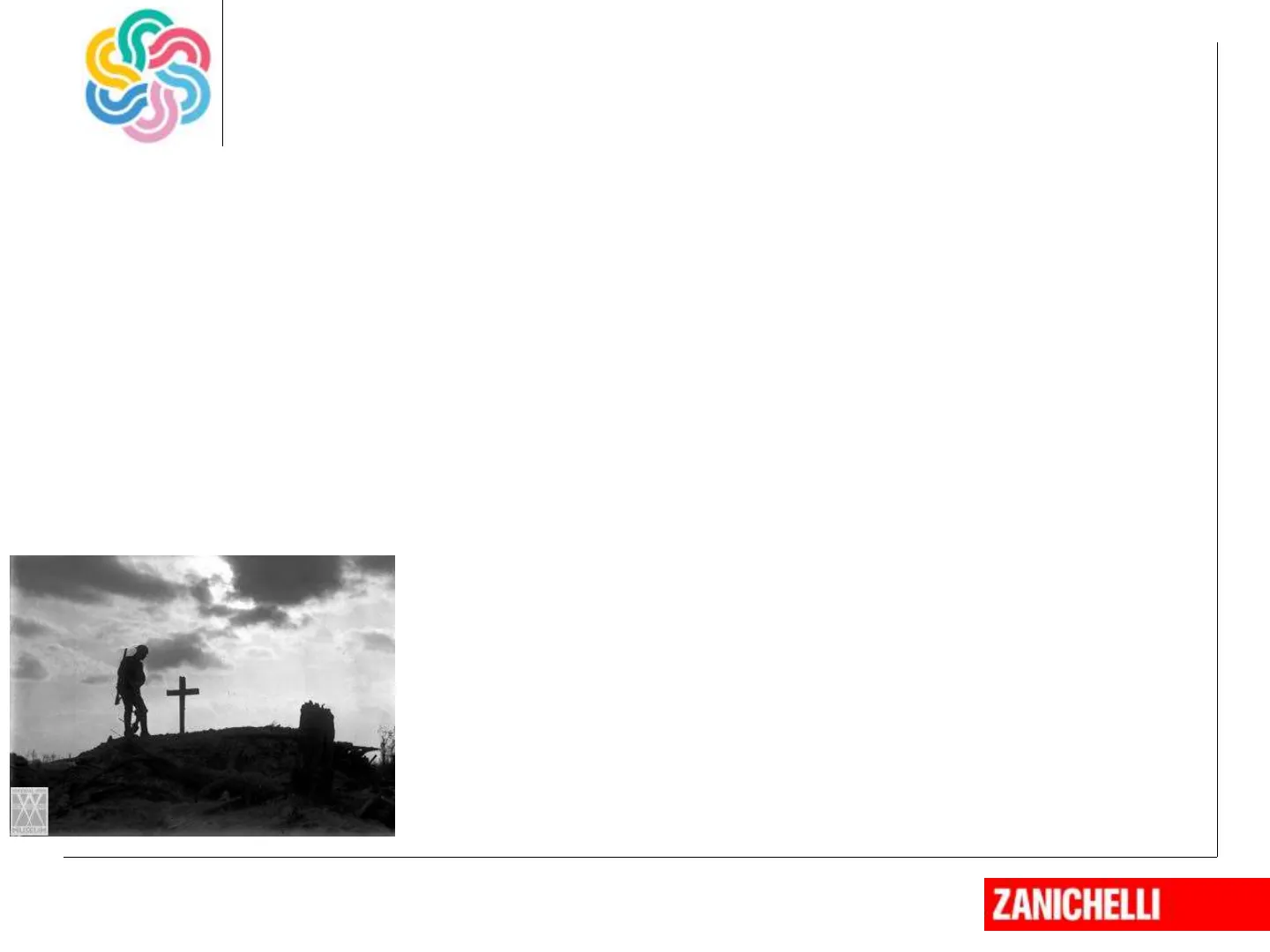
- Universal education meant that even private soldiers were, for the first time, literate and familiar with the English literary tradition. Soldier mourning a comrade, 1917, Imperial War Museum.
Compact Performer Shaping Ideas
ZANICHELLI The War Poets
2. Attitudes to war
When the war broke out many young men enlisted regarding the war as a noble adventure.
After the Battle of the Somme in 1916 pride and excitement were replaced by doubt and disillusionment.
Compact Performer Shaping Ideas
ZANICHELLI The War Poets
3. Trench warfare
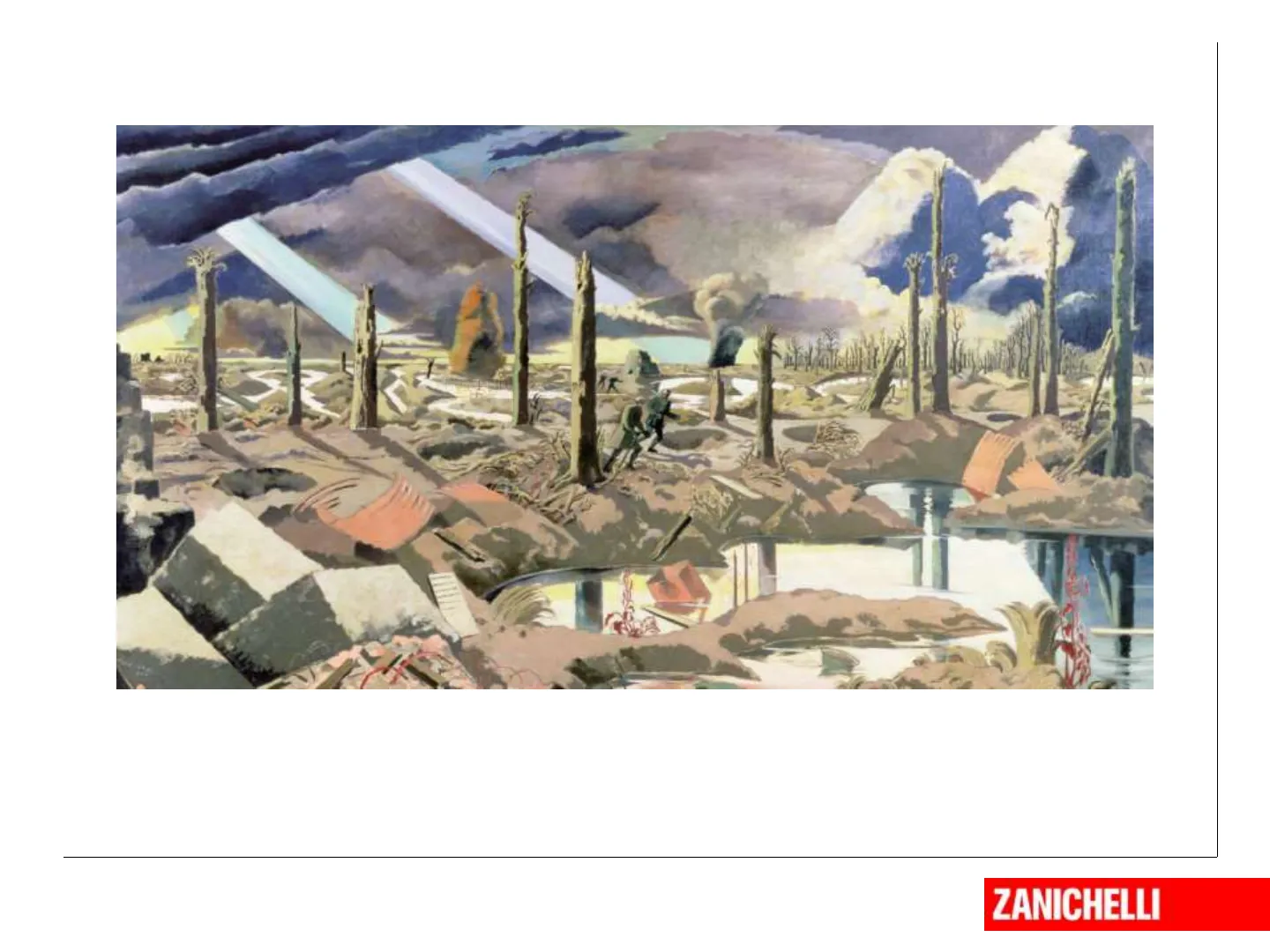
Life in the trenches was hell because of:
- rain and mud;
- decaying bodies;
- repeated bombings;
- use of poison gas.
0286 Draining Trenches. 22nd Infantry Battalion (French Canadian), July, 1916.
Soldiers wrote poems songs letters
Compact Performer Shaping Ideas
ZANICHELLI The War Poets
4. The War Poets
A group of poets:
- volunteered to fight;
- experienced the fighting;
- in most cases lost their lives in the conflict;
- managed to represent modern warfare in a realistic and unconventional way.
Sigfried Sassoon. Isaac Rosenberg, Self-portrait, 1915.
Compact Performer Shaping Ideas
ZANICHELLI The War Poets
4. The War Poets
- They awoke the conscience of their readers to the horrors of the war.
- They were modern in subject-matter.
- They tried to find new modes of expression.
Rupert Brooke. Wilfred Owen.
Compact Performer Shaping Ideas
ZANICHELLI The War Poets
5. Recurrent themes
courage /1
- patriotism glory
pain and suffering themes 1/ duty 1 violence heroism loss of innocence
Compact Performer Shaping Ideas
ZANICHELLI The War Poets
6. Rupert Brooke (1887-1915)
- Born in 1887 into a wealthy family;
- was educated at Rugby School and then at King's College, Cambridge;
- handsome, a good student and athlete, became popular in the Cambridge Fabian Society;
- got to know many important political, literary and social figures before the war;
- enlisted in the Royal Navy when World War I broke out.
Compact Performer Shaping Ideas
ZANICHELLI The War Poets
6. Rupert Brooke (1887-1915)
- Brooke's entire reputation as a War Poet is linked to the 5 sonnets of 1914;
- had limited war experience;
- died of blood poisoning;
- is buried on the Greek island of Skyros.
Compact Performer Shaping Ideas
ZANICHELLI The War Poets
6. Rupert Brooke (1887-1915)
His sonnets express a sentimental attitude to war:
- war is clean and cleansing;
- the only thing that can suffer is the body;
- death is seen as a reward and it is glorious to die for one's country.
Compact Performer Shaping Ideas
ZANICHELLI The War Poets
7. Wilfred Owen (1893-1918)
- He was 21 when the war broke out, working in France as a teacher.
- In 1915 he went back to England and enlisted.
- In 1916 he was sent to France and experienced military action.
- He had traumatic experiences.
- He fell through a shell-hole into a cellar and was trapped in the dark for three days.
Compact Performer Shaping Ideas
ZANICHELLI The War Poets
7. Wilfred Owen (1893-1918)
- He was blown out of the trench in which he was taking cover from an artillery bombardment.
- He was eventually diagnosed as having shell shock and was sent to Craiglockhart War hospital near Edinburgh.
- At Craiglockhart he met the poet Siegfried Sassoon.
- A close friendship and literary partnership began which would create some of the finest poetry of the war.
- Owen wrote his most famous poems from this time until he left the hospital.
Compact Performer Shaping Ideas
ZANICHELLI The War Poets
7. Wilfred Owen (1893-1918)
- Every night Owen had haunting nightmares. Sassoon suggested that he should write about these memories in poetry.
- Wilfred Owen returned to the front in 1918.
- He was awarded the military cross for bravery for capturing a German.
- He never received it because he was killed on 4th November 1918, seven days before the armistice.
- He is regarded as the greatest of the War Poets.
Compact Performer Shaping Ideas
ZANICHELLI The War Poets
7. Wilfred Owen (1893-1918)
In June 1918 Owen was preparing Disabled and Other Poems for publication. In the 'Preface' to the book he wrote:
'This book is not about heroes. English poetry is not yet fit to speak of them. Nor is it about deeds, or lands, nor anything about glory, honour, might, majesty, dominion, or power, except War. Above all I am not concerned with Poetry. My subject is War, and the pity of War. The Poetry is in the pity. Yet these elegies are to this generation in no sense consolatory. They may be to the next. All a poet can do today is warn. That is why the true Poets must be truthful.'
Compact Performer Shaping Ideas
ZANICHELLI The War Poets
7. Wilfred Owen (1893-1918)
- His poems describe the conditions of constant stress experienced by the soldiers: mud, rats, barbed wire, lice, fleas, corpses, blood, constant shelling, the effects of poisonous gas.
- He introduced the technical innovation of pararhymes - half-rhymes where the consonants in two different words are the same but the vowels vary.
- His poems have a haunting quality, a gravity and moral force which make them suitable for any situation in which people must suffer and die.
Compact Performer Shaping Ideas
ZANICHELLI The War Poets
8. Siegfried Sassoon (1886-1967)
- He was educated at Cambridge where he studied both law and history before leaving without taking a degree.
- He lived the life of a sportsman, hunting, riding and playing cricket.
- Before the War he was a minor Georgian poet.
- He joined the war in 1915 and was sent to France.
- His bravery in action earned him the nickname of 'Mad Jack'.
Compact Performer Shaping Ideas
ZANICHELLI The War Poets
8. Siegfried Sassoon (1886-1967)
- His reactions to the realities of the war were bitter and violent.
- He expressed them through irony in his poems.
- Sassoon protested publicly, reading out a declaration against the war in the House of Commons in July 1917.
- He was not court-martialled because the review board was convinced he was suffering from shell shock.
Compact Performer Shaping Ideas
ZANICHELLI The War Poets
8. Siegfried Sassoon (1886-1967)
- He was sent to Craiglockhart War Hospital near Edinburgh, where he met and influenced Wilfred Owen.
- His poems were collected in The Old Huntsman (1917) and in Counter-Attack (1918).
- Sassoon denounced the political errors through anger and satire and through sardonic distancing.
Compact Performer Shaping Ideas
ZANICHELLI The War Poets
8. Siegfried Sassoon (1886-1967)
- He used a documentary manner to recreate the physical horror of the war.
- His poems express neither compassion nor pity, but shocking and realistic detail.
- After the war, he became a resolute pacifist and got involved in politics with the Labour Party.
- In 1957 he became a Roman Catholic.
Compact Performer Shaping Ideas
ZANICHELLI The War Poets
9. Isaac Rosenberg (1890-1918)
- He was born in 1890 into a working-class Jewish family, emigrated to the East End of London from Lithuania.
- He was a talented artist and enrolled at the Slade School in London.
- He enlisted in 1916 and was killed at the front in 1918. Self-portrait, 1915.
Compact Performer Shaping Ideas
ZANICHELLI The War Poets
9. Isaac Rosenberg (1890-1918)
- His vision of the war was unsentimental and less concerned with the pity of things.
- He presented realistic and shocking details, with a touch of irony or through paradox and contrast.
- His finest poems were published in Collected Works in 1937. Self-portrait, 1915.
Compact Performer Shaping Ideas
ZANICHELLI
Can’t find what you’re looking for?
Explore more topics in the Algor library or create your own materials with AI.
