Ancient Rome: Economy, Society, Religion, and Art
Slides about Ancient Rome, exploring its economy, society, religion, and art. The Pdf provides a clear overview of Roman architecture, including religious, public, and engineering constructions, useful for high school History students.
See more19 Pages


Unlock the full PDF for free
Sign up to get full access to the document and start transforming it with AI.
Preview
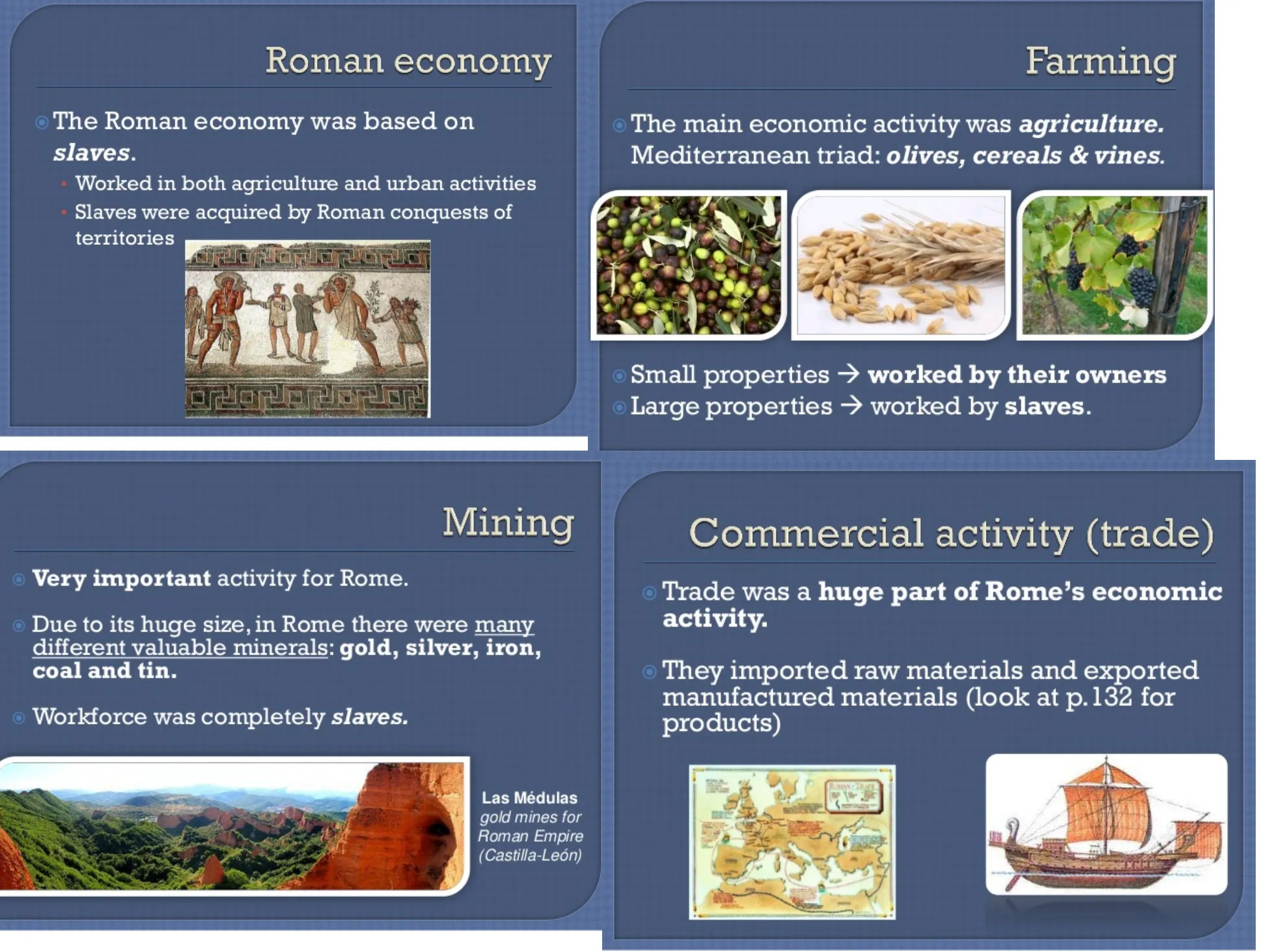
Roman Economy
Mercè JansàRoman economy
O The Roman economy was based on slaves.
- Worked in both agriculture and urban activities
- Slaves were acquired by Roman conquests of territories
Farming in Ancient Rome
o The main economic activity was agriculture. Mediterranean triad: olives, cereals & vines.
O Small properties > worked by their owners · Large properties > worked by slaves.
Mining in Ancient Rome
o Very important activity for Rome.
o Due to its huge size, in Rome there were many different valuable minerals: gold, silver, iron, coal and tin. Workforce was completely slaves.
Las Médulas gold mines for Roman Empire (Castilla-León)
Commercial Activity (Trade)
o Trade was a huge part of Rome's economic activity.
. They imported raw materials and exported manufactured materials (look at p. 132 for products)
-o Commerce increased with the following developments:
- A common currency
- A road network
- Standardized weights
- Control over the Mediterranean (security against pirates)
ANIN The use of the same currency & units of measure across the whole empire made trading easier.
pes pedis, m = 0.29 m oubitus -i. m. = 0,44 m Ivel oubitum -i, n.l gradus -0s. m. = 0,74 m
Common Coins of the Roman Empire
As 280 BCE-250 CE 9-12g, -27mm
Follis 294-310 CE 5-12g. ~ 26mm (early)
Dupondius 23 BCE-250 11-15g, -29m
AR Aureus 200 BCE-305 CE 7g,~20mm
Solidus 310-693 CE 4.5g,~20mm
AE3 315-400 CE 2-4g .- 18mm
AF4 383-400 0.5-1.5g .- 14
Denarius 211 BCE-241 CE 3g,~19mm
Tremissis 380-367 CE 1.5g .~ 14mm
Sestertius 23 BCE-250 CE 20-30g .- 35mm
Antoninianus 215-295 CE 3-5g .~ 21mm
Siliqua 310-650 CE 1-3g .~ 18mm
Activity 8: Roman Economy Questions
Activity 8: copy & answer in your notebook: ROMAN ECONOMY
- P. 132: exercises 1 & 2.
- What factors helped commerce grow in Rome?
Roman Society
During the Monarchy & early years of the Republic (until 3rd Century BC)
Since the late years of the Republic (from 3rd Century BC onwards)
Social Division Based on Political Rights
Social division was based on political rights We distinguish:
- Patricians
- Plebeians
- Slaves
Social Division Based on Wealth
Social division was based on wealth We distinguish:
- Citizens: · Honestiores · Humiliores
- Non-citizens: . Conquered population · Foreigners · Freedmen · Slaves
Monarchy & Early Republic Social Classes
Monarchy & early years of the Republic
PATRICIANS:
- Were the aristocracy of Rome.
- Richest & most powerful families.
- Had huge plots of land.
- Had political rights, and controlled the government.
PLEBEIANS:
- Artisans, small farmers ...
- Paid taxes.
- Had some civil rights, but no political rights.
SLAVES:
- Worked for their owner.
- Had no rights at all.
Late Republic & Empire Social Classes
Late years of the Republic & the Empire
THE CITIZENS: had all political and civil rights. Divided into:
- Honestiores: the wealthiest · Humiliores: lower social status
Female citizens: less rights than a man of the same status.
THE NON-CITIZENS: all the people who had no right to citizenship:
- Conquered populations: non-citizens until 212 AD, when, thanks to the Edict of Caracalla, they became citizens.
- Foreigners: came from beyond the Empire's borders. Usually traders or artisans.
- Freedmen: slaves freed by their owners (manumission) or who had bought their freedom
- Slaves: no rights; property of their master. People could become slaves if · Conquered in war · Not paying debts · Born from slave parents
Activity 9: Roman Society Questions
Activity 9: copy & answer in your notebook: ROMAN SOCIETY
- Define "patrician" & "plebeian".
- Design 2 social pyramids: . One for the Roman society until the 3rd Century BC. . One for the Roman society after the 3rd Century BC.
- Explain the Edict of Caracalla: When and by who was it issued? What was its consequence?
- What is manumission?
- Why could a person become a slave?
Roman Religion
Traditional Roman Religion
At first, Romans were polytheistic:
o Domestic/private religion:
- Worship of household gods (lares & penates) and the spirits of ancestors (manes).
- The pater familias (head of the house) made offerings in the lararium (altar).
o State/official religion:
- Worship of different gods, many taken from Greek mythology (Jupiter, Mars, Venus, Neptune ... ).
- From the 1st Century AD onwards: worship of the emperor.
Roman Gods and Goddesses
ROMAN GODS AND GODDESSES
Apollo God of the sun and music
Diana Goddess the moon and hunting
Jupiter God of the sky and most important god
Mars God of war
Mercury Messenger of the gods and god of trade
Minerva Goddess of wisdom
Neptune God of the sea
Venus Goddess of love and beauty
Birth & Expansion of Christianity
Birth & expansion of a new religion: Christianity
· BIRTH OF CHRISTIANITY:
- 1 st Century AD.
- Preached by Jesus of Nazareth, who was crucified by Pontius Pilatus.
O EXPANSION OF CHRISTIANITY:
- EARLY DAYS: Christians were persecuted by the Romans (refusal to worship the emperors, to enrol in the army ... ). However, Christianity expanded rapidly since it promised life after death in heaven, equality ...
- 313 AD: emperor Constantine announced the Edict of Milan > Christians were authorized to practice their religion.
- 380 AD: emperor Theodosius announced the Edict of Thessalonica > made Christianity the official religion of the empire.
Roman Art
Roman Architecture Characteristics
ROMAN ARCHITECTURE
CHARACTERISTICS:
- It was practical.
- Influenced by Greek art.
- Materials: stone, brick, concrete.
- Flat ceilings supported by columns: Greek architectural orders: Doric, Ionic & Corinthian. A new order: Tuscan. They also combined different orders.
- Arches & domesT.
C D) 2 A E 1 1 4 F 6 GB GBG
Greek Doric lonic Corinthian
Tuscan Composite
Greek orders
New order (Tuscan)
Sometimes they combined different orders !!!
Arch eye Traitx |.
Dome (The Pantheon of Rome, temple consecrated to all the Roman gods)
Activity 11: Roman Architecture Questions
Activity 11: copy & answer in your notebook: ROMAN ARCHITECTURE
- Complete: . Roman architecture was ... and functional. . The ceilings were ... and supported by ... . However, they also used ... and ... to cover large surfaces.
- Which civilisation mostly influenced Roman architecture?
- What materials did Romans use to construct their buildings?
- What architectural orders did Romans used?
Roman Building Materials
Bricks & concrete WALL OF OPUS INCERTUM
WALL OF OPUS RETICULATUN
Stone (Temple of Jupiter, Baalbek, Lebanon)
WALL OF OPUS TESTACEUM 10+2+2+++ 4
Main Roman Buildings
ROMAN ARCHITECTURE
o MAIN BUILDINGS: Religious buildings: Temples: Greek influence. Tombs: catacombs (subterranean collective burials)
Public buildings: Entertainment: circuses, amphitheatres, theatres, thermal baths. Administrative: basilicas Commemorative: columns, triumphal arches.
- Engineering constructions: Roads Bridges Sewer systems Aqueducts
Religious Buildings
Religious: TEMPLES
Temple of Hercules The ultimate sundial Only at noon on an equinox does the sun shine through the Pantheon's oculus at the perfect angle to pass through a grille above the closed door and light up the front courtyard
48° NORTH-+ 43.3 metres Pantheon of Rome (Temple of all the Roman gods)
Religious: CATACOMBS
Catacombs of Saint Callixtus (Rome)
Entertainment Buildings
2 Entertainment: CIRCUS
CIRCVS MAXIMVS. PATINI LALIMOR
Entertainment: AMPHITHEATRE
Gladiators & naumachia show
Entertainment: THEATRES
Roman theatre in Merida (Extremadura)
Entertainment: THERMAL BATHS
D Water & air was heated using the hypocaust system -anut tubuli piscine chasde ........ ypecusto plotes chauffage du caldarium
Administrative Buildings
Administrative: BASILICAS
Basilica of Maxentius & Constantine (Roman Forum, Rome, Italy)
Commemorative Buildings
Commemorative: COLUMNS
Trajan column (Rome, Italy) It commemorates emperor Trajan's victory in the Dacian Wars (Rome VS Dacia, an area north of Macedon and Greece)
W A B
Commemorative: TRIUMPH ARCHES
Arch of Constantine (Rome, Italy) It was erected to commemorate Constantine l's victory over Maxentius at the Battle of Milvian Bridge on October 28, 312.
Engineering Constructions
Engineering: ROMAN ROADS
O http://majocobe.blogspot.com Ruins of a Roman road that belonged to the Silver Route (Vía de la Plata. Caceres, Extremadura)
Engineering: BRIDGES
Roman bridge in Cordoba
Roman bridge in Merida
Engineering: AQUEDUCTS
Roman Aqueduct intake reservoir conduit aqueduct bridge city
Roman aqueduct in Segovia (Spain)
Engineering: SEWER SYSTEMS
Activity 12: Roman Architecture Poster
Activity 12: ROMAN ARCHITECTURE POSTER!
- In groups of 2, you need to prepare a poster about ROMAN ARCHITECTURE. You'll be given a topic: · Religious buildings · Entertainment buildings · Administrative buildings · Commemorative buildings · Engineering constructions
- AT HOME: you need to look for (internet, books, magazines ... ): · Pictures of buildings of your topic. · Information of each building (function, when was it build, by who ... )
- IN CLASS: you'll be given time in class to prepare your poster (organize information, stick pictures, write information, colour things in ... )
YOU HAVE TO PRESENT TO THE CLASS YOUR FINISHED POSTER
Roman Sculpture, Paintings & Mosaics
ROMAN SCULPTURE, PAINTINGS & MOSAICS
- Sculptures: · Copied Greek models. · Very realistic. · Romans developed 2 new genres: Portrait Historical relief
- Painting: Frescoe technique · Used to decorate walls of Roman villas.
- Mosaics: Made with small pieces of coloured stone (tessellas). Used to decorate floors.
Roman Sculptures
SCULPTURES
Portrait of a emperor Caracalla
Sculpture of Neptune
Portrait of a Roman priest
Detail of the column of emperor Trajan
Roman Paintings
PAINTINGS
Frescoe: technique in which colour pigments are dissolved in water and applied to a wet plaster wall. When it dries the paint becomes an integral part of the wall.
Frescos in "Villa dei Misteri" (Villa of the Mysteries). Pompey (Italy)
Frescos in a Roman Villa in Herculaneum (Italy)
In both cases, they survived quite undamaged to the eruption of the Vesuvius volcano of 79 AD
Roman Mosaics
MOSAICS
Can’t find what you’re looking for?
Explore more topics in the Algor library or create your own materials with AI.
