Communicative Competence: Analysis of its Components
Slides from University about Communicative Competence: Analysis of its Components. The Pdf, a detailed presentation, explores the evolution of the concept and its implications in foreign language teaching, covering linguistic and pragmatic aspects for university-level language studies.
See more20 Pages


Unlock the full PDF for free
Sign up to get full access to the document and start transforming it with AI.
Preview
4. Communicative competence.
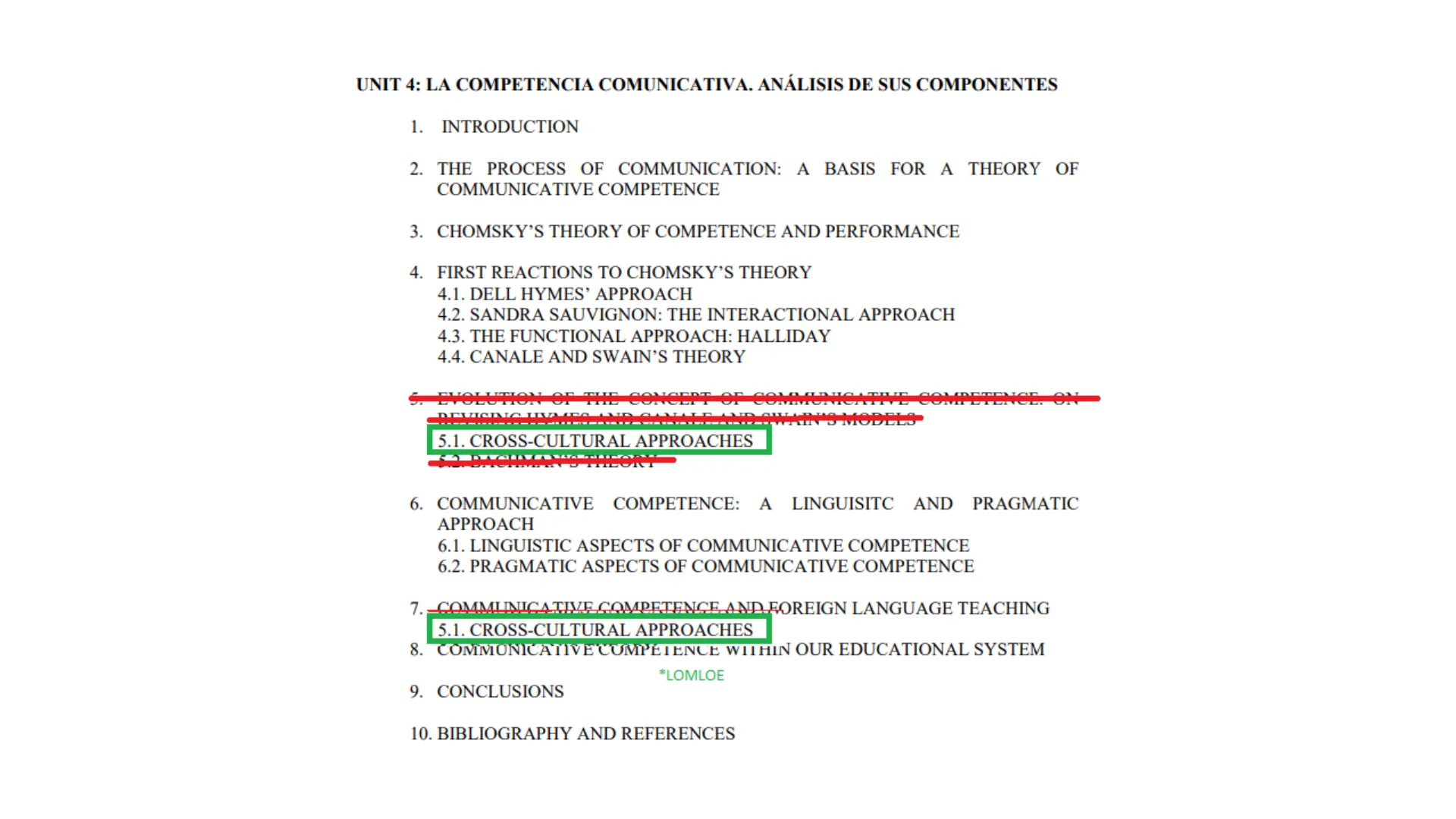
Analysis of its components.UNIT 4: LA COMPETENCIA COMUNICATIVA. ANÁLISIS DE SUS COMPONENTES
1. INTRODUCTION
2. THE PROCESS OF COMMUNICATION: A BASIS FOR A THEORY OF COMMUNICATIVE COMPETENCE
3. CHOMSKY'S THEORY OF COMPETENCE AND PERFORMANCE
4. FIRST REACTIONS TO CHOMSKY'S THEORY
4.1. DELL HYMES' APPROACH
4.2. SANDRA SAUVIGNON: THE INTERACTIONAL APPROACH
4.3. THE FUNCTIONAL APPROACH: HALLIDAY
4.4. CANALE AND SWAIN'S THEORY
MUNICH COMPETENCE. ON IN D MODELS
5.1. CROSS-CULTURAL APPROACHES
6. COMMUNICATIVE COMPETENCE: A LINGUISITC AND PRAGMATIC APPROACH
6.1. LINGUISTIC ASPECTS OF COMMUNICATIVE COMPETENCE
6.2. PRAGMATIC ASPECTS OF COMMUNICATIVE COMPETENCE
7 .- COMMUNICATIVE COMPETENCE AND FOREIGN LANGUAGE TEACHING
5.1. CROSS-CULTURAL APPROACHES
8. COMMUNICATIVE COMPETENCE WITHIN OUR EDUCATIONAL SYSTEM
9. CONCLUSIONS
*LOMLOE
10. BIBLIOGRAPHY AND REFERENCES
Introduction to Communicative Competence
According to the view of classical authors, human communication is based on a process in which certain information is encoded by the sender and decoded by the receiver. For communication to occur, there should be a common code, which is language. This view was gradually challenged throughout the course of linguistic studies, especially in the 20th century.
In recent years, there has been a shift of emphasis within Linguistics from an almost exclusive concern with formal aspects of language to a growing interest in language use. Language system is no longer viewed in isolation but related to extralinguistic factors so that the nature of communication can be analysed. This communicative approach to language teaching takes the notion of communicative competence as a key feature, . According to this new approach, communication involves more than being able to produce and correct sentences, since we do not always produce correct sentences and not all of our sentences are relevant or appropriate in a given context. Communication implies having what the sociolinguist Dell Hymes called "communicative competence".
The Process of Communication: A Basis for a Theory of Communicative Competence
- What is communication?
- Approaches from different fields: philosophy, psychology, anthropology and sociology.
Saussure Langage (faculty of speech)
- Langue: language system
- Parole: the act of speaking
Semiotics:
- Verbal communication (code: language)
- Non-verbal communication (code: visual and tacticle modes)
Chomsky
- Competence (actual knowledge of the language)
- Performance (the use of language)
Halliday Language: instrument of social interaction with a clear communicative purpose.
FUNCTION + SEMANTICS = basis human communicative activity.
SOCIAL CONCEPT as key concept.
Chomsky's Theory of Competence and Performance
1960 Three interrelated theories which need to be developed in any language study:
- Theory of Language Structure (structural properties)
- Theory of Language Acquisition (how children acquire their native language) . Theory of Language Use (speech comprehension and production For Chomsky, grammar is a model of those linguistic abilities which enable native speakers to speak and understand their language. These linguistic abilities are presented as the competence of the native speaker. Competence is different from performance, which is the actual use of language in concrete situations.
Chomsky's Theory: Competence and Performance
Competence: with an ideal speaker listener's knowledge of the rules of language. It is exclusively associated with rules of form and grammaticality
Performance: language use. It becomes residual category of imperfect nature due to psychological constraints operating in language use.
The reaction against Chomsky's narrow concept of competence is the notion of COMMUNICATIVE COMPETENCE
First Reactions to Chomsky's Theory
COMMON VIEW Linguistic competence is just one of the requirements to be a competent language user.
To be linguistically competent is not enough. There is more to it.
Dell Hymes' Approach to Communicative Competence
Chomsky's competence-performance model lacks: - social interaction component - empirical support.
The language user utters grammatically correct forms and, also, knows when and where to use them, and to whom (contextual and sociolinguistic component).
COMMUNICATIVE COMPETENCE
*Hymes was concerned with explaining language use in social contexts. As a result, Hymes's model for communicative competence included grammatical, sociolinguistic and contextual concepts.
Sandra Sauvignon: The Interactional Approach
Interactional approach. Experiment with foreign language learners. Communicative competence: the ability to function in a truly communicative setting.
*Learners CC: expression, interpretation and negociation of meaning involving interaction between two or more persons or between a person and a written or oral text.
The Functional Approach: Halliday
. Also rejected Chomsky's dichotomy. FUNCTION: The purposive nature of communication. 7 functions of language: INSTRUMENTAL, REGULATORY, REPRESENTATIONAL, INTERACTIONAL, PERSONAL, LINGUISTIC, HEURISTIC, IMAGINATIVE.
INTERACTIONAL FUNCTION ensures social maintenance, communicative contact between and among humanbeings that simply allows them to establish social contact and to keep channels of communication open (slang, jokes, folklore, cultural aspects, politeness ... )
PERSONAL FUNCTION allows the speaker to express feelings, emotions, personality. The nature of language, cognition and culture all interact in this function.
The acquisition of styles and registers, an important factor in strategic competence for second language learners.
Canale and Swain's Theory of Communicative Competence
- Linguistic communication is a form of social interaction. It is used and acquired in social interaction and it involves a high degree of unpredictability and creativity.
Communicative competence
Grammatical Knowledge of lexical items and rules of morphology, syntax, sentence gramar semantics and phonology.
Discourse The ability to use language in order to achieve a unified spoken or written text in different genres.
Sociolinguistic The understanding of the social context in which language is used: the roles of participants, shared information and function of interaction.
Strategic The verbal and non verbal strategies which may be used to compensate for breakdowns in communication.
Canale and Swain's Theory: Use of Language
- Linguistic communication is a form of social interaction. It is used and acquired in social interaction and it involves a high degree of unpredictability and creativity.
Communicative competence USE OF LANGUAGE FUNCTIONAL ASPECTS
Grammatical Knowledge of lexical items and rules of morphology, syntax, sentence gramar semantics and phonology.
Discourse The ability to use language in order to achieve a unified spoken or written text in different genres.
Sociolinguistic The understanding of the social context in which language is used: the roles of participants, shared information and function of interaction.
Strategic The verbal and non verbal strategies which may be used to compensate for breakdowns in communication.
Canale and Swain's Theory: Influential Interpretation
- Linguistic communication is a form of social interaction. It is used and acquired in social interaction and it involves a high degree of unpredictability and creativity.
MOST INFLUENTIAL AND EFFECTIVE INTERPRETATION OF THE NOTION OF COMMUNICATIVE COMPETENCE
Communicative competence
Grammatical Knowledge of lexical items and rules of morphology, syntax, sentence gramar semantics and phonology.
Discourse The ability to use language in order to achieve a unified spoken or written text in different genres.
Sociolinguistic The understanding of the social context in which language is used: the roles of participants, shared information and function of interaction.
Strategic The verbal and non verbal strategies which may be used to compensate for breakdowns in communication.
Communicative Competence: A Linguistic and Pragmatic Approach
According to Canale, communicative competence is the ability to use appropiately all aspects of verbal and non-verbal language in a variety of contexts, as would a native speaker.
Communicating with people from other cultures involves: -linguistic appropiateness -pragmatic appropriateness
Linguistic Aspects of Communicative Competence
Pragmatic Aspects of Communicative Competence
It refers to the control of the purely linguistic aspects of the language code itself. It subsumes:
- Phonological competence: the ability to recognize and produce distinctive and meaningful sounds of a language.
- Ortographic competence: the ability to decipher and write the system of a language.
- Lexical competence: the ability to recognize and use words in a language in the way speakers of the language use them.
- Discourse competence: the ability to combine gramatical forms and meaning to achieve a unified spoken written text in different genres.
It refers to the knowledge of the appropiate communicative uses, verbal and non verbal, which enables comprehensible interaction in a given context.
- Functional competence: the ability to accomplish communication purposes.
- Sociolinguistic competence: the knowledge of the sociocultural use of language. The ability to choose appropriate language according to the communicative context.
- Interactional competence: the ability to use and know unwritten rules for interaction (manage a conversation, negotiate the meaning, body language, personal space or eye contact).
- Cultural competence: the ability to understand the relevant aspects of a different culture and the role that they can play in communicative interactions.
Can’t find what you’re looking for?
Explore more topics in the Algor library or create your own materials with AI.