Hybrid and Electric Vehicles: Powertrain Architectures and Energy Management
Slides about hybrid and electric vehicles, covering powertrain architectures and energy management strategies. The Pdf provides a detailed overview of hybrid vehicle classifications, power flow, and optimal control approaches for energy efficiency, suitable for university-level Physics students.
See more20 Pages

Unlock the full PDF for free
Sign up to get full access to the document and start transforming it with AI.
Preview
Hybrid and Electric Vehicles Overview
In particular this chapter is divided in three sub chapters: the first one is related to a general overview and an introduction on hybrid and electric vehicles. In the second part we will discuss modeling of hybrid electric vehicles which will be of paramount importance because all the energy management strategies that we will discuss in the last part of the course are based on the models that we have developed previously.
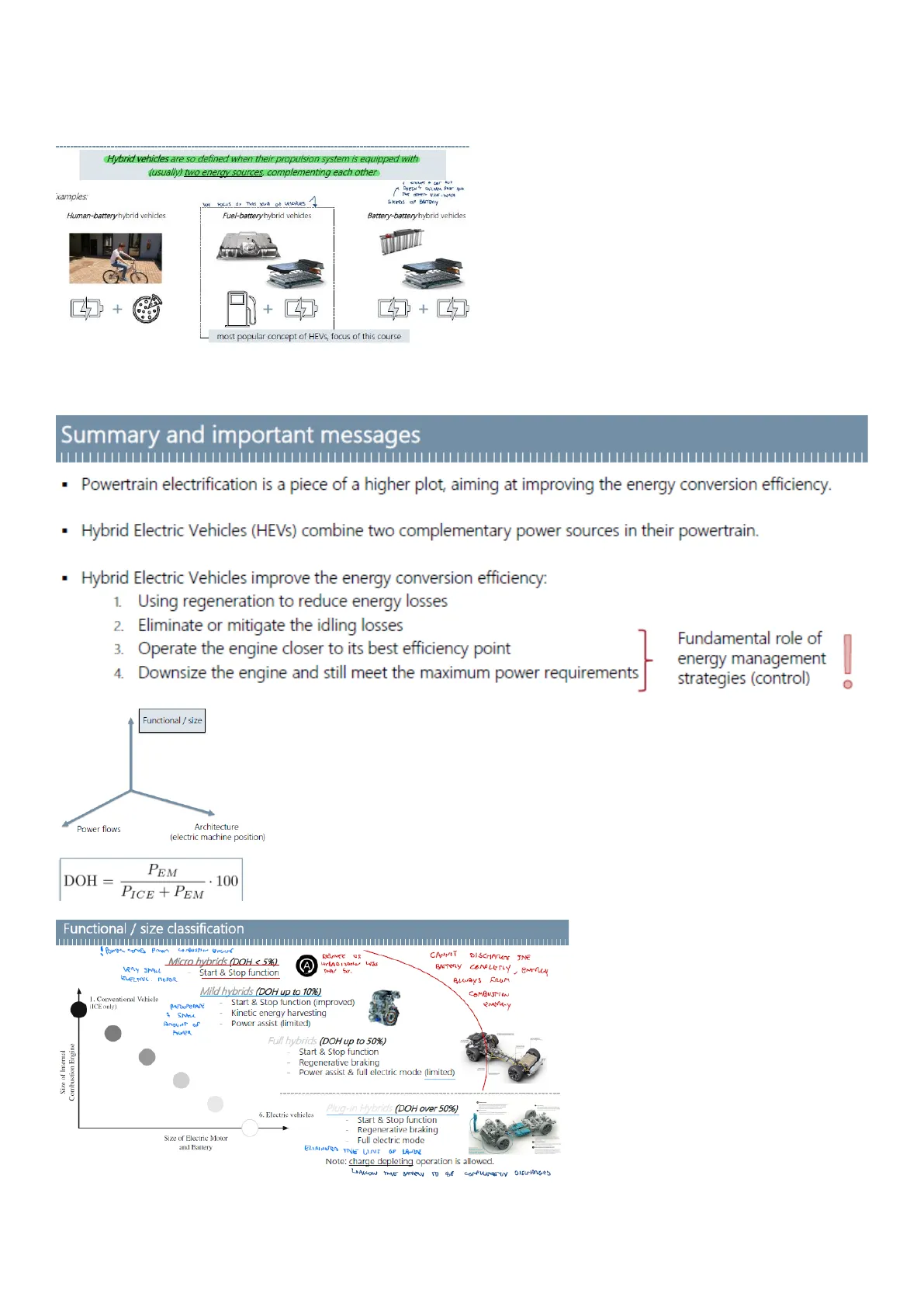
Hybrid vehicles are so defined when their propulsion system is equipped with (usually) two energy sources, complementing each other Hybrid vehicle is so defined: you have two different propulsion systems which typically are combined or I sitt A Los lot DOESN'T ONLINEA PAS AND xamples: WE FOCUS ON THIS KIND OF VEICHLES 1 2 KILOS of BAmany Human-battery hybrid vehicles Fuel-battery hybrid vehicles linked to two or more different energy sources and the Battery-battery hybrid vehicles two power sources complement each other. So, one power source it's useful or has greater advantages in doing some tasks and the other power source has advantages in other tasks. Third case has two different
------ + kind of batteries which typically have complementary + most popular concept of HEVs, focus of this course characteristics, one for instance is capable of storing a lot of energy but cannot deliver the energy faster, so, has a high energy density, opposite the other kind of battery is not capable of storing a big amount of energy, but it can deliver and accept energy in a very short amount of time, so, this is typically called battery with a very high power density.
Summary and Important Messages
- Powertrain electrification is a piece of a higher plot, aiming at improving the energy conversion efficiency.
- Hybrid Electric Vehicles (HEVs) combine two complementary power sources in their powertrain.
- Hybrid Electric Vehicles improve the energy conversion efficiency:
- Using regeneration to reduce energy losses
- Eliminate or mitigate the idling losses
- Operate the engine closer to its best efficiency point
- Downsize the engine and still meet the maximum power requirements[ 7 r
Fundamental role of energy management strategies (control) !
Hybrid Vehicle Classification
The classification of hybrid powertrain or of a hybrid vehicle is done according to different categories: One category is related to the kind of functionality or the size. Another kind of classification can be done in terms of the type of power flows that we have in the architecture considered. Finally, we can have a different classification according to the type of architecture, the position of the electrical machine within the power train.
PEM DOH = . 100 PICE + PEM
Functional / Size Classification
; POWER COMES FROM COMBUSTION SINGING Micro hybrids (DOH < 5%) VERY SMALL GELEZENC. MOTOR Start & Stop function Mild hybrids (DOH up to 10%) 1. Conventional Vehicle (ICE only) Start & Stop function (improved) Kinetic energy harvesting AMOUNT of Power Power assist (limited) Size of Internal Combustion Engine 6. Electric vehicles Size of Electric Motor and Battery Functional / size Power flows Architecture (electric machine position) Classification of a hybrid vehicle in terms of functional and or size: the number for classifying different power trains is the so-called degree of hybridization, DOH. It's the ratio between the power of the electric motor and the rated power. It's basically the fraction of power delivered of the CANNOT A DELAFE DISCHARGE THE BATTERY COMPLETLY, ENERGY ALWAYS FROM COMBUSTION emMary HYBND12Arles Leds THAY ST. overall power delivered by the electric motor. When the percentage is zero, we have a conventional vehicle because there is no electric motor, when the Full hybrids (DOH up to 50%) degree of hybridization is 100, means we Start & Stop function Regenerative braking have a full electric vehicle. The first Power assist & full electric mode (limited) category is called micro hybrids. The Plug-in Hybrids (DOH over 50%) degree of hybridization is less than 5% - Start & Stop function Regenerative braking Full electric mode and the only functionality that is ELIMINAREA THE LINE OF RANDE Note: charge depleting operation is allowed. LOALLOW THE BATTERY TO BE COMPLETLY DISCHARGED implemented is the start and stop functionality. You have a very small electric motor that is used when you are at the traffic light to start the internal combustion engine when you want tostart again. The power comes always from internal combustion engine, the electric part, it's only used to continuously stop and start the engine. Then we have the mild hybrid that typically are classified as hybrid vehicles where the degree of hybridization is up to 10%. The start and stop function is of course present, maybe it's improved because the electric motor is bigger. Typically, for this kind of vehicles, you also have the capability of harvesting, so of recuperating some part of electric power during braking. Given that the electric part of your power train is small, you cannot recuperate all the electric or the braking energy, you can recuperate a small amount. This is the so-called power assist, it's not full electric driving, but I am assisting my internal combustion engine in delivering the required power to the vehicle. The next step is the full hybrid. It reaches a degree of hybridization up to 50% and of course, the functionalities are start and stop, complete regenerative braking so you really recuperate a lot of energy and you can actually brake with the electric motor simply because the motor is bigger. Of course, they allow the power assist, but the important thing is that they enable the full electric motor compared to the single power assist. It means that you can drive your car even when internal combustion engine is shut down and you can, let's say you are guaranteed to be able to deliver basically all the power that you need only with electric motor. You have this capability, but only for a limited amount of kilometers. The last category are the plugin hybrid. They are hybrid vehicles where the degree of liberalization is beyond 50%. They of course allow the start and stop, regenerative braking, the full electric motor, but its limitation in terms of range is eliminated. You can travel in the full electric motor for a lot of kilometers. For these other type of vehicles, there is no plug that comes when you buy the vehicle. This allows the charge depleting, it means that you can completely discharge the battery, go to the charging station, plug the plug, and still recharge the battery. The degree of hybridization is related to the power, the higher the power, the bigger the machine, the size is bigger. The power of the electric motor increases, the battery capacity increases also.
Power Flows Classification
Another classification is related to how the power flows within the vehicle itself. There are basically three macro categories, which are the following:
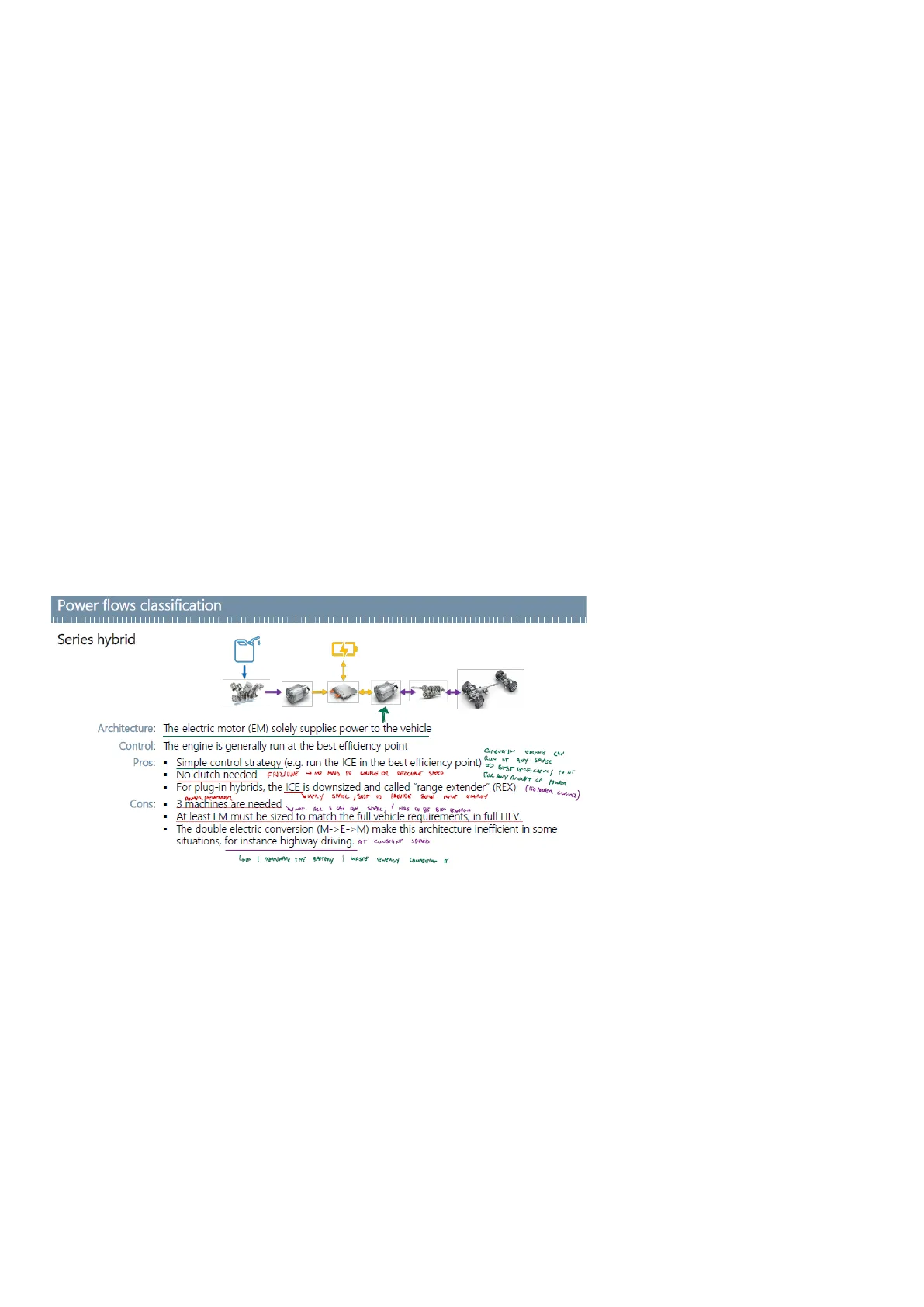
Series Hybrid Architecture
Architecture: The electric motor (EM) solely supplies power to the vehicle Control: The engine is generally run at the best efficiency point COMBUSTION ENGINE CAN RUN AT ANY SPEED Pros: . Simple control strategy (e.g. run the ICE in the best efficiency point) > BEST EFFICIENCY POINT . No clutch needed FRUIZIONE IN MIND TO COUPLE OR DECOURE SARD FOR ANY AMOUNT OF POWER . For plug-in hybrids, the ICE is downsized and called "range extender" (REX) (60 rosen crans) Funny STALL, JUST TO PROVIDE SOME NOW UMANY Cons: . 3 machines are needed VNOT ALL I CAN BE STALL, I HAS TO BE BIG ENOUGH . At least EM must be sized to match the full vehicle requirements, in full HEV. . The double electric conversion (M->E->M) make this architecture inefficient in some situations, for instance highway driving. AT CONSTANT SPEND LIT I RENATE THE BATORY I WASHET LEVENCY CONVENTION IN Series hybrid vehicle, it's like an electric vehicle, because the power is delivered to the vehicle only by an electrical machine. All the power coming from the battery or from the fuel converges into this power link and finally is delivered to the vehicle. So, the power delivered by the internal combustion engine always flows through an electric conversion and then again is converted into mechanical power. The engine is never in direct contact with the chassis. This is the key feature of the series hybrid. In terms of control strategies this kind of architecture is rather simple, the idea to improve efficiency, given that our internal combustion engine is free to run at any speed, because it's not linked to the vehicle, is that we will always deliver power with the engine in its best efficiency point. Another interesting point of this kind of vehicles is that you don't need any clutch. The clutch is a component that allows you to couple or decouple the speed of two rotating machines. In You don't need any clutch because indeed the internal combustion engine is not connected to the vehicle. Finally, the internal combustion engine for this kind of vehicle is usually rather small, because overall the idea is that the engine must supply a certain constant amount of power in order to increase the electric range guaranteed by the electric part of the vehicle. Opposite, you need a reasonably sized electric machine, because it has to deliver all the power requested by the vehicle. Another disadvantage of this strategy is that overall you need three power generators. And the last machine must be big enough for the power request of the chassis, Finally, another disadvantage, is that this kind of architecture is not particularly efficient in some conditions. For instance, if you travel on the highway at constant speed, because you are basically using only your internal combustion engine, and you are wasting some power into this double conversion of the energy. Instead of delivering the power directly to the car, which is at the mechanical level, you first convert it into electric power, and then you convert it again into mechanical power. The second architecture, is called the parallel. The idea is that you have two parallel branches where the energy flows. One branch is at an electrical level, the other branch is at the mechanical level and involves the internal
Can’t find what you’re looking for?
Explore more topics in the Algor library or create your own materials with AI.
