Interpretation of Laboratory Data: Common Tests and Reference Ranges
Slides about Interpretation of Laboratory Data. The Pdf covers the interpretation of laboratory data, including common tests like albumin, bilirubin, and liver function tests (LFTs). This University Science Pdf, produced in a schematic format with bullet points and diagrams, is useful for self-study.
See more20 Pages

Unlock the full PDF for free
Sign up to get full access to the document and start transforming it with AI.
Preview
Interpretation of Laboratory Data
Vicki Lean
Today we'll cover A brief overview of; The usual laboratory tests seen in practice The reference ranges for each of these tests What happens to the patient if the test is outside of the range What can we do for the patient to get them back in range. This a follow on from lectures on Urea and electrolytes
What is Important?
- Series of results
- Single result
'Normal' reference range Drugs can affect results
- Drugs can prevent/treat abnormalities
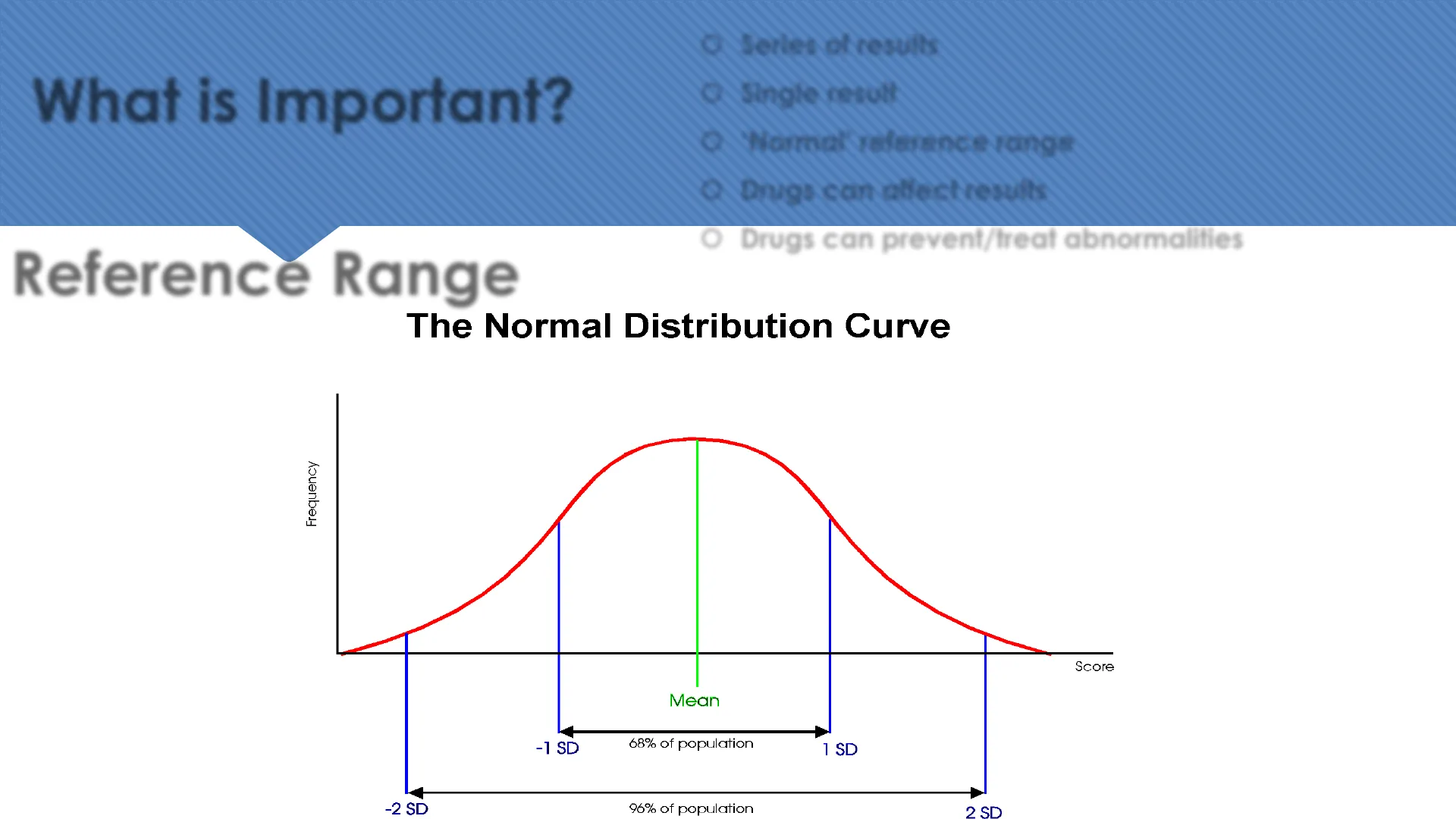
Reference Range
The Normal Distribution Curve
Frequency Score Mean -1 SD 68% of population 1 SD -2 SD 96% of population 2 SD
Typical Biochemical Data
U&E's
- Sodium
- Potassium
- Creatinine
Covered in the U&Es lecture
- Urea
- Calcium (Corrected)
- Phosphate
- Magnesium
BLOOD TEST BD
Calcium
20 Ca Calcium 40.078
Calcium cont.
Reference Range: 2.1-2.6mmol/L
- 99% of calcium is found in bone
- Most of the rest circulates in the blood.
- 40% is bound with proteins
- 50% circulates as ionised calcium
- Corrected calcium
Too High - Hypercalcaemia
- Could be malignancy
- Treatment - bisphosphonates e.g. zoledronic acid or pamidronate
- Hydration
Too Low - Hypocalcaemia
- Treatment - supplements with vitamin D e.g. Adcal D3
Phosphate
Phosphate cont.
Reference Range - 0.8 - 1.5mmol/L
- 80% found in bones
- 15-20% in intracellular fluid
- Crucial for energy metabolism
A + B C Calcichew 500mg Chewable Tablets calcium carbonate equivalent to 500mg calou- 100 Chewable Tablets
Too High - Hyperphosphatemia
- Tends to be chronic renal failure or CKD
- Treatment - Binding agent (calcium or aluminium based compounds)
Too Low - Hypophosphatemia
- Occur due to refeeding syndrome
- Treatment - supplements e.g. Phosphate Sandoz or IV phosphate if life threatening
Magnesium
Magnesium 12 Mg 24.305
Magnesium Reference Range
Reference Range - 0.7 - 1.05mmol/L
- Important for normal nerve and muscle function, keeps heart beat steady and helps bones to remain strong.
- Tend to see a decrease in magnesium
- Too low - Hypomagnesemia
- Severe vomiting and diarrhoea
- Can cause issues with the heart
- Treatment - supplements, oral = magnesium glycerophosphate, or IV if severe
Typical Biochemical Data
LFTs (liver function tests)
- Albumin
- Bilirubin (unconjugated/ conjugated)
- AST
- ALT
- ALP
- Gamma GT
Albumin
Reference Range - 35-50g/L
- Most abundant protein in the blood and synthesised by the liver
- Concentration shows how well liver is synthesising this protein
- If level starts to decrease maybe something wrong with the liver e.g. liver disease
- Binds with calcium/bilirubin/drugs in the blood
- Highly protein bound drugs include e.g. warfarin, phenytoin
Albumin and Warfarin Binding
Albumin Ph w Albumin w w w w Albumin w W 1% free warfarin w W. Albumin w w w Albumin w
Albumin and Drug Binding
Albumin Ph W Ph W Albumin Ph W Albumin Ph Ph W Albumin W W W W W Albumin W 1% free warfarin W W W
Bilirubin
- RBC = Haemoglobin
- Haem = iron + bilirubin
- Globulin = protein part
- Bilirubin is a waste product as unconjugated form, but needs to be in conjugated form to be excreted.
- So if liver problems won't see conjugated process
- Build up of bilirubin
Red cell destruction Heme protein catabolism Bone marrow erythropoiesis Bilirubin 1 Circulating albumin - bilirubin (unconjugated) Hepatic conjugation 1 (Circulating conjugated bilirubin) Conjugated bilirubin Bacterial deconjugation 1 Fecal stercobilinogen
LET'S
AST - Aspartate Aminotransaminase ALT - Alanine Aminotransaminase
- Approx. 1000U/L above - acute assault on liver e.g. Paracetamol overdose, shock
- 3 x normal value to 1000 - viral hepatitis, alcoholic liver disease, infection, drug induced hepatitis
- AST - Not liver specific (don't rely on this alone!)
- ALT - 'Almost' liver specific
ALP - Alkaline Phosphatase
- A large raise usual indicates a blockage (cholestasis)
- A small raise usual indicates liver damage (but will be coupled with AST/ALT raises)
- Not liver specific - also raised in bone diseases such as rickets and pagets disease, also raised in pregnancy and when children grow.
LET'S
Gamma GT - Gamma Glutamyl Transferase
- A large raise usually indicates a blockage (cholestasis) -coupled with ALP raise
- A small raise usually indicates liver damage (but will be coupled with AST/ALT raises)
- Also, raised during drug treatment with enzyme inducers and following high alcohol intake.
LFT Summary
LFT Liver Damage / Impairment Post liver blockage (Cholestasis) AST Large increase Small increase ALT Large increase Small increase ALP Normal or small increase Large increase GGT Normal or small increase Large increase
Typical Biochemical Data
Cardiac Markers (Specific/Non Specific)
x Upper limit of normal Myoglobin CK - MB Troponin V/T - 2 4 6 8 10 12 24 hours 2 4 5 7 days Time from onset of infarction
Cardiac Markers
Troponin
- Specific to cardiac damage
- Released shortly after a heart attack
- Reach peak at 24hours
CK-MB - Creatinine Kinase
- Reaches peak quicker than troponin
- Not cardiac specific
Myoglobin
- Much quicker 6-8hours
- Not cardiac specific
BBC News
Heart attack test 'cuts hospital stays'
By James Gallagher Health editor, BBC News website
They have levels of troponin, a chemical released by damaged heart muscle, tested when they are admitted and again 12 hours later. The new test also looks for troponin, but can detect much lower levels and needs to be done only once. So those given the all-clear can go straight home. A blood test can more than halve the number of people admitted to hospital with a suspected heart attack, say doctors. They say the rapid test, which looks for a chemical in the blood, would reduce stress for patients, save money and ease pressure on hospital wards. Trials on 6,304 people, published in the Lancet medical journal, suggested it was 99.6% accurate. They have levels of troponin, a chemical released by damaged heart muscle, tested when they are admitted and again 12 hours later. The new test also looks for troponin, but can detect much lower levels and needs to be done only once. So those given the all-clear can go straight home.
BBC News
adrad17 News Sport TV NEWS Home UK Zuucation
Rapid diagnosis test for heart attacks
f Share ptember 2017 |Health E A heart trace, called an ECG, can quickly show up major heart attacks, but it is not very good at excluding more common, smaller ones that can still be life- threatening. Currently, patients with suspect chest pain and a clear ECG can have a different heart-attack blood test, called troponin, when they arrive at A&E. But it needs to be repeated three hours later to pick up signs of heart muscle damage. SCIENCE PHOTO LIBRARY A blood test tha used routinely, sa Rack in under 20 minutes should be A team from King's College London have tested it on patients and say the cMyC test could be rolled out on the NHS within five years. TICTS. Levels of cMyC (cardiac myosin-binding protein C) in the blood rise more rapidly and to a higher extent after a heart attack than troponin proteins, studies suggest.
Typical Haematology Data
- Hb
- Ferritin
- WBC
- Neutrophils
- Lymphocytes
- Monocytes
- Eosinophils
- Basophils
- Platelets
- INR
- APTT
- D-dimers
Other Tests
Plenty more tests ....
- T4/TSH
- CRP
- Vitamin B12 and folate- covered in a pharmacology lecture this year
Hypothalamic-Pituitary-Thyroid Axis
Hypothalamus TRH Pituitary O Negative feedback from T4 TSH Thyroid Hypothalamic releasing factors TRH: thyrotropin releasing hormone Pituitary trophic hormones TSH: thyroid stimulating hormone Thyroid hormones T3: triiodothyronine T4: thyroxine T3 + T4 Dr Nicky Keav nickykeavfitness.com
Can’t find what you’re looking for?
Explore more topics in the Algor library or create your own materials with AI.