Session 1: Analyzing My Environment, Efa Torrealedua Tsidmn Presentation
Slides from Efa Torrealedua Tsidmn about Session 1: Analyzing My Environment. The Pdf focuses on technical English, specifically medical language, and includes sections on specialized vocabulary and grammar, with a focus on Past Simple and Present Perfect for University Languages students.
See more15 Pages

Unlock the full PDF for free
Sign up to get full access to the document and start transforming it with AI.
Preview
Analyzing My Environment
Specialists and Health Systems
Specialists. British health system. Doctors. Patients. Describing feelings. Verb tenses: Past simple (irregular verbs), Present perfect, used to. Being polite. Understanding and producing oral messages.
EFA TORREALEDUA · TSIDMN · INGLÉS TÉCNICO II 2023/24A= =Z
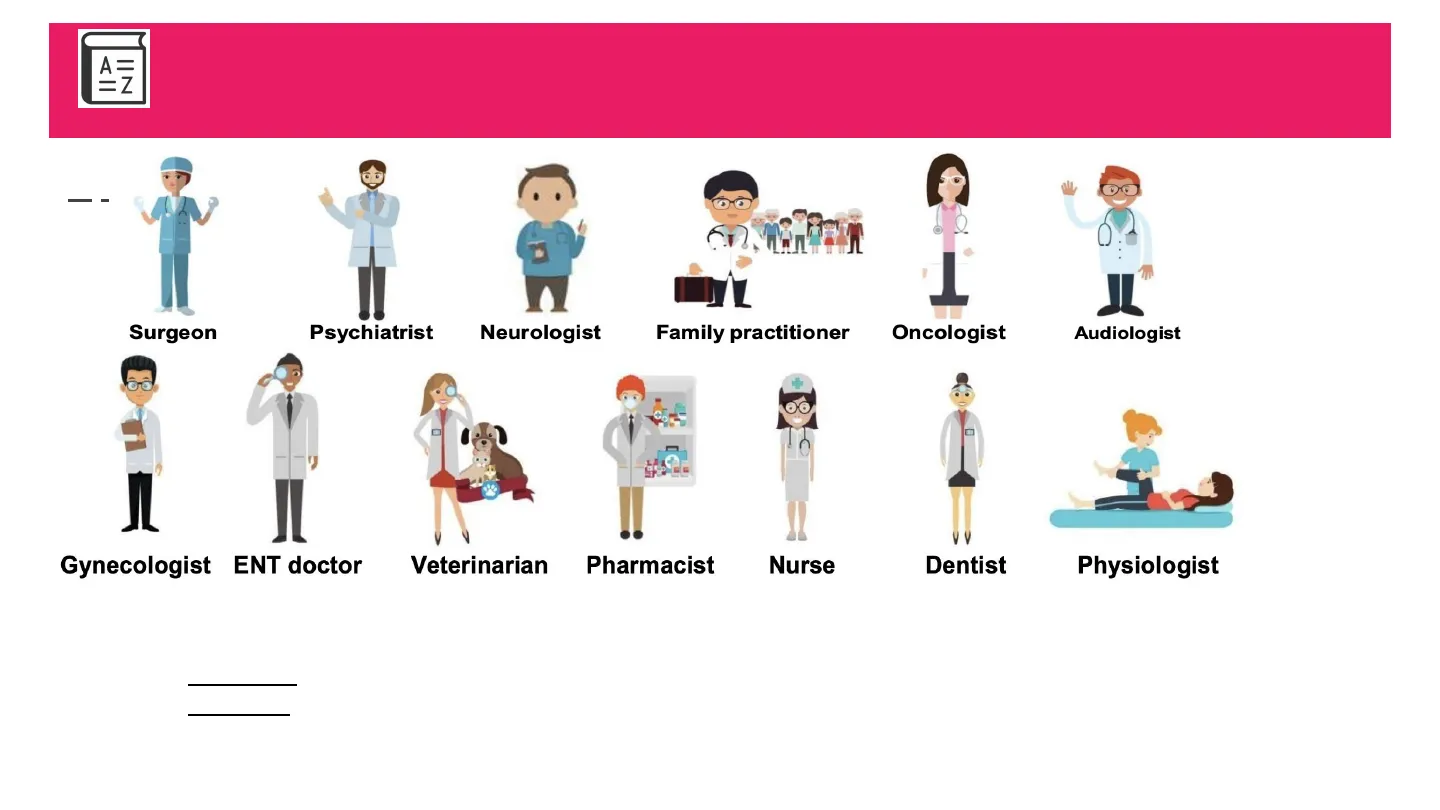
Doctors and Specialists Vocabulary
Surgeon Psychiatrist Neurologist Family practitioner Oncologist Audiologist Gynecologist ENT doctor Veterinarian Pharmacist Nurse Dentist Physiologist
- A/an specializes diseases of // is a specialist in // treats ... . The specialities normally end in -ology: cardiology. . The specialists normally end in - ologist: cardiologist. ○ Exception: anaesthetics - anaesthetist. Sometimes it ends in -ics: pediatrics. And then, it ends in -ician: pediatrician.
EFA TORREALEDUA · TSIDMN · INGLÉS TÉCNICO IIA= =Z
British Health System Vocabulary
EFA TORREALEDUA . TSIDMN · INGLÉS TÉCNICO II
Medical Practitioners in Britain
In Britain, doctors, also known as medical practitioners, must be qualified: have a university degree in medicine. They must also be registered - included in the General Medical Council's list, or register - in order to practice. A doctor who treats patients, as opposed to one who only does research, is called a clinician. A doctor who provides primary care for patients is known as a general practitioner (GP) or family doctor. GPs usually work in a group of practice. Larger group practices work in a building called a health centre. Doctors normally work in shifts. Specialist doctors, for example pediatricians, generally work in hospitals. However, they may provide private health care, may have consulting rooms outside a hospital. The two main branches of medicine are surgery and internal medicine, and the doctors who practice these branches are called surgeons and physicians, respectively. In Britain, male surgeons are addressed as Mr and females as Ms - so Dr Smith is a physician, and Ms Smith is a surgeon. Consultant physicians and surgeons are responsible for a specific number of patients in hospital. Each consultant has a team of junior doctors to help care for those patients. In many hospitals, there are multidisciplinary teams which consist not only of doctors but also of physiotherapists and other allied health professionals.
Medical Staff Groups in British Hospitals
The medical staff in a British hospital belong to one of four main groups:
- A pre-registration house officer (PHO), or house officer, is a newly graduated doctor in the first year of postgraduate training. He is not registered yet. After a year, he or she becomes a registered medical practitioner. In the current system of training, the Foundation Programme The name for these junior doctors is Foundation Year 1 doctor (FY1).
- A senior house officer (SHO) is in the second year of postgraduate training. He is studying for a higher qualification. The title is now Foundation Year 2 doctor (FY2), but the old terms senior house officer and SHO are still used.
- A specialist registrar (Sp) is a doctor who has completed the Foundation Programme, and is training in one of the medical specialties. There are also some non-training registrars - doctors who have completed their training but do not wish to specialize yet.
- A consultant is a fully qualified specialist who has completed a programme of higher specialist trainer. He is the most senior.A= =Z
British Health System Doctor Roles
EFA TORREALEDUA . TSIDMN · INGLÉS TÉCNICO II
DOCTORS (qualified 4-5y degree in medicine +) registered
PHRO = PRE- REGISTRATION HOUSE OFFICER = HOUSE OFFICER
In training. He is a Foundation Year 1 Doctor (FY1)
After 1 year: he registers - MEDICAL PRACTITIONER
SHO = SENIOR HOUSE OFFICER
2 nd year postgraduated training. FY2
SpR = SPECIALIST REGISTRAR
Training in an specialty or no specialty for now (non-training registrar)c
ASSOSIATE SPECIALISTS
Seniors who don't want to become consultants
CONSULTANT
Fully qualified specialist (postgraduated)
FOUNDATION PROGRAMMEA= =Z
British Health System Patient Vocabulary
EFA TORREALEDUA . TSIDMN · INGLÉS TÉCNICO II
Patient Types
PATIENTS
OUTPATIENTS
They come to: - Attend a clinic - Have tests - Have treatment (referral letter)
They may come for a follow up. There are outpatient departments (OPDs)
INPATIENTS
They stay in the hospital (in wards) for 1 or more days. (admitted or put on a waiting list)
Assessment Unit: where patients are temporarily admitted while their condition is assessed/discharged to the GP.A= =Z
British Health System Patient Care
EFA TORREALEDUA . TSIDMN . INGLÉS TÉCNICO II
Patient Wards and Admissions
PATIENTS The rooms where patients stay are called wards. When patients enter - or are admitted to - hospital, they are usually seen first by one of the junior doctors on the ward where they will receive treatment and care. The junior doctor takes their medical history and examines them. Some time later, the registrar (Sp) also sees the patients, and may order investigations or tests, for example X-rays or an ECG, make a provisional diagnosis, and begin treatment. The consultant usually sees the new admissions - people who have recently been admitted to the ward - for the first time on one of the regular ward rounds, when the management of the patients is discussed with the registrar. Consultants also decide when a patient is ready to be discharged (sent home). Outpatients are people who come to hospital to have tests or a treatment and then return home on the same day. Inpatients stay in the hospital for one or more days. After treatment is completed, the patient is discharged back to the GP's care.
Nurses and Support Workers
NURSES The nurse's roles has changed considerably in recent years. In addition to general patient care, checking temperatures, pulse rates and blood pressures, changing dressings, giving injections and removing sutures, nurses now do some of the things previously reserved for doctors, such as prescribing drugs, and ordering laboratory tests. Nurses working in a hospital have the following grades:
- Student nurse: a nurse who is still in training.
- Staff nurse: a nurse who has completed the training course.
- Charge nurse: a more experienced nurse who is in charge of, or responsible for, a ward or department.
- Nurse manager: a nurse who is in charge of several wards.
- A midwife has specialized from the beginning by doing a course in midwifery, the management of pregnancy and childbirth.
- District nurses visit patients in their homes.
SUPPORT WORKERS Support workers assist nursing staff. They are:
- The clinical support worker, who has done a short course and obtained basic qualifications.
- The nursing auxiliary or nursing assistant, who is usually unqualified or untrained.
- Ward clerks, whose duties include making sure patients' notes and information are up to date, and answering the telephone.A= =Z
Describing Feelings Vocabulary
EFA TORREALEDUA . TSIDMN · INGLÉS TÉCNICO II
Self-Description and Current Feelings
How would you describe yourself? I think I am ... How are you feeling today?
Exhausted Furious Crazy Frightened Sad Happy Relaxed Depressed Surprised Angry Nervous Lonely In love Jealous Shy Upset
Words to Describe Mood and Personality
WORDS TO DESCRIBE MOOD/PERSONALITY
Aggressive Ambitious Anxious Arrogant Brave Bored Calm Cautious Cheerful Confident Cruel Curious Disappointed Enthusiastic Exasperated Friendly Gentle Grieving Healthy Horrified Indifferent Kind Lively Miserable Modest Optimistic Paranoid Peaceful Perplexed Pessimistic Positive Puzzled Relieved Rude Safe Satisfied Shocked Sleepy Sociable Strict Suspicious Tense Thoughtful Violent Worried
Words to Describe Attitude and Tone
WORDS TO DESCRIBE ATTITUDE/TONE
Absurd = silly, ridiculous Cynical = bitter Loving = compassionate, affectionate Mocking = treating with ridicule, offensive Comic = humorous, funny Tragic = disastrous Pathetic = pitiful, useless
Grammar: Past Simple Irregular Verbs
EFA TORREALEDUA . TSIDMN . INGLÉS TÉCNICO II
Past Simple Usage and Structure
Se utiliza para describir eventos del pasado. Sujeto + verbo + complementos -> I went to London last summer = Fui a Londres el verano pasado. Verbo base: go (ir) Pasado: went Goed
Sujeto + didn't + verbo en forma base (normal) + complementos -> I didn't go to London last summer. Did + sujeto + verbo en forma base (normal) + complementos -> Did you go to London last summer?
Past Simple Conjugation Examples
AFFIRMATIVE
I wrote = Yo escribía You wrote = Tu escribías He/she/it wrote = Él/ella/ello escribía We wrote = Nosotros escribíamos You wrote = Vosotros escribíais They wrote = Ellos escribían
NEGATIVE
I didn't write = I did not write = Yo no escribía You didn't write = You did not write = Tu no escribías He/she/it didn't write = He/she/it did not write = Él/ella/ello no escribía We didn't write = We did not write = Nosotros no escribíamos You didn't write = You did not write = Vosotros no escribíais They didn't write = They did not write = Ellos no escribian
INTERROGATIVE
Did I write? = ¿ Escribía yo? Did you write? = ¿ Escribías tú? Did he/she/it write? = ¿Escribía él/ella/ello? Did we write? = ¿Escribíamos nosotros? Did you write? = ¿ Escribíais vosotros? Did they write? = ¿ Escribian ellos?
Cuidado. Cuando escribimos preguntas y negativas con did/didn't, el verbo principal NO se pone en pasado. I didn't go to the cinema last night. I didn't went to the cinema last night = No fui al cine anoche.
Grammar: Past Simple Irregular Verbs List
EFA TORREALEDUA . TSIDMN · INGLÉS TÉCNICO II
Irregular Verbs A-L
Base form become begin break bring build buy choose come cut draw drive fall feel find get give go grow hear hold hurt keep know lead leave
Past Simple became began broke brought built bought chose came cut drew drove fell felt found got gave went grew heard held hurt kept knew led left
Past Participle become begun broken brought built bought chosen come cut drawn driven fallen felt found got/gotten (US) given gone grown heard held hurt kept known led left
Traducción llegar a ser empezar romper traer construir comprar elegir venir cortar dibujar conducir caer sentir encontrar obtener dar ir crecer escuchar sujetar herir mantener saber dirigir abandonar
Irregular Verbs L-W
Base form lie lose make mean meet pay put read rise run say see send set show sit speak spend stand take tell think understand wear write
Past Simple lay lost made meant met paid put read rose ran said saw sent set showed sat spoke spent stood took told thought understood wore wrote
Past Participle lain lost made meant met paid put read risen run said seen sent set shown sat spoken spent stood taken told thought understood worn written
Traducción mentir perder hacer significar encontrarse pagar poner leer subir, crecer correr decir ver enviar establecer mostrar sentarse hablar pasar tiempo, gastar dinero ponerse de pie coger, tomar contar (una historia) pensar entender llevar puesto (ropa) escribir
BE WAS /WERE BEEN = ser, estar
DO DID DONE = hacer
Can’t find what you’re looking for?
Explore more topics in the Algor library or create your own materials with AI.
