Immunology, Infection & Inflammation: Purines, Prostanoids, and NSAIDs
Slides about Immunology, Infection & Inflammation, exploring local and peripheral mediators like purines, prostanoids, and leukotrienes. The Pdf, a university-level biology presentation, details the synthesis from arachidonic acid and clinical applications, comparing NSAIDs and SAIDs.
See more26 Pages


Unlock the full PDF for free
Sign up to get full access to the document and start transforming it with AI.
Preview
Local and Peripheral Mediators: Autacoids 1 (Purines, Histamine & Eicosanoids)
Purines (adenosine, adp & atp)
Ligands: ❑ Adenosine, ADP and ATP Receptors ❑ Adenosine Receptors " A1, A2A, A2B & A3 (formerly known as P1 receptors) GPCRS acting through cAMP ❑ P2Y metabotropic receptors P2Y 1-14 ❑ GPCR's using PLC or cAMP as signalling molecules ❑ Respond to ATP (preferred) but also ADP and AMP. Some also recognise UTP ❑ P2X ionotropic receptors P2X1-7 ATP-gated cation channels (Ca2+ and Na+)
Purines as Mediators
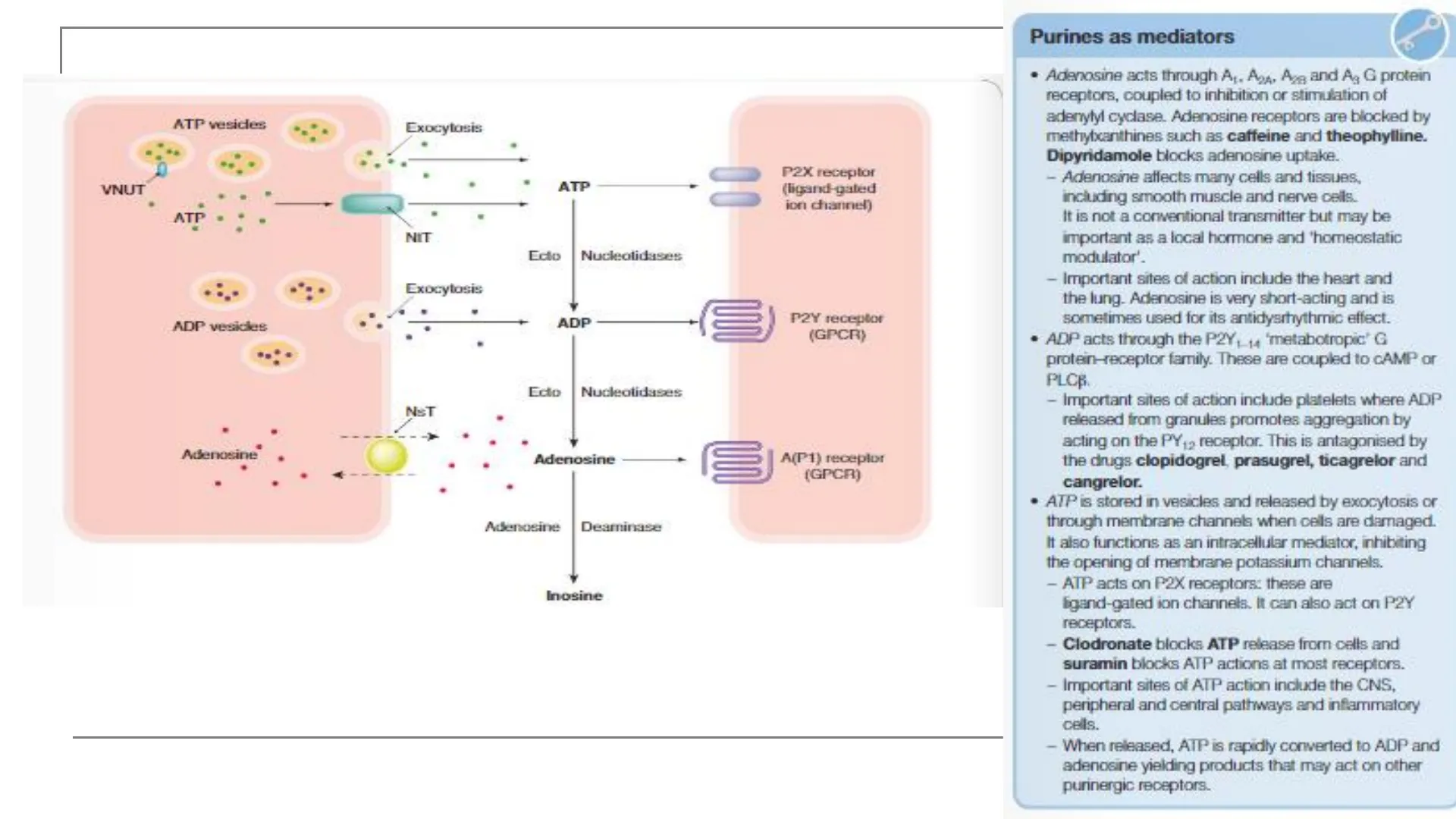
◼ 1Purines as mediators ATP vesicles Exocytosis VNUT - ATP NIT Ecto Nucleotidases Exocytosis ADP vesicles ADP P2Y receptor (GPCB) . Ecto Nucleotidases NST Adenosine Adenosine A(P1) receptor (GPCR) Adenosine Deaminase VNUT = vesicular nucleotide transporter Nucleotides may be released via pannexins (Pnx) or transporters NtT. Once released, ATP can be converted to ADP and to adenosine by the action of ectonucleotidases. Adenosine is present in the cell cytosol of all cells and is released and taken up via a specific membrane transporter (NsT) which is blocked by dypyridamole. Adenosine itself can be hydrolysed to inosine by the enzyme adenosine deaminase. ATP acts diectyl on the P2X receptor and also the P2Y receptors ..
- Adenosine acts through A,. Asx, Ang and Ag G protein receptors, coupled to inhibition or stimulation of adenylyl cyclase. Adenosine receptors are blocked by methylxanthines such as caffeine and theophylline. Dipyridamole blocks adenosine uptake.
- Adenosine affects many cells and tissues, including smooth muscle and nerve cells. It is not a conventional transmitter but may be important as a local hormone and 'homeostatic modulator'.
- Important sites of action include the heart and the lung. Adenosine is very short-acting and is sometimes used for its antidysrhythmic effect.
- ADP acts through the P2Y, ,, 'metabotropic" G protein-receptor family. These are coupled to CAMP or PLCB.
- Important sites of action include platelets where ADP released from granules promotes aggregation by acting on the PY12 receptor. This is antagonised by the drugs clopidogrel, prasugrel, ticagrelor and cangrelor.
- ATP is stored in vesicles and released by exocytosis or through membrane channels when cells are damaged. It also functions as an intracellular mediator, inhibiting the opening of membrane potassium channels.
- ATP acts on P2X receptors: these are ligand-gated ion channels. It can also act on P2Y receptors.
- Clodronate blocks ATP release from cells and suramin blocks ATP actions at most receptors.
- Important sites of ATP action include the CNS, peripheral and central pathways and inflammatory cells.
- When released, ATP is rapidly converted to ADP and adenosine yielding products that may act on other purinergic receptors. . . P2X receptor (ligand-gated ion channel) ATP Inosine
Effects of Purines
Effects upon Cardiovascular system Asthma and inflammation Platelets
5-Hydroxytryptamine (5-HT) Serotonin
5-HT Historical Perspective
5-HT Historical perspective Originally called serotonin. Vasoconstrictor substance found in the serum after blood had clotted. Identified chemically as 5-HT in 1948. Originated from platelets. Later found in GIT and CNS.
5-HT Biosynthesis & Metabolism
3Biosynthesis & Metabolism Distribution Highest concentrations: Gastrointestinal Tract (GIT) ❑ 90% of total amount in enterochromaffin cells in GIT. ❑ Some 5-HT is found in the myenteric plexus (excitatory neurotransmitter). ◼ Blood ❑ Platelets accumulate 5-HT from the plasma via active transport. ❑ Released when platelets aggregate. ◼ Central Nervous System (CNS) Localised regions of the midbrain COOH CH2CH NH2 ZI Tryptophan Tryptophan hydroxylase COOH HO CH2CH NH2 ZI 5-Hydroxytryptophan L-Aromatic acid decarboxylase (= dopa decarboxylase) HO CH2CH2NH2 N 5-Hydroxytryptamine (serotonin) H Monoamine oxidase HO CH2CHO ZI Aldehyde dehydrogenase HO CH2COOH ZI H 5-Hydroxyindoleacetic acid (5-HIAA) ◼ Diet ❑ 5-HT is present in the diet but most is metabolised before entering bloodstream. ◼ Biosynthetic pathway ❑ similar to noradrenaline except precursor is triptophan instead of tyrosine. ❑ Platelets possess a high affinity uptake transporter and become saturated as they pass through vessels of GIT. ◼ Metabolism & excretion ❑ Similar to noradrenaline ❑ 5-HIAA excreted in urine and high levels can be used to diagnose carcinoid syndrome.
5-HT Receptor Family
5-HT receptor family 7 types ❑ 5-HT 1-7 ◼ Subtypes ❑ 5-HT (A-F) ❑ 5-HT2 (A-C) ❑ 5-HT3 ❑ 5-HT 4-7 ❑ asas G-Protein coupled (Gi) G-Protein coupled (G;) Ligand gated ion channel G-Protein coupled (Gs)
Main 5-HT Receptor Subtypes
5Main 5-HT receptor subtypes Receptor Location Main effects Second messenger 1A CNS Neuronal inhibition, sleep, feeding thermoregulation, anxiety. UcAMP 1B CNS Vascular SM Presynaptic inhibition, behavioural effects, pulmonary vasoconstriction UcAMP 1D CNS Blood vessels Cerebral vasoconstriction, behavioural effects & locomotion. UcAMP 2A CNS, PNS SM, Platelets Neuronal excitation, behavioural effects, SM contraction, platelet aggregation, blood vessel tone. ÎNIP3/DAG 2B Gastric Fundus Fundic contraction TIP3/DAG 20 CNS Choroid plexus CSF secretion. TIP3/DAG
6Main 5-HT receptor subtypes Recept or Location Main effects Second messen ger 3 PNS CNS Neuronal inhibition, autonomic nociceptive neurons. Emesis, anxiety Ligand gated ion channel 4 PNS (GIT) CNS GI motility Neuronal excitation ÍÎCAMP 5 CNS Not known Not known 6 CNS Not known Not known 7 CNS, GIT Blood vessels Not known ÎÌCAMP
Clinical Conditions with 5-HT Role
Clinical Conditions in which 5- HT plays a role. Migraine: see next 2 slides Carcinoid Syndrome: a rare disorder associated with malignant tumours of enterochromaffin cells, which usually arise in the small intestine and metastasise to the liver. ❑ symptoms, including flushing, diarrhoea, bronchoconstriction and hypotension, which may cause dizziness or fainting. Stenosis of heart valves, which can result in cardiac failure, also occurs. ❑ diagnosed by measuring the urinary excretion of the main metabolite of 5- HT, 5-HIAA.
Histamine
Histamine: Synthesis and Storage
7Histamine Histamine: Synthesis and storage Basic amine synthesised from histidine by histidine decarboxylase O CO2 N N OH HN NH2 HN NH2 Found in most tissues ❑ Skin, lungs and high concentrations in GIT ❑ Cellular localisation Mainly mast cells and basophils, complexed with high molecular weight heparin and acidic protein In stomach = histaminocytes ❑ In brain = histaminergic neurons.
Histamine Summary
Summary Receptors: 0 H1, H2, H3 and H4 ◼ Main actions ◼ Pathophysiological roles
Histamine Actions and Roles
Histamine · Histamine is a basic amine, stored in mast cell and basophil granules, and secreted when C3a and C5a interact with specific membrane receptors or when antigen interacts with IgE fixed on cells triggering the high affinity IgE receptor. · Histamine produces effects by acting on H1, H2, H3 Or HA receptors on target cells. · The main actions in humans are: - stimulation of gastric secretion (H2) - contraction of most smooth muscle, except blood vessels (H1) - cardiac stimulation (H2) - vasodilatation (H1) - increased vascular permeability (H1) · Injected intradermally, histamine causes the 'triple response': reddening (local vasodilatation), weal (increased permeability of postcapillary venules) and flare (from an 'axon' reflex in sensory nerves releasing a peptide mediator). · The main pathophysiological roles of histamine are: - as a stimulant of gastric acid secretion (treated with H2-receptor antagonists) - as a mediator of type I hypersensitivity reactions such as urticaria and hay fever (treated with H1-receptor antagonists) - CNS functions (see Ch. 40).
Lipid Mediators
Eicosanoids
Lipid mediators Eicosanoids (p235 R&D's) Mediators derived from phospholipids . The principal phospholipid-derived mediators are the eicosanoids (prostanoids and leukotrienes) and platelet-activating factor (PAF). . The eicosanoids are synthesised from arachidonic acid released directly from phospholipids by phospholipase A2, or by a two-step process involving phospholipase C and diacylglycerol lipase. · Arachidonate is metabolised by cyclo-oxygenases (COX)-1 or COX-2 to prostanoids, by 5-lipoxygenase to leukotrienes and, after further conversion, to lipoxins and other compounds. · PAF is derived from phospholipid precursors by phospholipase A2, giving rise to lyso-PAF, which is then acetylated to give PAF.
Membrane Lipids
Membrane Lipids Phospholipids Phosphoglycerides PtdSer (PS) PtdEtn (PE) PtdCho (PC) Ptdins (PI) HO TOH NH3 NH3 N *"CO2 HO 1 O=p 0 -OH 0 NH NH Hydrophilic Polar Head Group Hydrophilic Polar Head Rigid Sterol Hydrophobic Chains Hydrophobic Chains (a) (b) Arachidonic acid Fatty acid FOFO O HOPP - OH HO OH OH Palmitate Palmitate Palmitate Membrane Lipids HO . OH OH O 0 0 HO- HO- Sphingosine Sphingosine Oleate Glycolipids Sphingomyelin Glucosyl-Cerebroside NR3 HO.J HO Phosphatidylinositol (PI)
Inflammatory Mediators from Phospholipids
11Phospholipid Phospholipase A2 Glucocorticoids (induce annexin 1) Arachidonate Lyso-glyceryl- phosphorylcholine 12-Lipoxygenase Cyclo-oxygenase NSAIDS 5-Lipoxygenase PAF antagonists 15-Lipoxygenase Cyclic endoperoxides 5-HPETE Glucocorticoids inhibit induction TXA2 synthase inhibitors 5-Lipoxygenase inhibitors (e.g. zileutin) PAF (vasodilator; increases vascular permeability; bronchoconstrictor: chemotaxin) 12-HETE (chemotaxin) Lipoxins A and B PGI2 (vasodilator; hyperalgesic; stops platelet aggregation) TXA2 (thrombotic; vasoconstrictor) TXA2 antagonists LTA4 LTB4 (chemotaxin) Leukotriene receptor antagonists, e.g. zafirukast, montelukast PG antagonists PGF20 (bronchoconstrictor; myometrial contraction) PGD2 (inhibits platelet aggregation; vasodilator) PGE2 (vasodilator; hyperalgesic) LTC4 1 LTD4 1 LTE4 (bronchoconstrictors; increase vascular permeability) Fig. 18.3 Summary diagram of the inflammatory mediators derived from phospholipids, with an outline of their actions and the sites of action of anti-inflammatory drugs. Copyright @ 2020 by Churchill Livingstone, an imprint of Elsevier Inc.
Key Lipid Mediators in Host Defence
Key Lipid Mediators Involved in Host Defence A COOH Arachidonic acid B 1 CH2-O-R 1 1 CH3COO-CH 2 O 3 CH2-0-P-O-CH2CH2N(CH3)3 + I 0- Platelet Activating Factor (PAF) Made from the metabolism of the cell membrane by the ◼ enzyme: Phospholipase A2 13
Can’t find what you’re looking for?
Explore more topics in the Algor library or create your own materials with AI.
