Respirazione cellulare: metabolismo del piruvato e ciclo di Krebs
Slide di Università sulla respirazione cellulare, il metabolismo del piruvato e il ciclo di Krebs. Il Pdf, adatto per lo studio universitario di Biologia, presenta schemi dettagliati sul destino del piruvato, il ciclo di Krebs e la catena di trasporto degli elettroni.
Mostra di più9 pagine

Visualizza gratis il Pdf completo
Registrati per accedere all’intero documento e trasformarlo con l’AI.
Anteprima
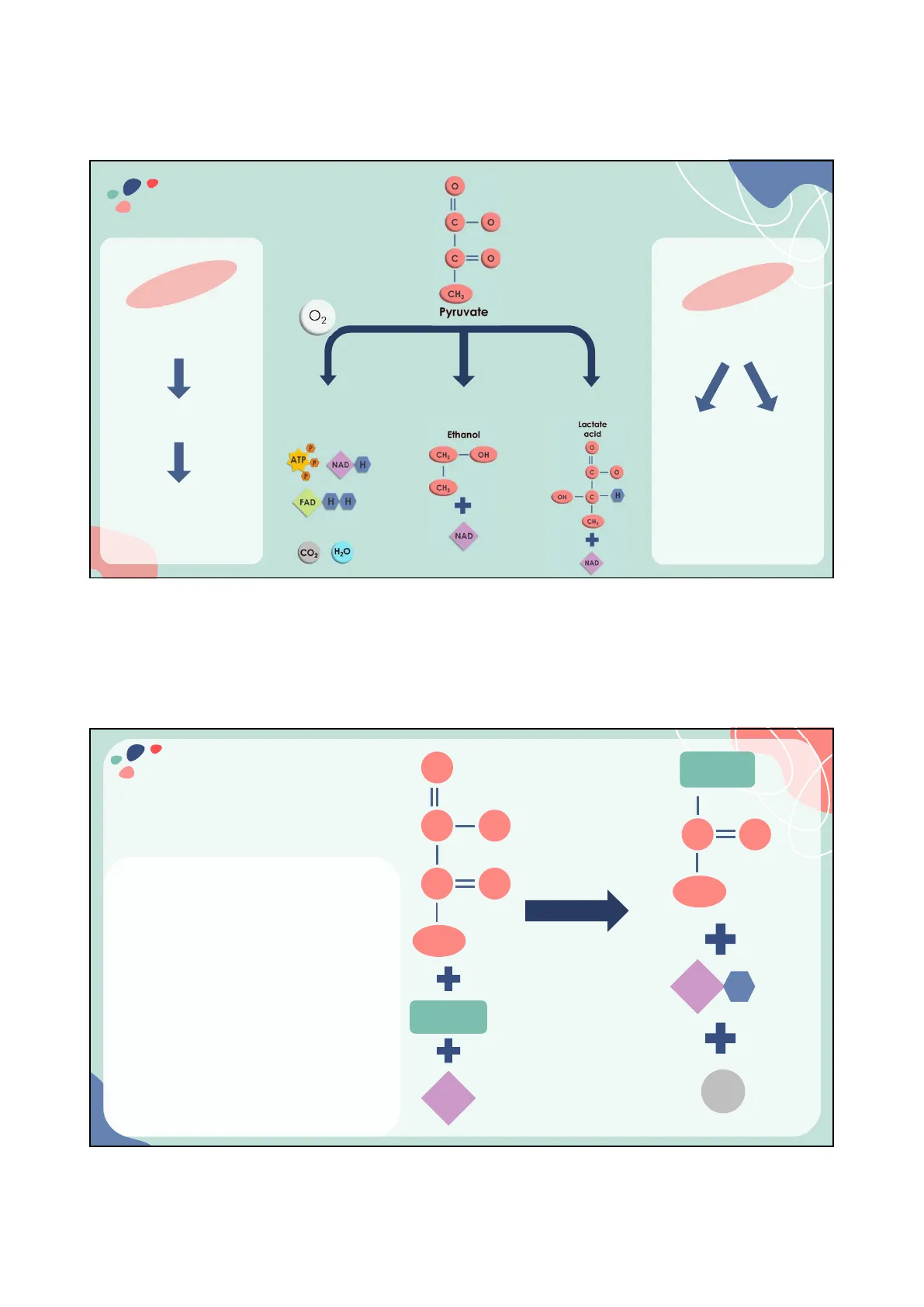
Ossidazione del piruvato
04/05/2025 O PYRUVATE C O c O Aerobic CH Pyruvate O2 Pyruvate Pyruvate Krebs cycle and oxidative phosphorilation Alcoholic fermentation Lactic acid fermentation Energy Ethanol P ATP P NAD H P FAD HH + Byproduct or waste NAD ++ Dra. Ivonne Hernández Rodríguez
Ossidazione e decarbossilazione del piruvato
NAD PYRUVATE OXIDATION AND DECARBOXYLATION O S-CoA C O C = O Acetil-CoA C O CH3 CH3 + The lost carbon takes two molecules of oxygen forming CO2. + NAD H NAD is reduced by the hydrogen present in Coenzyme A. CoA-SH + + Coenzyme A forms a bond with the remaining two carbons of pyruvate creating a new molecule, Acetyl-CoA. NAD CO2 Dra. Ivonne Hernández Rodríguez
Fermentazione anaerobica
Anerobic Acetyl-CoA Lactate acid Lactic acid Ethanol O CH OH o CH OH c H Fermentation Krebs cycle and oxidative phosphorylation CH CO2 H2O Mitochondrial matrix Pyruvate This metabolic pathway needs Coenzyme A, NAD and pyruvate. Pyruvate is decarboxylated (remove carbons) and oxidized (remove hydrogens)04/05/2025
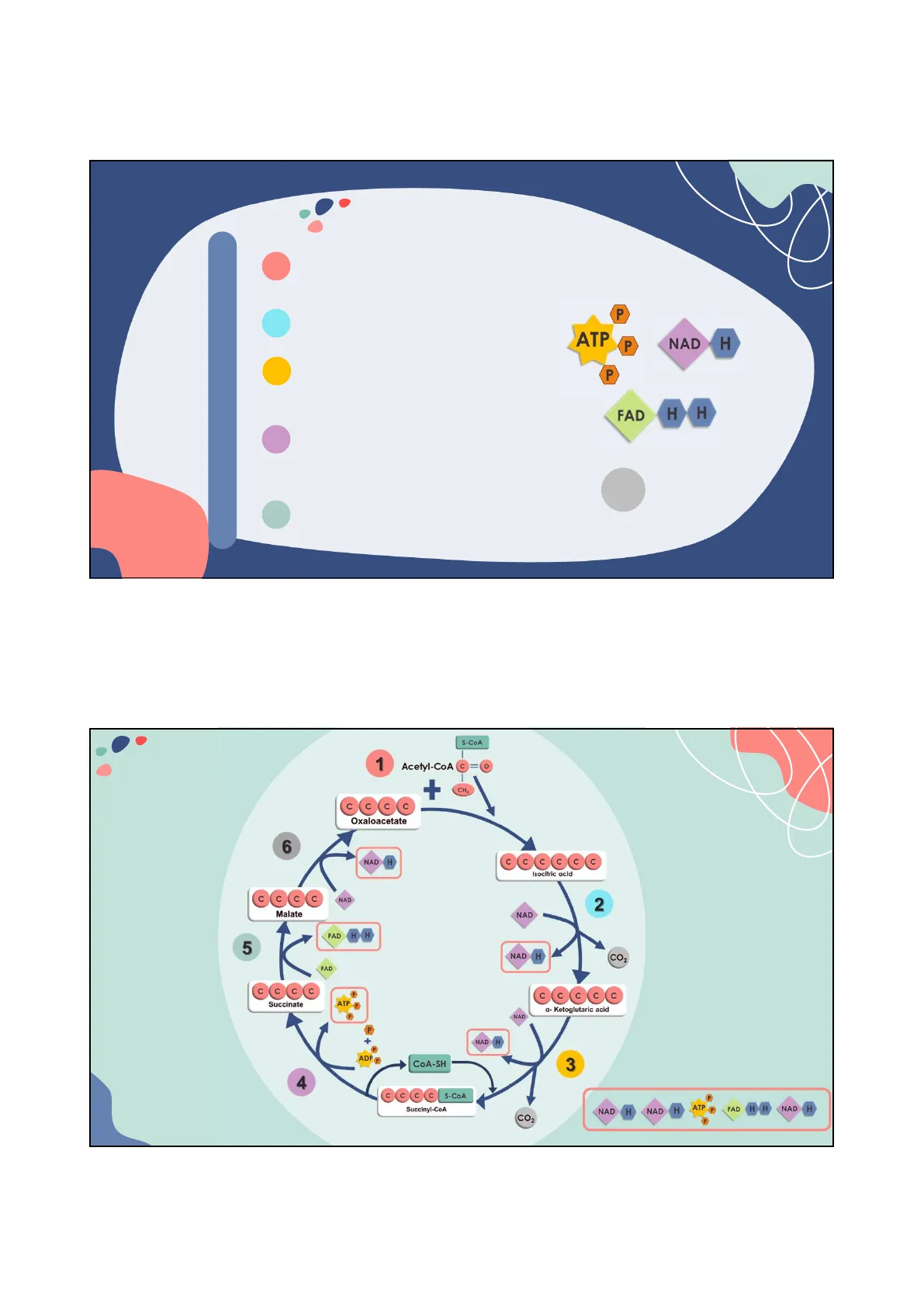
Ciclo di Krebs
Caratteristiche del ciclo di Krebs
C H 1 Amphibolic pathway. ENERGY P ATP P NAD H C 3 Mitochondrial Matrix. P E R Product: FAD H H I 4 6 NADH S T 2 FADH2 2ATP I C 5 Byproduct: CO2. BYPRODUCT Dra. Ivonne Hernandez Rodríguez
Processo del ciclo di Krebs
S-CoA CICLO DE KREBS 1 Acetyl-CoA c o + CH, Oxaloacetate 6 NAD H CCCC CC Isocitric acid NAD 2 Malate NAD FAD H H 5 NAD H CO2 FAD Succinate ATP P a- Ketoglutaric acid NAD P + NAD H P ADP P CoA-SH 3 4 S-CoA P Succinyl-CoA NAD H NAD H ATP P FAD H H NAD H CO2 P Dra. Ivonne Hernández Rodríguez A R 2 Oxidation of Acetyl-CoA. A T CO2 S04/05/2025
Fosforilazione ossidativa
Caratteristiche della fosforilazione ossidativa
C 1 ATP production. A Membrana Externa R A C T E R Í S T I C 2 Inner mitocondrial membrane. Two steps: 3 1 Electron transport chain 2 Chemiosmosis membrana Interior 4 Needs Oxygen (O2) 5 Byproduct > Water. Sintasa ATP Dra. Ivonne Hernández Rodríguez
Catena di trasporto degli elettroni
Outer mitochondrial membrane NAD H FAD HH NAD H FAD P Inner mitochondrial membrane ADP Electron transport chain ATP synthase Dra. Ivonne Hernández Rodriguez Cadena de transporte de electrones A S FAD H H04/05/2025
Accumulo di molecole NADH e FADH2
NADH y FADH2 molecules accumulate inside the matrix, they go through the electron chain transport were they are oxidized (loose hydrogens). FAD HH NAD H HH NAD FAD HH NAD H NAD H ADP Inner mitochondrial membrane P ADP P Electron transport chain ATP synthase Dra. Ivonne Hernández Rodríguez NADH y FADH2 molecules accumulate inside the matrix, they go through the electron chain transport were they are oxidized (loose hydrogens). FAD HH NAD H FAD HH NAD H FAD H H ADP ADP NAD H NAD H Inner mitochondrial membrane P ADP P Electron transport chain ATP synthase Dra. Ivonne Hernández Rodríguez FAD H04/05/2025
Creazione del gradiente elettrochimico
The hydrogens released are taken out to the intermembrane space were they accumulate creating an electrochemical gradient (more H+ in the space than the matrix). NAD and FAD stay in the matrix were they will be reused in the Krebs cycle. FAD HH NAD H FAD FAD HH NAD H H NAD H H P ADP P Electron transport chain ATP synthase Dra. Ivonne Hernández Rodríguez
Ritorno degli idrogeni alla matrice
Hydrogens then have to return to the matrix were there is a lower hydrogen concentration. FAD HH NAD H FAD FAD H H NAD NAD H NAD H P H ADP P Inner mitochondrial membrane Electron transport chain ATP synthase Dra. Ivonne Hernández Rodríguez NAD H Inner mitochondrial membrane04/05/2025
Sintesi di ATP
Hydrogens go through an enzyme called ATP synthase to enter the matrix releasing energy that is used to créate a bond between an ADP and a phosphate, creating ATP. NAD H FAD FAD HH NAD FAD H H NAD NAD H P P ADP P Electron transport chain ATP synthase Dra. Ivonne Hernández Rodríguez Hydrogens go through an enzyme called ATP synthase to enter the matrix releasing energy that is used to créate a bond between an ADP and a phosphate, creating ATP. NAD H FAD FAD HH NAD H I ADP P NAD ATP P NAD H P H P ADP P Inner mitochondrial membrane Electron transport chain ATP synthase FAD Inner mitochondrial membrane H04/05/2025
Ripetizione del processo di sintesi ATP
The process is repeated, to create multiple ATP molecules. NAD H FAD FAD I NAD NAD FAD H NAD H H H P ADP P Electron transport chain ATP synthase Dra. Ivonne Hernández Rodríguez The process is repeated, to create multiple ATP molecules. NAD H FAD FAD H H NA NAD FAD NAD H H P H H ADP P Inner mitochondrial membrane Electron transport chain ATP synthase Dra. Ivonne Hernández Rodríguez Inner mitochondrial membrane04/05/2025 The process is repeated, to create multiple ATP molecules. NAD H FAD FAD HH NAD NAD FAD NAD H P P ADP P Inner mitochondrial membrane Electron transport chain ATP synthase Dra. Ivonne Hernández Rodríguez The process is repeated, to create multiple ATP molecules. NAD H FAD FAD HH NAD FAD P ATP P P H P ADP Inner mitochondrial membrane Electron transport chain ATP synthase Dra. Ivonne Hernández Rodríguez NAD NAD04/05/2025
Riepilogo della fosforilazione ossidativa
OXIDATIVE PHOSPHORYLATION 1 Electron transport chain Hydrogens are removed from NADH y FADH2 + H+ is taken out to the intermembrane space An electrochemical gradient is created More H+ in the intermembrane space than the matrix 2 Chemiosmosis H+ returns to the matrix (towards lower concentration) - H+ goes through ATP synthase releasing energy Using the energy released a bond between ADP and a phosphate is made ATP is created Dra. Ivonne Hernández Rodríguez
Energia generata dalla respirazione cellulare aerobica
ENERGY GENERATED BY AEROBIC CELLULAR RESPIRATION P P Glycolysis ATP P ATP NAD H NAD H P 1 NADH = 3 ATP 1 FADH2 = 2 ATP Pyruvate oxidation and decarboxylation NAD H NAD H NAD H NAD H ATP FAD HH NAD H P Krebs cycle NAD H NAD H FAD HH NAD H P How many ATP molecules are generated at the end of the aerobic celular respiration? ATP P P
Non hai trovato quello che cercavi?
Esplora altri argomenti nella Algor library o crea direttamente i tuoi materiali con l’AI.