Introduction to Marketing I: Creating Customer Value and Engagement
Document from University about Introduction to Marketing I. The Pdf explores fundamental marketing concepts, focusing on creating customer value and engagement. It covers customer needs, market offerings, and customer-driven marketing strategies for university students studying Economics.
See more28 Pages

Unlock the full PDF for free
Sign up to get full access to the document and start transforming it with AI.
Preview
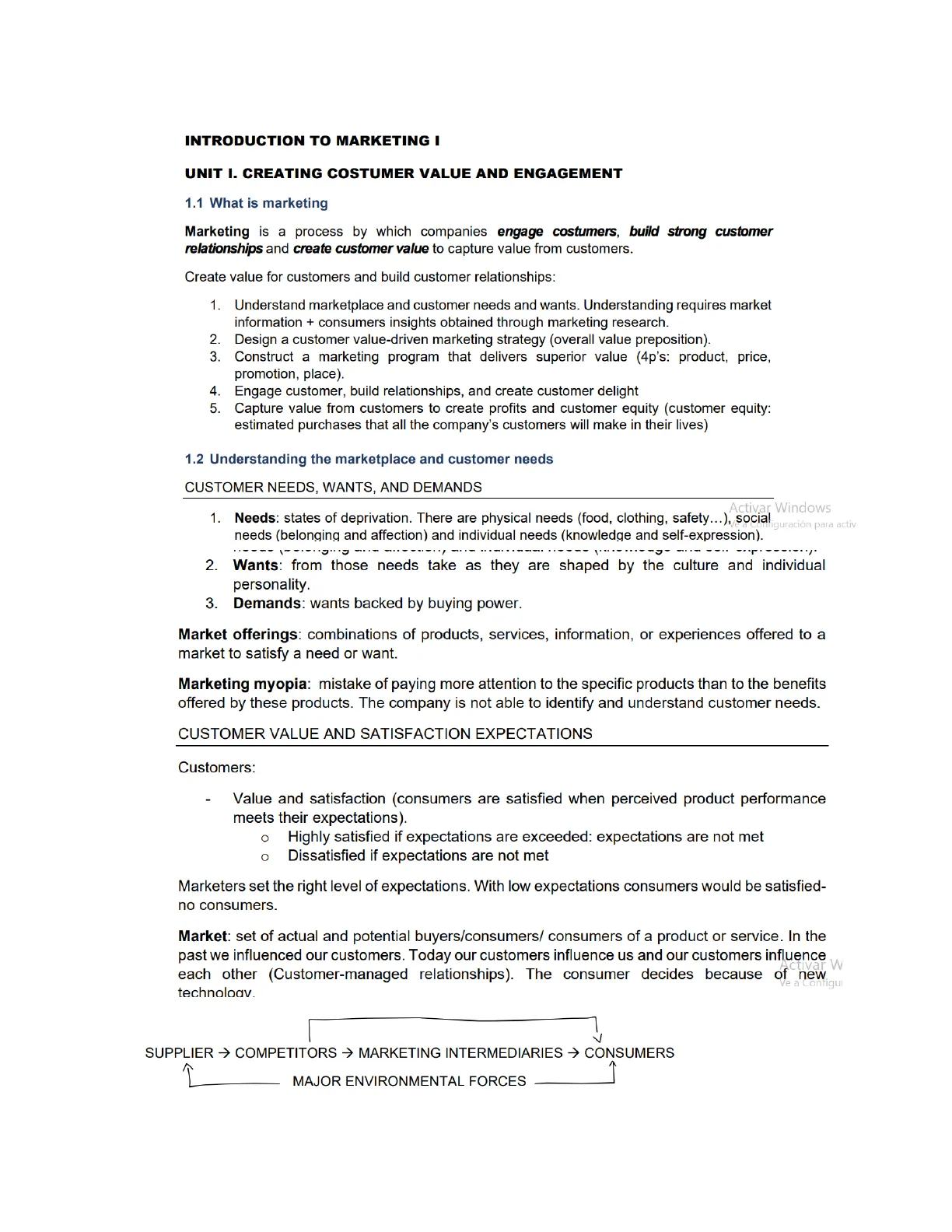
INTRODUCTION TO MARKETING I
UNIT I. Creating Customer Value and Engagement
What is Marketing
Marketing is a process by which companies engage costumers, build strong customer relationships and create customer value to capture value from customers.
Create value for customers and build customer relationships:
- Understand marketplace and customer needs and wants. Understanding requires market information + consumers insights obtained through marketing research.
- Design a customer value-driven marketing strategy (overall value preposition).
- Construct a marketing program that delivers superior value (4p's: product, price, promotion, place).
- Engage customer, build relationships, and create customer delight
- Capture value from customers to create profits and customer equity (customer equity: estimated purchases that all the company's customers will make in their lives)
Understanding the Marketplace and Customer Needs
Customer Needs, Wants, and Demands
- Needs: states of deprivation. There are physical needs (food, clothing, safety ... ), social Activar Windows needs (belonging and affection) and individual needs (knowledge and self-expression). Aliguración para activi
- Wants: from those needs take as they are shaped by the culture and individual personality.
- Demands: wants backed by buying power.
Market offerings: combinations of products, services, information, or experiences offered to a market to satisfy a need or want.
Marketing myopia: mistake of paying more attention to the specific products than to the benefits offered by these products. The company is not able to identify and understand customer needs.
Customer Value and Satisfaction Expectations
Customers:
- Value and satisfaction (consumers are satisfied when perceived product performance
meets their expectations).
- Highly satisfied if expectations are exceeded: expectations are not met
- Dissatisfied if expectations are not met
Marketers set the right level of expectations. With low expectations consumers would be satisfied- no consumers.
Market: set of actual and potential buyers/consumers/ consumers of a product or service. In the past we influenced our customers. Today our customers influence us and our customers influence ctivar W each other (Customer-managed relationships). The consumer decides because of new Ve a Configurac technoloav.
SUPPLIER > COMPETITORS > MARKETING INTERMEDIARIES -> CONSUMERS
5 MAJOR ENVIRONMENTAL FORCES
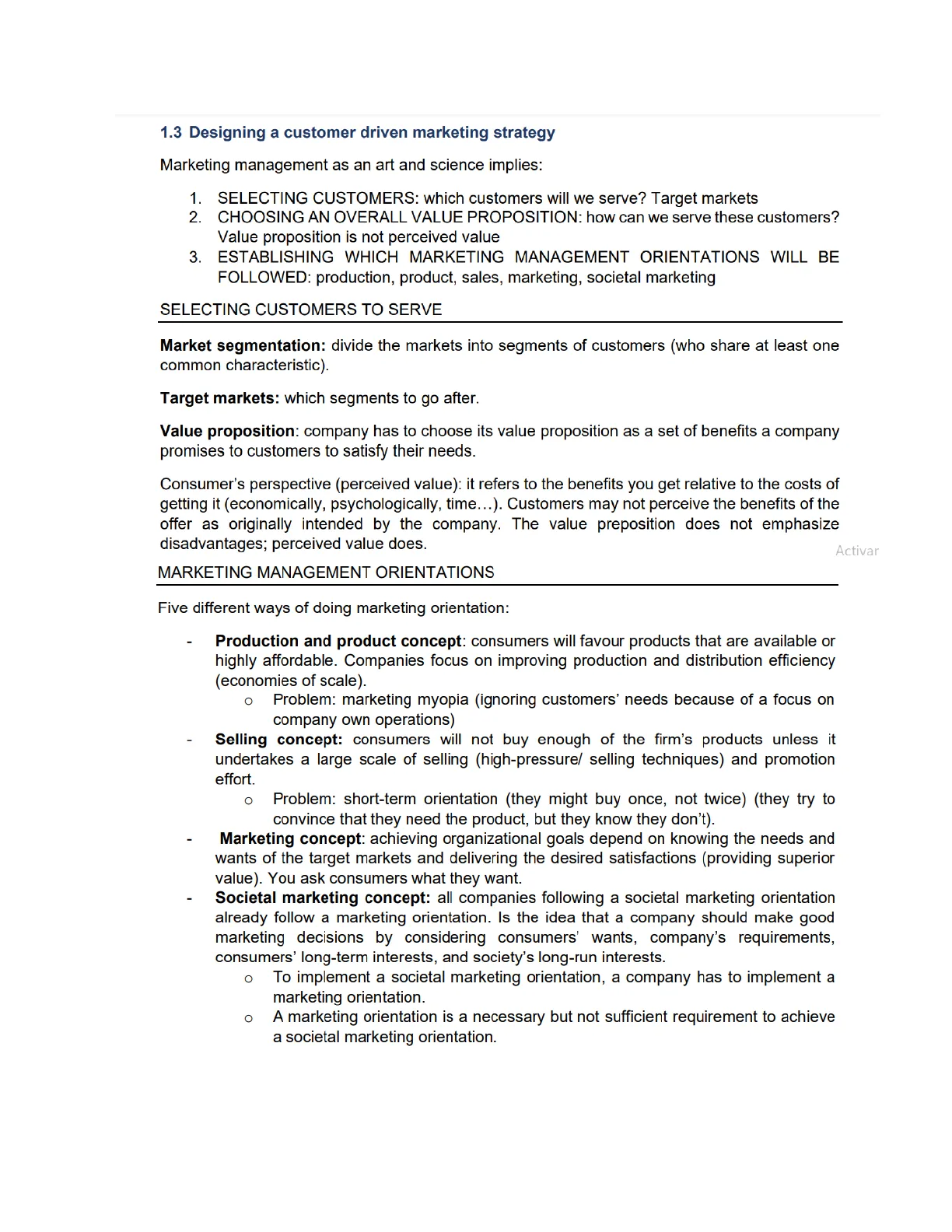
Designing a Customer Driven Marketing Strategy
Marketing management as an art and science implies:
- SELECTING CUSTOMERS: which customers will we serve? Target markets
- CHOOSING AN OVERALL VALUE PROPOSITION: how can we serve these customers? Value proposition is not perceived value
- ESTABLISHING WHICH MARKETING MANAGEMENT ORIENTATIONS WILL BE FOLLOWED: production, product, sales, marketing, societal marketing
Selecting Customers to Serve
Market segmentation: divide the markets into segments of customers (who share at least one common characteristic).
Target markets: which segments to go after.
Value proposition: company has to choose its value proposition as a set of benefits a company promises to customers to satisfy their needs.
Consumer's perspective (perceived value): it refers to the benefits you get relative to the costs of getting it (economically, psychologically, time ... ). Customers may not perceive the benefits of the offer as originally intended by the company. The value preposition does not emphasize disadvantages; perceived value does.
Marketing Management Orientations
Five different ways of doing marketing orientation:
Activar
- Production and product concept: consumers will favour products that are available or
highly affordable. Companies focus on improving production and distribution efficiency
(economies of scale).
- Problem: marketing myopia (ignoring customers' needs because of a focus on company own operations)
- Selling concept: consumers will not buy enough of the firm's products unless it
undertakes a large scale of selling (high-pressure/ selling techniques) and promotion
effort.
- Problem: short-term orientation (they might buy once, not twice) (they try to convince that they need the product, but they know they don't).
- Marketing concept: achieving organizational goals depend on knowing the needs and wants of the target markets and delivering the desired satisfactions (providing superior value). You ask consumers what they want.
- Societal marketing concept: all companies following a societal marketing orientation
already follow a marketing orientation. Is the idea that a company should make good
marketing decisions by considering consumers' wants, company's requirements,
consumers' long-term interests, and society's long-run interests.
- To implement a societal marketing orientation, a company has to implement a marketing orientation.
- A marketing orientation is a necessary but not sufficient requirement to achieve a societal marketing orientation.
The Selling vs. The Marketing Concept
Starting point FOCUS Means V Ends The selling focuses on Selling Concept Factory Existing products Selling and promoting Profits through Sales volume concept existing products and heavy selling. The aim is to sell what the company makes rather than making what customer wants.
Marketing concept Market Customer needs Integrated marketing Profits through customer satisfaction Marketing concept focuses on satisfying customer needs as a path to profits
Societal Marketing Concept
Society (human welfare ) Societal marketing concept Consumers ( want satisfaction) company (profits)
Preparing and Integrated Marketing Plan and Program
The marketing mix: set of tools a firm uses to implement its marketing strategy. It includes 4p's (product, price, promotion, place)
Integrated marketing program: plan that communicates and delivers the intended value to chosen customers (one or more target markets).
Managing Customer Relationships. Building Customer Relationships
Customer Relationship Management (CRM)
Broad conceptualization: overall process of building and maintaining profitable customer relationships by delivering superior customer value and satisfaction. It involves managing detailed information about individual customer and managing customer "touchpoints" to maximize customer loyalty.
The company leads the relationship (customer doesn't have an active role).
Relationships Building Blocks: Customer Value and Satisfaction
- Customer perceived value: customer's evaluation of the difference between total benefit and total cost of a marketing offers relative to those competing offers.
- Customer satisfaction: if a product's perceived performance matches or exceeds buyer's expectations.
Customer Relationship Levels and Tools
- Basic relationships: low margin customers.
- Full partnerships: key customers like their key distributors.
Between these two extreme companies may offer loyalty reward programs with customers that reward them for frequent purchases
Customer Engagement and Today's Digital and Social Media
Customer engagement now: companies are now incorporating more interactive two-way relationships through social networks. Marketing process is initiated by the company through social networks, but the company is seeking an active role from their consumers; to have engaged consumers.
Customer engagement then: the old marketing involved marketing brands to consumers (one- way communication).
Today's goal is to make the brans a meaningful part of consumer's lives.
Engagement: companies want their customers to be engaged with the brand, so they initiate positive interactions with other consumers about a brand (customer advocacy/ support).
Activar Wir Ve a Configurac
Because of the internet and social networks, consumers have more power and control, compared to the past. This takes us to: "customer-managed relationships".
Marketing relationships in which customers, empowered by today's new digital technologies, interact with companies and with each other to shape their relationships with brands.
Greater consumer empowerment means that companies can no longer rely on marketing by intrusion; it has to be marketing by attraction: creating contents that engage consumers rather than interrupt them.
The Changing Nature of Customer Relationships
Consumer-generated marketing: marketing created by consumers. Consumers are playing an increasing role in shaping their own brand experiences and those of other consumers. (Amazon, Nike, converse, google, Microsoft ... )
Partner-relationship management: working closely with partners in other company departments and outside the company to provide greater value to customers.
Capturing Value from Customers
Customer lifetime value: value of the entire stream of purchases that one consumer would make over his/her entire life. The younger, the bigger it is.
Customer equity: total combined customer lifetime values of all of the company's customers.
Share of customer: portion of the customer's purchasing that a company gets in its product categories.
Building the Right Relationships with the Right Customers
High Potential Profitable BUTTERFLIES TRUE FRIENDS True believers ( spread + WOM ) (Capturing as much value as possible, converting them into true friends is very difficult) (Delight them and provide superior value)
STRANGERS BARNACLES (Not investment at all) (Try to sell them more, with more margin, if not, leave them)
Low Short-term Projected Loyalty Long-term
The Changing Marketing Landscapes
- Digital age (online, mobile and social media marketing, big data, Al)
Growth of Non-for-profit marketing
- Rapid globalization (global marketing) Sustainable marketing (environmental and social responsibility)
1) THE DIGITAL AGE: digital technologies have changed the way we live and entertain, communicate and share information and shop
Internet of things (loT): global environment where everything and everyone is digitally connected to everything and everyone else.
Marketers need to use as many digital marketing tools as possible to engage consumers anywhere, at any time via digital devices.
Digital technologies allow companies to collect customer data (big data) used to get customer insights. Some companies are using artificial intelligence (apple's Siri and amazon's Alexa)
Mobile marketing: companies offer apps to engage customers with the brans and facilitate their purchasing process.
2) THE GROWTH OF NOT-FOR-PROFIT MARKETING (marketing in hospitals, schools, museums, churches ... )
3) RAPID GLOBALIZATION: enhanced by digital technologies and leading to increased levels of competition from everywhere.
4) SUSTAINABLE MARKETING: more environmental and social responsibility. Companies are following a societal marketing concept.
1 POVERTY 2 3 6000 HEALTH 4 QUALITY EDUCATION 5 GENDER EQUALITY 6 CLEAN WATER AND SANITATION Planet 7 RENEWABLE 8 GOOD JOBS AND ECONOMIC GROWTH 9 INNOVATION AND INFRASTRUCTURE 010 1 011 10 REDUCED INEQUALITIES 11 SUSTAINABLE CITIES AND COMMUNITIES 12 RESPONSIBLE CONSUMPTION ao 3p's 13 CLIMATE ACTION 14 LIFE BELOW WATER 15 LIFE 5 ON LAND 16 PEACE AND JUSTICE 17 PARTNERSHIPS FOR THE GOALS 1 Profit Peoplec THE GLOBAL GOALS For Sustainable Development Ve ¿ O
Can’t find what you’re looking for?
Explore more topics in the Algor library or create your own materials with AI.
