Unit 1: Introduction to phonetics and phonology
Document about Unit 1 Intro to Phonetics and Phonology. The Pdf, a university-level document for Languages, delves into phonetics and phonology, covering the speech chain, phonemes, allophones, and sound production mechanisms, including subglottal, laryngeal, and supraglottal systems.
See more30 Pages


Unlock the full PDF for free
Sign up to get full access to the document and start transforming it with AI.
Preview
Introduction to Phonetics and Phonology
Unit 1 Intro to phonetics and phonology
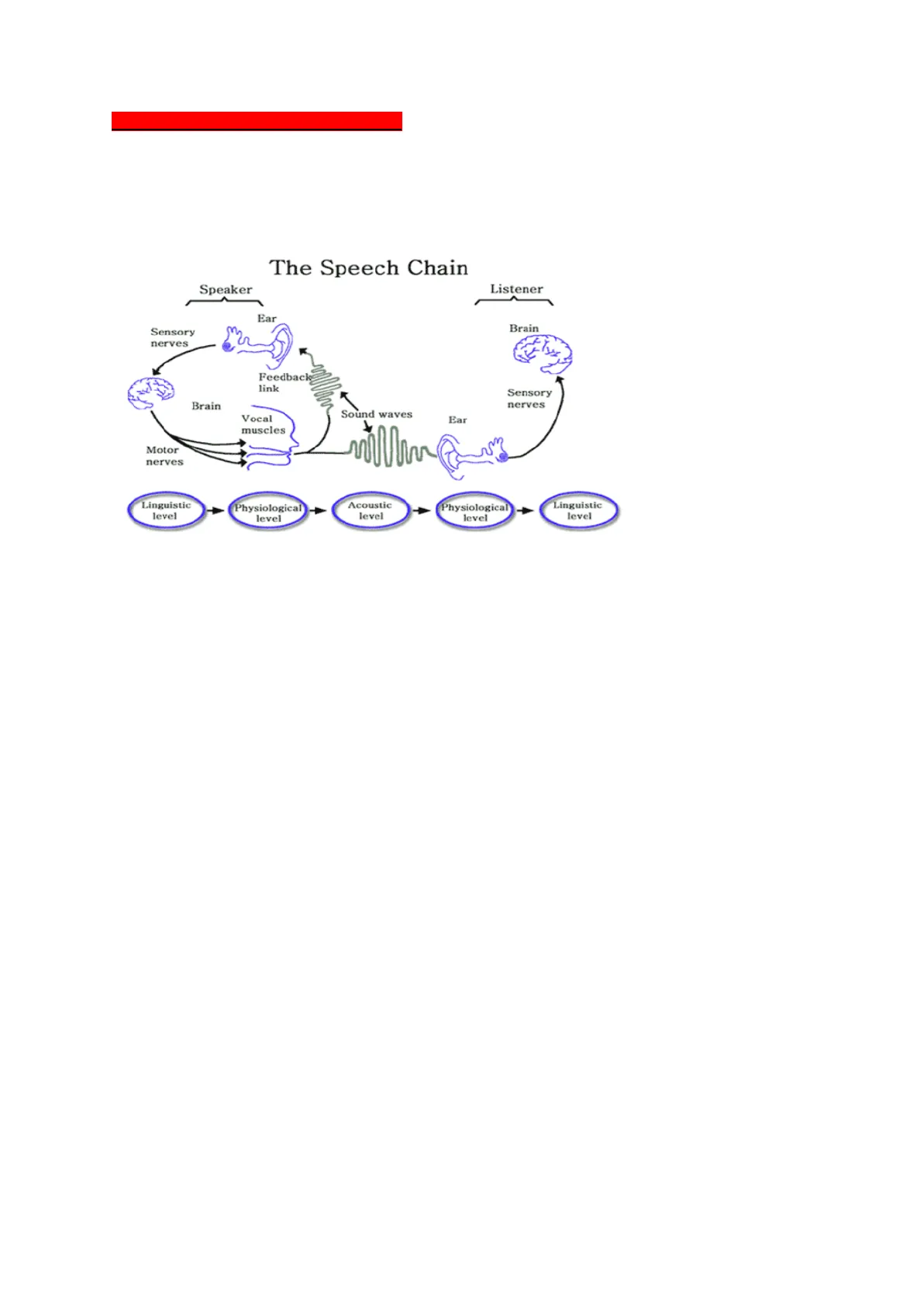
The Speech Chain is a simple model of spoken communication. It highlights the transformation of the speaker's communicative intention to an understanding of that intention in the listener's mind.
The Speech Chain Model
The Speech Chain Speaker Listener Ear Brain Sensory nerves Feedback link Sensory nerves Brain Sound waves Vocal muscles Ear Motor nerves Linguistic level Physiological level Acoustic level Physiological level - Linguistic level
5 stages at 3 levels:
-
linguistic (encoding)
- The speaker first decides what to say.
- The desired thought passes through the language centres of the brain (neurolinguistically programmed).
- Brain sends nerve impulses to speech organs to execute speech motor program. - Speech motor program imparts motion to muscles responsible for speech production.
-
physiological (articulation)
- Speech organs (e.g. diaphragm, lungs, larynx, etc.) are set in motion.
- An airstream emerges from the lungs, then passes through the vocal folds.
- The airstream receives its final shape in the vocal tract and eventually leaves the body
-
acoustic (speech transmission)
- The vibrations caused by the speaker's vocal apparatus radiate through an elastic medium as a sound wave.
-
physiological (perception)
- Sound waves strike the eardrums continuing until it reaches de neural fibers of the auditory nerves
-
linguistic (decoding)
- Recognition of the acoustic signal, understanding of the auditory data and the listener may turn to become the speaker
Glossary of Phonetics Terms
Glossary
-
Phoneme
- A phoneme is an abstract unit in phonology, capable of distinguishing meanings (for example, /p/ in pill as opposed to /b/ in bill). Phonemes may be realized phonetically in slightly different ways, often predictable from the phonetic context
-
Allophone
- Different pronunciations of the same phoneme
- we could say that the English phoneme /p/ has two allophones. The aspirated one [ph] found in words such as pin and pill and the unaspirated one [p] found in words such as spin and spill.
-
Minimal pairs
- A pair of words which are identical, except for one single segment that makes a difference in meaning. For example, the English words cut and cut illustrate the opposition between the phonemes /A/ and /æ/ respectively.
-
Complementary distribution
- The appearance of certain allophones is determined by phonetic context. Phonemes may have two or more allophones which appear in different contexts. For instance, the Spanish phoneme /d/ has two allophones, [d] and [o] and these are in complementary distribution. [d] appears word-initially and after nasals and [], intervocalically, e.g. dedo ['dedo].
Phonetics and Phonology Overview
1.2 Phonetics and phonology -> Phonetics deals with the production, transmission and perception of speech sounds
Branches of Phonetics
3 main branches:
- Articulatory phonetics -> deals with how the different speech organs interact to create speech sounds (initiation, phonation, articulation)
- Acoustic phonetics -> deals with sound waves made by the human speech organs and transmitted in speech.
- Auditory phonetics -> deals with how listeners perceive speech sounds.
Branches of Phonology
1.3 Branches of phonology -> Phonology is the linguistic study of how speech sounds produced by human beings are used linguistically in the system of language.According to the theoretical strand, 2 main groups
-
Structuralist phonology (Saussure, Bloomfield)
- Treats sounds as part of a system, which contains patterns, contrasts, distributions.
- Key concepts a) Phoneme and allophone (e.g. pill [phil], spill [spit]) a) Minimal pairs/commutation test (e.g. cat /kæt/ vs. cut /kAt/) b) Complementary distribution (e.g. dedo ['dedo]) c) Neutralization, archiphoneme (e.g. writer-rider /'rarD3-/) d) Variation (of phonemes: e.g. either /i:/-/ar/) (of allophones: e.g. ci[t]y, ci[r]y)
-
Generative phonology (Chomsky, Halle)
- focuses on distinctive features and derivational rules.
English Phonetics and Phonology
1.4 English phonetics English phonetics is the study of the articulatory, acoustic and auditory properties of English. English phonology is the study of how sounds are used in the English language (structures, patterns, functions, etc.).
To study English phonetics and phonology, specialists often refer to specific accents. Distinction between dialects (grammar/vocab.) and accents (pronunciation).
Both can be standard or non-standard
-
Standard English dialect
- A specific form of English - written and spoken - thought to be normative for educated users (e.g. no double negative, use of doesn't, etc.)
-
Standard English accent
- There's no acknowledged pronunciation standard for all speakers of English. Rather, there're many standard accents, depending mostly on the 'national' variety of English.
Rhotic vs Non-Rhotic Accents
1.5 Rhotic vs non-rhotic accents
- Rhotic -> always pronounce the final and post-vocalic 'r'
- Non-rhotic -> post-vocalic 'r' is silent
There's no acknowledged standard of pronunciation valid for all speakers of English. The standard accents of the USA (GA) and England (RP) are rhotic and non-rhotic respectively.
Glossary of Dialect and Accent
Glossary
-
Dialect
- is a variety of a language with its own phonetic, grammatical and lexical peculiarities
-
Accent
- is restricted to phonetic variability
Speech Transmission and Perception
Unit 2 Speech - Transmission - Perception
Mechanisms of Speech Production
2.1 Mechanisms of speech production The branch of phonetics that deals with how the sound is produced is called articulatory phonetics. 3 main systems in speech production
a) Subglottal system
- Diaphragm
- Lungs
- Trachea
b) Laryngeal system
- Larynx
- Thyroid -> prominent in some men (Adam's apple)
- Epiglottis
- Artenoyd -> Allos vocal folds to open and close
- Intrinsic and extrinsic muscles -> Adduct (close) vocal folds
c) Supraglottal system
- Pharynx
- Nasal cavity
- Oral cavity (mouth)
- uvula
- velum
- hard palate
- alveolar ridge
- teeth
- lips
- tongue
- tip
- blade
- front
- back
- root
Processes of Speech Production
Processes of speech production
- Initiation -> of pulmonic airstream
- Phonation -> periodic vibration of vocal folds (Aerodynamic theory of phonation)
- Articulation
Initiation of Airstream
2.1.1 Initiation In order to produce sounds, we need an airstream or moving column of air and the process whereby the airstream is set in motion is known as initiation and the organs setting air in motion are called initiators.
The airstream direction may be outwards (eggresive) or inwards (ingressive) Airstream mechanisms are divided in 2 categories
a) Pulmonic airstream
- Involve the lungs
- Egressive (lungs exhale) or ingressive (lungs inhale)
b) Non-pulmonic airstream
- Glottalic airstream -> involves a more or less tight closure of the glottis Velaric airstream -> uses the velum as the initiator
- -> Sounds produced with velaric ingressive are clicks.
Phonation Types
2.1.2 Phonation To start with, we distinguish between phonation and lack of it. There are also different phonation types.
a) Lack of phonation
- Characterized by an open glottis (as in voiceless sounds or breathing), a whisper or a closed glottis (as in a glottal stop).
b) Normal / Modal voice
- All the vocal folds vibrate uniformly and regularly .This type of voice requires no special marking
c) Breathy voice (e.g. English [f] in ahead)
- Breathy voice is a type of phonation in which the vocal cords are slightly apart, allowing more air to escape during speech. This creates a breathy, airy sound. The vocal cords still vibrate, but not as tightly as in modal, or normal voice, leading to a mix of vocal fold vibration and audible airflow.
d) Creaky voice (e.g. word-final /t/ in colloquial what)
- Creaky voice (also known as vocal fry) is a type of phonation where the vocal cords are tightly compressed, vibrating at a very low frequency. This creates a characteristic "creaky," low-pitched sound, often described as popping or rattling. The vocal cords open and close irregularly, resulting in a rough, uneven sound.
e) Falsetto
- It occurs when speakers stretch their vocal folds, thus increasing their vibration rate and producing higher pitch sounds. Used in singing
Articulation and Articulators
2.1.3 Articulation The articulators are the structures of the vocal tract that interact to create specific sounds. These are divided into movable, active articulators and static, passive articulators.
a) Active articulators
- the lower lip
- the tongue and its parts
- the epiglottis
b) Passive articulators
- the upper lip
- teeth
- the alveolar ridge
- the hard palate
- the velum (soft palate)
- the uvula
- the pharyngeal wall.
Speech Transmission and Sound Waves
2.2 Speech transmission
Sound
- oscillation or fluctuation in pressure, these pressure variations propagate as an acoustic wave through a transmission medium.
Waveforms
- a visual representation of vibrations typical of those in human speech. It is a graph of how pressure variation (vertical, x-axis) changes with time (horizontal, y-axis)
- According to their shape, waveforms are classified into
a) periodic (repeat in time) N
b) aperiodic (don't repeat in time) -> noise
Periodic signals can be simple or complex
Simple -> Repetitive M M
- Complex -> Wiggly
Frequency, Amplitude, and Intensity
2.3 Frequency, amplitude and intensity
Amplitude
- Amplitude of a wave is related to the amount of energy it carries.
- A loud sound has a high intensity or amplitude. This means the sound waves are more powerful, with larger vibrations in the air or medium.
Frequency
- is the no. of cycles per unit time
- measured in Hertz (hz)
Intensity
- depends on its energy and the energy varies in a different way from the amplitude.
- measured in decibels (dB).
Spectrograms
- visual representations of the frequency and the intensity of speech sounds as they change throughout time
Mechanisms of Speech Perception
2.4 Mechanisms of speech perception The branch of phonetics deals with this is 'auditory phonetics'
a) amplitude/intensity is called loudness -> higher amplitude vs lower amplitude
- A loud sound has a high intensity or amplitude. This means the sound waves are more powerful, with larger vibrations in the air or medium. The intensity of a sound is usually measured in decibels (dB).
- We use loudness in spoken language for various purposes, mainly to convey emphasis, emotion, and meaning.
- Loudness plays a crucial role in both linguistic stress (how we emphasize certain words or syllables) and paralinguistic features (how we communicate beyond words, such as through tone, emotion, or intention)
- Imperative statement and grab attention
Can’t find what you’re looking for?
Explore more topics in the Algor library or create your own materials with AI.
