Discrete Mathematics Graph Theory: Concepts and Applications from Bemacs
Slides from Bemacs about Discrete Mathematics Graph Theory. The Pdf introduces graph theory, covering fundamental concepts like graphs, terminology, special and bipartite graphs. The Pdf is suitable for university-level study in Mathematics.
See more30 Pages

Unlock the full PDF for free
Sign up to get full access to the document and start transforming it with AI.
Preview
Discrete Mathematics: Graph Theory Introduction
Mathematics Mod. II
30400 BEMACS
Class 25
D Fein
A.Y. 2024-2025
Discrete mathematics
Graph theory
Lesson 1
- Graphs
- Key terminology
- Special graphsThe origin story: The bridges of Königsberg
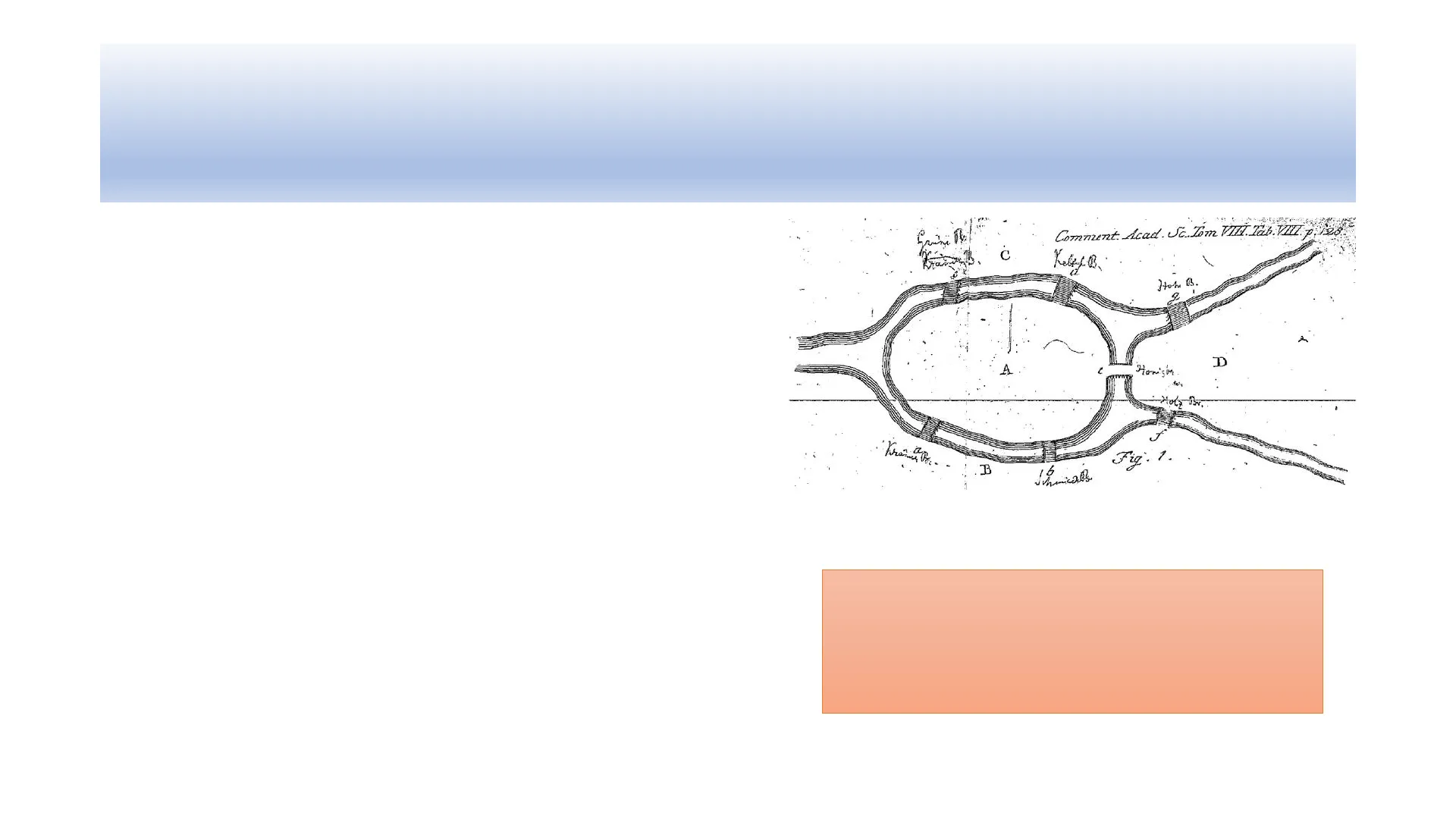
The town of Königsberg, Prussia,
was divided into four sections by
branches of the Pregel river. In the
1700s, there were 7 bridges
connecting these regions.
"The question is whether a person
can plan a walk in such a way that
he will cross each of these bridges
once but not more than once."
-Euler 1736
Comment. Acad. Sc.Tom VIII. Tab. VIII. p. 12.8.
Hohe B.
D
Hormigón.
Fig. 1.
. B
18 20
The town still exists but is now called
Kaliningrad in Russia. There are only 5
bridges still standing, 2 of which date back
to Euler's time.The solution led to graph theory!
Euler's Contribution to Graph Theory
In his 1736 paper solving the age-old problem, Euler effectively invented
graph theory.
- The 4 land masses are represented by 4 vertices (or nodes).
- The 7 bridges are represented by 7 edges.
c
9
C
A
€
D
6
a
B
C
D
A
B
We will find the solution
soon!A graph
Graph Definition and Properties
: Order
/VI
TEL : Size
O. S.
Definition
A graph G = (V, E) consists of two sets:
- V, a nonempty set of vertices.
- E, a set of unordered pairs of vertices called edges.
In the graph shown,
- The vertex set is
V = {A, B, C, D, E}
- The edge set is
E = {A, B}, {A, D}, {A, E}, {B, C}, {B, D}, {C, D}, {C, E} }
OE
C
A
B
D - The order of a graph is |V|, the
number of vertices. - The size of a graph is | E|, the
number of edges.Simple graphs, multigraphs and pseudographs
Types of Graphs
A graph containing multiple edges (edges connecting the same
vertices) is called a multigraph.
A graph containing loops (edges that connects a vertex to itself) and
perhaps multiple edges, is called a pseudograph.
A simple graph contains neither loops nor multiple edges.
.C
OD
B
A
C
+C
D
B
B
A
ADirected graphs
Directed Graphs (Digraphs)
( We won't focus on these)
A directed graph (digraph) G = (V, E)
consists of two sets:
- V, a nonempty set of vertices
- E, a set of directed edges (or arcs)
associated with an ordered pair of
vertices.
The directed edge associated with (u, v)
starts at u and ends at v. - GBR
- FRA
- USA
TA - USA
GBR
ITA
FRAGraph model - module dependency
Graph Models and Applications
Module Dependency Graph
A module dependency graph
provides a useful tool for
understanding how different
modules of a program
interact.
In a program dependency
graph, each module is
represented by a vertex.
There is a directed edge from
a module to a second module
if the second module depends
on the first.
main
display
parser
protocol
abstract
syntax tree
page
networkGraph model - precedence
Precedence Graph for Program Statements
Suppose we are writing a
program with the statements
shown.
How can you represent the
precedence using a graph?
Statement 1
a == 0
Statement 2
b == 1
Statement 3
c == a+1
Statement 4
d := b+a
Statement 5
e := d + 1
Statement 6
e == c+dGraph model - precedence
The dependence of statements on
previous statements can be
represented by a directed graph.
Each statement is represented by a
vertex, and there is an edge from one
statement to a second statement if the
second statement cannot be executed
before the first statement.
This resulting graph is called a
precedence graph.Graph model - airline routes
Airline Routes Graph Model
1. What is the shortest
path from one airport
to another by distance?
2. How about by flight
time?
In either case we must use
a weighted graph (not
shown), whose edges are
labeled with the distances
or times between airports.
CRP
OMA
AN
AMA
BDL
LE
MAR
DU
DE
STU
GEC
MCI
FLL
BO
B
PIT
SP
RNC
SD
SNA
LBB
STW
MH
RSW
BUR
BUF
ÒNŤ
TU
SFO
HRL
The graph shown is the undirected, unweighted
graph. We will explore weighted graphs in
detail during future lessons.
ALE
PB
PD
OKOGraphs are EVERYWHERE!
Ubiquitous Graph Applications
- Electrical/water/gas networks (connections, conductors)
- Road/railway networks (stations, lines)
- Sports tournaments (teams, matches)
- Internet (sites, links)
- Social networks (users, friends)
- Molecules (atoms, chemical bonds)
- Calendars (events, overlaps)
- Neural networks (neurons, connections)
- Tree graphs (events, probabilities)
- Concept maps (concepts, relations)
- Hierarchical structures
- Protein interactions, DNA
- Structure of a polyhedron
- .
.
dington
Road
Marylebone
Baker
Street
Portland
Street
Euston
1 Warren Street
Euston
Square
Edgware
Road
Farrings
rove
Bayswater
+
Notting
Hill Gate
Lancaster
Gate
Bond
Street
Oxford
Circus
Chancer
Lane
Queensway
Marble
Arch
+ Tottenham
Court Road
Covent Garden t
Green Park
Leicester Square +
Hyde Park Corner
Knightsbridge
Piccadilly
Circus
+ Canne
ta Charing
Cross
Gloucester
Road
St. James's
Par
Temple
Earl's
Court
South
Kensington
Sloane
Square
Westminster
Embankment f
H
H
c
H
H
Regent's Park
Russell
Square
Goodge
Street
Land
ark
Holborn
High Street
Kensington
Mansion Ho
+-Blackfriars-
VictoriaTerminology - undirected graphs
Terminology for Undirected Graphs
Consider an undirected graph G (V, E).
- Two vertices u and v are adjacent (or neighbors) in G if u and v are
endpoints of an edge e of G. This edge e is incident with the vertices
u and v. The edge e connects u and v. - The set of all neighbors of a vertex v is called the neighborhood of v,
denoted N(v). - The degree of a vertex v is the number of edges incident with it, and
we denote this deg(v).
A vertex of degree 0 is isolated.
A vertex of degree 1 is pendant.Example
Graph Degree and Neighborhood Example
A (G ) :
max des in G
8 (G) : min deg in G
Find the degrees and the neighborhoods of each vertex in the graphs
shown. Find the max and sum of the degrees in each.
4
9
b
C
d
2
3
·
0
Nbdª
f 4
e
g
Vtx
des
-
a
b
2
4
4
e
1
3
f
S
4
0
( b, f3
{a, c,e,f}
Es, die, f}
Ec3
(b,c,f3
(a, b, c,e)
¢
9
b
C
d
e
4
5
1
5
6
a
b
C
e
d
Vtx
deg
Nbd
& b, d,e3
(a, b, c, d,e)Handshaking lemma
Handshaking Lemma and Degree Sequence
Handshaking Lemma
Theorem
In a simple graph with n vertices, the maximum degree of a vertex is
n -1.
Theorem (Handshaking lemma)
Consider an undirected graph G = (V, E) with m edges. Then,
deg(v) = 2m
vEVDegree sequence
Degree Sequence of a Graph
The degree sequence of a graph is the sequence of
the degrees of the vertices in decreasing order
(usually).
The degree sequences of the graphs shown are:
S1: 3,3,3,2,1
S2: 4,3,3,3,1
Example
(Simple only!)
How many edges does a graph have if its degree
sequence is s: 5,2,2,2,2,1? Draw an example.
6 vertices
{ deg(v) = 2/El =)
14 = 2/El
(order 6)
VEV
IEL = 7 (5:7 7)
1
3
3
2
3
3
4
3
3Explore
Even and Odd Degree Vertices
Consider the following graphs. How many vertices have even degrees
and how many have odd degrees?
1. a
b
e 4
od 2
3
1
1
d
f 2
e
@ 2
e 2
d 2
even :
odd :
4
1
4
3
6
0
2
2
2
b
b
c 3
2
3
ac
a
d
4 5
2
2
C
b
3
2Odd degree vertices (1/2)
Theorem on Odd Degree Vertices
Theorem
An undirected graph has an even number of vertices of odd degree.
Proof
Consider G = (U, E) where IEl =m
Let V1 = { vertices of even degree ?
V2 = { vertices of old degrees
2 m = > deg (v) =
VEV
& deg(v )
VEV,
+
& deg (v)
.
VE V2Odd degree vertices (2/2)
Since HUEV,, deg (v) is even => 1 is even
Since 1 + 2) is am, which is even .
is even.
But, all term in 2 is
odd .
So , there must be an even number of terms in
(2)
.: There is always on
Yven # of odd degree vertices.Complete graphs
Complete Graphs and Edges
Complete Graph Definition
A complete graph on n vertices, denoted Kn, is a simple graph in which
every vertex is connected to every other vertex.
The first 6 complete graphs are shown.
1. What is the degree sequence of Kn?
2. How many edges are in Kn?
K2
K3
K5
K6
des 8%!
Size :
0
1,1
2, 2, 2
K4
3,3, 3,3
0
1
3
6
10Edges in a complete graph
Number of Edges in a Complete Graph
Theorem
The number of edges in a complete graph Kn is
e =
n(n-1)
2
=
(2)
Proof
Kn has 1 vertices.
Each vtx is
adj .
to the other n-1 vertices.
So, at each vtx there are n-1 edge-ends.
=> The total # of
f edge-ends is n ( - 1 ) . But each edge has 2 ends,
vertices edge- ends
1 (1-1) = e
2Common degree
Common Degree Theorem
Theorem In any simple graph G, there are at least 2 vertices of the
same degree.
Proof Let G = (V,E) where IvI = n
G simple => S(G) = 0 and D(G) = n-1
Case 1: Ja vix or degree o.
Then , the largest possible degree is n - 2 . D ( G ) < n - 2
=) } n-1 possible degrees. (Holes)
Case 2.'
A a vtx of deg O. So 8(6)=1
Then, &(G) => ] n-l possible degrees
( Holes)
In both cases, we have A-1 values (Holos) and in vertices (pigeons)
: By the pigeonhole principle, at least 2 vertices have the same degree.Cyclic graphs
Cyclic and Regular Graphs
Cyclic Graph Definition
The cyclic graph on n vertices (where n ≥ 3) consists of:
- Vertex set V = { v1, V2, ... , Un}
- Edge set E = {{v1, 12}, {v2, 13}, ... {vn-1, Un}, {un, v1}}
The first 4 cyclic graphs are shown.
C3
CA
C5
C6Regular graphs
Regular Graph Example
A graph is k -regular if every vertex has degree k.
Example
The graph shown is called a wheel graph (for obvious reasons).
List the degree sequence to confirm it is not regular.
Create a subgraph of W6 that is regular.
W6The utility graph
Utility Graph and Planarity
Consider the three houses shown. Each
must be connected to three utilities
(water, gas, electric).
1. Draw the corresponding utility
graph.
2. Can you draw this on paper without
any edge crossings? NolBipartite graphs
Bipartite Graphs and Coloring
Bipartite Graph Definition
A simple graph G is a bipartite graph if its vertex set V can be
partitioned into two disjoint sets V1 and V2 such that each edge in G
connects a vertex in V1 and a vertex in V2. The pair (V1, V2) is a
bipartition of the vertex set V of G.
Example
VI
V2
V2
Va
Is C6 bipartite?
V 1 = { V, V3, Vs}
VS
V6
Nu
V2 = {V2, Va, Vo}
Example
Is K3 bipartite?
V3
If we split V into a disjoint sets, one must contain
Theorem
A simple graph is bipartite if and only if it
is possible to assign one of two different
colors to each vertex of the graph so that
no two adjacent vertices are assigned the
same color.
2 vertices . If Ky were bipartite , these 2 could not be adj . But they are! contr.
Not biputin.
Vg
VExample
Bipartite Graph Identification
Are the graphs shown bipartite?
C
g
f
e
d
Yes. V .= {a,b,d} V2= {c,e,f,g3
b
a
C
e
d
No, Just consider a, b , f.Complete bipartite graphs
Complete Bipartite Graphs
A complete bipartite graph Km,n is a bipartite graph in which the
bipartition of the vertex set is (M, N) and each of the m vertices in M is
connected to each of the n vertices in N.
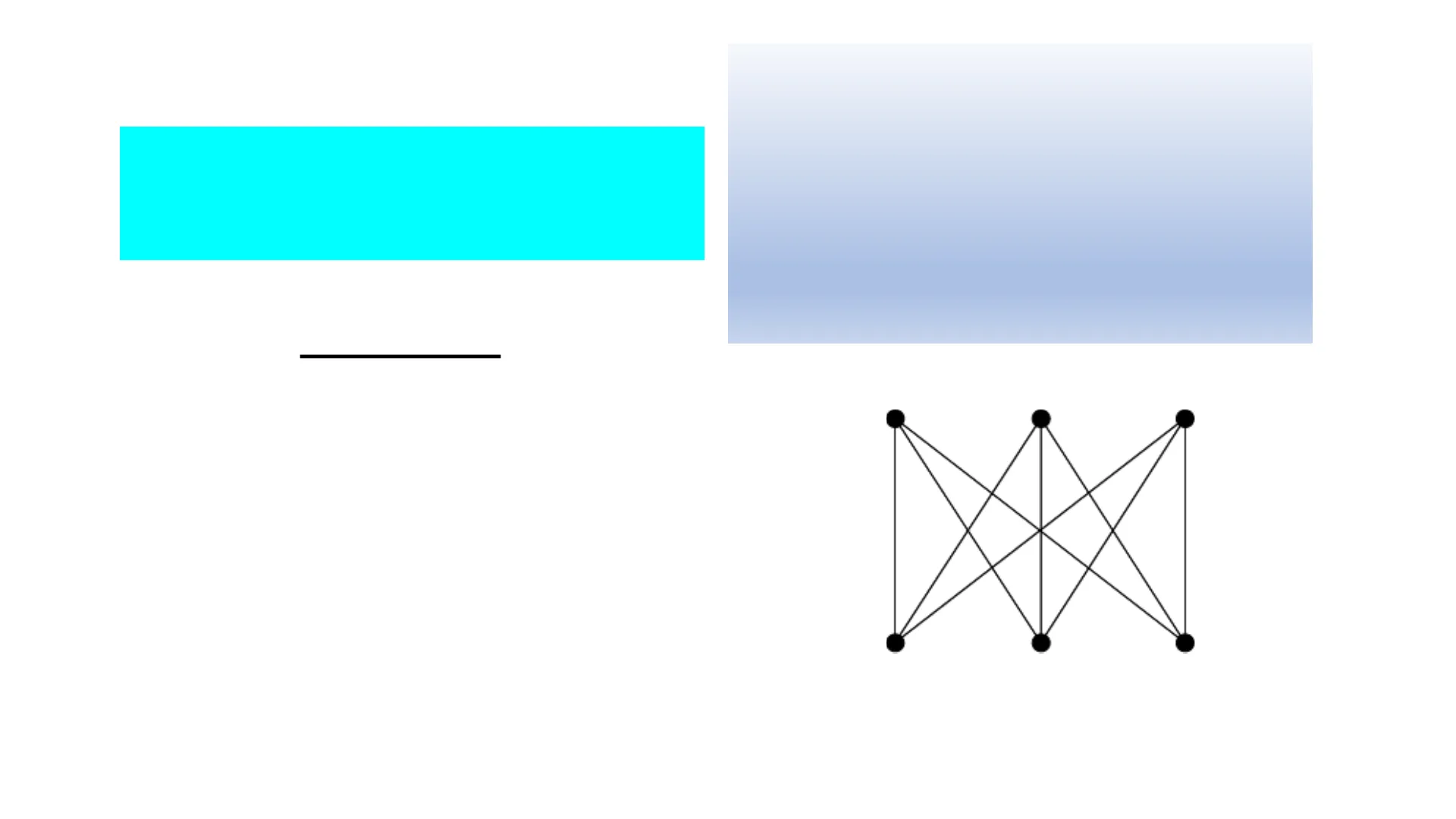
The utility graph is thus K3,3.
K2,3
K3,3
The graph Km,n has mn edges.
K3,5
K2,6Connected components
Connected Components in Graphs
Suppose we wanted to model the relationship between numbers that share
a divisor greater than 1. i.e., the numbers a, b such that gcd (a, b) > 1
In the graph shown, the vertex set is
2
V = {2,3,4,5,6,7}
And the edge set is
2,4}, {2,6}, {3,6}, {4,6}}
The degree sequence (in vertex order) is
2,1,2,0,3,0
3
. 7
4
6
· 5
The graph is not connected, but it has three connected components:
{2,3,4,6}, {5}, {7}
Can’t find what you’re looking for?
Explore more topics in the Algor library or create your own materials with AI.
