Recombinant DNA Technology and Its Applications in Drug Design
Slides about Recombinant DNA Technology (Drug Design). The Pdf, a university-level Biology document, explains the principles and applications of recombinant DNA technology, including its use in medicine and drug design. It provides concrete examples and is structured for effective learning.
See more16 Pages


Unlock the full PDF for free
Sign up to get full access to the document and start transforming it with AI.
Preview
Recombinant DNA Technology Overview
Dr James SmithWhat is recombinant DNA technology?
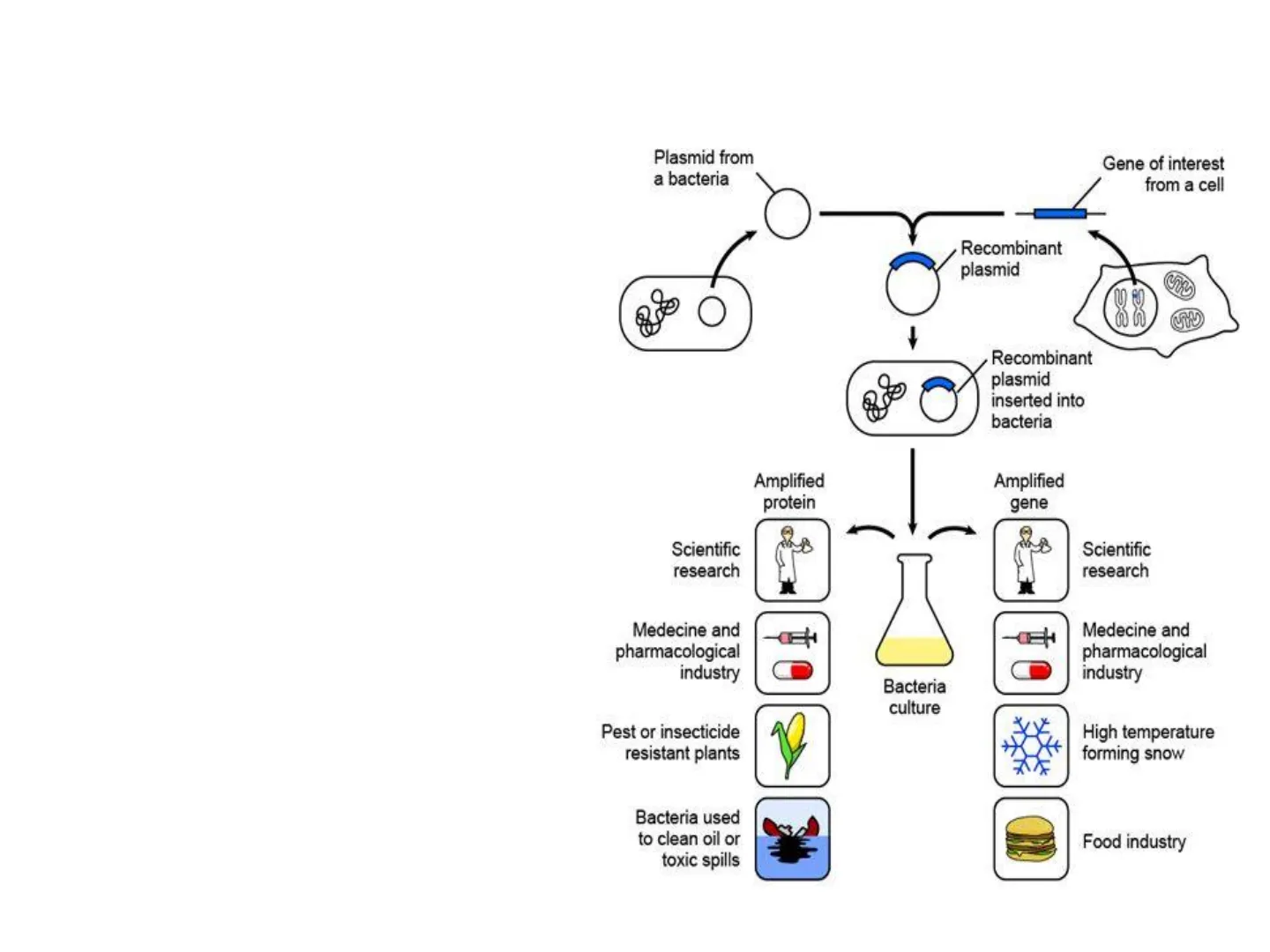
- Recombinant DNA (rDNA) technology involves combining genetic material from different sources to create new DNA sequences.
. This process allows for the production of genetically modified organisms, the study of gene function, and the development of various medical and agricultural applications, such as producing insulin and improving crop yields.
Plasmid from a bacteria Gene of interest from a cell Recombinant plasmid Recombinant plasmid inserted into bacteria Amplified protein Amplified gene Scientific research B Scientific research Medecine and pharmacological industry Medecine and pharmacological industry Bacteria culture Pest or insecticide resistant plants High temperature forming snow Bacteria used to clean oil or toxic spills Food industryrDNA examples
rDNA Examples in Food Industry
Food Industry: Chymosin enzyme (normally in rennet) is produced in large quantities and more cheaply.
rDNA Examples in Medical Research
Medical Research: Development of diagnostic technique for HIV based on antibodies.
rDNA Examples in Agricultural Industry
Agricultural Industry: To produce crops that are tolerant to herbicides and so only weed then affected.
rDNA Examples in Medical Research (Algae Proteins)
Medical Research: Algae proteins partially restore man's sight.How is rDNA used in medicine?
rDNA in Medicine
. rDNA technology has revolutionised medicine by enabling the production of therapeutic proteins such as:
- Insulin
- Growth factors
. Clotting factors . It has also facilitated the development of gene therapy
- Modified genes introduced to patients to treat genetic disorders and provide targeted therapies.
Humulin R KwikPen™M 100 1U/ml injekční roztok Insulinum humanum biosyntheticum,Combining gene sequences
Combining Gene Sequences
- Advances in genetic engineering have made possible cloning, which involves making copies of a gene segment.
- Further understanding of the DNA properties, replication process and structure have presented the opportunity to combine specific gene sequences that code for specific proteins into the gene sequence of various hosts (rDNA).
- rDNA alters the DNA of the host and has found application in a number of disciplines (biotech).rDNA steps
rDNA Steps
- rDNA involves a number of steps:
- Use restriction endonucleases (aka restriction enzymes) to cleave off required segment. May need to produce more of the segment using the polymerase chain reaction (PCR).
- Select a suitable cloning vector (e.g., plasmid) - a DNA fragment that is able to replicate from bacteria, yeast or viruses.
- Using DNA ligase, covalently link the segment to the cloning vector by reforming the sugar phosphate backbone to form the rDNA.
- Insert the rDNA into a host that will already have the system for DNA replication.
- Select host cells that have the rDNA.Molecular Cloning
Molecular Cloning Process
foreign DNA plasmid restriction site GGATCCI ICCTAGGI lacZ gene ampicillin resistance gene AMP 1 Both foreign DNA and a plasmid with an ampicillin resistance gene are cut with the same restriction enzyme. In the plasmid, the restriction site occurs in the middle of a single copy of the lacZ gene in the plasmid. When functional, the lacZ gene will lead to the production of an enzyme ß-galactosidase. Cutting the lacZ gene prevents the eventual production of the enzyme ß-galactosidase. GATCC! GATCC G G sticky ends G CCTAG CCTAG AMP GGATCC! CCTAGG; AGGATCC CCTAGG IGGATCC CCTAGG GGATCC! CCTAGG, 3 Adding DNA ligase reattaches the DNA backbones. These are recombi- nant plasmids. AMP AMP IGGATCC ICCTAGG AMP recombinant plasmids transformation 4 )The plasmids are combined with a culture of actively growing bacteria. Some cells do not take up plasmids, others take up nonrecombinant plasmids, and a few take up the recombinant plasmids. Bacterium does not take up plasmid, is not ampicillin- resistant. Bacterium takes up nonrecombinant plasmid with intact lacZ gene. Bacterium takes up recombinant plasmid, cannot produce ß-galactosidase enzyme. White colonies have recombinant plasmids. Blue colonies have nonrecombinant plasmids. 0 0 0 @ 2 The restriction enzyme leaves comple- mentary sticky ends on the foreign DNA fragment and the plasmid. This allows the foreign DNA to be inserted into the plasmid when the sticky ends anneal. GATCC G COTAG CCTAG G GATCO GGATCC! CCTAGG, 5 Bacteria are cultured on a plate with ampicillin and a substance that changes color when exposed to the ß-galactosidase enzyme. Cells that did not take up plasmids are killed by ampicillin. Cells with nonrecombinant plasmids grow colonies that change color. Cells with recombinant plasmids grow white colonies.Join: vevox.app ID: 175-264-171 POLL OPEN Which is the correct sequence of steps in rDNA technology? 1. grow cells, cleave DNA, use DNA ligase, isolate protein 8.7% 2. cleave DNA, use DNA ligase, grow cells, select cells, isolate protein 26.09% 3. cleave DNA, use DNA ligase, isolate protein, grow cells 52.17% 4. use DNA ligase, cleave DNA, grow cells, select cells, isolate protein 8.7% 5. isolate protein, grow cells, select cells, cleave DNA, use DNA ligase 4.35%Restriction enzymes
Restriction Enzymes
- These enzymes recognise specific base sequences where they will cut DNA (recognition site). They occur in many bacterial species and have a protecting role, e.g., viral infection. The DNA in the host is protected from the enzymes by methylation of the DNA (using DNA methylase).
- 3 Types of restriction enzymes:
- Type I: cleaves DNA at random sites.
- Type III: cleaves DNA about 25 base-pairs from the recognition site.
- Type II: more selective, cleaving at particular phosphodiester bonds at the recognition site. Recognition sequences are 4 to 6 base pairs. Often the cuts are staggered leaving one strand with unpaired base-pairs (aka 'sticky ends' - these can complement sticky ends of other DNA fragments). Many types of type II restriction enzymes discovered.Join: vevox.app ID: 175-264-171 POLL OPEN What type of restiction enzyme is most useful in rDNA technology? 1. Type 3 11.76% 2. Type 4 0% 3. Type 3a 5.88% 4. Type 2 5. Type 1 82.35% 0%DNA isolation, purification and ligation
DNA Isolation, Purification and Ligation
- The cleaved DNA segment is then isolated & purified using electrophoresis in agarose gel.
- The cloning vector DNA (e.g., plasmid) would similarly be digested by using the same restriction enzyme (base-pair sequence has to match). DNA Ligase Ligase DNA
- The link between the cloning vector and the DNA segment is made by means of DNA ligase, by formation of new phosphodiesterase bonds using ATP. Complementary sticky ends facilitate the ligation reaction.Cloning vectors
Cloning Vectors
- These are DNA molecules into which other DNA can be inserted.
- Most popular cloning vectors are plasmids (circular DNA), bacterial artificial chromosomes and yeast artificial chromosomes. They use the cells resources for replication & gene expression.
- Some plasmids have genes that express for certain antibiotic resistance. This can be used to identify plasmids that have the recombinant version.
- Plasmids with the rDNA can be introduced into bacterial cells (e.g., E. coli) by incubation at varying temperatures in CaCl2 solution.
- Other cloning vectors include, e.g., yeast, microalgae, insects and mammalian cells, but bacteria are used often for protein expression.
- Expression vectors can be used to increase rate of expression of cloned gene, e.g., to form insulin.rDNA applications in pharmacy
rDNA Applications in Pharmacy
- Producing blood clotting factor VIII in large quantities rather than rely on donated blood for treatment of Haemophilia A patients.
- rDNA to prepare human insulin rather than rely on animal sources, e.g., Aspart®. The process involves the isolated human insulin gene linked to a DNA vector & then replicated in E. coli or Saccharomyces cerevisiae. The gene is expressed in the host cells, leading to large amounts of human insulin rapidly.
- Other recombinant proteins, e.g., erythropoietin, botulinum toxin (Botox), papain, collagenase & streptokinase.
- Human growth hormone for treatment of patients with defective pituitary gland rather than rely on human cadavers.
- rDNA of the hepatitis B virus surface antigen (produced with the use of yeast cells) for production of hepatitis B vaccine, used for preventing infection of the liver by the virus.Join: vevox.app ID: XXX-XXX-XXX POLL OPEN Which medicine would be an unlikely candidate for production using rDNA techniques? 1. Factor VIII 0% 2. Papain for skin lesions 0% 3. A new statin drug 0% 4. Hepatitis B vaccine 0% 5. Human insulin 0%Applications of recombinant proteins for therapeutic use
Applications of Recombinant Proteins for Therapeutic Use
Leader et al. (2008) proposed that protein therapeutics are grouped according to function:
- Group 1: Protein therapeutics with enzymatic or regulatory activity
- Replacing a protein that is deficient/abnormal, e.g., insulin, factor VIII
- Augmenting an existing pathway, e.g., erythropoietin, G-CSF, GM-CSF, IL-11
- Providing a novel function/activity, e.g., Botulinum toxin type A (Botox), papain, collagenase, streptokinase
- Group 2: Protein therapeutics with special targeting activity (monoclonal antibody,
mAb/mab)
- Interfering with a molecule or organism, e.g., Trastuzumab (Herceptin), Rituximab (Rituxin), Infliximab (Remicade), Muromonab-CD3 (OKT3)
- Delivering other compounds or proteins, e.g., Denileukin diftitox (Ontak)
- Treatment for Alzheimer's disease, e.g., Aducanumab (2021)
- Group 3: Protein vaccines
- Protecting against a deleterious foreign agent, e.g., HBsAg (Recombivax HB), HPV Vaccine (Gardasil)
- Treating an autoimmune disease, e.g., Anti-Rhesus (Rh) immunoglobulin G (Rhophylac), Rh prophylaxis
- Cancer Vaccines - in trials
- Group 4: Protein diagnostics (monoclonal antibody, mAb/mab) Used in the diagnosis of a range of disorders, e.g., TSH (Thyrogen), Arcitumomab (CEA-scan: cancer imaging & therapy), Nofetumomab (Verluma)The future ...
The Future of Gene Editing
Gene editing (gene therapy) is making it possible to alter abnormalities in DNA which cause diseases, e.g., cystic fibrosis.
- This involves adding the vital genes into cells taken from a patient, editing them, and then placing them back in the patient where they will express the required protein or compound.
- Patients with virulent skin melanoma have been treated in this manner to express tumour necrosis factor, an anticancer protein.
- This technology along with stem cell application is already making a positive impact and will further revolutionise clinical treatment of many of the diseases in time.
Can’t find what you’re looking for?
Explore more topics in the Algor library or create your own materials with AI.