AQA GCSE Physics: Combined Science, Atomic Structure and Rutherford Scattering
Document from Savemyexams about Aqa Gcse Physics: Combined Science. The Pdf provides a comprehensive overview of atomic structure, isotopes, and Rutherford scattering, ideal for high school Physics students. It covers key discoveries and the evolution of atomic models.
See more31 Pages

Unlock the full PDF for free
Sign up to get full access to the document and start transforming it with AI.
Preview
AQA GCSE Physics: Combined Science
4.1 Atoms & Isotopes
- 4.1.1 Atomic Structure
- 4.1.2 The Absorption & Emission of EM Radiation
- 4.1.3 Atomic & Mass Number
- 4.1.4 Isotopes
- 4.1.5 Positive lons
- 4.1.6 The Plum Pudding Model
- 4.1.7 Rutherford Scattering
- 4.1.8 Bohr's Model of the Atom
- 4.1.9 Discovery of the Proton & Neutron
4.1.10 Changes in the Atomic Model
Your notes
Page 1 of 31
@ 2015-2025 Save My Exams, Ltd. . Revision Notes, Topic Questions, Past PapersSave My Exams
Head to www.savemyexams.com for more awesome resources
Your notes
Atomic Structure
Atomic Structure Overview
Atoms are the building blocks of all matter
- They are incredibly small, with a radius of only 1 x 10⁻¹⁰ m
This means that about one hundred million atoms could fit side by side across your thumbnail
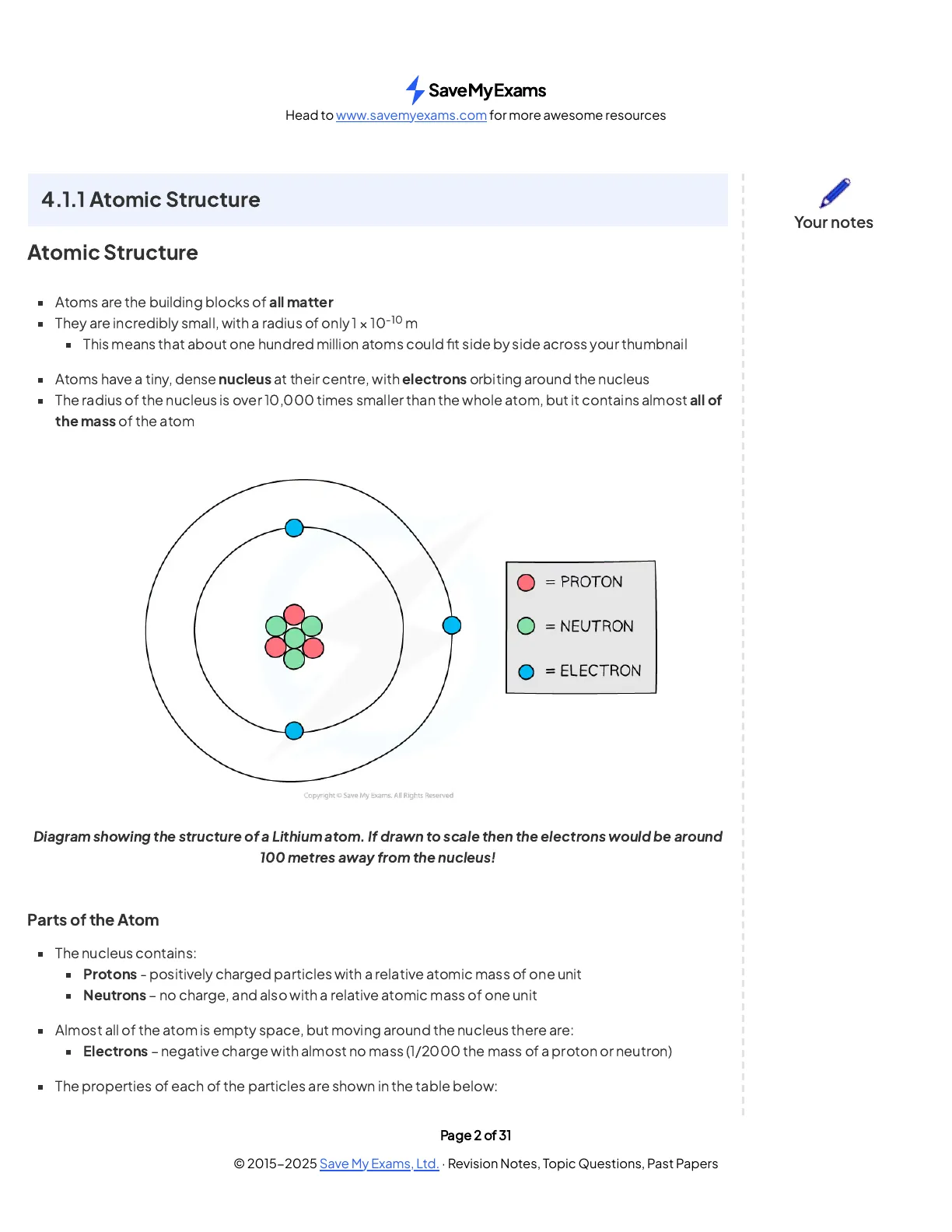
Atoms have a tiny, dense nucleus at their centre, with electrons orbiting around the nucleus
The radius of the nucleus is over 10,000 times smaller than the whole atom, but it contains almost all of the mass of the atom
O = PROTON
O = NEUTRON
O
= ELECTRON
Copyright @ Save My Exams. All Rights Reserved
Diagram showing the structure of a Lithium atom. If drawn to scale then the electrons would be around 100 metres away from the nucleus!
Parts of the Atom
- The nucleus contains:
Protons - positively charged particles with a relative atomic mass of one unit Neutrons - no charge, and also with a relative atomic mass of one unit
Almost all of the atom is empty space, but moving around the nucleus there are:
- Electrons - negative charge with almost no mass (1/2000 the mass of a proton or neutron)
- The properties of each of the particles are shown in the table below:
Page 2 of 31
@ 2015-2025 Save My Exams, Ltd. · Revision Notes, Topic Questions, Past Papers4
Save My Exams
Head to www.savemyexams.com for more awesome resources
Particle Properties
Your notes
| Particle | Location | Relative Charge | Relative Mass |
| Proton | In the nucleus | +1 | 1 |
| Neutron | In the nucleus | 0 | 1 |
| Electron | Orbiting the nucleus | -1 | 1/2000 (Negligible) |
Examiner Tip
There are many different models of the atom. As you progress through the topic you will discover that the atom can be described in many different ways, such as the Plum Pudding Model that is covered later, but for your exam, make sure to only use the model and descriptions described here!
Be careful with your terminology:
Atom = nucleus (proton and neutron) and electrons Nucleus = protons and neutrons at the centre of the atom
Your notes
Page 3 of 31
@ 2015-2025 Save My Exams, Ltd. . Revision Notes, Topic Questions, Past Papers4
Save My Exams
Head to www.savemyexams.com for more awesome resources
Electron Structure
Electron Energy Levels
Your notes
Electrons in an atom orbit around the nucleus at particular distances, known as energy levels
- A certain number of electrons can occupy each energy level
For example, only two electrons can orbit in the first energy level
- Only eight electrons can fit in the second energy level, and eight in the third as well
- The higher the energy level, the further the distance of the electron from the nucleus
3rd ENERGY LEVEL
2nd ENERGY LEVEL
·1st ENERGY LEVEL
NUCLEUS
INCREASING ENERGY
DUE TO GREATER
DISTANCE FROM
NUCLEUS
In this diagram the first two energy levels are full. Electrons further from the nucleus have more energy
- Like moving up a ladder, electrons in higher energy levels have greater potential energy because they have more distance between them and the nucleus
Examiner Tip
If you are studying for your Chemistry GCSE then you will need to know the number of electrons that fit into the different energy levels. They may also be called electron shells.
Page 4 of 31
@ 2015-2025 Save My Exams, Ltd. · Revision Notes, Topic Questions, Past Papers4
Save My Exams
Head to www.savemyexams.com for more awesome resources
Electrons & Protons
Atomic Charge
Your notes
Although atoms contain particles of different charge, the total charge within an atom is zero
This is because the number of electrons is equal to the number of protons
O = PROTON
O = NEUTRON
O = ELECTRON
Copyright @ Save My Exams. All Rights Reserved
A Lithium atom has three protons, four neutrons and three electrons
The following table sets out the calculation of the total charge in the Lithium atom:
Total Charge Calculation Table
| Relative Charge | Number of Particles in the Lithium atom | Number x charge | Total Charge | |
| Protons | +1 | 3 | +3 | (+3) + 0 + (-3) = 0 |
| Neutrons | O | 4 | 0 | |
| Electrons | -1 | 3 | -3 |
Copyright @ Save My Exams. All Rights Reserved
If an atom loses electrons, then it is said to be ionised
Page 5 of 31
@ 2015-2025 Save My Exams, Ltd. . Revision Notes, Topic Questions, Past Papers4
Save My Exams
Head to www.savemyexams.com for more awesome resources
Worked Example: Carbon-12 Electrons
Your notes
A nucleus of carbon-12 is shown below.
N
P
N
P
N
P
P
N
N
P
N
P
Copyright & Save My Exams. All Rights Reserved
How many electrons are there in an atom of carbon-12?
Step 1: Count the number of protons in the carbon nucleus
- There are 6 protons in the carbon atom
Step 2: Determine the number of electrons
Remember, the number of electrons in an atom is equal to the number of protons
Therefore there must be 6 electrons in the carbon atom
Page 6 of 31
@ 2015-2025 Save My Exams, Ltd. . Revision Notes, Topic Questions, Past PapersSave My Exams
Head to www.savemyexams.com for more awesome resources
Your notes
4.1.2 The Absorption & Emission of EM Radiation
Electron Energy Absorption
The Absorption & Emission of EM Radiation
Electrons in an atom are arranged in energy levels
Lower energy levels are closer to the nucleus, whilst higher energy levels are further away from the nucleus of the atom
- These electrons can absorb energy
This happens when waves of electromagnetic radiation (such as light and heat) hit them
When electrons absorb electromagnetic radiation, they move to a higher energy level
0 2nd ENERGY LEVEL ·
-O
ELECTRON
MOVES UP
ENERGY
LEVEL
o 1St ENERGY LEVEL
NUCLEUS
WAVE OF
ELECTROMAGNETIC
RADIATION
Copyright @ Save My Exams. All Rights Reserved
The electron absorbs electromagnetic radiation which causes it to move up an energy level
Dark coloured objects are good absorbers of radiation
They appear dark because they do not reflect the energy that hits them
Emission of Electromagnetic Radiation
When an electron has moved up an energy level, it will be unstable
Eventually, it will move back down to its original energy level, which will be closer to the nucleus
- As it moves back down, It emits a wave of electromagnetic radiation
Page 7 of 31
@ 2015-2025 Save My Exams, Ltd. · Revision Notes, Topic Questions, Past Papers4
Save My Exams
Head to www.savemyexams.com for more awesome resources
Electron Emission Diagram
2nd ENERGY LEVEL
1st
ENERGY LEVEL
ELECTRON MOVES DOWN
AN ENERGY LEVEL AND
EMITS A WAVE OF
ELECTROMAGNETIC RADIATION
V
Copyright Save My Exams. All Rights Reserved
The electron emits a wave of electromagnetic radiation and moves down an energy level
All of the colours in the visible spectrum are produced in this way
- The light waves come from electrons moving down energy levels and emitting electromagnetic radiation
Examiner Tip
Whilst you are expected to know about energy levels and the absorption and emission of electromagnetic waves, you are not expected to know about the number of electrons in each energy level or the way in which they fill up - that's all part of Chemistry.
Your notes
Page 8 of 31
@ 2015-2025 Save My Exams, Ltd. . Revision Notes, Topic Questions, Past PapersSave My Exams
Head to www.savemyexams.com for more awesome resources
Your notes
4.1.3 Atomic & Mass Number
Atomic Number
Atomic Number
- The number of protons in an atom is called its atomic number (it can also be called the proton number)
Elements in the periodic table are ordered by their atomic number
- Therefore, the number of protons determines which element an atom is
The atomic number of a particular element is always the same
- For example:
Hydrogen has an atomic number of 1. It always has just one proton
- Sodium has an atomic number of 11. It has 11 protons
Uranium has an atomic number of 92. It has 92 protons
The atomic number is also equal to the number of electrons in an atom
This is because atoms have the same number of electrons and protons in order to have no overall charge
Mass Number
The total number of particles in the nucleus of an atom is called its mass number
The mass number is the number of protons and neutrons in the atom
The number of neutrons can be found by subtracting the atomic number from the mass number
Number of Neutron = Mass Number - Atomic Number
For example, if a sodium atom has a mass number of 23 and an atomic number of 11, then the number of neutrons would be 23 - 11 = 12
Examiner Tip
You may have noticed that the number of electrons is not part of the mass number. This is because electrons have a tiny mass compared to neutrons and protons. We say their mass is negligible when compared to the particles in the nucleus.
Atomic and mass numbers in GCSE Physics are just the numbers that can be found on the periodic table for every element. You have probably used the periodic table in your Key Stage 3 Chemistry lessons, and if you take GCSE Chemistry or Combined Science. You are already familiar with these numbers, just not necessarily using them in Physics! You will not be given a periodic table in your Physics exam, but don't worry, you will be given the atomic numbers and mass numbers you need to perform any calculations.
Page 9 of 31
@ 2015-2025 Save My Exams, Ltd. . Revision Notes, Topic Questions, Past Papers4
Save My Exams
Head to www.savemyexams.com for more awesome resources
Nuclear Notation
The mass number and atomic number of an atom are shown by writing them with the atomic symbol
This is called nuclear notation
- Here are three examples:
MASS NUMBER
(PROTONS + NEUTRONS)
2
H
1
V
23
Na
235
92
U
11
ATOMIC NUMBER
(NUMBER OF PROTONS)
HYDROGEN
SODIUM
URANIUM
Copyright @ Save My Exams. All Rights Reserved
Your notes
Examples of nuclear notation for atoms of Hydrogen, Sodium and Uranium
The top number is the mass number
This is equal to the total number of particles (protons and neutrons) in the nucleus
- The lower number is the atomic number
This is equal to the total number of protons in the nucleus
The atomic and mass number of each type of atom in the examples above is shown in this table:
Atomic and Mass Number Table
| Atom | Number of protons (Atomic Number) | Number on Neutrons (Mass number - Atomic number) | Number of electrons (same as the number of protons) |
| Hydrogen | 1 | 1 | 1 |
| Sodium | 11 | 12 | 11 |
| Uranium | 92 | 143 | 92 |
Copyright @ Save My Exams. All Rights Reserved
Page 10 of 31
2015-2025 Save My Exams, Ltd. . Revision Notes, Topic Questions, Past Papers
Can’t find what you’re looking for?
Explore more topics in the Algor library or create your own materials with AI.
