Genetic Information and Genetic Engineering: DNA Structure and Protein Synthesis
Slides from Instituto Bilingüe about Genetic Information and Genetic Engineering (A). The Pdf, a presentation for High school Biology students, explains the fundamentals of genetic information, DNA structure, transcription, and translation, as outlined in Unit 6 of Biology and Geology 4th ESO.
See more33 Pages

Unlock the full PDF for free
Sign up to get full access to the document and start transforming it with AI.
Preview
Genetic Information: Nucleic Acids
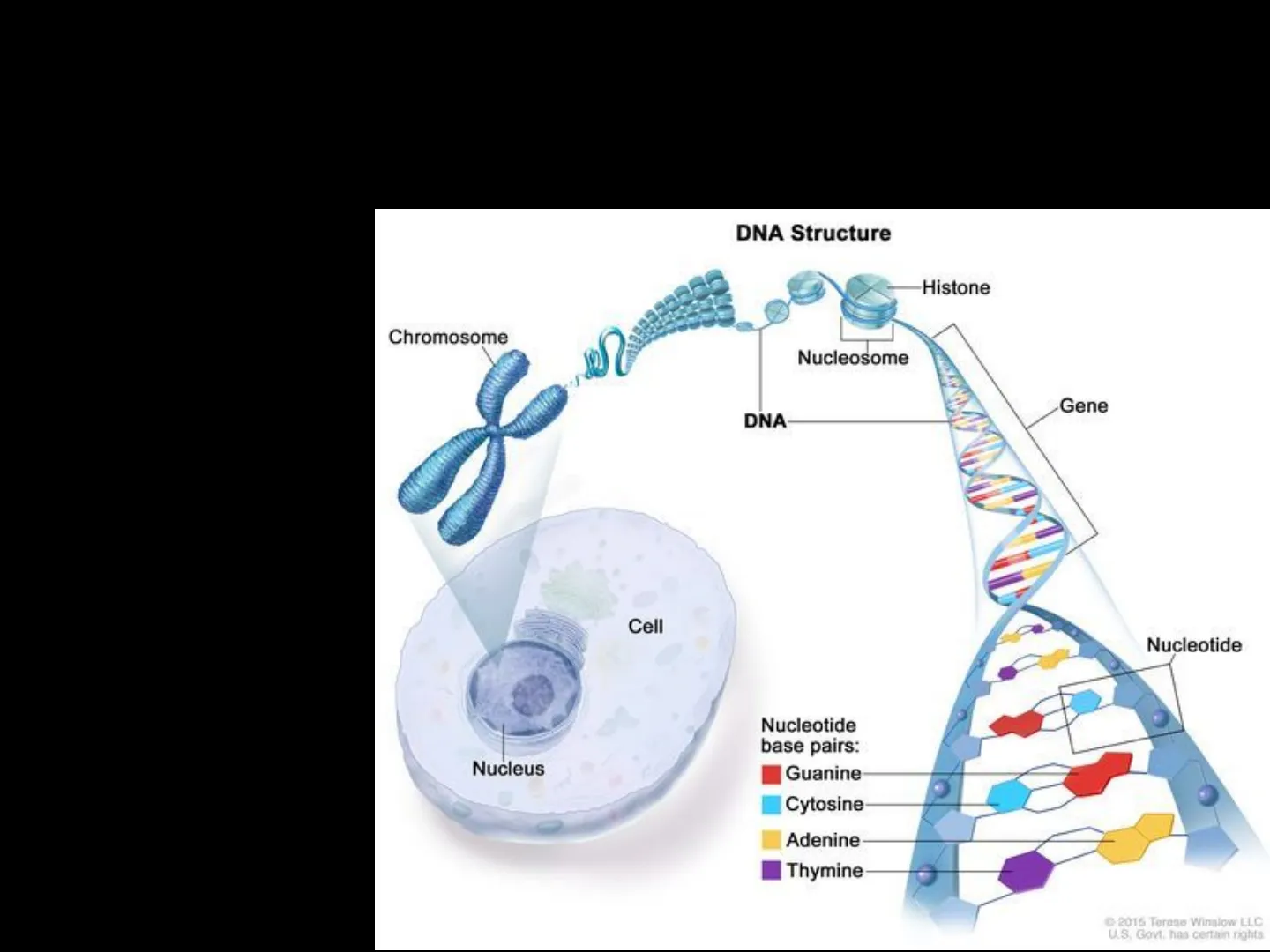
- Every cell has DNA, a Nucleic Acid that contains the Genetic Information.
DNA Structure
Histone Chromosome Nucleosome Gene DNA Cell Nucleotide Nucleotide base pairs: Nucleus Guanine Cytosine Adenine Thymine C 2015 Terase Winslow LLC U.S. Govt. has certain rights
Genetic Information: Nucleic Acids and RNA
- The expression of DNA, in proteins that make up structures and functions implies other Nucleic Acids, RNA.
DNA RNA Protein
Genetic Information Overview
- Nucleic acids structure: DNA and RNA - DNA replication - Genetic expression, from DNA to proteins: transcription and translation *the genetic code
Nucleic Acids Structure: DNA and RNA
Nucleic Acids Structure: RNA vs DNA
Nucleobases RNA One strand DNA Two Base pair strands in a double helix helix of sugar-phosphates RNA Ribonucleic acid DNA Deoxyribonucleic acid
Nucleic Acids Composition: Nucleotides
- are organic biomolecules (polymers*) composed of many smaller molecules: nucleotides (monomers*).
Nucleic Acid K Monomer = Nucleotides*Many big ORGANIC BIOMOLECULES (macromolecules) are polymers. Structure of Monomers and Polymers MONOMER A monomer is a small molecule. POLYMER A polymer is a long-chain molecule made up of a repeated pattern of monomers.
Nucleic Acids Structure: RNA vs DNA Polymers
DNA RNA @AmoebaSisters
Nucleotides Structure: Components
- Nucleotides structure: phosphate group, nitrogenous base and pentose sugar.
phosphate base deoxyribose sugar DNA structure Nucleotide Bases - Adenine Cytosine - Guanine Thymine 5' 1 5' 3' Thymine Adenine Guanine Cytosine Base Phosphate Sugar 3'
Nucleotides Structure: Detailed View
- Nucleotides structure: phosphate group, nitrogenous base and pentose sugar.
O 1 0-P -0-CH2 5 N-Base (A/T/G/C) 0 4 1 Phosphate H H H 3 2 H Pentose sugar OH H N o- 1 H O=P-O-CH 1 H N Phosphate group H H H Nitrogenous base (adenine) H - - OH H Pentose Sugar H H N H C N = 2= C-H 0 C= 1 H N N Adenine H H N N N
Nucleotides Structure: DNA vs RNA Comparison
- Nucleotides structure: RNA vs DNA.
Polymer: Nucleic Acid Monomer: Nucleotide Picture DNA 1. Phosphate 2. 5 Carbon Sugar - Deoxyribose 3. Nitrogenous Bases: Adenine Thymine Guanine Cytosine Base-Pair Rules: A - T G - C Bases pair connect with hydrogen bonds phosphate base deoxyribose sugar 1. Phosphate 2. 5 Carbon Sugar - Ribose 3. Nitrogenous Bases: Adenine Uracil RNA Guanine Cytosine Base Pair Rule: A - U G - C Bases pair connect with hydrogen bonds phosphate base ribose sugar wallpapersus.com
Nucleotides Structure: Pentose Sugar
- Nucleotides structure: RNA vs DNA pentose sugar.
5' carbon 5' HOCH2 OH O 4' C C 1' 1 エ ー エ ー H C C H [3' 2' 3' carbon OH H 5' carbon 5' HOCH2 OH O 1 4' C C 1' H H - 1 H C C H |3' 2' 3' carbon OH OH 2-Deoxyribose Ribose
Bonds Between Nucleotides: Phosphodiester Bonds
- Bonds between nucleotides: are covalent bonds, called phosphodiester bonds, that join the phosphate group of one nucleotide to the pentose sugar in the next nucleotide.
5' end O=P-O-CH2 T 0 I Č(1) H C C / (3) P T A P S $ CH. P A T P S CH2 S P CH2 G Base pair S CH3 $ P P CH S P Nucleokde DNA sugar- Sugit- phosphate bacibona Sugate molecule bases A T S S Hyrdragon borda P 1 G C P S S O H 3' to 5' phosphodiester bond O=P-O G O (5) CH2 O I C - 1 H C C H OH 3' end H G C S CH2 backbone C -I phosphate group
DNA Structure: Double Helix
- double helix: two strands held together by hydrogen bonds, between nitrogenous bases on opposite strands.
Nitrogenous base Nucleotide Thymine Adenine H Phosphate group 5' Phosphate HąC H-N N H 3 Hydroxyl Hydrogen bonds --- N O H N-H A 0=P-O-CH2 N N O H Sugar T A P C G Nucleotides H C N H CH Hydrogen bonds O N -H-N N H C G 0=P-O-CH2 N N H-N CH2-0-P=0 H 3 5' Hydroxyl Phosphate 3 5 CH2-0-P=0 -2-0 Cytosine Guanine h A T P G C P 3 5 O Deoxyribonucleic acid (DNA) Base Pairs O O T N-H-
Nucleotides Structure: Nitrogenous Bases
- Nucleotides structure: RNA vs DNA nitrogenous bases.
N H O H-N N N H2N Guanine N H H2N N N N H Adenine H NH3 H N H N-H H-N N O Thymine Uracil Purines N H H3C 0 --------- H-N H N-H -- N H-N N O H Pyrimidines N H H N-H - 0 H N - ---- H-N N N N O H-N H Thymine / Uracil pairs with Adenine (2 hydrogen bonds) Cytosine pairs with Guanine (3 hydrogen bonds) N-H N O O Cytosine H3C O H O H --- N
RNA Types
- 3 types: Messenger RNA, mRNA, carries genetic information of DNA, from the nucleus to the cytoplasm. Ribosomal RNA, rRNA, makes up ribosomes(with proteins). Transfer RNA, tRNA, carries amino acids to mRNA to form proteins.
1 Messenger RNA (mRNA) Ribosomal RNA (rRNA) Transfer RNA (tRNA)
DNA Replication, Transcription, and Translation
replication DNA transcription RNA translation Protein
DNA Replication Process
DNA replication
- process to create an exact copy of the DNA (to duplicate).
DNA Replication fork Helicase 3 5' 5' 3' RNA primers 3' 5' 5' 3 DNA polymerase Leading strand Replication fork 5' Okazaki fragments 3' 3 Okazaki fragments 5 P Lagging strand Replicated DNA
DNA Replication Step 1: Unwinding Strands
1 - specific enzymes break the hydrogen bonds between complementary nitrogenous bases, unwounding the strands in a replication fork.
DNA Replication fork 3' 5' Helicase 5' 3' RNA primers 3' 5' 5' 3'
DNA Replication Step 2: Adding Nucleotides
2 - specific enzymes add complementary nucleotides, one by one.
Chromosome Free nucleotides DNA polymerase Leading stran al ate) Helicase Lagging strand Replication fork Adenine Thymine Cytosine Guanine DNA polymerase Original (template) DNA
DNA Replication Step 3: Semiconservative Synthesis
3 - synthesis of two identical molecules in a semi-conservative way: each molecule contains ones strand from the original molecule (conserved) and a new one synthesized).
Semiconservative Parental DNA Replication
From DNA to Proteins: Transcription and Translation
DNA to Proteins: Gene Expression
- each DNA fragment is a gene that carries information to synthesize a protein that expresses a certain trait (structure or function in the cell/organism).
responsible for codes for PROTEIN DNA fragment Gene Characteristic or trait
DNA to Proteins: Processes Involved
- processes involved:
TRANSCRIPTION from DNA to RNA TRANSLATION from RNA to protein
DNA pre-mRNA RNA polymerase Transcription mRNA mRNA Translation Ribosome polypeptide
DNA to Proteins: Steps in Nucleus and Cytoplasm
1 - Transcription (DNA to RNA) happens inside the nucleus. 2- mRNA molecules exit the nucleus towards the cytoplasm, where they attach to a ribosome (rRNA). 3- Translation starts, tRNA bring the necessary amino acids for protein synthesis.
Nucleus 5' Growing amino acid chain DNA tRNA leaving Amino Acid Transcription Transport to cytoplasm tRNA codon RNA tRNA docking Ribosome 3' mRNA Cytoplasm Translation
DNA Transcription Process
- is the process by which the information in a strand of DNA is copied into a new molecule of messenger RNA (mRNA).
DNA M pre-mRNA RNA polymerase Transcription mRNA
RNA Translation Process
- is the process by which a protein is synthesized from the information contained in a molecule of messenger RNA.
mRNA Translation Ribosome polypeptide
RNA Translation Steps
1 - the messenger RNA binds to a ribosome. 2- the ribosome 'reads' the genetic message in groups of 3 nucleotides, codons. 3- the transfer RNA provides the specific amino acid for each codon. 4- amino acids are joined by peptide bonds, creating proteins.
newly born protein amino acids large subunit tRNA P site A site mRNA small subunit https://www.youtube.com/watch?v=TfYf rPWUdY
The Genetic Code: mRNA to Protein
- relates the mRNA nucleotide sequence to the amino-acid sequence of the protein: determines which amino acid corresponds to each group of three nucleotides codons) in mRNA. *Multiple codons can code for the same amino acid. *AUG is an initiation codon.
Second nucleotide U C A G UCU UAU Tyr UGU UGC Cys U C A Leu UCC UCA UCG Ser UAA STOP UAG STOP UGA STOP UGG Trp G CUU CCU CAU CUC CCC CAC c CUA CCA CAA CGA CUG CCG CAG CGG AUU ACU AAU AGU lle ACC AAC AGC A AUC AUA Thr AAA AGA AUG Met ACG AAG AGG GUU GUC GUA GUG GCU GAU Asp G Va GCC GCA GCG Ala GAA GAG Glu GGU GGC GGA GGG C Gly A G *UAA, UAG, and UGA are termination codons.
504000000 U C G C U U Third nucleotide Asn Ser First nucleotide Leu Pro UAC U UUU UUC UUA UUG Phe His CGU CGC Arg Gin ACA Lys Arg GAC
The Genetic Code Chart
Aspartic acid CAGUCAGUCAGUGA Tyrosine U GU G G A C C C A U C A Cysteine Valine A c Stop C U GU G A U G Tryptophan G U Arginine A G AC U C c A Leucine U G G A C U A C C C A G G c Proline CUGACUGACUGA Histidine Methionine Isoleucine Arginine Glutamine 3 Phenylalanine Leucine acid Glutamic Serine Alanine U Stop A G G U Serine A Lysine U GA U Asparagine Threonine 3' Glycine(Q)123RF
Amino Acids Structure
H H OH N+C-FC H 0 R Amino group Carboxyl group Side chain (0) 123RF H 0 H H N C C H 0 R R-CH(NH2) COOH Glycine creom/time dream/cÎne COOH dreamstime I H2N-C-H 6 1 H Alanine COOH I H2N-C -- H CH3 Aminoacids Tryptophan COOH HON-C-H CH 2 ZI H 6
Can’t find what you’re looking for?
Explore more topics in the Algor library or create your own materials with AI.