Ancient Mesopotamia and Egypt: Early River Civilizations
Slides about Ancient Mesopotamia and Egypt. The Pdf, a presentation for Middle school History, explores the geographical areas and main characteristics of early river civilizations, including artistic artifacts and the importance of rivers for development.
See more33 Pages


Unlock the full PDF for free
Sign up to get full access to the document and start transforming it with AI.
Preview
Ancient Mesopotamia and Egypt: Early Civilizations
UNIT 9 ANCIENTE MESOPOTAMIA AND EGYPTWHERE DID THE EARLIEST CIVILIZATIONS APPEAR?
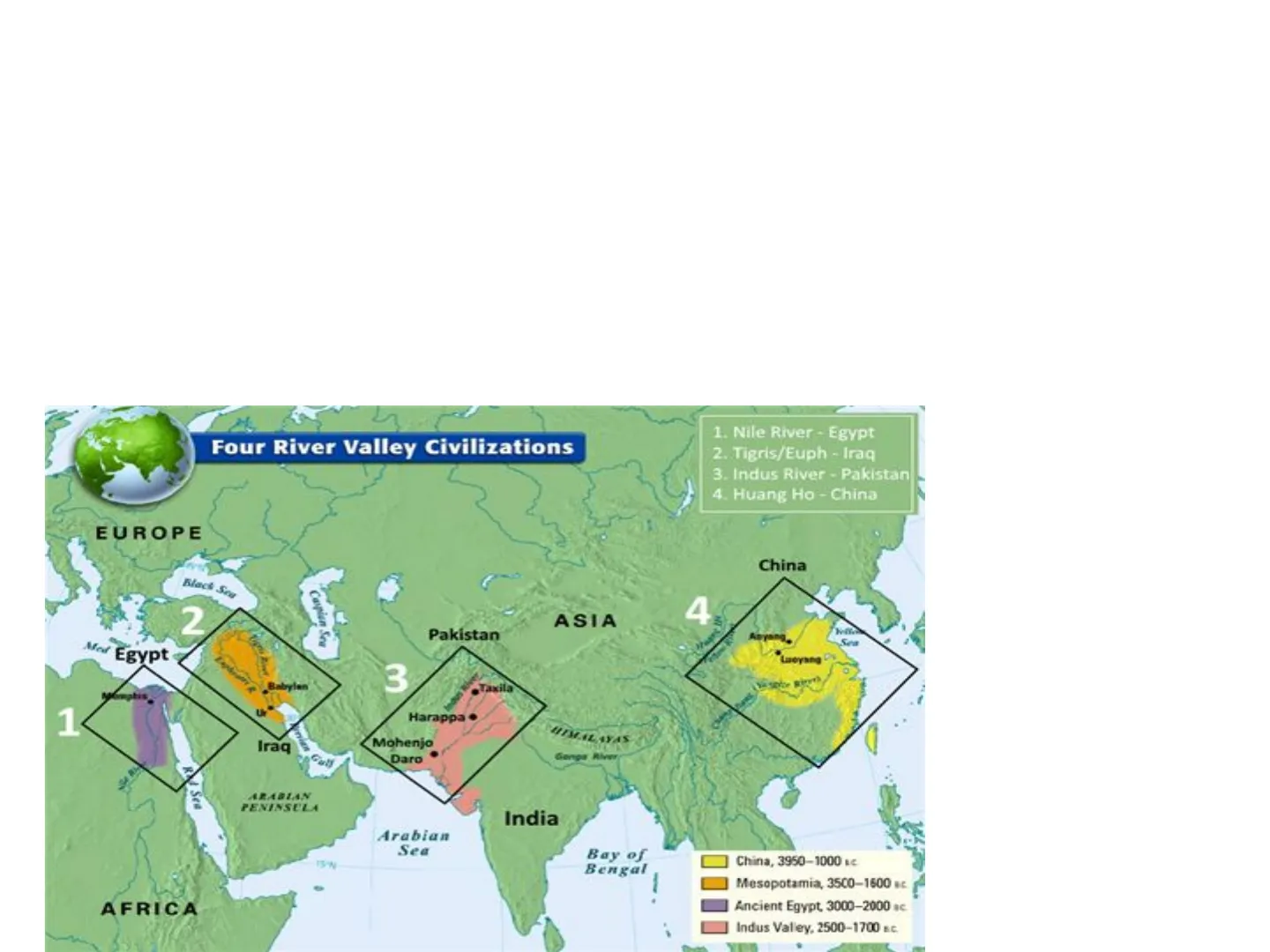
- River civilizations appeared in:
- Mesopotamia Tigris y Euprhates
- Egypt Nile
- India Indus
- China Huang He and Yangze .Rivers let them increase their harvest making possible that this farming small communities convert into cities
- Nile River - Egypt Four River Valley Civilizations
- Tigris/Euph - Iraq
- Indus River - Pakistan
- Huang Ho - China
EUROPE China Black Sea Caspian Sca 4 ASIA Anyang. Sea Med Egypt 3 Taxila 1 Harappa · Iraq Mohenjo Daro Genga River Rat Sca ARABIAN PENINSULA India Arabian Sea Bay of Bengal China, 3950-1000 c Mesopotamia, 3500-1600 mc Ancient Egypt, 3000-2000 ac AFRICA Indus Valley, 2500-1700 sc. 2 Pakistan Laoyang Babylen HIMALAYASTHE
The Importance of Writing
- Writing appeared in Mesopotamia in about 3500 BC
- Uses of the writng: .To keep a record of taxes, trade and population .Make the administration easier ·Transmit better the knowledge ·The birth of the writing is the beggining of History for Historians.The Mesopotamians wrote on tablets of damp clay, which were then left dried or cooked in an oven.
- It was written with a sharp cane.
- The strokes were wedge-shaped. That is why it is called cuneiform writing.
- The signs represented concepts but also sounds. This made it very is hard to learn.
- https://www.youtube.com/watch?v=HbZ2asfyHcA
- The Egyptians wrote with brushes on papyrus or on stone.
- They represented the meaning of words through drawings of figures or symbols.
- It's called hieroglyphic writing.
- Your meaning could be deciphered thanks to the discovery of PIEDRA ROSETTACHARACTERISTICS OF RIVER CIVILIZATIONS
Characteristics of River Civilizations
- The abundant of the harvests has the following consequences: .Not everybody had to work the land ·New jobs (potter, metalsmith) .The excess of products was change for other ones (trade) .Transport lines to develope the trade
- Also, there were political changes: ·King Made laws Led the army Collect taxes Built large monuments ·Administration state officials helped the king to rule ·Large-scale building worksMESOPOTAMIA
Mesopotamia
Mesopotamian civilization developed in the fourth millenium BC in the region between Tigris and Euphrates Rivers in Greek Mesopotamia means between rivers . Çatalhöyük Euphra Mediterranean Sea Tigris POTAMI Jericho Fertile Crescent Nile First towns 0 km 400 Red Sea Persian Gulf 0 miles 400MESOPOTAMIAN
Mesopotamian Society
G A HIS FAMILY PRIEST AND NOBLES TRADERS AND CLEKS (MERCHANTS, SCRIBES) PEASANTS AND CRAFTSMEN SLAVESECONOMY
Mesopotamian Economy
- The Agriculture: .Cereals (especially barley) and vegetables (onions, lettuce, garlic .) .Livestock: cows, sheep, goats and donkeys. .Craftsmen made pots, woolen fabrics, leather objects, etc.
- The trade had great importance: ·Mesopotamia bought raw materials (stone, wood, metals) that it did not have. .And sold wool, cereals, etcRELIGION
Mesopotamian Religion
- It was polytheistic: ·ANU, god of heaven, was the most ·important. .ENLIL, god of the air. .ENKI, god of wisdom. .ISHTAR, goddess of love and fertility and war.
- They considered that the gods dominated the world and they celebrated long ceremonies in his honor.
- The Mesopotamians believed in life after the death
- The priests were in charge of predicting the future and interpreting the messages of the gods. These functions gave him a lot of power.ART: ARQUITECTURE
Mesopotamian Art: Architecture
- The main material was adobe because there weren't wood and stones
- The main structural elements were: Arch VaultMAIN BUILDINGS
Main Mesopotamian Buildings
The Palaces
- Buildings Where the king, his family and the court live
- They had courtyards, rooms, libraries,
The Ziggurats
- They're temples in the form of a stepped tower formed for several floors of great height.
- In its upper part, it was installed a temple. LnnonART: SCULPTUREART: RELIEFS
Mesopotamian Art: Sculpture and Reliefs
Stele of Naram-Sin Code of HammurabiEGYPT
Egypt
- It developed along River Nile more than 5,000 years ago
- Nile flows from south to north
- Black land: it was covered by dark fertile mud from the river
- Red lands was the dry deserts
- Nile provided water for human needs and agriculture
- Also, it' was a route of communicationsMedilendnain Sas NILE RIVER BASIN BASSIN DU NIL 3004 · ELECTED CINES / VALES * NATIONAL CAPITALS / CAPTĂLES NATIONALES CARO MAIN ROADS / AXES ROUDERS PRINCIPAUX ARAB REP. OF EGYPT Lower Egypt Rod Sea JeHoved Doe-gole CHAD ERITREA KHART OUM ISN ASHARAS - I I SUDAN DIEOUT Dewe CE Upper Egypt UGANDA M. REP. FCONGO KENYA O ala RWANDA INDIAN OCEAN DWUWURAT BURUNDI- 200 TANZANIA 100 DODOMA 44 E ETHIOPIA SOMALIAHISTORY OF EGYPT
History of Egypt
Old Kingdom
- Among the 3100 and the 2050 a. C.
- Egypcian state was created
- It had the capital in Memphis.
- It's the period where is they built the pyramids more important, of the pharaohs Khufu, Khafra and Menkaura They built the pyramids of Giza
Middle Kingdom
- Among 2050 and the 1580 a. C.
- The capital moved to Thebes.
- There was a increase of the territory in the south.
- It disappeared by the invasion of the Hyksos, a nomadic people that dominated the territory during two centuries.
New Kingdom
- After the period of Hyksos domain, in 1580 begins on called New Empire.
- It is a period of great prosperity
- Libya and Syria were conquered
- Most important faraons: Amenhotep III, Akenaten, Ramses II.SOCIETY
Egyptian Society
Pharaoh Goverment Officials, Nobles, Priests Soldiers LE Scribes Merchants Craftsmen Farmers & Slaves www.ancient-egypt-online.comECONOMY
Egyptian Economy
- Agriculture, as in Mesopotamia, was the most important activity. They cultivated: ·cereals (bread and barley were fundamental in their diet). ·linen (to make dresses) ·vegetables
- The most important cattle were bovine, although they also raised sheep, goats, ducks ...
- The main items of craftsmanship were ceramics, jewellery, textils, wood, etc.
- Foreign trade was very developed, especially with Mesopotamia, Greece and the Southern towns.RELIGION
Egyptian Religion
- The Egyptian religion was polytheistic: ·Animals .Natural forces ·People (Pharaon)
- Egyptians believed that there was life after death: ·they thought that in that other life the spirit needed the body. .Therefore, they performed the mummification (they emptied the body, they impregnated it of diverse substances and wrapped in bandages).7 0 C Anubis Horus Bastet Thot Hathor RaART: ARCHITECTURE
Egyptian Art: Architecture
- Main buildings: .Tombs ·Temples
- Characteristics: -the colossal size of buildings -the use of large blocks (blocks rectangular stone) to build the walls -the use of columns - the use of lintel constructions (vertical supports on which place a horizontal piece or lintel)TEMPLE
Egyptian Temple Structure
5 4 3 2 1 Parte accesible al pueblo Zona accesible a altos dignatarios Dependencias reservadas a los sacerdotes 1 2 3 4 5ART: TOMBS
Egyptian Art: Tombs
Mastaba Tombs
- Destined to Pharaoh and other important people.
- They had a pyramid shape cut on the top.
- Two parts: ·room of offerings, with a statue, ·underground camera for the death body.
Pyramids
- Reserved to Pharaoh and his family.
- In the interior, there were numerous halls and corridors forming a labyrinth.
- In the mortuary chamber they deposited the body and its trousseaus
Hypogeum Tombs
- Tombs excavated in the rock. Cámara sepulcral Seccion de un hipogeoKing's Chamber with relieving chambers above 'Air shafts' 'Air shafts' 'Queen's Chamber' Grand Gallery Horizontal passage Ascending passage Entrance Enclosure wall Descending passage Two southern boat pits Eastern boat pit Subterranean chamber Eastern boat pit Mortuary temple Satellite pyramid and boat pit Boat pit Gl-a GI-b Causeway GI-c Boat pit Queens' pyramidsART: SCULPTURE
Egyptian Art: Sculpture
- religious purpose.
- materials (stone, wood)
- Their characteristics were different according to they represented the pharaoh or the high officials: ·- the figures of Pharaoh and his family are always idealized .They present a rigid posture; .The face is expressionless. ·- the figures of the high officials are more realistic.19180 EL ) العامART: PAINTING
Egyptian Art: Painting
- Hierarchical order
- No perspective
- The colors were obtained from various minerals
- People are seen from the front (eye, body) and in profile (head, legs, arms)
- Idealised
- Static
- Egyptian painting has been very useful to know their daily life: river, plants, animals and people.6
Can’t find what you’re looking for?
Explore more topics in the Algor library or create your own materials with AI.
