From the Celts to the Normans: Britain's Invaders History
Slides from the Celts to the Normans. The Pdf traces the history of invasions in Great Britain, from the Celts to the Normans, detailing social, economic, and religious aspects of each people. The Pdf, suitable for high school History, presents the main arguments in a clear and concise way, with schemes and images.
See more16 Pages

Unlock the full PDF for free
Sign up to get full access to the document and start transforming it with AI.
Preview
The Celts: 700 BC - 43 AD
From the Celts to the NormansThe invaders of Britain ca 700 BC - 43 AD The Celts 43 AD The Romans 5th century The Angles and the Saxons from Germany and Scandinavia 9th century The Vikings arrived from Denmark and Norway 1066 The Normans came from FranceThe Celts: 700 BC - 43 AD Boadicea statue, Westminster Bridge, London. . They began to arrive from Western Germany in the late Iron Age . They were tribes of worriors who shared a similar language, religion and culture
- Women were almost equal to men. They could lead men in battle.
Celtic Economy and Society
. They did not invade Britain but gradually settled in the country . They were hunters, fishermen and metal workers and also practiced agricolture . They worked iron (weapons independence) and introduced the iron plough, which made the cultivation easier . They lived in small villages or farming communities and built hill forts, groups of houses built on top of hills. People lived in huts made of wood . The basic unit of Celtic society was the clan
Celtic Religion and Symbols
TRIQUETRA Infinity and eternity, the circle means spiritual union. TREE OF LIFE The connection between our world, nature, earth, and sky. TRISKELION Balance between mind, body, and soul. CROSS Balance, faith, hope, and wisdom. BUTTERFLY Represents a stage of personal transition. CLOVER Associated with Irish culture, symbolizes magic, faith, and love. . They worshipped the natural elements: sun. moon, water (source of life) . They believed in the transmigration of the soul
- that life after death was spent in hills or lakes
- The Druids were their priests
Halloween Origins
- Halloween's origins can be traced back to the ancient Celtic festival known as Samhain, which was held on November 1
- It was believed that on that day, the souls of the dead returned to their homes, so people dressed in costumes and lit bonfires to ward off spirits
- It is the story of Jack O'Lantern
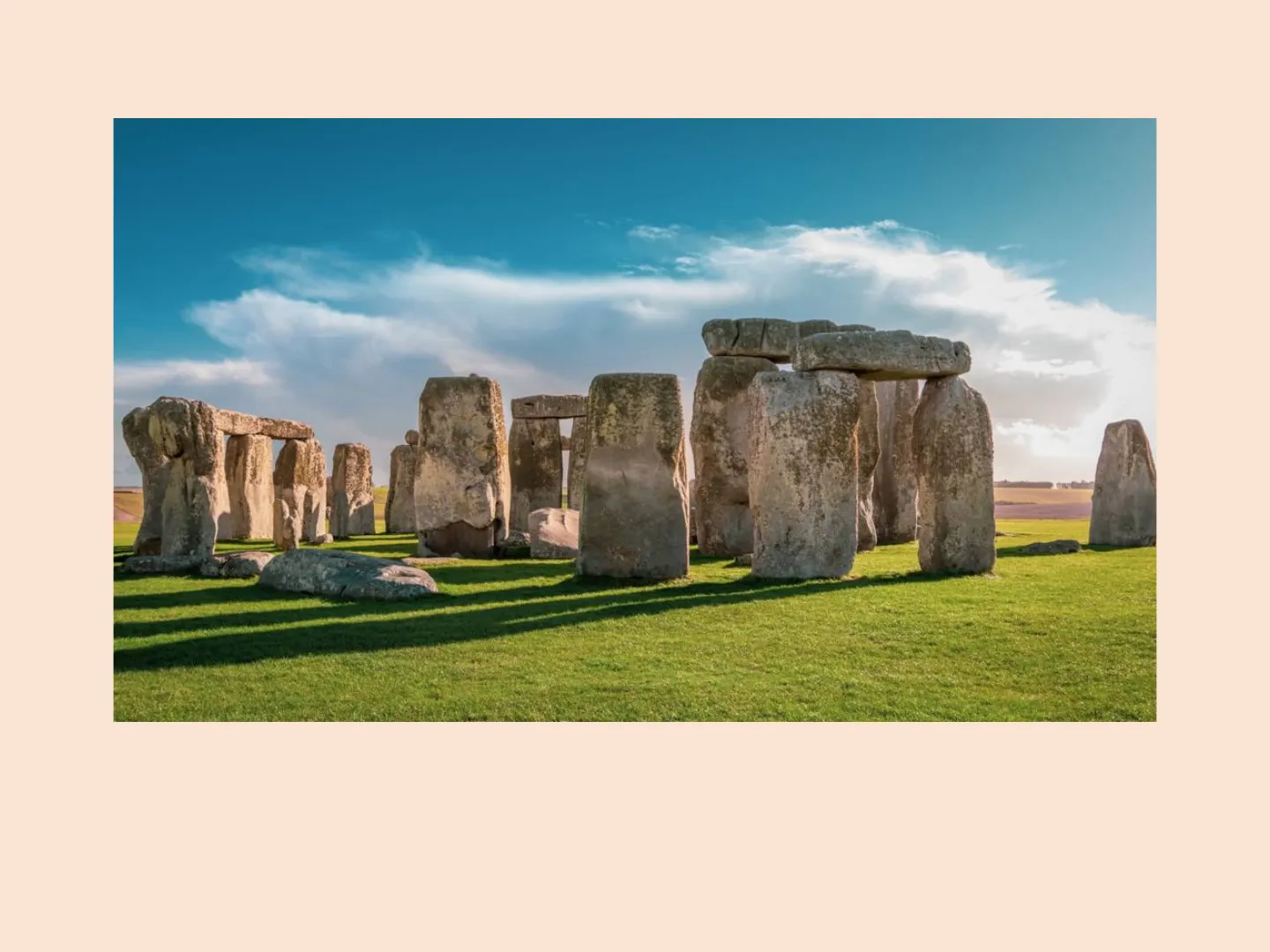
Stonehenge Monument
- It is a prehistoric megalitic structure in Salisbury, which consists of an outer ring of vertical standing stones, topped by horizontal stones. Inside is a ring of smaller bluestones and free-standing trilithons. The monument is aligned towards the sunrise on the summer solstice and sunset on the winter solstice.
- It is regarded as a British cultural icon, added to UNESCO's list of Wolrd Heritage Sites in 1986, owned by the Crown.
The Romans: 43 - 409 AD
- In 55 and 54 BC Julius Caesar invaded Britain, but the real conquest began in the years 43-47 AD under Emperor Claudius
- The Romans encouraged the growth of towns near their army bases
- The origin of London (Londinium) can be related to the Roman invasion.
- They built the Hadrian's Wall
Reasons for Roman Invasion
Why did the Romans invade Britain? attracted by the rich agriculture of the south, the tin and lead in the west availability of slaves Britain's strategic position as an offshore base 43-47 AD 47-59 AD 61-74 AD 78-84 AD HIBERNIA Londinium.The Romans . They created settlement of Londinium on the Thames · The names of many towns founded, like Doncaster, Gloucester, Manchester, derive from the word castrum, the Latin word for the fortified military camp . They brought Latin . They introduced Cristianity
The Anglo-Saxons: 410-1066
- The Angles, the Saxons and the Jutes, known collectively as the Anglo-Saxons, came from the North Sea regions of Northern Europe and invaded Britain over the course of the 5th and 6th centuries.
- They were illiterate and used runic dialects
- They settled south of Hadrian's Wall.
- They were farmers and deep-sea fisherman who hunted seals and whales in the ocean.
Anglo-Saxon Society
NORTHUMBRIA York ·Chester MERCIA EAST ANGLIA ESSEX London. KENT Winchester Canterbury WESSEX SUSSEX . They were organised in family groups or clans and lived in wooden houses. · Loyalty to family and lord was the most important value and exalted physical courage and personal freedom. · The language spoken evolved over time and became known as Old English. . They formed seven kingdoms known as the Heptarchy. · The kingdom of Wessex became the most important in 829.
Anglo-Saxon Christianisation
The Canterbury Tales . At first, they worshipped several Gods: that's why the Christianity introduced by the Romans disappeared at the end of the 6th century. · In 597 Pope Gregory I sent Bisho Augustine, to bring Christianity back to England. . Augustine became the first Archbishop of Canterbury, whose Cathedral was founded in 602 and many monasteries were built. · The names of days and place names (Birmingham, Southampton) come from Anglo-saxon words
The Danes: 793-1066
- The Vikings came to Britain between the 8th and the 9th centuries
- Called 'Danes' by the English, they came from Norway, Sweden and Denmark
- In 793 they attacked the monastery of Lindisfarne and gradually settled in the country
- By the 9th century they occupied England
- Their language blended with that of the local population name places ending in -thorpe, -by and -kirk.
Alfred the Great
- King Alfred the Great of Wessex united the Anglo-Saxons against the Vikings defeating them in 871 in the battle of Edington
- In 879 Mercia accepted his lordship: he established fortified towns, the coinage and an English law
- Established the capital at Winchester
- Alfred commissioned the writing of a history of England (Anglo-Saxon Chronicle)
- Alfred's son Edward conquered Midlands and East Anglia, his son Athelstan conquered Northumbria in 927, crating the kingdom of all England
The Viking Kings
SWEYN FORKBEARD . The Viking violence returned to England in 990
- In 1012 they murdered the Archbishop of Canterbury and Sweyn was the first Viking king on the throne
- The last one was Edward, who died childless
- He was succeeded by Harold II of Wessex, the last Anglo-Saxon king.
The Normans: 600-1066
- The Normans were Vikings who had settled in northern France
- They were led by William, Duke of Normandy
- He invaded Britain in 1600 defeating Harold II at Hastings: Harold died hit in the eye with an arrow
- William was later crowned William I in Westminster Abbey on Christmas Day the same year
- The Norman Conquest unified the country under a monarchy and provided it with the foundation of the medieval state
Can’t find what you’re looking for?
Explore more topics in the Algor library or create your own materials with AI.
