Gas Exchange Physiology: Diffusion Through The Respiratory Membrane
Slides from Department of Medicine & Surgery about Gas Exchange. The Pdf, a university-level biology presentation, details the physics of gas exchange, diffusion across the respiratory membrane, and ventilation/perfusion ratio, including clinical implications of Fick's Law.
See more36 Pages

Unlock the full PDF for free
Sign up to get full access to the document and start transforming it with AI.
Preview
GAS EXCHANGE PHYSIOLOGY LECTURES
2nd year of Medicine. 2024/2025 Dr Ana Checa-Ros MD, PhD Department of Medicine & Surgery
CO2 02 CO2 Physiology @ 2024 by Ana Checa-Ros is licensed under CC BY-NC 4.0ROADMAP
Physics of Gas Exchange
C A F.PSV Stock" PHYSICS $ 18 A P m&m.
Gas Diffusion Through The Respiratory Membrane
Ventilation / Perfusion Ratio
Ventilation/Perfusion Deoxygenated blood from pulmonary artery Alveolus capillary Images.google.com(A F.PSV (+) PHYSICS A m,<m.
Physics of Gas Exchange: Diffusion
- Diffusion is the random movement of molecules through a membrane
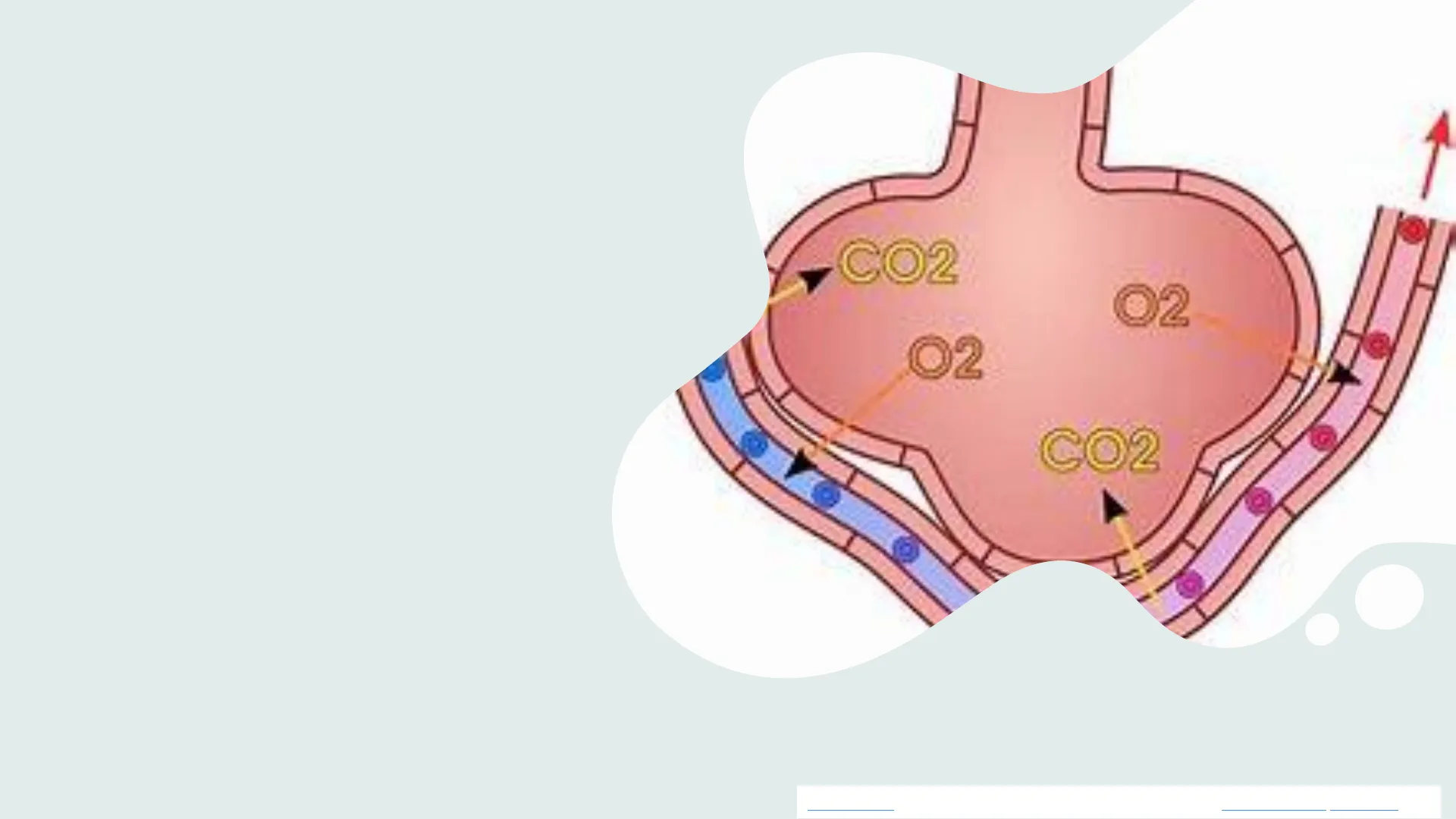
- In the respiratory system, the oxygen (02) diffuses from the alveoli into the pulmonary blood, and the carbon dioxide (CO2) diffuses out of the blood into the alveoli Alveolus Blood Capillary 02 in CO2 out
Physics of Gas Exchange: Pressure Gradient
- The diffusion of a gas occurs according to a pressure gradient: from high-pressure areas to low-pressure areas
- The pressure is directly proportional to the concentration of gas molecules
- Therefore, the gas moves from where it is highly concentrated (high pressure) to where it is lowly concentrated (low pressure) (A F.PSV (+) PHYSICS A P H m,<m.
Physics of Gas Exchange: Dissolved Gas Molecules
Dissolved gas molecules A B
- Diffusion of a gas from one end of a chamber to the other: there are far more molecules to diffuse from end A to end B (concentration-pressure gradient), than there are molecules to diffuse in the opposite direction (as given by the lengths of the arrows) Extracted from: Guyton & Hall Physiology (A F.PSV (+) PHYSICS A 1 m,<m.
Gas Diffusion Through The Respiratory Membrane: Structure
- In the lungs, the membrane through which gases diffuse is called the respiratory membrane or alveolo-capillary membrane, which thickness averages between 0.2-0.6 micrometers ALVEOLAR CELLS ALVEOLO- CAPILLARY MEMBRANE 0 CO2 PULMONARY CAPILLARY o O Extracted from: Osmosis.org
Alveolo-Capillary Membrane Composition
- The alveolo-capillary membrane is composed of: 1) The alveolar epithelium 2) The alveolar basement membrane 3) The interstitial space (interstitium) 4) The capillary basement membrane 5) The capillary endothelium Alveolar epithelium Epithelial basement membrane Alveolo-capillary membrane Fluid and surfactant layer Capillary Alveolus Diffusion O2 Diffusion CO2 Red blood cell Interstitial space Capillary endothelium Capillary basement membrane Extracted from: Guyton & Hall Physiology
Gas Diffusion Through The Alveolo-Capillary Membrane: Pressure Dependence
- Diffusion through the alveolo-capillary membrane depends on the pressure of each gas in the alveolus and in the capillaries:
- pO2 is greater in the alveoli than in the blood; therefore, O2 diffuses from the alveoli to the capillaries
- pCO2 is greater in the blood than in the alveoli; therefore, CO2 diffuses from the capillaries to the alveoli 0 O TO 0 Extracted from: Osmosis.org
Gas Diffusion Through The Alveolo-Capillary Membrane: Fick's Law
- However, in the lungs, gas diffusion does not only depend on the difference in gas pressures across the alveolo-capillary membrane
- Gas diffusion across the alveolo-capillary membrane also depends on other factors, in accordance with the Fick's Law Kamwica Adolf Fick (German physiologist)
Fick's Law of Diffusion
- In accordance with the Fick's Law, diffusion is:
- directly proportional to
- Pressure gradient across the alveolo-capillary membrane
- Surface area of the alveolo-capillary membrane
- inversely proportional to
- Alveolo-capillary membrane thickness
Fick's Law Diagram
FICK'S LAW PRESSURE GRADIENT L PARTIAL PRESSURE of GAS in: ALVEOLAR SACS - BLOOD SURFACE AREA Partial pressure in the alveolus (PA-Pa)A D : DIFFUSION T WALL THICKNESS 0 PA TO Pa Partial pressure in the capillary Extracted from: Osmosis.org
Clinical Implications of Fick's Law: Membrane Thickening
- Clinical Implications of the Fick's Law: 1) There are certain lung conditions, in which the alveolo-capillary membrane thickens. This happens in:
- Pulmonary fibrosis (chronic inflammation of the lung)
- COPD (chronic obstructive pulmonary disease, mainly due to smoking)
- Pneumonia (infection) O 0 0 0 0 0
Impact of Membrane Thickening on Diffusion
- What do you think it will happen to diffusion in accordance with the Fick's law if the alveolo-capillary membrane thickens? FICK'S LAW PRESSURE GRADIENT L PARTIAL PRESSURE of GAS in: ALVEOLAR SACS - BLOOD SURFACE AREA- V= NET RATE of DIFFUSION P (PA-Pa)A TTT WALL THICKNESS PA 0 e Pa
Diffusion Change with Membrane Thickening
- What do you think it will happen to diffusion if the alveolo- capillary membrane thickens according to the Fick's law? A) Diffusion will increase B) Diffusion will decrease C) Diffusion will not change
Diffusion Change with Alveolo-Capillary Membrane Thickening
- What do you think it will happen to diffusion in accordance with Fick's law if the alveolo-capillary membrane thickens? A) Diffusion will increase B) Diffusion will decrease C) Diffusion will not change
Clinical Implications of Fick's Law: Membrane Thickening and Diffusion
- Clinical Implications of the Fick's Law: 1) There are certain lung conditions, in which the alveolo-capillary membrane thickens. This happens in:
- Pulmonary fibrosis (chronic inflammation of the lung)
- COPD (chronic obstructive pulmonary disease, due to smoking)
- Pneumonia (infection) Diffusion will decrease 7 Gas exchange will decrease
Clinical Implications of Fick's Law: Emphysema
- Clinical Implications of the Fick's Law: 2) There is another lung condition, called emphysema, in which the walls of the alveoli are destroyed. This is caused by tobacco and genetic disorders. Emphysema Extracted from: Osmosis.org
Emphysema and Alveolar Wall Destruction
- Clinical Implications of the Fick's Law: 2) In emphysema, the massive destruction of the alveolar walls reduces the total surface area that allows gas exchange Emphysema Extracted from: Osmosis.org
Impact of Alveolar Wall Destruction on Diffusion
- What do you think it will happen to diffusion in accordance with the Fick's law if the alveolar walls are destroyed? FICK'S LAW PRESSURE GRADIENT L PARTIAL PRESSURE of GAS in: ALVEOLAR SACS - BLOOD SURFACE AREA- (PA-Pa)AVV V = T WALL THICKNESS PA 0 NET RATE of DIFFUSION e Pa
Diffusion Change with Alveolar Wall Destruction
- What do you think it will happen to diffusion in accordance with the Fick's law if the alveolar walls are destroyed? A) Diffusion will increase B) Diffusion will decrease C) Diffusion will not change
Diffusion Change with Destroyed Alveolar Walls
- What do you think it will happen to diffusion in accordance with the Fick's law if the alveolar walls are destroyed? A) Diffusion will increase B) Diffusion will decrease C) Diffusion will not change
Clinical Implications of Fick's Law: Emphysema and Gas Exchange
- Clinical Implications of the Fick's Law: 2) In emphysema, the massive destruction of the alveolar walls reduces the total surface area that allows gas exchange Diffusion will decrease L Gas exchange will decrease
Ventilation/Perfusion Ratio: Definition
Ventilation/Perfusion Deoxygenated blood from pulmonary artery Alveolus capillary Images.google.com
- The relationship between alveolar ventilation and perfusion, or the ventilation/perfusion ratio, is used to distinguish the causes and different types of pulmonary diseases Alveolar Ventilation (V) Perfusion (Q) PULMONARY BLOOD FLOW The amount of air in the alveoli (litres/min) AIR (LITERS/MINUTE) The cardiac output reaching the pulmonary arteries (litres/min) OSMOSIS
Normal V/Q Ratio
Ventilation/Perfusion Deoxygenated blood from pulmonary artery Air Alveolus capillary Images.google.com
- In conditions of health, when the alveoli are well ventilated and have excellent blood flow, the V/Q ratio is about 0.8 ALVEOLAR VENTILATION (V) PERFUSION (Q) when the LUNGS are UPRIGHT & at REST: V = 4 L/min = 0.8 ratio Q = 5 L/min Extracted from: Osmosis.org
V/Q Mismatch
Ventilation/Perfusion Deoxygenated blood from pulmonary artery Air Alveolus capillary Images.google.com
- Any change to the alveolar ventilation or perfusion will change the V/Q, causing what we know as V/Q mismatch
- The presence of V/Q mismatch changes the partial pressures of O2 and CO2 across the alveolo-capillary membrane, limiting gas exchange Extracted from: Osmosis.org
Types of V/Q Mismatch: Inadequate Perfusion
- Types of V/Q mismatch: 1)Perfusion (Q) not adequate:
- This happens when blood flow to the alveoli is reduced; but alveoli are well ventilated
- As Q is low and V is normal, the V/Q ratio increases; in severe conditions, Q may be 0, so the V/Q ratio equals infinity Ventilation/Perfusion Deoxygenated blood from pulmonary artery Air Alveolus capillary Images.google.com Extracted from: Osmosis.org
Pulmonary Embolism and V/Q Mismatch
- Types of V/Q mismatch: 1)Perfusion (Q) not adequate:
- An example of this situation is a pulmonary embolism, in which there is a blood clot blocking the capillary, so that the blood is not reaching the alveoli Ventilation/Perfusion Deoxygenated blood from pulmonary artery Air Alveolus capillary Images.google.com PULMONARY EMBOLISM BLOOD FLOW I ( LOW Q ) GOOD VENTILATION (NORMAL V) Extracted from: Osmosis.org
Pulmonary Embolism and Dead Space
- Types of V/Q mismatch: 1)Perfusion (Q) not adequate:
- In a situation of pulmonary embolism, the total dead space is higher than the anatomic dead space, as the air in the alveoli not receiving enough blood flow is not participating in gas exchange Ventilation/Perfusion Deoxygenated blood from pulmonary artery Air Alveolus capillary Images.google.com PULMONARY EMBOLISM BLOOD FLOW I (LOW Q) DEAD SPACE GOOD VENTILATION (NORMAL V) Extracted from: Osmosis.org
Types of V/Q Mismatch: Inadequate Ventilation
- Types of V/Q mismatch: 2) Ventilation (Q) not adequate:
- This happens when blood flow to the alveoli is normal, but the alveoli are not well ventilated
- As Q is normal but V is reduced, the V/Q ratio reduces; in severe conditions, when V reaches 0, the V/Q ratio may be 0 Ventilation/Perfusion Deoxygenated blood from pulmonary artery Air Alveolus capillary Images.google.com Extracted from: Osmosis.org
Can’t find what you’re looking for?
Explore more topics in the Algor library or create your own materials with AI.