Molecules, Genes and Disease 2025: Genetic Mutations and Their Impact
Slides from The University of Buckingham about Molecules, Genes and Disease 2025. The Pdf explores genetic mutations, including point mutations, insertions, and deletions, and their impact on gene expression and diseases. This University level Biology material, produced in 2025, offers a detailed overview of the subject.
See more37 Pages


Unlock the full PDF for free
Sign up to get full access to the document and start transforming it with AI.
Preview
Mutations
Session 3
Lecture 3.2
04.02.2025
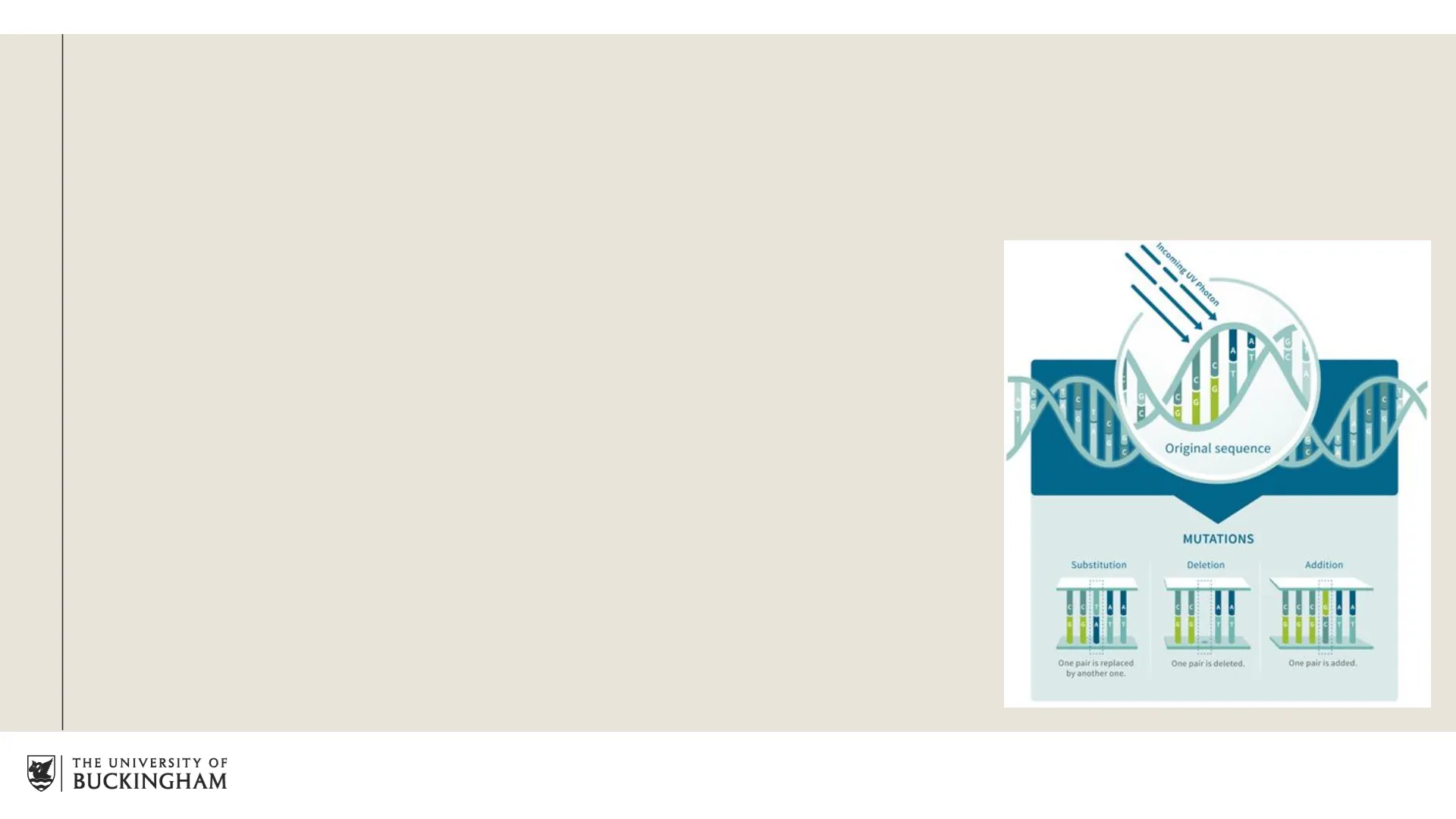
Incoming UV Photon
-
A
C
C
G
C
G
G
Original sequence
Types of Mutations
Substitution
Deletion
Addition
.....
One pair is replaced
by another one.
One pair is deleted.
One pair is added.
Dr. Anusha Sathyanarayanan
anusha.sathya@buckingham.ac.uk
THE UNIVERSITY OF
BUCKINGHAM
Learning Outcomes
- Describe the different types of mutational changes, e.g. point mutation, insertion, deletion
- Explain the effect that different mutations may have, e.g. silent mutation, missense mutation, nonsense
mutation, frameshift mutation - Describe how spontaneous and induced mutations may occur
- Describe the genetic link between mutation and mutant phenotype and explain how some mutations can be
inherited - Describe the process and the role of DNA repair
- Explain the relationship between DNA damage and cancer
- Describe the fundamental importance of PCR in the diagnosis of genetic disease
- Describe the different genetic tests available for the detection of mutations in genes
- : Explain some of the ethical issues associated with genetic testingGenetic variation
There are two major sources of genetic variation:
- MUTATIONS
o Permanent alteration to DNA sequence
o Mutations create new alleles in a population - RECOMBINATIONS
o Independent assortment of chromosomes and
genetic crossing over (or recombination) between
chromatids of homologous chromosomes during
meiosis (223 = > 8 million possible combinations !)
Original
Original
TITT
Correct
copy
Mutant
copy
THE UNIVERSITY OF
BUCKINGHAM
Germ-line and Somatic Mutations
Mutations can occur in germ-line cells or somatic cells
SOMATIC
somatic mutation
local effect
germline
mutation
-
GERMLINE
entire organism
will be affected
Without mutations, evolution would not be possible: mutations provide the "raw material" upon
which the mechanisms of natural selection can act; by way of this process, those mutations that
furnish individual organisms with characteristics better adapted to changing environmental conditions
are passed on to offspring at an increased rate, thereby influencing the future of the species.
THE UNIVERSITY OF
BUCKINGHAM
Types of DNA Mutations and Their Impact
Class of Mutation
Type of Mutation
Associated human
disease(s)
Substitution
Sickle-cell anaemia
Point mutation
Insertion
One form of ß-
thalassemia
Deletion
Cystic fibrosis
Inversion
Opitz-Kaveggia
syndrome
Deletion
Cri du chat
syndrome
Chromosomal
mutation
Duplication
Some cancers
Translocation
Some forms of
leukaemia
Copy number
variation
Gene amplification
Some cancers
Expanding
trinucleotide repeat
Fragile X syndrome
Huntington's disease
THE UNIVERSITY OF
BUCKINGHAM
https://www.nature.com/scitable/topicpage/genetic-mutation-441/
Point Mutation: Base Substitutions
A point mutation is a type of mutation where a single
nucleotide in the DNA sequence is changed,
inserted, or deleted.
Point mutations are the most common type of
mutation and there are 2 types:
- Transition: a purine is substituted with another purine
or when a pyrimidine is substituted with another
pyrimidine - Transversion: a purine is substituted for a pyrimidine
or a pyrimidine replaces a purine
Transitions:
pyrimidine to
pyrimdine
purine to
purine
T
c
A
G
Transversions:
pyrimidine
to purine
purine to
pyrimidine
A
₸
T
A
G
C
C
.
G
A
T
THE UNIVERSITY OF
BUCKINGHAM
Point Mutations in Protein-Encoding Sequences
Point mutations that occur in DNA protein-encoding
sequences can be:
- Silent: base substitution results in the generation of a
codon for the same aa (redundancy of genetic code) - Missense: base substitution results in the generation of a
codon that specifies a different amino acid and hence leads
to a different polypeptide sequence; can be conservative
(Val -> Ala) or nonconservative - Nonsense: base substitution results in the generation of
a stop codon
Types of Point Mutations
No mutation
Silent
Nonsense
Missense
conservative
non-conservative
DNA level
TTC
TTT
ATC
TCC
TGC
mRNA level
AAG
AAA
UAG
AGG
ACG
protein level
Lys
Lys
STOP
Arg
Thr
NH
NHỊ
HẸN
NH2"
HỌCOH
HN
1
basic
polar
THE UNIVERSITY OF
BUCKINGHAM
Base Substitutions and Protein Synthesis
Protein
mRNA
Gene
5
3'
Ribosome
Ribosome
Normal Amino Acids
Ala lle Arg Leu Gly Tyr Ser Ala Cys Ile His Val Ala lle Arg ....
tRNA
anticodon
. . CGAUAUUCCGAUCCAAUGUCACGUACGUAUGUGCAUCGAUAUGCG ...
Protein
3
mRNA
GCUAUAAGCCUAGGUUACAGUGCAUGCAUACACGUAGCUAUACGC ...
5' codons
Missense Mutation Example
Amino Acids
Ala lle Arg Leu Ala Tyr Ser Ala Cys Ile His Val Ala lle Arg
tRNA
anticodon
CGAUAUUCCGAUCGAAUGUCACGUACGUAUGUGCAUCGAUAUGCG ...
3'
mRNA
.. . GCUAUAAGGCUAGCUUACAGUGCAUGCAUACACGUAGCUAUACGC ...
5' codons
Nonsense Mutation Example
Amino Acids
Ala lle Arg Leu Gly Tyr Ser Ala Cys stop
tRNA
Protein
anticodon
CGAUAUUCCGAUCCAAUGUCACGUACGAUU
mRNA
GCUAUAAGGCUAGGUUACAGUGCAUGQUAACACGUAGCUAUACGC. . . 3'
5'
codons
THE UNIVERSITY OF
BUCKINGHAM
Effects of Point Mutations
K-Ras Proto-oncogene Activation
K-Ras proto-oncogene is activated by missense
mutation
The most frequent K-Ras mutation in human cancers is
K-RasG12V that is a consequence of missense mutation
GGC -> GTC resulting in a change of Gly to Val at
position 12
K-Ras mutations are observed in 17%-25% of all
cancers; most frequently in pancreatic (80% - 90%),
lung (~30%) and colorectal (30% - 40%) cancers
N'
GTP
1
C'
Gly 12
y-PO4
GIn 61
+
gly - proto-oncogene
met thr glu tyr lys leu val val val gly ala GGC gly val gly lys ser ala leu thr
ATG ACG GAA TAT AAG CTG GTG GTG GTG GGC GCC GTC GGT GTG GGC AAG AGT GCG CTG ACC
val
~ oncogene
THE UNIVERSITY OF
BUCKINGHAM
Sickle Cell Disease
DNA
CAC
GTG
GAC
TGA
GGA
CTC CTC
sequence
GTG
CAC
CTG
ACT
CCT
GAG
GAG
Amino acid
sequence
Valine
Histidine
Leucine
Threonine
Proline
Glutamic
Glutamic
HbA
acid
acid
Normal
DNA
CAC
GTG
GAC
TGA
GGA
CAC
CTC
sequence
GTG
CAC
CTG
ACT
CCT
GTG
GAG
Amino acid
sequence
Valine
Histidine
Leucine
Threonine
Proline
Valine
Glutamic
acid
HbS
Mutant
HbS mutant protein is a result of missense mutation GAG -> GTG in the ß-globin gene, a
consequence of which is glutamate (E/Glu) being substituted by valine (V/Val) at position 6
(E6V substitution)
THE UNIVERSITY OF
BUCKINGHAM
Insertion and Deletion Mutations
Both
insertions
and
deletions can be small,
involving a single extra
DNA base pair, or large,
involving a piece of a
chromosome
Base Pair Insertion
Normal
. . . GCTATCGCTA ...
. . GCTAT CGCTA ...
A'
Macro Insertion
17
area
to be
inserted
4
area
inserted
17
4
Base Pair Deletion
Normal
.
. GCTATACGCTAGG ...
. GCTAT CGCTAGG. . .
Macro Deletion
Deleted area
Chromosome
4
After
deletion
Chromosome
4
THE UNIVERSITY OF
BUCKINGHAM
Frameshift Mutations
Wild Type mRNA Sequence
A
U
G
A
A
G
U
U
U
G
G
C
U
A
A
mRNA 5'
3
Protein
MET
LYS
PHE
GLY
STOP
Base-pair Deletion
Frameshift causing extensive missense
Missing U
U
A
U
G
A
A
G
U
U
G
G
C
U
A
A
...
mRNA 5'
3
Protein
MET
LYS
LEU
ALA
...
Base-pair Insertion
Frameshift causing immediate nonsense
Extra U
A
U
G
U
A
A
G
U
U
U
G
G
c
U
A
A
mRNA 5'
3
Protein
MET
STOP
Three-nucleotide Insertion/Deletion
Extra/missing amino acids
Missing codon
A
A
G
A
U
G
U
U
U
G
G
C
U
A
A
mRNA 5'
3'
Protein
MET
PHE
GLY
STOP
Insertion or deletion of just
one base pair can lead to a
frameshift
mutation
(change in the reading
frame) resulting in a change
of amino acid sequence
and
sometimes
in
premature termination of
translation
THE UNIVERSITY OF
BUCKINGHAM
Deletion - Cystic Fibrosis
CF is caused by a mutation in
the gene CFTR encoding for cystic fibrosis
transmembrane
conductance
regulator (CFTR) protein
The most common mutation, AF508, is a
deletion of three nucleotides that results
in
a
loss
of
the
amino
acid phenylalanine (Phe/F) at position 508
on the protein
More than 1500 other mutations are
associated with CF
Patient
Mutation
Result
482
Arg-117
A
C GC
+
CAC
His-117
Nucleotide ATC ATC
TTT
GGT GTT
Amino Acid Ile Ile
Phe
508
Gly Val
506 507
509
510
TAG
STOP
C
Insertion of 2
nucleotides
(AT) at 2566
Frameshift
Nucleotide ATC ATC GGT GTT
Amino Acid
Ile Ile
506
Gly Val
D
Deletion of one
C at 3659
Frameshift
E
Deletion of 3
nucleotides at
1654-1656
Deletion of
Phe-508
CFTR Sequence:
1609
CAG
GIn-493
B
AF508 CFTR Sequence
THE UNIVERSITY OF
BUCKINGHAM
Mutations in Non-Coding Sequences
Mutations in non-coding sequence can also impact
gene expression
In addition to point mutations that occur in DNA
protein-encoding sequences, they can also occur:
o In promoter or enhancer* sequences of a gene
o In termination signals
o In splice donor and acceptor sites
o In ribosome binding sites
Gain of Function
A
TF
8
TCTGGCCG
TF motif
2
Wild Type
Bits
A
A
G
CGGCco
0
1 2 3 4 5 6 7 8
TCCGGCCG
Mutant
Loss of Function
B
TF
AGCTCTTA
TF motif
Wild Type
2
Bits
1
UU
U
US
0
1 2 3 4 5 6 7 8
€
AACTCTTA
Mutant
THE UNIVERSITY OF
BUCKINGHAM
*Enhancers are regulatory elements that specify where and when
particular genes are expressed
0
TF
1
TF
Effect of Mutations in Promoter Region
Activation of TERT Oncogene
Activation of TERT
oncogene
by
mutation
o TERT
gene promoter mutations
generate de novo consensus binding
motif
for ETS/TCF
transcription
factors
resulting
in
increased
expression of TERT gene
o TERT gene promoter mutations are
observed in ~ 30% of primary
melanomas
TERT gene
Core promoter
-200
-100
Transcription Start Site
>
-150
-140
-130
-120
-60
-50
....... I.
.. ...
. . I.
.................
. ...... ..... |
TGGGGAGGGCCCAGGGGCCGGGTCGGGGGAGGCCCG
ACCCCTCCCGGGTCCCCGGCCCAGCCCCCTCCGGGC
CTCAAAGTCCGTCGC
GAGTTTCĄGGCAGCG
Wild type
Sequence
-124 G>A (C>T)
-57 T>G (A>C)
-146 G>A (C>T)
TGGGGAAGGCCCAGGGGCCGGGTCGGGGAAGGCCCG
ACCCOTTCCGGGTCCCCGGCCCAGCCCCTTCCGGGC
CTCAAAGGCCGTCGC
Mutant
Sequence
GAGTTTCCGGCAGCG
146
G>A
-124
G>A
57
T>G
GAAGGCC
ATH
Ets/TCF binding motif
Ets/TCF
.AAGGCC.
TTCCGG
TERT
Increased Expression
. .
Coding Region
ATG
THE UNIVERSITY OF
BUCKINGHAM
Mutations in Splice Donor and Acceptor Sites
o Abnormal processing of the ß-
globin primary RNA transcript in
humans with the ß-thalassemia:
o The disease (severe anaemia due to
aberrant haemoglobin synthesis) is
caused by splice-site mutations
found in the genomes of affected
patients
Normal Adult ß-Globin RNA Transcript
(A)
NORMAL ADULT B-GLOBIN
RNA TRANSCRIPT
exon
1
exon
2
exon
3
intron sequences
normal mRNA is formed from three exons
Exon Skipping due to Splice Site Destruction
(B) A SINGLE-NUCLEOTIDE CHANGE THAT
DESTROYS A NORMAL SPLICE SITE,
THEREBY CAUSING EXON SKIPPING
mRNA with exon 2 missing
Cryptic Splice Site Activation
(C) A SINGLE-NUCLEOTIDE CHANGE THAT
DESTROYS A NORMAL SPLICE SITE, THEREBY
ACTIVATING A CRYPTIC SPLICE SITE
mRNA with extended exon 3
New Exon Insertion
(D) A SINGLE-NUCLEOTIDE CHANGE THAT
CREATES A NEW SPLICE SITE THEREBY CAUSING
A NEW EXON TO BE INCORPORATED
mRNA with extra exon inserted
between exon 2 and exon 3
THE UNIVERSITY OF
BUCKINGHAM
Can’t find what you’re looking for?
Explore more topics in the Algor library or create your own materials with AI.