Macroeconomic Policy: Monetary Policy and RBA Decisions
Slides from University of New England about Macroeconomic Policy: Monetary Policy. The Pdf explores macroeconomic policy, focusing on monetary policy and the factors influencing the Reserve Bank of Australia's decisions. This University Economics material analyzes how the RBA formulates economic forecasts and communicates its choices.
See more38 Pages

Unlock the full PDF for free
Sign up to get full access to the document and start transforming it with AI.
Preview
University of New England Week 9 Macroeconomic Policy
University of New England Week 9 LO.1 LO.2 LO.3 LO.4 Macroeconomic Policy: Monetary Policy ECON102 Week 9 Prescribed reading: Holden et. al., Chapter 22the University of New England
Pre-emptive Strike and Economic Growth
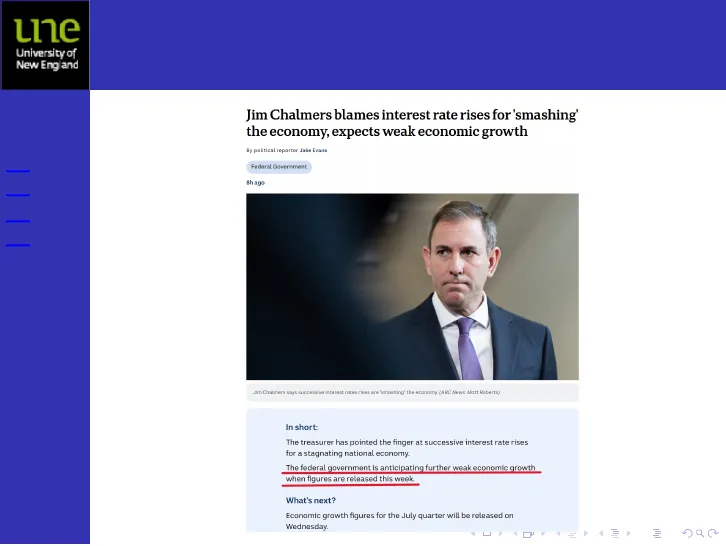
Pre-preemptive Strike? Week 9 LO.1 LO.2 LO.3 LO.4 Jim Chalmers blames interest rate rises for 'smashing' the economy, expects weak economic growth By political reporter Jake Evans Federal Government 8h ago Jim Chalmers says successive interest rates rises are "smashing" the economy. (ABC News: Matt Roberts) In short: The treasurer has pointed the finger at successive interest rate rises for a stagnating national economy. The federal government is anticipating further weak economic growth when figures are released this week. What's next? Economic growth figures for the July quarter will be released on Wednesday.une
Learning Objectives for Week 9
University of New England Learning Objectives Week 9 LO.1 LO.2 LO.3 LO.4
- The Reserve Bank of Australia (RBA)
- The RBA's policy goals and decision-making frameworks
- How the RBA sets interest rates
- Unconventional monetary policyune
The Reserve Bank of Australia's Role
University of New England The Reserve Bank of Australia Week 9 LO.1 LO.2 LO.3 LO.4 Central banks determine a country's monetary policy, which is the process of setting the policy interest rate to influence economic conditions. The Reserve Bank of Australia (RBA) is our central bank. The Australian Parliament created the RBA and gave instructions to: "to ensure that the monetary and banking policy of the Bank is directed to the greatest advantage of the people of Australia and that the powers of the Bank .. . are exercised in such a manner as, in the opinion of the Reserve Bank Board, will best contribute to a. the stability of the currency of Australia; b. the maintenance of full employment in Australia; and c. the economic prosperity and welfare of the people of Australia."the
RBA's Historical Context and Functions
University of New England A Brief Context Week 9 The RBA was originally part of the Commonwealth Bank, which is now a private commercial bank. The Commonwealth Bank used to be a government-owned bank that also functioned as Australia's central bank. In 1959, with the Reserve Bank Act, these two functions were separated. The RBA: Conducts monetary policy Is responsible for maintaining a strong financial system Issues the nation's currency Manages Australia's gold and foreign exchange services Provides banking and registry services to various Australian government agencies and to a number of overseas central banks. LO.1 LO.2 LO.3 LO.4une
RBA Organisational Structure and Independence
University of New England The Organisational Structure Week 9 LO.1 LO.2 LO.3 LO.4 The Reserve Bank Board consists of the Governor (who acts as the chair), the Deputy Governor, Secretary to the Australian Treasury, and six external members who are appointed to five-year terms. The Board is responsible for oversight of the RBA. It is the body that determines the policy interest rate. The RBA conducts monetary policy in with a lot of independence from the government. Research shows that countries with high central bank independence have lower inflation rates. But there is a lot of government oversight of the RBA. The Governor and the Board are selected by Federal Cabinet.une
Political Commentary on RBA Actions
University of New England Attack on Titan !! Week 9 LO.1 LO.2 LO.3 LO.4 Coalition accuses Chalmers of attacking RBA Shadow Finance Minister Jane Hume accused Mr Chalmers of warring with the RBA, and said his comments laid blame on the central bank, instead of himself. Paradox at heart of cost-of- living debate 8874600 337737 1234 REFUND $ 100.00 $ 100.00 Card type Payment methy 100.00 Auth. 0006 100.00 Tender watersrice Balance TOTAL APPROVED Retain for your records Subtotal Total If sharp increases in interest rates aren't the right tool to control inflation, what is? The experience of the 1980s provides an idea. "Jim Chalmers blamed overseas factors for high inflation, then he blamed Philip Lowe, and now he's blaming his hand-picked replacement for Philip Lowe, Michele Bullock. He's got to turn the mirror on himself," Senator Hume said. Asked about Mr Chalmers's comments, Prime Minister Anthony Albanese said they were unremarkable. "Rate rises have an impact on the economy, that is what they are designed to do," Mr Albanese said. "And I do note there is nothing new in what Jim Chalmers has said. "What I would acknowledge is that many Australians are doing it tough. We have an economy that is growing but that growth is very modest." Mr Chalmers later clarified at a press conference that "of course" his comments should not be interpreted as an attack on the RBA, but didn't repeat the claim. M400-401665 700887315108 CARDHOLDER ENthe
RBA Board Meeting: Key Questions
University of New England Step Into an RBA Board Meeting Week 9 LO.1 LO.2 LO.3 LO.4 To decide monetary policy, each board member must be prepared to answer three questions.
- What are your forecasts for the Australian economy?
- What are the right policy choices given the economic outlook?
- How should the RBA communicate effectively to the public?
Let's take a deeper look at each question ...une
Question 1: Australian Economy Forecasts
University of New England Question 1: Forecasts for the Australian Economy Week 9 LO.1 LO.2 LO.3 LO.4 The board chair asks each member to share their views on current economic conditions and their short-term and medium-term forecasts for the economy. The RBA tracks thousands of variables, each of which provides clues about the future path of inflation and employment. Board members have different forecasts and expectations reflecting their unique knowledge and different reading of noisy data => The wisdom of crowds!the
Question 2: Policy Choices and Economic Outlook
University of New England Question 2: The Right Policy Choices Given the Economic Outlook Week 9 LO.1 LO.2 LO.3 LO.4 The board will raise the real interest rate when it wants to encourage people to spend less today and save for later => Lower output and inflationary pressure. The board will reduce the real interest rate when it wants to stimulate spending => Higher output and employment. Once the members have debated the options and assessed the risks, the governor typically recommends a course of action and the board votes on it.the
Question 3: RBA Communication Strategy
University of New England Step 3: How Should the RBA Communicate Effectively to the Public? Week 9 LO.1 LO.2 LO.3 LO.4 The board's decision is announced to the public at 2.30 pm on the second day of the meeting, followed by the Statement on Monetary Policy. The Governor holds a media conference after each Board meeting to explain the decision. Minutes of the Board meeting are published two weeks later, providing transparency to the public about the factors that influenced the decision. RBA officials give regular speeches and try to influence expectation about the path of the economy. The RBA wants to convince people that it will follow through and achieve its goals => Time-consistency problem.the
Statement on Monetary Policy - August 2024 Overview
University of New England Statement on Monetary Policy - August Week 9 LO.1 LO.2 LO.3 LO.4 I Statement on Monetary Policy - August 2024 Overview Key messages Inflation remains above target and is proving persistent. Inflation continues to moderate but is some way above the midpoint of the 2-3 per cent target range. Inflation in the June quarter was broadly in line with the May Statement forecast, with headline inflation at 3.8 per cent over the year and trimmed mean inflation at 3.9 per cent. But the latest data also demonstrate that inflation is proving persistent and the quarterly underlying inflation rate has fallen very little over the past year. Inflation is expected to take slightly longer to reach the target than was thought at the time of the May forecasts. Underlying inflation is forecast to return to the target range of 2-3 per cent in late 2025 and approach the midpoint in 2026. This is a slightly slower return to target than forecast in May and is due to greater inflationary pressures in the economy. In part, this owes to a stronger outlook for domestic demand, led by higher public demand and a recovery in household consumption as real disposable incomes and household wealth rise. But it also reflects the assessment that the economy's capacity to meet this demand is less than previously thought. The cash rate remains unchanged to support inflation returning to target. The outlook remains highly uncertain. Ongoing strength in the labour market, persistent inflation and still-high growth of both labour and non-labour costs suggest there are upside risks to inflation. At the same time, there is a risk that household consumption and economic activity pick up more slowly than expected. The unemployment rate is rising gradually, many households and businesses are under pressure and the lagged effects of monetary policy are uncertain. Conditions in the labour market could deteriorate by more than expected. At its August 2024 meeting, the Reserve Bank Board decided to hold the cash rate. Inflation in underlying terms remains too high and it will be some time yet before inflation is sustainably in the target range. Data have reinforced the need to remain vigilant to upside risks to inflation. Returning inflation to target within a reasonable timeframe remains the Board's highest priority. Policy will need to be sufficiently restrictive until the Board is confident that inflation is moving sustainably towards the target range. The Board will rely upon the data and the evolving assessment of risks to quide its decisions and remains concerned about the upside risks to inflation.une
RBA News and Announcements
University of New England RBA News & Announcements Week 9 LO.1 LO.2 LO.3 LO.4 News & Announcements Latest news Coming up
- 5 September 2024 Speech by Michele Bullock, Governor, to The Anika Foundation, Sydney 12.00 pm AEST
- 5 September 2024 7.00 pm AEST Fireside Chat (pre-recorded) with Michele Bullock, Governor, at the Women in Banking & Finance Awards
- 11 September 2024 10.20 am AEST Keynote by Sarah Hunter, Assistant Governor (Economic), at the Barrenjoey Economic Forum, Sydney
- 18 September 2024 Speech by Brad Jones, Assistant Governor (Financial System), at the Intersekt Festival, Melbourne
- 23-24 September 2024 Reserve Bank Board Meeting
- Monetary Policy Decision 24 September 2024 2.30 pm AEST
- Monetary Policy Decision Statement Media Release
Can’t find what you’re looking for?
Explore more topics in the Algor library or create your own materials with AI.
