Polymer Synthesis: Living, Anionic, and Cationic Polymerization
Slides from University of Twente about Polymer Synthesis. The Pdf provides a detailed overview of polymer synthesis, including living, anionic, and cationic polymerization, reaction kinetics, and functional monomers. This University-level Chemistry material, suitable for polymer chemistry courses, also covers copolymerization and the effects of solvent and counterion.
See more39 Pages

Unlock the full PDF for free
Sign up to get full access to the document and start transforming it with AI.
Preview
Sustainable Polymer Chemistry
Anionic Polymerization
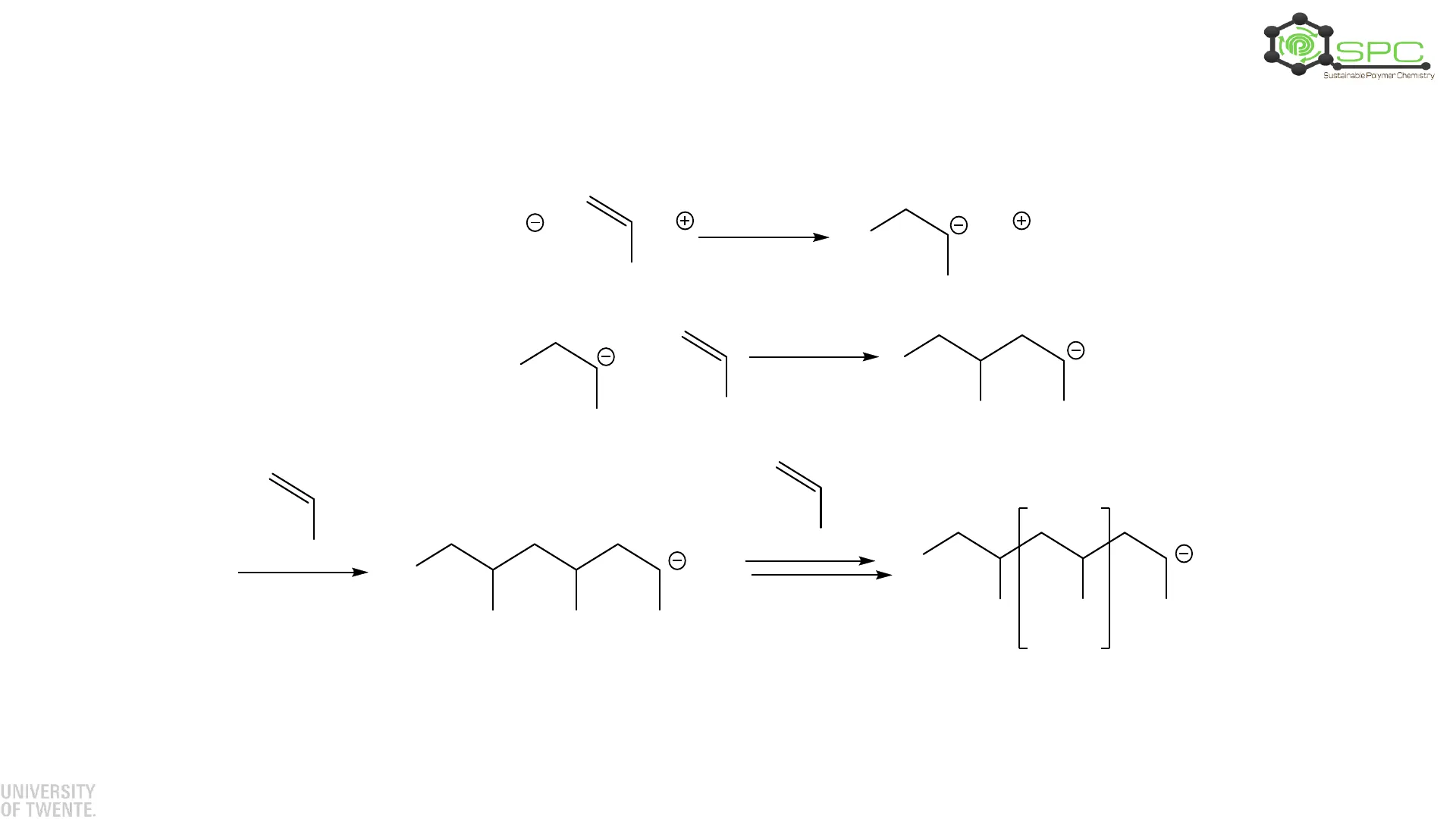
1) Initiation
SPC Sustainable Polymer Chemistry AO + + KO A ℮ + KO R R + A O A R R R R A O R R R R R R n UNIVERSITY OF TWENTE. www.utwente.nl/en/tnw/spc 2) Growth/ Propagation 0 R R A O
Anionic Polymerization Termination
H SPC Sustainable Polymer Chemistry 3) Termination A O + 0 A R R R R R R n m > Two macro-anions do not combine or "self"-terminate termination occurs to intentionally added electrophiles (functionality) 0 + KC A R R R R R R n n >+ many other reactions UNIVERSITY OF TWENTE. www.utwente.nl/en/tnw/spc K A
Initiators for Anionic Polymerization
SPC Sustainable Polymer Chemistry a Alkali-metals (Li, Na, K) RLi, RNa, RK (R = Alkyl, Aryl) M + (M = Li, Na, K) Ph3CLi, RMgX, MH and MNR2 (M = Li, Na, K), LiAIR4, NaAIR4, NaZnR3 Increasing basicity (more reactive) b [Ph2C = O] M + € 0 + R-CH-C(=O)-OR' R-CH-C=N LiAIH4 MO M+ (M = Li, Na, K) c MOH and MOR (M = Li, Na, K), Et2Zn N N -N d NH3, NH2R, NHR2, NR3, PR3, R-O-R', R-OH, H-O-H UNIVERSITY OF TWENTE. From Hadjichristidis/ Hirao Anionic Polymerization 2015 www.utwente.nl/en/tnw/spc R M 0
Monomers for Anionic Polymerization
SPC Sustainable Polymer Chemistry a b S=0 N C=0 C=0 C=0 N OR - OR NR2 Increasing electrophilicity C C=0 SO2-R CEN C=N R d C=N CEN NO2 C=0 CEN OR UNIVERSITY OF TWENTE. From Hadjichristidis/ Hirao Anionic Polymerization 2015 www.utwente.nl/en/tnw/spc
Further Monomers for Anionic Polymerization
SPC Sustainable Polymer Chemistry S=0 C=N COOR COOC(CH3)3 CONR2 R-N=C=0 R C=0 Me Me O O Si O Me HN O Me Me Si O Me Me O Me R' O Many of these can be polymerized via living conditions. (see also Chapter on Ring-opening polymerization) UNIVERSITY OF TWENTE. From Hadjichristidis/ Hirao Anionic Polymerization 2015 www.utwente.nl/en/tnw/spc R C O O O Fe 'Si S O O
Initiator-Monomer Compatibility
SPC Sustainable Polymer Chemistry a b - =0 C=0 C=0 C=0 1 OR OR NR2 = C C=0 SO2-R CEN C=N R d C=N CEN = NO2 C=0 CEN OR Alkali-metals (Li, Na, K) a RLi, RNa, RK (R = Alkyl, Aryl) (M = Li, Na, K) Ph3CLi, RMgX, MH and MNR2 (M = Li, Na, K), LiAIR4, NaAIR4, NaZnR3 .O R M O R-CH-C(=O)-OR' R-CH-C=N LiAIH4 MO Mª (M = Li, Na, K) c MOH and MOR (M = Li, Na, K), Et2Zn d NH3, NH2R, NHR2, NR3, PR3, R-O-R', R-OH, H-O-H Important: nucleophilicity of initiator and of the resulting chain end UNIVERSITY OF TWENTE. Initiator Monomer a > A b B Increasing basicity (more reactive) c C d D > : Polymerization Increasing electrophilicity (more reactive) b [Ph2C = O] M" From Hadjichristidis/ Hirao Anionic Polymerization 2015 www.utwente.nl/en/tnw/spc
Anionic Polymerisation of Styrene Example
SPC Sustainable Polymer Chemistry Initiation: CH3-CH2-CH 1 0 CH3 Li + CH2=CH ki CH3-CH2-CH-CH2-CH 0 Li + 1 CH3 cyclohexane Sec-butyllithium Propagation: CH3-CH2-CH-CH2-CH Li + CH3 cyclohexane / 6 h Termination: kt + CH3OH CH3-CH2-CH-(CH2-CH-)-CH2-C-H 1 CH3 n-1 H UNIVERSITY OF TWENTE. From Controlled and Living Polymerizations. Edited by Axel H.E. Muller and Krzysztof Matyjaszewski 2009 WILEY-VCH Verlag GmbH & Co. KGaA, Weinheim ISBN: 978-3-527- 32492-7 www.utwente.nl/en/tnw/spc kp (n-1) CH2=CH CH3-CH2-CH-CH2-CH- CH2-CH n-1 I CH3 Li CH3-CH2-CH --- CH2-CH- CH2-CH I n-1 CH3 Li
Reactors for Anionic Polymerization
SPC Sustainable Polymer Chemistry Strictly avoid water and oxygen! UNIVERSITY OF TWENTE. www.utwente.nl/en/tnw/spc
Flow-Reactor for Anionic Polymerization
SPC Sustainable Polymer Chemistry micromixer sec-BuLI Fluid B oLi Fluid A · Allows anionic polymerization of styrene in THF at room temperature (instead of -78 to -100℃) UNIVERSITY OF TWENTE. Macromol. Chem. Phys. 2008, 209, 1106-1114 www.utwente.nl/en/tnw/spc
Ionic Polymerization Propagation
H SPC Sustainable Polymer Chemistry R2 KØ + n R R2 R1 CH3CR 1R2[CH2CR1R2]n-1CH2CR1R KO Reaction kinetics depend on the counterion, the solvent, the temperature and the type of monomer. AK A-K+ A-/K+ A-+ K + covalent intimate ion pair solvent separated ion pair free ions insertion of monomer into strongly polarized bond addition of monomer to free anion unpolar solvent small cations polar solvent large cations UNIVERSITY OF TWENTE. e.g: Cyclohexane e.g .: THF, DMSO www.utwente.nl/en/tnw/spc
Kinetics of Anionic Polymerization: Solvents
SPC Sustainable Polymer Chemistry In poorly solvating hydrocarbon solvents 2 200 CH2-CH-Li R - 200 CH2-C. Li Li C-H2Cm I R R association - Rp V Larger alkali metal cations Weaker coordination than Li+ Rp Î In a more polar solvating medium (e.g., ether) Li+ the most strongly solvated of the alkali metal cations Li-based initiators the fastest Rp UNIVERSITY OF TWENTE. www.utwente.nl/en/tnw/spc
Kinetics of Anionic Polymerization: Monomer Reactivity
SPC Sustainable Polymer Chemistry Solvating power 1,2-dimethoxyethane > tetrafydrofuran > benzene > cyclohexane CH2-CH2 OCH3 OCH3 Reactivity of monomer CH3 I CH2=CH CH2=CH 1 CN > CH2=C > > CH2=CH-CH=CH2 COOCH3 e -- withdrawing resonance Methyl substitution on the a-carbon - RpV CH3 CH3 I CH2=CH > CH2=C > CH2=CH > CH2=C CN CN COOCH3 COOCH3 . induction destabilization of the carbanion and steric interference with both chain-end solvation and approach of monomer UNIVERSITY OF TWENTE. www.utwente.nl/en/tnw/spc
Kinetics of Anionic Polymerization: Solvent and Counter Ions
SPC Sustainable Polymer Chemistry Propagation rate constants for the anionic polymerization of styrene: Counterion Solvent kp/ L/mol s Na+ Tetrahydrofuran 80 Na+ 1,2-Dimethoxyethane 3600 Li+ Tetrahydrofuran 160 Li+ Benzene 10-3 -10-1 Li+ Cyclohexane 10-5 Increase of reaction kinetics of polymerization in nonpolar solvents by addtition of small amounts of polar solvents of chelators for the cation. UNIVERSITY OF TWENTE. www.utwente.nl/en/tnw/spc
Kinetics of Anionic Polymerization: Beta-Carbon Shift
SPC Sustainable Polymer Chemistry Table 4 13C NMR vinyl ß-carbon chemical shift values of para-EWG-substituted styrene derivatives EWG CB (ppm) -H(styrene) 113.8 -CON(iC3H7)2 114.8 -CH=N-C6H11 114.9 N 115.3 O EWG -COOC(C4H9)3 116.0 -SO2N(C2H5)2 117.0 -CEN 117.6 Low field shift = increased reaction rate UNIVERSITY OF TWENTE. From Hadjichristidis/ Hirao Anionic Polymerization 2015 www.utwente.nl/en/tnw/spc
Anionic Polymerization of Acrylates: Side Reactions
SPC Sustainable Polymer Chemistry Possible side reactions: c c a H H H 1 a CH2 = C a ℮ CH2 = C I 1 C= 0 C= 0 b OCH3 b OCH3 OCH3 a: Polymerization, b: Carbonyl attack, and c: Proton abstraction ... what happens: CH3 CH3 (a) I Mt + CH2=C CH2=C + CH3O Mt C=0 OCH3 (b) H3C CH3 H2C CH3 CH2 CH2 C COOCH3 C-COOCH3 + CHO Mi OCH CH3 OC-CH3 C=0 OCH3 OCH3 UNIVERSITY OF TWENTE. From Hadjichristidis/ Hirao Anionic Polymerization 2015, Controlled and Living Polymerizations. 2009 WILEY-VCH www.utwente.nl/en/tnw/spc C 0 CH2 MO CH2 sec-BuLi w CH2-C C= 0 a
Isoprene/Butadiene Microstructures
SPC Sustainable Polymer Chemistry Delocalized anion at the chain end during the anionic polymerization of dienes: 0 w CH2-CH-CH=CH2 ^^CH2-CH=CH-CH2 V V 1,2-Addition 1,4-Addition Possible microstructures of dienes after anionic polymerisation {CH, FCH, H -(CH2-CH) CH,=CH-CH=CH2 1,3-Butadiene H CH2) CH2 cis-1,4 trans-1,4 1,2-vinyl CH3 CH ICH, C CH (CH, CH-) CH,=C-CH=CH2 Isoprene (2-Methyl-1,3-butadiene) C cis-1,4 trans-1,4 1,2-vinyl 3,4-vinyl UNIVERSITY OF TWENTE. From Hadjichristidis/ Hirao Anionic Polymerization 2015 www.utwente.nl/en/tnw/spc CH CH
Isoprene/Butadiene Microstructures in Solvents
SPC Sustainable Polymer Chemistry Anionic propagation of 1,3-butadiene in non-polar and polar solvent influences the microstructure along the polymer chain by delocalized anion at the chain end: 1,2- or 1,4- addition possible 0 in non-polar solvent CH CH2-CHO: CH2 in polar solvent (Lewis + base) n CH2-CH Li (or) Lewis base CH=CH2 (Lewis base) n ℮ Li CH2-CH=CH-CH2) L CH2 CH2 CH=CH2 CH=CH2 CH-CH 1,4-addition 1,2-addition (Lewis + base) n CH2-CH=CH-CH2-CH2-CH=CH-CH2 Li CH2-CH-CH2-CH Li CH=CH2 CH= CH2 Keep in mind: in nonpolar solvents (hexanes) mainly 1,4-addition, in polar solvents (THF) mainly 1,2-addition (for isoprene mainly 3,4-addition (steric and electronic reasons) UNIVERSITY OF TWENTE. From Controlled and Living Polymerizations. Edited by Axel H.E. Muller and Krzysztof Matyjaszewski 2009 WILEY-VCH Verlag Gmbh & Co. KGaA, Weinheim ISBN: 978-3-527-32492-7 www.utwente.nl/en/tnw/spc CH2-CH=CH-CH2 Li delocalized polybutadienyl lithium + CH2-CH CH2=CH
Isoprene/Butadiene Microstructures with BuLi or Sodium
SPC Sustainable Polymer Chemistry Isoprene, initiated with BuLi or sodium Gegenion Solvent 1,4-cis 1,4-trans 1,2 3,4 Li Cyclohexane 80% 15% - 5% Li Cyclohexane/ - THF (9:1) 26% 8% 66% Li THF - - 26% 74% Na Cyclohexane 28% 29% - 42% Na THF 18% 82% UNIVERSITY OF TWENTE. Data taken from: Canadian Journal of Chemistry, 1964, 42(12): 2884-2892 www.utwente.nl/en/tnw/spc
Kinetics of Living Polymerization
SPC stry constant [P*] > termination > slow initiation 1 Free radical CHAIN Mn n (or Dp) Non-terminating ANIONIC STEP 0 0.25 0.50 0.75 1.00 Extent of Reaction, p Dp = number of moles of monomer [M] number of moles of initiator = [I] mass of monomer Mn = number of moles of initiator = Dp X M(monomer) UNIVERSITY OF TWENTE. www.utwente.nl/en/tnw/spc time
Kinetics of Styrene Polymerization
SPC Sustainable Polymer Chemistry · E.g styrene, BuLi, THF, -80 ℃ Ri>> Rp d[M] = kp [0]. [M] dt where [I] = initial concentration of initiator d[M] [M] = kp Q. dt In [M] = - kp[1]. dt [M] = [M] + [1] at No termination or chain transfer reactions Integrate and plot! V = [M]. - [M] V= [M] o M completely consumed For simple anionic initiator (e.g., BuLi) v = DP For electron-transfer initiators DP = 2v Narrow molecular weight distribution Living polymerization: 1) No termination 2) No transfer 3) Fast initiation Note: a living polymerization is not immortal! (conditions need to be right) UNIVERSIT . OF TWENTE. www.utwente.nl/en/tnw/spc
Functional Monomers: Protective Groups
SPC Sustainable Polymer Chemistry 1 1) Protection 2) Living Anionic Polymerization F P P F): Functional Group MeOH 3) Deprotection P: Protected Functionality P F Scheme 3 Protection and living anionic polymerization of functional styrene Protective groups necessary to prevent termination or side reactions of/ with the living chain end. O O O Si O Fig. 14 Silyl-, ether-, and acetal-protected 4-vinylphenol derivatives UNIVERSITY OF TWENTE. From Hadjichristidis/ Hirao Anionic Polymerization 2015 www.utwente.nl/en/tnw/spc
Can’t find what you’re looking for?
Explore more topics in the Algor library or create your own materials with AI.
