AQA A Level Biology: Topic 1 Biological Molecules and Enzyme Reactions
Document from AQA about Aqa A Level Biology Topic 1 Biological Molecules. The Pdf provides detailed notes for high school Biology students, covering monomers, polymers, carbohydrates, lipids, proteins, DNA, RNA, ATP, and inorganic ions, including common errors and enzyme kinetics.
See more21 Pages


Unlock the full PDF for free
Sign up to get full access to the document and start transforming it with AI.
Preview
Biological Molecules Overview
AQA A Level Biology
Topic 1
Biological molecules
Model answer notes by @biologywitholivia
Topic
Understand
Memorise
Practise
....
- 1 Monomers & polymers
- 2 Carbohydrates
- 3 Lipids
- 4.1 General properties of proteins
- 4.2 Many proteins are enzymes
Required practical 1
- 5.1 Structure of DNA and RNA
- 5.2 DNA replication
- 6 ATP
- 7 Water
- 8 Inorganic ions
Monomers and Polymers
AQA A Level Biology Topic 1 Biological molecules
biologywitholivia.co.uk
Defining Monomers and Polymers
What are monomers and polymers?
- Monomers - smaller / repeating molecules from which larger molecules / polymers are made
- Polymer - molecule made up of many identical / similar molecules / monomers
Condensation and Hydrolysis Reactions
What happens in condensation and hydrolysis reactions?
Condensation
reaction
- 2 molecules join together
- Forming a chemical bond
- Releasing a water molecule
Hydrolysis
reaction
- 2 molecules separated
- Breaking a chemical bond
- Using a water molecule
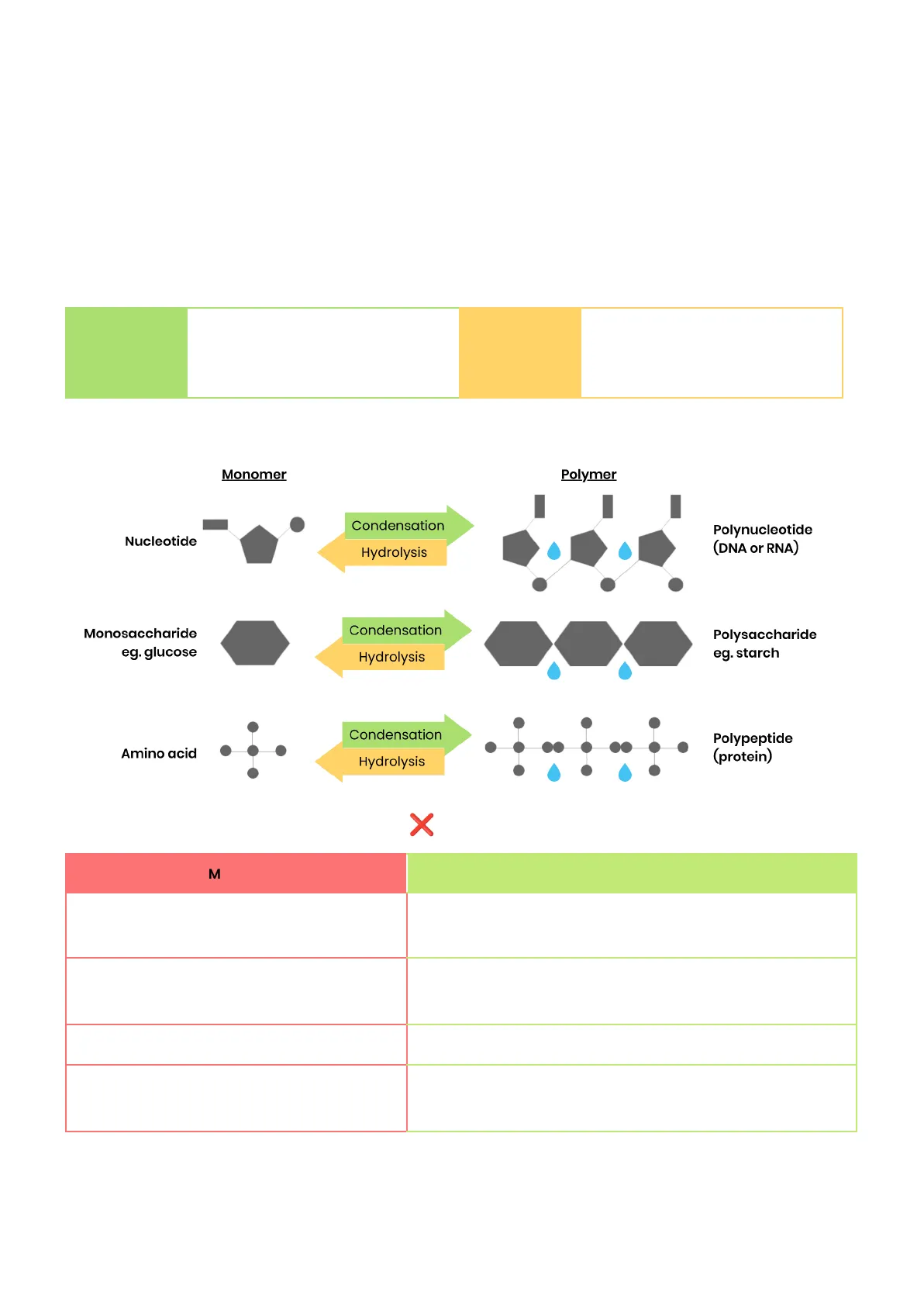
Examples of Polymers and Monomers
Give examples of polymers and the monomers from which they're made
Monomer
Polymer
Nucleotide
Condensation
Hydrolysis
Polynucleotide
(DNA or RNA)
Condensation
Monosaccharide
eg. glucose
Hydrolysis
Polysaccharide
eg. starch
Condensation
Amino acid
Hydrolysis
Polypeptide
(protein)
Common Mistakes in Monomers and Polymers
Exam insight: common mistakes
Mistake
Explanation
- Mixing up hydrolysis and
condensation reactions .
'C' for condensation; 'C' for connecting molecules. Imagine
condensation on a window to remember water is released.
- Forgetting to include H2O in diagrams of
condensation and hydrolysis reactions .
1 H2O molecule is released for every condensation reaction
and 1 H2O molecule is used for every hydrolysis reaction.
"Lipids are polymers."
Lipids are not made from repeating monomers.
"A polymer is made of two
or more monomers."
'Poly' means many. Two monomers joined
together is a dimer.
Carbohydrates
2biologywitholivia.co.uk
Monosaccharides
What are monosaccharides? Give 3 common examples
- Monomers from which larger carbohydrates are made
- Glucose, fructose, galactose
Alpha-Glucose Structure
Describe the structure of a-glucose
CH,OH
H
C-
-O
H
6
H
C
.C.
4
OH
H
1
C.
C
OH
3
1 2
H
OH
- Left - full structure, carbon
atoms labelled - Right - simplified structure
as in the specification to
be memorised for exam
Alpha and Beta Glucose Differences
Describe the difference between the structure of a-glucose and @-glucose
OH group is below carbon 1 in a-glucose
but above carbon 1 in @-glucose
Alpha & beta glucose are isomers ->
same molecular formula, differently arranged atoms
Disaccharides Formation
What are disaccharides and how are they formed?
- Two monosaccharides joined together with a glycosidic bond
- Formed by a condensation reaction, releasing a water molecule
Common Disaccharides and Monosaccharides
List 3 common disaccharides & monosaccharides from which they're made
Disaccharide
Monosaccharides
Maltose
Glucose + glucose
Sucrose
Glucose + fructose
Lactose
Glucose + galactose
Joining Monosaccharides Diagram
Draw a diagram to show how two monosaccharides are joined together
Alpha glucose
Alpha glucose
Maltose
H
C
I
H
O
/H
H
-0
HH
-O
,H
+
+ H2O
Hydrolysis
O
HO
OH HO
OH
HO
OH
Glycosidic bond
Polysaccharides Formation
What are polysaccharides and how are they formed?
- Many monosaccharides joined together with glycosidic bonds
- Formed by many condensation reactions, releasing water molecules
3
H
-0
H
HO
HO
OH
AQA A Level Biology Topic 1 Biological molecules
Condensation
Starch and Glycogen
biologywitholivia.co.uk
Function and Structure of Starch and Glycogen
Describe the basic function and structure of starch and glycogen
Starch
Energy store in
plant cells
- Polysaccharide of a-glucose
- Amylose - 1,4-glycosidic bonds -> unbranched
- Amylopectin - 1,4- and 1,6-glycosidic bonds -> branched
Glycogen
Energy store in
animal cells
- Polysaccharide made of a-glucose
- 1,4- and 1,6-glycosidic bonds -> branched
Starch - amylose
Glycogen
4
HO
O
Starch - amylopectin
H H
0
0
1,4-glycosidic
bond
1,6-glycosidic
bond
0
0
H
H
H
H H
H H
H
HO
0
0
0
OH
Structure-Function Relationship of Starch and Glycogen
Explain how the structures of starch and glycogen relate to their functions
Starch
(amylose)
- Helical -> compact for storage in cell
- Large, insoluble polysaccharide molecule -> can't leave cell / cross cell membrane
- Insoluble in water -> water potential of cell not affected (no osmotic effect)
Glycogen
(and starch
amylopectin)
- Branched -> compact / fit more molecules in small area
- Branched -> more ends for faster hydrolysis -> release glucose for respiration to
make ATP for energy release - Large, insoluble polysaccharide molecule -> can't leave cell / cross cell membrane
- Insoluble in water -> water potential of cell not affected (no osmotic effect)
Cellulose
Function and Structure of Cellulose
Describe the basic function and structure of cellulose
Function
- Provides strength and structural support to plant / algal cell walls
Structure
- Polysaccharide of @-glucose
- 1,4-glycosidic bond -> straight, unbranched chains
- Chains linked in parallel by hydrogen bonds forming microfibrils
Structure-Function Relationship of Cellulose
Explain how the structure of cellulose relates to its function
- Every other ß-glucose molecule is inverted in a
long, straight, unbranched chain - Many hydrogen bonds link parallel strands
(crosslinks) to form microfibrils (strong fibres) - Hydrogen bonds are strong in high numbers
- So provides strength to plant cell walls
B-glucose 1,4-glycosidic bond
Hydrogen bond
4
O
O
0
AQA A Level Biology Topic 1 Biological molecules
Biochemical Tests for Sugars
AQA A Level Biology Topic 1 Biological molecules
biologywitholivia.co.uk
Test for Reducing Sugars
Describe the test for reducing sugars
Reducing sugars = monosaccharides, maltose, lactose
- Add Benedict's solution (blue) to sample
- Heat in a boiling water bath
- Positive result = green / yellow / orange / red precipitate
Test for Non-Reducing Sugars
Describe the test for non-reducing sugars
Non-reducing sugars = sucrose
- Do Benedict's test and stays blue / negative
- Heat in a boiling water bath with acid (to hydrolyse into reducing sugars)
- Neutralise with alkali (eg. sodium bicarbonate)
- Heat in a boiling water bath with Benedict's solution
- Positive result = green / yellow / orange / red precipitate
Measuring Sugar Quantity: Precipitation Method
Suggest a method to measure the quantity of sugar in a solution
- Carry out Benedict's test as above, then filter and dry precipitate
- Find mass / weight
Measuring Sugar Quantity: Colorimetry Method
Suggest another method to measure the quantity of sugar in a solution
- Make sugar solutions of known concentrations
(eg. dilution series) - Heat a set volume of each sample with a set
volume of Benedict's solution for same time - Use colorimeter to measure absorbance (of
light) of each known concentration - Plot calibration curve - concentration on x axis,
absorbance on y axis and draw line of best fit - Repeat Benedict's test with unknown sample and
measure absorbance - Read off calibration curve to find concentration
associated with unknown sample's absorbance
1.0
Absorbance of
light / abritrary units
Absorbance of
unknown solution
0.8
0.6
0.4
×
0.2
Concentration
of unknown
solution
0
0
1
2
3
4
5
Concentration of sugar / mol dm -3
Biochemical Test for Starch
Describe the biochemical test for starch
- Add iodine dissolved in potassium iodide (orange / brown) and shake / stir
- Positive result = blue-black
None
Increasing quantity of sugar
5
Common Mistakes in Carbohydrate Biology
AQA A Level Biology Topic 1 Biological molecules
biologywitholivia.co.uk
Exam Insight: Carbohydrate Mistakes
Exam insight: common mistakes
Mistake
Explanation
- Referring to alpha glucose
as 'a glucose' .
This is not an equivalent of writing 'alpha glucose' or
'a-glucose' and will usually be rejected.
"Glycogen and starch are energy stores as
hydrolysis of glycosidic bonds releases
energy."
Glycogen and starch are energy stores as they are made of
a-glucose, which is the substrate for respiration in cells. This
produces ATP for energy release.
- Comparing and contrasting
polysaccharides by making a list about
each .
This will achieve no marks. In these questions, each statement
needs to make a clear comparison. Aim to use a word like
'whereas' to ensure you're covering both sides.
When chains of beta glucose are linked by
hydrogen bonds, myofibrils form."
Myofibrils are found in muscle fibres and are completely
different. Microfibrils are found in cellulose cell walls.
"Cellulose is strong because of
hydrogen bonds."
Hydrogen bonds are weak individually, but strong in high
numbers. You need to say that there are many hydrogen bonds.
"Use the same amount of Benedict's
solution on each sample when comparing
the quantity of reducing sugar."
Amount is too vague. You need to use the
term volume to get the mark.
Lipids
Groups of Lipids
Name two groups of lipid
Triglycerides and phospholipids
Saturated fatty acid
Unsaturated fatty acid
H H H H H H H H H H H H H H H
O = C - ¿ - c - c - c - c - c - c - c - C - C - C - C - C - C - C - H
H-O-CES-
ИННИННИН
Н Н Н Н НАН
. { C . c . c . c . c - C - C ' C - C - C - C - C - C - C - C - H
Н Н Н Н Н НА
H-O-
Double bond
Fatty Acid Structure
Describe the structure of a fatty acid (RCOOH)
- Variable R-group - hydrocarbon chain (saturated or unsaturated)
- -COOH = carboxyl group
Saturated vs. Unsaturated Fatty Acids
Describe the difference between saturated and unsaturated fatty acids
- Saturated: no C=C double bonds in hydrocarbon chain; all carbons fully saturated with hydrogen
- Unsaturated: one or more C=C double bond in hydrocarbon chain (creating bend / kink)
Triglyceride Formation
Describe how triglycerides form
- 1 glycerol molecule and 3 fatty acids
- Condensation reaction
- Removing 3 water molecules
- Forming 3 ester bonds
Glycerol
3 fatty acids
Triglyceride
H
0
H -C
OH
HO
c
I
O-C
0
+ H2O
H -
OH
HO
c
H -C
0-C
O
O
H -C
OH
HO
C
H -C
0-C
H
H Ester bond
O
+ H2O
I-0-
O
+ H2O
6
Triglycerides and Phospholipids
AQA A Level Biology Topic 1 Biological molecules
biologywitholivia.co.uk
Triglyceride Properties and Structure
Explain how the properties of triglycerides are related to their structure
Function: energy storage
- High ratio of C-H bonds to carbon atoms in hydrocarbon chain
- So used in respiration to release more energy than same mass of carbohydrates
- Hydrophobic / non-polar fatty acids so insoluble in water (clump together as droplets)
- So no effect on water potential of cell (or can be used for waterproofing)
Triglyceride and Phospholipid Structure Differences
Describe the difference between the structure
of triglycerides and phospholipids
Triglyceride
Glycerol
Glycerol
Fatty acid
Fatty acid
Fatty acid
Fatty acid
Fatty acid
Phospholipid
Phosphate
group
One of the fatty acids of a triglyceride is substituted
by a phosphate-containing group
Phospholipid Properties and Structure
Describe how the properties of
phospholipids relate to their structure
Function: form a bilayer in cell membrane, allowing diffusion of lipid-soluble (non-polar) or very small
substances and restricting movement of water-soluble (polar) or larger substances
- Phosphate heads are hydrophilic
- Attracted to water so point to water (aqueous environment) either side of membrane
- Fatty acid tails are hydrophobic
- Repelled by water so point away from water / to interior of membrane
Test for Lipids
Describe the test for lipids
- Add ethanol, shake (to dissolve lipids), then add water
- Positive = milky white emulsion
Common Mistakes in Lipid Biology
Exam insight: common mistakes
Mistake
Explanation
"Phospholipids have a phosphorus group."
Phospholipids have a phosphate group (PO23-).
"Phospholipids don't contain glycerol."
Both phospholipids and triglycerides contain glycerol.
"To test for lipids, add water then ethanol."
Ethanol is added first and this is crucial to pick up the mark.
"A positive test for lipids is cloudy."
This is too vague. You need to use the term 'emulsion'.
"Phospholipids have phosphodiester bonds."
Phospholipids have ester bonds. Phosphodiester bonds are
found in nucleic acids such as DNA and RNA.
"In the test for lipid, ethanol is heated."
Only Benedict's solution (for sugars) requires heating.
7
Can’t find what you’re looking for?
Explore more topics in the Algor library or create your own materials with AI.
