Nutrition in aquatic sports by Fina
Slides from Fina about Nutrition in Aquatic Sports. The Pdf focuses on nutritional practices for aquatic athletes based on scientific evidence, covering general principles, individualized needs, and supplements for university students in Physical Education.
See more16 Pages

Unlock the full PDF for free
Sign up to get full access to the document and start transforming it with AI.
Preview
General Principles of Aquatic Nutrition
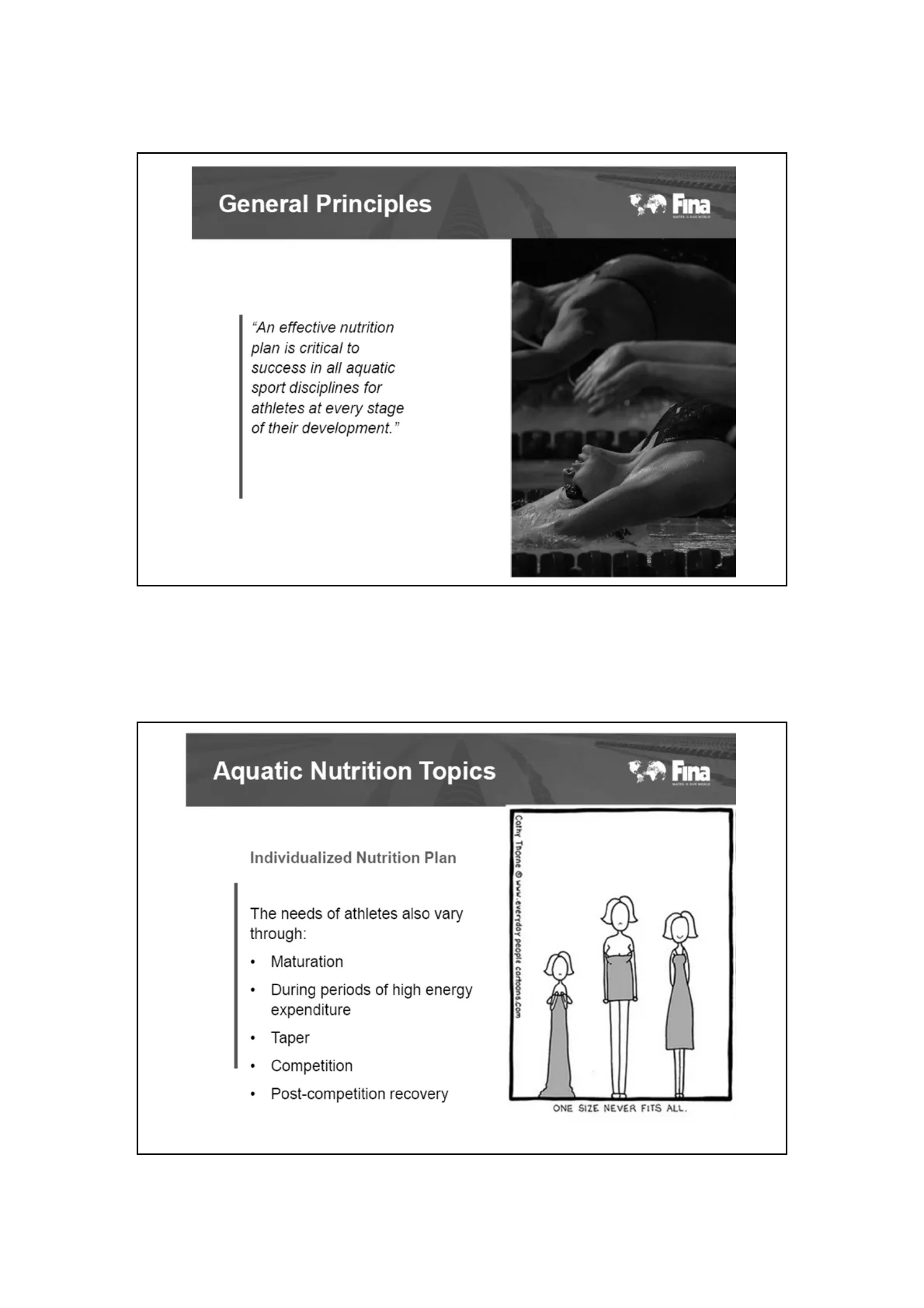
Nutrition in aquatic sports Fina WATER IS OUR WORLD FINA-Yakult Nutrition for Aquatics M Mujika PH Fina Project Rationale Fina To identify best nutritional practices for aquatic athletes based on the available scientific evidence. Yakult Page 1General Principles Fına "An effective nutrition plan is critical to success in all aquatic sport disciplines for athletes at every stage of their development."
Aquatic Nutrition Topics
Individualized Nutrition Plans
Aquatic Nutrition Topics Fına Individualized Nutrition Plan The needs of athletes also vary through:
- Maturation
- During periods of high energy expenditure
- Taper
- Competition
- Post-competition recovery
Cathy Thorne @ www.everyday people cartoons.com ONE SIZE NEVER FITS ALL. Page 2
Periodization in Aquatic Sports
Aquatic Nutrition Topics Fina Periodization match the phase and type of training including concurrent endurance and resistance training, altitude, overload and taper
Recovery Nutrition Plan
Aquatic Nutrition Topics Fina Recovery Nutrition Plan Post training or competition Restoration of body energy Promote adaptation to the exercise stimulus Preparation for optimal performance in the next session Page 3
Body Mass Composition Management
Aquatic Nutrition Topics Fına Body Mass Composition Informed management of body mass and composition is key to ensuring that athletes achieve peak performance.
Recipe for Success: Diet and Nutrients
Aquatic Nutrition Topics Fina Recipe for Success Aquatic athletes should consume a well-chosen diet with sufficient: energy macronutrients (CHO + protein) micronutrients to maintain immune function and health (Vitamin D + iron) Page 4
Nutritional Supplements in Aquatic Sports
Aquatic Nutrition Topics Fına WATER IS OUR WORLD Nutritional Supplements The use of supplements does not compensate for poor food choices Contaminated supplements may cause a positive doping test PHELPS A few evidence-based supplements may provide a performance benefit for some athletes with no risk to health, but the scientific evidence specific to aquatic sports is limited or absent
Environment and Travel Considerations
Aquatic Nutrition Topics Fına MATER . OUR WORLD Environment + Travel adequate hydration carbohydrate, protein and iron intake while at altitude manipulation of fluid and carbohydrate in relation to climate careful food and fluid hygiene Page 5
Long-Term Dietary Planning
General Principle Fına HATER IS OUR WORLD Athletes should also be aware of the need for long-term dietary planning to ensure lifelong health and wellbeing and should recognise the pleasures of good food choices
Project Outcomes
Project Outcomes Fina FINA-Yakult Consensus Statement Dedicated Edition IJSNEM Athlete - Coach Educational tool brochure on line Page 6
FINA-Yakult Consensus Statement on Nutrition for the Aquatic Sports
FINA-Yakult consensus statement binational dumal al Spot Narien and Exorcino Meubalon, 2014,24,346-350 INTERNATIONAL YXORNAL OP SPORT NUTRITION AND EXERCISE METABOLISM www.WSNEM-Joumal.com CONSENSUS STATEMENT FINA-Yakult Consensus Statement on Nutrition for the Aquatic Sports An effective nutrition plan is critical to success in all aquatic sport disciplinos for athletes at every stage of their developesent. A well-desi ent. A well-designed, periodinad train- program remains the fundamental cornerstone of peak: performance outcomes, but this will moun liale if nutrition needs are ignored. Specialised sports nutri- tion experts should apply evidence-based science to the intake of key macro- hod micronutrients essential to the health, physique and performance of all athktes. Coaches, parents and health professionals in the athlete support am should recognise that thes cognise that these needs are specific to the individual and are different for each of the aquatic disci plines. The noods of achlatos alo vary through matuncion und during periods of high energy expenditure, the taper, competition and post-compet post-competition recovery. ic intake of foods and fluids can enhance per- raining and competition and help athletes to realise their potential. Specific nutrition strategies should match the phune and type of training, including concurrent endurance and resistance training, altitude, overload and tapor. When the training load changos during high volume phanes, injury, taper, or in the off-season and after rotirp. ment, athletes should adjust their energy intake according to the alterod energy expenditure. Recovery after training or competition should address the nutritional aspects of restoration of homeostasis, adaptation to the exorcise stimulus and preparation for optimal performance in the next session. These challenges are specific to the session und the athlete's goals and may require a planned intake of key nutrients such as protein, carbohydrate, fluid and electrolytes, particularly in the period immediately after training. Training adaptations can be promoted by the lingestion of about 0.3 g/kg body m 03 g&g body mass of high quality protein at intervals throughout the day and around train. ing sessions, up to a lot is, up to a total of about 1.3 to 1.8 g/kg body mas per day. Carbohydrate intake, both over the day and in relation to training sessions, should be manipulated according to the fuel costs of training and racing, and the varying importance of undertaking these sessions with high carbohydrate availability. tions. Low energy availability (EA) and disorderod esting are concerns for athletes in disciplines that emphasize leunness, such as synchronized swimming, diving and swimming. Athletes in all aquatic sports should practise y eating behaviours to prevent low EA and reduce the rak of suppemion of the endocrine, metabolic and immune systems that can lead to impaired bone health and injury. Even when a well-contracted and justified program to reduce body fat is undertaken, adequate EA should be ensured The athlete's support team should be educated to recognise early siges and symptoms of low HA and disordered outing behaviours. Aquatic athletes are encouraged to consume a wel. chosen diet with sufficient energy, macronutrients (pue- ticularly carbohydrate and protein), nd peutcin), and micronutrients, maintain immune function and health. Vitamin D status may be compromised: enpromised in athletes who are predominantly based indoors. Bone health requires adequate energy availability and micronutrient ietiker bono loading activi. ties, which may be limited in an aquatic sport training ogram, are also required. Strategies to manage alcohol intake should be developed in the context of the teuen cul- ture to minimise the negative consequences on recovery and athlete welfare. The use of supplements does not compensate for poor food choices. Supplements containing essential nutrients may be useful only when a diagnosed deficiency Cannot be comected easily and promptly by changes to the diet. Athletes contemplating the une of supplements and sports foods should consider their consider their legality, efficacy cost, practicality, and safety, including the risk to health and perfor and performance. Contaminated supplements may cause a positive doping test. A few evidence based supplements a performance benefit for some athletes with no risk to health, but the scientific evidence specific to aquatic sports is often limited or absent. Ingesting car- bohydrate via sports drinks, gels or sports foods during intensive undor prolonged training sessions should be beneficial for performance. Elite aquatic athletes are required to undertake andu ous training and competition schedules in challenging conditions including varying water tempera es, வா Informed management of body mass and com. position is key to ensuring that athletes achieve peak performance, including the meeting of aesthetic expecta- Detopoulos and Papamikos are with the Dept. of Nutrition, General Hospital Korytalento-Betakio (Red Cross Hospital), Athens, Cirece. Address author correspondence to Paraskevi Detopoulos all viviandeto@yahoo.je. and water pollution, altitude and jetlag/ravel fatigue Nutrition interventions that mighi mitigate the nega tive environmental effects include: adequate hydration carbohydrate, protein and iron intake while at altitude; manipulation of fluid and carbohydrate intake during races according to the varying water and ambient tem. peratures; and careful food and fluid hygiene practices when travelling. 349 FINA Nutrition Expert Panel, Int. J. Sport Nutr. Exerc. Metab. 24: 349-350, 2014
Periodization of Energy Needs
Periodization of energy needs
- Considerable variation in exercise load according to swimmers annual program, macro cycle, training week and stage of development
- Research and practice examples of failure to
- adequately increase energy intake when training volume is high
- reduce energy intake during off-season and injury (Costill et al. 1988) (Almeras et al. 1997) (Trappe et al. 1997)
LOWER HIGHER Offseason Heavy training Taper Injury Energy needs Growth/development Training at altitude Body weight/FM reduction Page 7
Matching Energy Intake to Requirements
Increased Energy Needs Strategies
INCREASED ENERGY NEEDS
- Increase number of meals
- Add CHO-rich snacks
- Consume energy containing fluids (juice, sports drink, flavored milk, smoothies)
- Take advantage of energy dense sports products
- Fortify meals with vegetable oils and nuts and/or add a liquid meal supplement
Reduced Energy Needs Strategies
REDUCED ENERGY NEEDS
- Reduce intake of energy dense low-nutrient snacks
- Consume foods high in volume and fiber (e.g. vegetables, fruits)
- Select foods high in protein and low in fat (e.g. low fat dairy, filets of fish/chicken)
- Reduce portion sizes
- Avoid "eating to boredom"
Requires: - Recognition of changing energy needs - Basic knowledge of foods - Planning, lifestyle/time management
Carbohydrate Requirements for Swimming
Carbohydrate requirements for swimming
- 3-10 g CHO/kg BW per day
- Not necessarily high CHO per se but rather high CHO availability
- 'When it is important to train hard or with high intensity, daily carbohydrate intakes should match the fuel needs of training and glycogen restoration." IOC 2010 Consensus conference on Nutrition for Sport
- High carbohydrate availability for high intensity sessions
- Some sessions may be deliberately done with low CHO
availability
- Low carbohydrate availability may enhance aerobic adaptation
- Informed application to avoid any negative effects (Burke et al. 2011) (Hawley et al 2010) (Mujika et al. Nutrition and training adaptations in aquatic sport. IJSNEM, 2014)
Page 8
Can’t find what you’re looking for?
Explore more topics in the Algor library or create your own materials with AI.
