Digital Data Processing in agriculture and food industry
Document from Unicatt about Digital Data Processing. The Pdf explores data mining, machine learning, and deep learning, with a focus on logistic regression. The Pdf is a university-level computer science material, useful for understanding the evolution of agriculture through its revolutions, from mechanization to Agriculture 4.0.
See more46 Pages


Unlock the full PDF for free
Sign up to get full access to the document and start transforming it with AI.
Preview
Food Processing 2023-2024
UNICATT
Food Processing
2023-2024
Digital Data Processing
Matteo FROSI
21 February 2024
Theorical & practical knowledge of the topics of data mining, machine learning and deep learning.
> Food influences the heath ; main goal = have an acceptable amount of heathy food (= prepared and
developed accordingly to specific standard)
Exam fully written (1.5 - 2 hours)
Data Analysis and Agenda 2030
Data analysis
Agenda 2030 = result of assembly of united nation. Goal = reach sustainable development goals
Objective No 2 = Zero Hunger : achieve food security &
improve nutrition & promote sustainable agriculture
(specially in developing country) > sustainable
food
production system
Climate change bring many problem > flooding ; draw ;
extreme weather ... > may change content of nutrient of the
soil.
Sustainable Development Goals Overview
SUSTAINABLE
DEVELOPMENT
GOALS
1 POVERTY
ZERO
HUNGER
3
GOOD HEALTH
AND WELL-BEING
QUALITY
EDUCATION
GENDER
EQUALITY
CLEAN WATER
AND SANITATION
7
CLEAN ENERGY
DECENT WORK AND
ECONOMIC GROWTH
O NOUSTRY NAVATEN
AND INFRASTRUCTURE10 INEQUALITIES
11
SUSTAINABLE CITIES
AND COMMUNITIES
RESPONSIBLE
CONSUMPTION
ANDPRODUCTION
CLIMATE
13 ACTION
14 BELOW MATER
15 CH LAND
PEACE JUSTICE
16 AND STRONG
INSTITUTIONS
PARTNERSHIPS
17 FOR THE GOALS
SUSTAINABLE
DEVELOPMENT
GOALS
Importance of studying & digitalizing this field.
EU Agri-Food Sector
- 10.5 million farm & 34.3 billion € of production
- World leader in agri-food trade
- World leader in trade of machinery
Agriculture is not only associated with field work > more complex = large supply chain involving many
actors in the whole pipeline (input producers, farmers, conditioning center = storage, food processing
company, wholesaler, retailers, consumers ... ) = agri-food chain
Agricultural Revolutions
The agriculture revolutions
> mechanization (19-20 centuries) > chemical procedures > robotic & digitalization ...
In the 19-20 centuries = first industrial revolution (mechanization)
In the last centuries : computer & robotic application.
The development of industry led to the development of agriculture and vice versa.
Agriculture 1.0: Neolithic Revolution
Agriculture 1.0 = Neolithic revolution (10.000 BC) : beginning of sedentarization > domestication,
settlement ...
> Increase population density = urbanization
> Social stratification
Ø
Occupational specialization > depending of the job
Ø
Trade
> Social structuring of humanity
AFFORDABLE ANDUNICATT
Food Processing
2023-2024
But negatives effects including endemic diseases, famine, expansionism
Agriculture 2.0: Machines Revolution
Agriculture 2.0 = Machines revolution (19th - 20th centuries)
CAUSES : Early mechanization, crop rotation, selective breeding = creating animal focus on specific
production, enclosure movement = privatization
EFFECTS : Increase food supply & population, increase cultivation, harvesting, yield, storage &
shipping. Usage of fist form of mechanism machine = less need of workers > movement to large
urban setting = cities
Agriculture 2.5: Green Revolution
Agriculture 2.5 = The green revolution (Around the 1960s)
CAUSES : new form of mechanization, genetic manipulation, chemical control of soil & pest > good
choice ? At the time, yes.
> The usage of chemical and genetic modification drastically improved the yield of crops.
Ø
Giving crops & animal resistance to harsh climate, illnesses ...
Agriculture 3.0: Precision Agriculture
Agriculture 3.0 = Precision agriculture (From 1990)
From the development of advanced technologies :
- Global Positioning System (GPS)
- Wireless Sensor Network
- Camera > hyper spectra imagery : look into the chemical composition of soil
- Prescription maps > apply the right input / location / time
Utility of using GPS in agriculture ? Know where to plant crops in a yield.
> Averall enhancement of production & reduction of resources (human & mechanical power)
Agriculture 4.0: Robotics and Sustainable Agriculture
Agriculture 4.0 = Robotics and sustainable agriculture (from 2010)
Four and last industrial revolution (till end of 2030)
Ø
Precision agriculture
> Physical & software techniques = digitalization
> Industry 4.0 > improve approach to industry & to perform agriculture
> Inform decision making > customization for each plant & animal
Ø
Sustainable agriculture ?
EFFECTS > Yet to see at the end of 2030
Agriculture 4.0
Agricultural revolution comes from many causes = different actors
End goal = reach a human level sustainability & profitability.
> Economical factors (less resources consume > can be used for other
tasks)
By 2030 > higher specialize technology > beneficial.
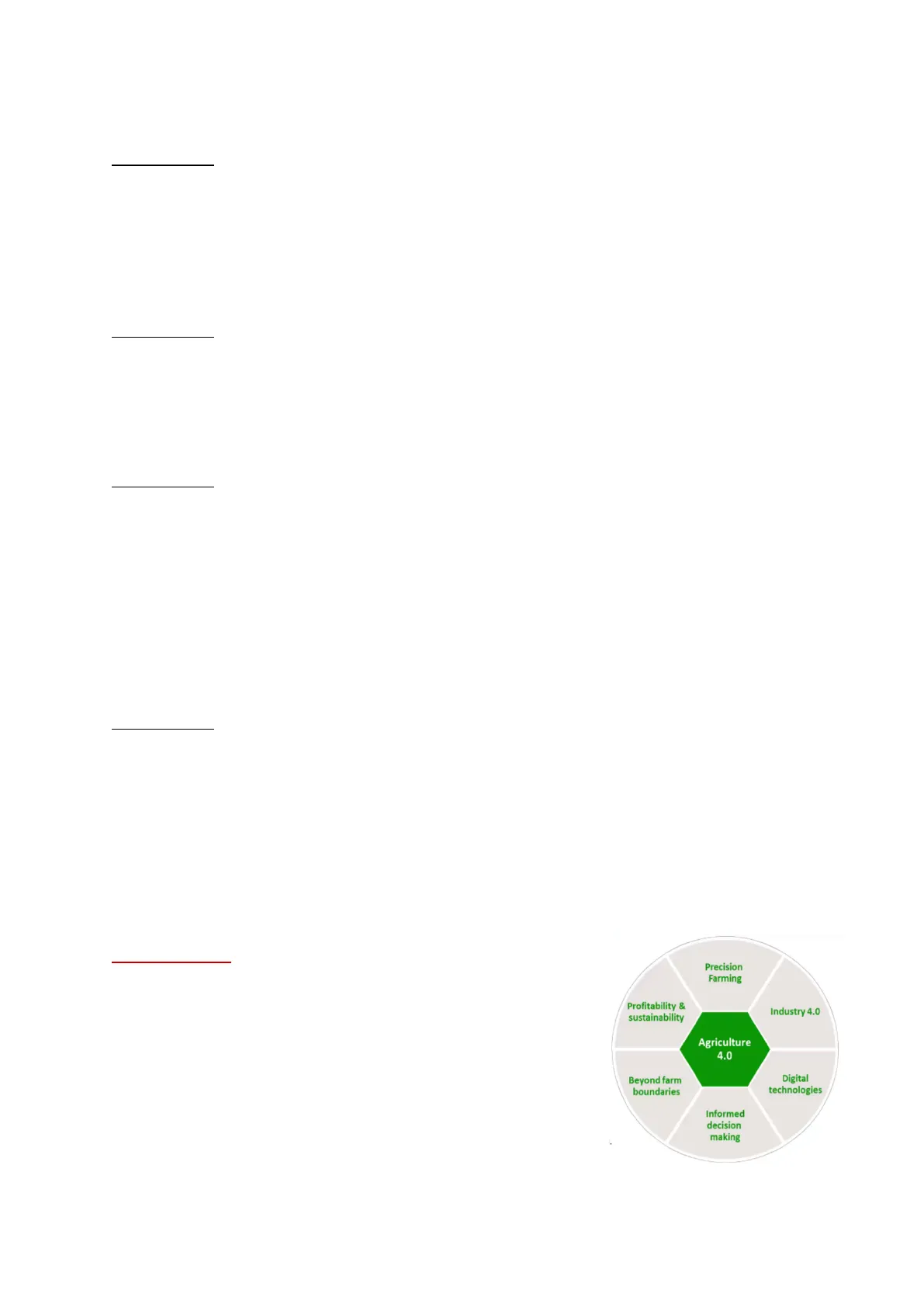
Agriculture 4.0 Key Pillars
Precision
Farming
Profitability &
sustainability
Industry 4.0
Agriculture
4.0
Beyond farm
boundaries
Digital
technologies
1.
Informed
decision
makingUNICATT
Food Processing
2023-2024
Industry 4.0 and Digital Transformation
ERP
INDUSTRY 4.0
INDUSTRY 3.0
INDUSTRY 2.0
INDUSTRY 1.0
Mechanization, steam
power, weaving loom
Mass production,
assembly line,
electrical energy
Automation, computers
and electronics
Cyber Physical Systems,
internet of things, networks
Industry 4.0 > all entities of the working
environment are linked to each other
Digital twin = virtual version of a particular
world.
In simulation = acceleration / deceleration to gather
more data > apply & develop in the real world (real
world will confirm or infirm the data)
Also apply to industries > simulation.
From internet of thing (= achieve thing through a common network) to internet of plants
> From the field = real time monitoring > gather data send to data center = stored & analyzed >
indication & application to the real world
Usage of digital technologies = able the collection, integration & analysis of data storage. Can give
new prospect to the farmer > collect data from the field, surrounded environment & market =
decision making.
UGVs & UAVS = Unman Ground Vehicles / Unman Aerial Vehicle (ex : drones) > increase data collect &
farming operation. Data available (stored).
Informed Decision Making
Informed decision making : farmers & all the actors of the
supply chain make decisions on their personal goal and
subjective beliefs.
> Decision Support System (take the date, collect, based on
the goal = suggestion) > make decision more fact, math-
based & less intuition-based.
Ex : crops planted during full moon.
Beyond Farm Boundaries
Beyond Farm Boundaries > Nowadays : integration of the
farm process to external actors.
Crop
environment
DSS
Database
Plant,
pests
&
diseases
Expert
knowledge
Interpretation
Weather
&
soil
models
Advise
Actions
Decision-making
> Agriculture 4.0 allow the integration of all those actors in a fast & efficient way
Example of compagnies : Climate FIELD VIEW, TARANIS (develop platform for analysis of heath of
crops > number of insects through uses of analysis method), AgriSOING (soil characterization),
FARMSTAR ...
Agriculture 4.0 Solutions
28 February 2024
Agriculture 4.0 - Solution
- Mapping = can assume huge varieties of forms : point could, occupancy map.
They can represent :
o
Soil conditions (health ... )
o
Cultivation conditions (quality of the field > humidity ... )
o
Advice on the quantity of input to be use = prescription map - Monitoring and control (sensors, GPS, cameras ... ) > duality of sensor > sensors used to
monitor the state of the digital equipment used on the field (drone, tractors ... )UNICATT
Food Processing
2023-2024
Data = many things (quantity of fuel consumption, fertilizer, time ... )
From sensors = collect data & from data = can build maps - Variable rate distribution system ; foal = digitalize everything (use prescription map as input
to specific digitize system > act according to the data) = interconnected software ... to carry
out the activity given the input prescription map - Satellite guide = seeding & planting (used by tractors > GPS sensor)
> Unreliable in urban scenario & in indoor environment (greenhouses) - Precision irrigation (already in place)
- Drones > data collection, file inspection but also agricultural treatment (give all the same
treatment to all field) - Robots > mobile bases
- Decision support systems > depending on activity and time : give suggestion on where and
what to do - Farm management information system > allow all the other solution to be apply : support the
farmer to carry out its task > helps actor to carry out theses activities (automation of
agriculture) > can be used to manage fleet and food traceability.
Agenda 2030 and Digitalization Benefits
Agenda 2030 > Food and agriculture organization
- No poverty > improvement in agriculture = improvement in economic
- Zero hunger = sustainability, profitability, ...
- Decent work & economic growth (achieve by zero hunger & no poverty) > digitalization =
development & economic growth - Industry, innovation & infrastructure > agriculture is tight with industry
- Responsible consumption and production
- Life on land > sustainability & management of the environment
DATA = base of every system BUT capacity of storage = limit > Big Data
Data needed ? > develop models that allow us to understand which data is useful and which is not.
Importance of simulation = allow to recreate the physical & evolution of the world > we can see
predict
Can have high quality sensor but have to know how to interpret & analyze it = how to approach the
data ? > what impact of the data ?
Data Analysis Process
Data analysis : the process
= long & complex pipeline - summarized in 5 steps :
- Collection of data
o
Depends on the environment ... = influencing factors
o
Heterogeneous > depend on the drivers, software = different form of representation - Feature engineering = inconsistency or error to eliminate (machines can makes mistake) > Ex :
GPS does not operate well in closed environments = mistakes
Ø
First thing to ask : is something wrong with the data ? Depends on the situation > data cleaning
Ø
Reduced among of image = feature extraction = only certain feature of the data (useful)UNICATT
Food Processing
2023-2024
Ø
But which data are necessary to answer the task = feature selection - Learning or Modeling
a. Select the learning task (classification, prediction ... ) > each particular task can be achieving
trough different solution > classification can be done with different solution than
prediction > choose the algorithm to implement
b. Select the algorithm to deal with the specific task
c.
Perform learning & modeling
> each algorithm has to learn from experience
> have to model the algorithm > relies on different level of complexity - Evaluation = assess performance of the model > Go back to Step 2
- Deployment
Data analysis = 60% of cleaning & organizing
Feature engineering = most important step > if mess up step 2 to 4 = wrong
Data collection is essential ; data is useful for different aspect > same data can be used for a lot of
varieties of task > economical values (company, user, model, system ... ) & allow to create a physical
simulation of the world. Need to understand what task can be carried out.
Features and Instances in Data
Features and instances
Easier way to represent data = table
> Instance = entities consisting of a series of information ; characterized by a set of information
= atomic element of information (ex : person)
Ø
Feature = attribute / variables used to describe each instance
Values of the features ? Concept = special content inside the data = thing that can be learned = values
that each particular feature can be learn.
Data & features can be classified by types :
- Categorical feature : from a predefined set > used as labels or names (ex : color)
o Nominal feature > no relation between nominal values, no ordering, cannot be
compared, only quality test can be performed (ex : color)
o
Ordinal feature > order on values, no distance defined between values, no addition
or subtraction (ex : education level) - Numerical feature > ordered & measure in fixed equal unit (measured unit)
Can be subdivide between :
Discrete = set of define number of a finite amount ; ex : from 1 to 10
> Have value represented in finite & compatible set
> Can easily be mapped (ex : 1 color correspond to a number)
Continuous = values represented in infinite or uncountable set
> Represented has floating point (ex : pi ... )
> Mapping is more complex
o Interval feature > difference between 2 values ; no concept of ratio
o
Ratio feature > 0 point is defined (relationship between 2 number) > depend on the
scientific knowledge of the field) ; ratio between measurement makes sense
Can’t find what you’re looking for?
Explore more topics in the Algor library or create your own materials with AI.
