Operations Management: Key Concepts, Processes, and Strategies
Document about Operations Management, covering production processes, supply chain management, and improvement strategies. The Pdf explores methodologies like Just-in-time, Lean Manufacturing, and Six Sigma, relevant for university-level Economics students. It also details various production layouts and work measurement techniques, including a case study on the Lingotto factory.
See more50 Pages

Unlock the full PDF for free
Sign up to get full access to the document and start transforming it with AI.
Preview
OPERAT TION Carola 1 year 2022 -23
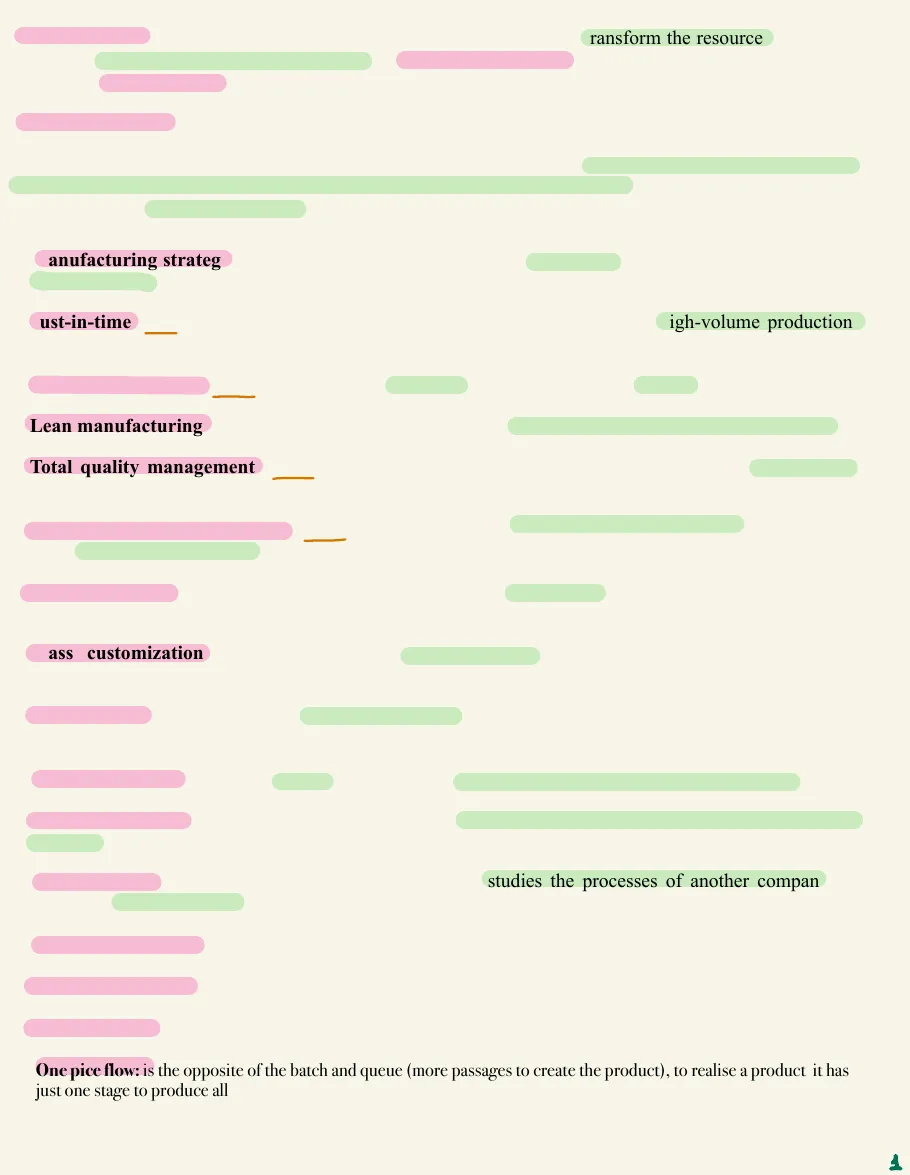
Operations: refers to manufacturing and service processes used to transform the resources employed by a firm into products desired by customers. A manufacturing process is producing some type of physical product. A service process would produce an intangible product.
Supply chain: refers to processes that move information and material to and from the manufacturing and service process of the firm, this includes the logistics processes that physically move product and the storage processes. The central idea of supply chain management is to apply a total system approach to managing the flow of information, materials and services from raw material suppliers through factories and warehouses to the end customer.
Manufacturing strategy (1970): emphasizes how a factory's capabilities could be used strategically to gain advantage over a competing company.
Just-in-time (JIT, 1980): an integrated set of activities designed to achieve high-volume production using minimal inventories of parts that arrive exactly when they are needed.
Total quality control (TQC, 1980): seeks to eliminate causes of production defects.
Lean manufacturing: achieving high customer service with minimum levels of inventory investment.
Total quality management (TQM, 1980-1990): managing the entire organization so it excels in all dimensions of products and services important to the customers (ISO).
Business process reengineering (BPR, 1990): approach of improving business processes that seeks to make revolutionary changes as opposed to evolutionary small changes.
Six Sigma quality (part of TQM): a term that describe the quality goal of no more than 3.4 defects out of every million units. It refers to a quality improvement philosophy and program.
Mass customization: ability to produce a unique product exactly to a particular customer's requirements.
Sustainability: ability to maintain balance in system. The ability to meet current resource needs without compromising the ability of future generations to meet their needs.
Triple bottom line: a business strategy that includes social, economic and environmental criteria.
Business analytics: the use of current business data to solve business problems using mathematical analysis.
Benchmarking: it is a process in which one company studies the processes of another company to identify the best practices.
Receivable turnover: annual credit sales/ average account receivable
Inventory turnover: cost of goods sold/average inventory value
Asset turnover: revenue/total assets
One pice flow: is the opposite of the batch and queue (more passages to create the product), to realise a product it has just one stage to produce all
OPERATION & SUPPLY CHAIN MANAGEMENT (05CM)
manufacturing and service process used to transform resources into products
Processes that move information and material to and from the firm
design, operation and improvement of the system that create and delivery the firm's promony products and services
Process Steps for Men's Nylon Supplex Parkas
Mandachang Plant Warehouse T wacheuse Assente On Line Out Front: noceke at Low Warcheune
MAJOR CONCEPTS THAT DEFINE THE OSCH FIELD
- Manufacturing strategy paradigm
- Lean manufacturing, JIT and TQC
- Services quantity and productivity
- Tot quality management and quality certification
- Business process reengineer
- Six sigma quality
- Supply chain management
- Electronic commerce
- Sustainability and the triple bottom line (business strategy that includes social, economic and environmental cinema)
- Business analytics
efficiency > doing something at the lowest possible cost effectiveness > doing the right things to create the most value for the company value> attractiveness of the product considering its features and durability; quality devided by price
PROCESS ACTIVITIES
- PLANNING - processes needed to operate an existing supply chain
- SOURCING - selection of suppliers that will deliver the goods and services needed to create the firm's product
- MAKING - producing the major product or service
- DELIVERING- logistic process such as selecting carriers, coordinating the movement of good and information and collecting payment
- RETURNING - receiving worn-out, excess and/or defective products back from customers
service on demand
MANUFACTURING PROCESSES
from a finished goods inventory
Lead time: time needed to respond to a customer order (source, make, deliver).
A key concept is the customer order decoupling point which determines where inventory is positioned in the supply chain. Selection of decoupling points is a strategic decision that determines customer lead times.
The essential issue in satisfying the customers in the make-to-stock environment is to balance the level of finished inventory against the level of service to the customer.
Lean manufacturing (investment for make-to-stock firms): programs to achieve high customer service with minimum levels of inventory investment.
PLANNING OF PRODUCTION SYSTEM ( Planning > Realisation -> Start -> Practice)
there Isn't option sequence or hierarchy of these decision ( Indipendent choices)
PROCESS SELECTION
It refers to the strategic decision of selecting which kind of production processes to use to produce a product or provide a service. The format by which a facility is arranged is defined by the general pattern of workflow, there are five basic structures:
- Project layout, a setup in which the product remains at one location and equipment is moved to the product (construction of houses)
- Workcenter layout (job shop), suited for low-volume production of a great variety of nonstrandard products, they are referred to as departments and are focused on a particular type of operation
- Manufacturing cell layout, a dedicated area where similar products are produced (metal fabricating)
- Assembly line (straight line), a setup in which an item is produced through a fixed sequence of workstations, designed to achieve a specific production rate (cars)
- Continuous process, is similar to an assembly line but it is a process that converts raw materials into finished product in one continuous process. These structures are highly automated and constitute one "machine" that may operate 24 hours a day without shutdowns or startups (chemicals)
DEFENING THE PRODUCT TO OFFER
technical Feasibility Machinery Quality Cost Product consumer and Technical requirements) Reliability TQM, Six sigma, ...
LAYOUT CHOICE
Machinery Others factors Layout Depending on: type of production Staff 2
DEFINING THE PRODUCTION VOLUME & PHASE
General services Sales projections Investment Support activities Phases and production volume Machinery Equipment and staff requirement Sequence and production activities 5
DEFENING THE SPACE REQUIREMENT
Markets Cost Inside / Outside Type of production Areas choice Others factors Building choice 5
MANAGEMENT OF PRODUCTION SYSTEM
Japanese "CONTINOUS" IMPROVEMENT Just in time kaizen Lean production Production management Lead time MRP Material Requirements Planning: A production planning and inventory control system used to manage manufacturing processes. It calculates what materials are needed, how much is needed to complete a build and when materials are needed in the build process .
· Each plant has characteristics that make it suitable for a certain production . Therefore the plant must be defined around in view of the good that it intends to realize · In this sense, proper planning is a fundamental requirement for a profitable establishment
PRODUCT CLASSIFICATION
· Joint products, obtained from one or more inputs with a single production process · Main product/by-product (depending on the weight of revenue), the revenue that comes from the sale of the product is much higher than the other products (by-products) obtained from the same production cycle The process from which the products derive, can be combined : · From an economic point of view, processes are combined at the time of the sale (razor and razor blade, console and video games) · From a manufacturing point of view, processes are combined at the time of production (milk and derivatives) From a manufacturer point of view, combined processes must respect certain conditions: . Deriving from the same production process · Up to a certain point in the production process the different types of products must not be able to identify · Each product must have its own market
PRODUCTION PROCESS CHOICE
High level view can be divided into three steps: . Source the parts needed · Make the product · Deliver the product
DIAGRAMS
4 symbols related CAN BE qualitative quantitative more or less analytic
transportation operation storing or storage operation inspection or control operation manufacturing operation D wait or delay operation
CORRELATION PRODUCT- PLANT
-> need for a SUSTAINABLE production structure There's a point in the prod. syst . in which we can splet the prod. into 2/3 diff. rand of prod. which are + on - equal in terms of revenuesex
FLOW CHART
(graphic representation of the production process, tool for making quality) & manufacturing process flow design: a method to evaluate the specific processes that materials follow as they move through the plant.
The most common production management tools used in planning and designing the process flow are:
- assembly drawings, is an exploded view of the product showing the component parts.
- assembly charts, uses the information of the assembly drawing and defines how parts go together, their order of assembly and the material flow pattern.
- route sheets, specifies operations and process routing for a particular part.
- flow process charts, denotes what happens to the product as it progresses through the productive facility.
Each of these charts is a tool used to improve operations during the steady state of the production system. Indeed, the first step in analyzing any production system is to map the flows and operations by using one or more of these techniques that are the "organization charts" of the manufacturing system.
INDUSTRY CLASSIFICATION
Parameters:
- Dimensions
- Level of integration
- Capital-labour ratio
- Transformations nature
- Production cycle size
- Technological diagram
- Process continuity
- Legal form of the company
Dimension
- Small, medium, large industry
- Reference parameters (production capability, number of employees, range of investments, annual turnover)
- The parameters value can change with mechanization and/or automation degree or with sector classification (manufacturing, chemical)
Level of integration
- Vertical integration industry, upstream or downstream extension of the process which overall constitutes the so- called "integral cycle", the benefits are more added value, respect of time and quality
- Horizontal integration industry, increase in production volume by acquiring orders of the same product (or similar products) from multiple suppliers, the benefits are specialization, saturation and rapid amortization of plants and low costs
Technological diagram / production cycle
- One-line industry
- Converging industry (cars)
- Analytical or divergent industry (refineries, distilleries)
- Converging-divergent industry (steel industry)
Production cycle size
- Closed or integral cycle industries, from raw materials to final product
- Opened cycle industry, base or extraction (from raw materials to semi-finished product), refiners or processing (from semi-finished to a more advanced processing stage) and completive (from semi-finished to final product)
- Complementary industry (waste as raw material)
- Subsidiary industry (they produce services, ex. maintenance)
Process continuity
- Continuous, if they are conducted without interruption for long periods of time
- Non continuous, if they are conducted for limited periods of time. It can also be repetitive (medium-size or large lots, production can be interrupted without major damage, they are industries that produce for the warehouse) or intermittent (the production takes place for dealing with specific orders and in small batches)
Rigid or flexible production processes: even if the manufacturing process is bounded by the type of production that has been chosen , within the same category of products you can work with some flexibility. As more you approach homogeneous product categories the more you try to reduce the rigidity. For intermittent process for single order or small lots it is necessary having a loud flexibility to avoid depending on a few customers. For large lots processes will tend towards high production automation process to increase the volume produced and reduce costs (not suitable for a variable final demand).
Can’t find what you’re looking for?
Explore more topics in the Algor library or create your own materials with AI.
