Organization and Information System in Computer Science
Document from University about Organization and Information System. The Pdf explores business processes, ERP systems, information security, and Business Intelligence. It is a Pdf for University students of Computer science.
See more57 Pages


Unlock the full PDF for free
Sign up to get full access to the document and start transforming it with AI.
Preview
TABLE OF CONTENTS:
Warm up 2 The importance of MIS 6 Business Processes, Information Systems, and Information 8 Information Technology 10 Database Processing 15 Operational Processes and Information Systems 19 Business Process Management 22 BPM Analysis 27 ERP 30 The whole picture 36 Selecting an ERP System 38 Implementing ERP: change management. 42 Implementing An ERP System 45 Managing an ERP System 49 Business Intelligence 52 ERP Satellite Systems 55
WARM UP
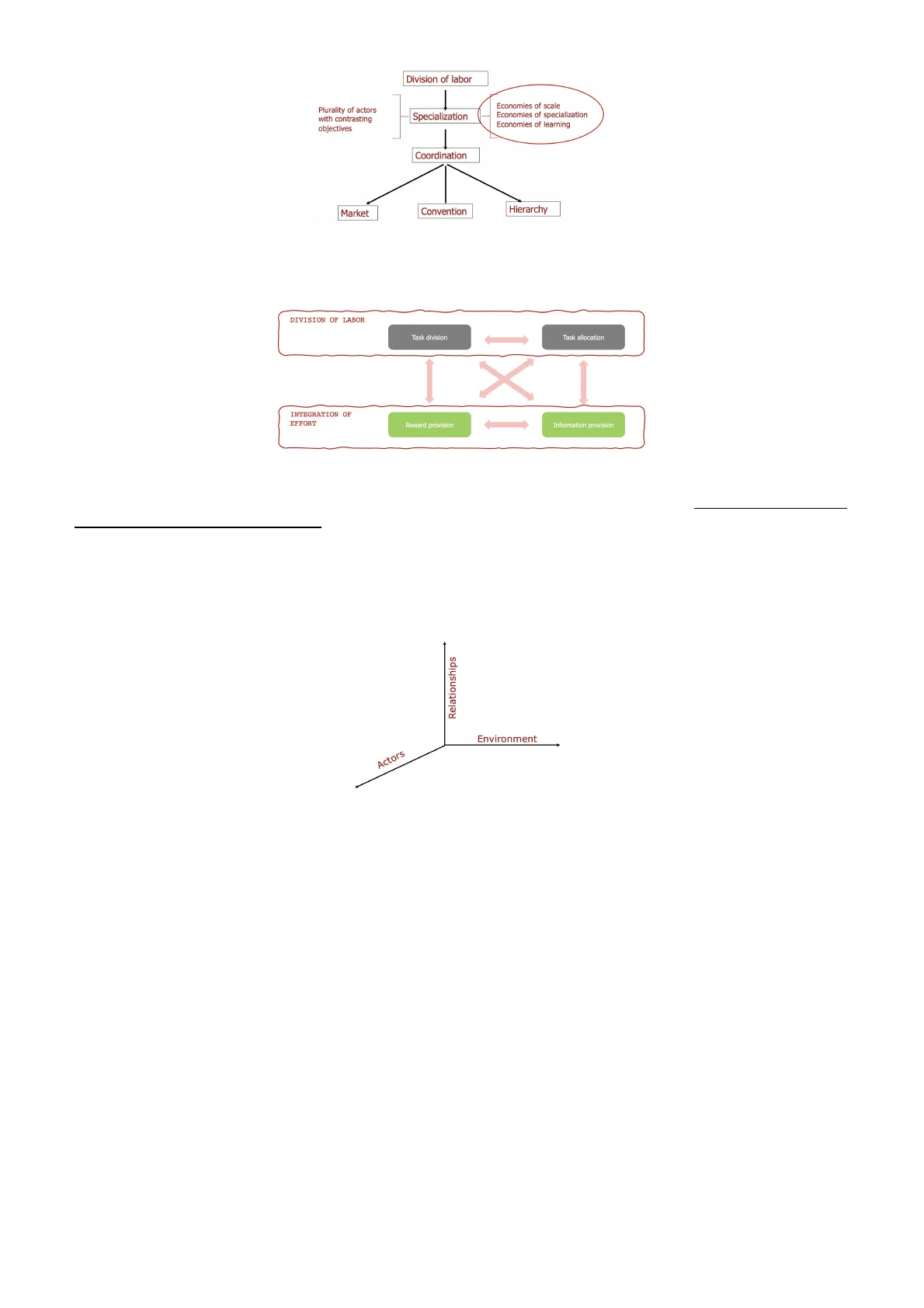
Division of labor - Plurality of actors with contrasting objectives Specialization Economies of scale Economies of specialization Economies of learning Coordination Convention Hierarchy Market Hierarchy -> coordination through authority Convention -> something that creates coordination on a social base. Values are supposed to drive the action of people. A different perspective on the universal problem of organizing:
DIVISION OF LABOR
Task division Task allocation X INTEGRATION OF EFFORT Reward provision Information provision Division of labor also means task division, not only task allocation. The second step of the universal problem of organizing is integration of effort, which corresponds with coordination in the previous model. According to Puranam we integrate effort through rewards and information provision. Providing information is essential to ensure coordination. - New trend: hierarchy is not necessary anymore; bosses are not needed. The presence of bosses helps the information flow. If we want to pass to a horizontal organization, we have to ensure that there is a horizontal information flow. - Technology: very pervasive in organization design. Organizational dimensions: - Relationships Environment Actors Where we talked about information in GGA2: - Transaction cost economics - Agency theory - Communication flows in a bureaucratic structure. According to Weber information had to follow a vertical flow. - Fayol, administrative theory: described the role of management. - Theory of decision making: we are in a world of bounded rationality and information cost. - Motivational theories: Maslow, McClelland, Herzberg, Vroom, Adams, Porter and Lawler. According to Porter and Lawler the result of your work depends on your competence and the perception of how you'll be rewarded. The perception is built through information. Having information impact the performance. - Resource dependence theory - Organizational routines: incorporate processes. They accumulate knowledge over time that translates in a way to do things. - Thompson: interdependency. Organizing tasks to work in parallel make the process faster. - Galbraith: dedicated his studies to tasks. As complexity & variability increase, more info is needed. - Organizational space: physical, social, and symbolic space. - Operating systems: coordination among units - Mintzberg: every organization can be thought as made of five different elements: top management team, middle line, operative corps, technostructure and staff. The middle line must manage the flow of information from the bottom to the top and vice versa. - Chester Barnard: communication and authority. We have to make sure that communication is authority so that people really use that as an input for their job.Challenges of organizational design: [1] Vertical and horizontal differentiation [2] Differentiation Balancing Integration [3] Centralization Balancing Decentralization [4] Standardization Balancing Mutual Adjustment Information system is involved in all these challenges. Information systems affect the way we solve these trade-offs.
Balancing Vertical and Horizontal Differentiation
1) Balancing vertical and horizontal differentiation: Vertical differentiation: The way an organization designs its hierarchy of authority and creates reporting relationships to link organizational roles and subunits. Represented by the number of hierarchical levels in a structure. Establishes the distribution authority between levels. Flat organization: has a low number or hierarchical levels. Increasing the number of them is a way to promote control. Advantages associated with tall hierarchy are control and more way to move from one level to another. The career path is clearer, important decisions are retained at the top. On the other hand, in flat hierarchies it is harder to be promoted. Cons: in a tall hierarchy information are slower and information can be distorted from one level to another -> possibilities to create information systems that solve that. Horizontal differentiation: the way an organization groups organizational tasks into roles and roles into subunits (function and division). Roles differentiated according to their main task responsibilities.
Vertical and Horizontal Differentiation Advantages and Disadvantages
Advantages Disadvantages Vertical differentiation Control, supervision, feedback, career management as motivational factor Less autonomy, risk of distorted comunication, slow decision- making, high bureaucratic costs Advantages Disadvantages Horizontal differentiation Economies of scale Economies of specialization Divergent sub-unit orientation High coordination costs Low flexibility Low sinergies
Balancing Differentiation and Integration
2) Balancing Differentiation and Integration: Integration: the process of coordinating various tasks, functions, and divisions so that they work together and not at cross-purposes. Lawrence and Lorsch: you should replicate the complication of the environment in the internal structure. And if you differentiate, you need to integrate. Managers facing the challenge of deciding how and how much to differentiate and integrate must: - Guide differentiation process so that it develops the core competences that give the organization a competitive advantage. - Integrate the organization by choosing appropriate mechanisms that allow subunits to cooperate and that build up the organization's core competences.
INTEGRATION MECHANISM
(IN ORDER OF INCREASING COMPLEXITY) DESCRIPTION EXAMPLE (E.G., IN JOHNSON & JOHNSON) Hierarchy of authority A ranking of employees integrates by specifying who reports to whom. Salesperson reports to Diaper Division sales manager. Direct contact Managers meet face-to-face to coordinate activities. Diaper Division sales and manufacturing managers meet to discuss scheduling. Liaison role A specific manager is given responsibility for coordinating with managers from other subunits on behalf of his or her subunit. A person from each of J&J' production, marketing, and research and development departments is given responsibility for coordinating with the other departments. Task force Managers meet in temporary committees to coordinate cross-functional activities. A committee is formed to find new ways to recycle diapers. Team Managers meet regularly in permanent committees to coordinate activities. A permanent: J&J committee is established to promote new-product development in the Diaper Division. Integrating role A new role is established to coordinate the activities of two or more functions or divisions. One manager takes responsibility for coordinating Diaper and Baby Soap divisions to enhance their marketing activities. Integrating department A new department is created to coordinate the activities of functions or divisions. A team of managers is created to take responsibility for coordinating J&J' centralization program to allow divisions to share skills and resources.
Balancing Centralization and Decentralization
3) Balancing Centralization and Decentralization: Power: someone can affect someone else's behavior Authority: can affect someone's behavior even if that person doesn't agree. Balance takes to: - Enabling lower managers to make important decisions. - Allowing top managers to focus on long-term strategy making. IS are there to ensure that who is entitled to take a decision has all the information to make the best choice.
Centralization and Decentralization Pros and Cons
Centralization - Pros: clear and unified decision, focus on organizational goals - Cons: scarce autonomy, low flexibility, slow response Decentralization People are more involved, lowest level are entitled to make decisions.
Balancing Standardization and Mutual Adjustment
4) Balancing Standardization and Mutual Adjustment: Challenges managers faces are: - To find a way of using rules and norms to standardize behavior. - Allow mutual adjustment to give managers opportunity to discover better ways to achieve goals. Standardization: - Pros: standard quality, efficiency, no ambiguity, predictability - Cons: Routine task, low flexibility, scarce autonomy and innovation
ORGANIZATIONAL STRUCTURES:
There are three types of structure: simple, divisional, and functional. All these structures have just one line of authority, based on function or division. Another type of structure, different from the others, is the matrix structure: it has two lines of authority (against Fayol's theory, according to which there has to be only one line). In a matrix there are two bosses-managers. This structure merges the functional and the divisional structure (one line based on inputs and one based on outputs).
Simple Structure
Simple structure: Information flows through people. The management of information is essential also in small firms. It may be a rudimental information system, but there has to be one.
Functional Structure
Functional structure: A functional structure is a design that groups people based on their common skills, expertise or used resources. A functional structure privileges efficiency, sometimes it's difficult to deal with variety. Sometimes the variety makes the function not effective anymore: variety also means variety of competence and inputs and a function is based on common competencies. If the firm grows through diversification it may switch to a divisional structure. Different divisions achieve effective results, managers are evaluated by profits and losses. A functional manager cannot be evaluated by profits and losses. - Functional structure is the bedrock of horizontal differentiation. - Tasks are grouped into functions to increase the effectiveness with which it achieves its goals. B. This format shows the position of each function within the organization's hierarchy. CEO Research and Development Sales and Marketing Manufacturing Materials Management Finance
Functional Structure Advantages and Disadvantages
Advantages Disadvantages Provides people with the opportunity to learn from one another and become more specialized and productive Communication Problems: as functions develop, each with their own hierarchy, they become increasingly distant from one another People who are grouped together by common skills can supervise one another and control each other's behavior Measurement Problems: information needed to measure the profitability of any functional group is difficult to obtain People develop norms and values that allow them to become more effective at what they do Location Problems: centralized control hinders ability to satisfy the special needs in different geographic regions Customer Problems: servicing the needs of new kinds of customers and tailoring products to suit them is relatively difficult
Can’t find what you’re looking for?
Explore more topics in the Algor library or create your own materials with AI.
