Introduction to Investment: Financial Assets and Market Theories
Document from an Introduction to Investment. The Pdf, an outline for University-level Economics, covers real and financial assets, the three main types of financial assets, and theories such as Arbitrage Pricing Theory (APT) and Efficient Market Hypothesis (EMH).
See more59 Pages

Unlock the full PDF for free
Sign up to get full access to the document and start transforming it with AI.
Preview
Introduction to Investment
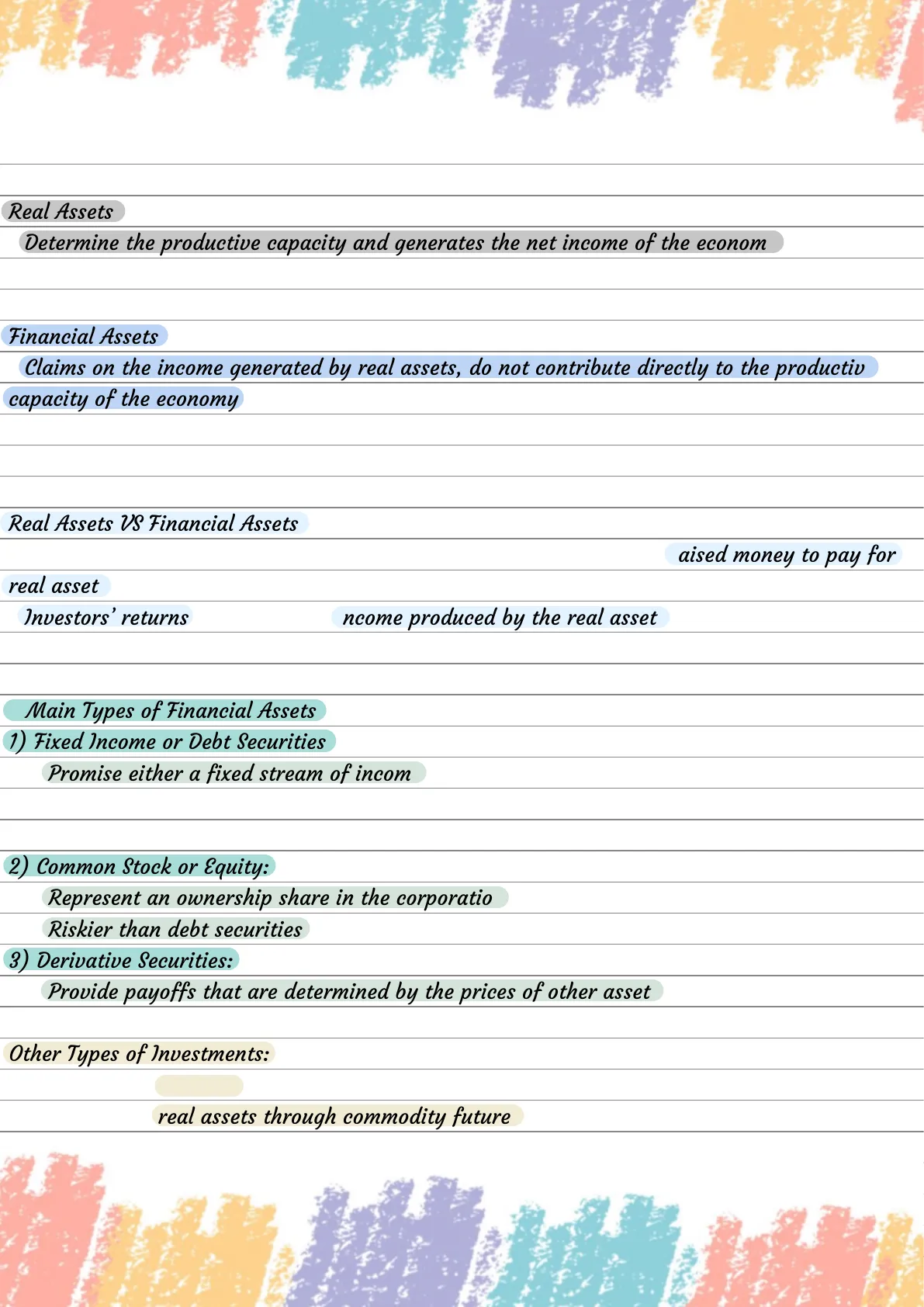
Real Assets
Real Assets: · Determine the productive capacity and generates the net income of the economy > Land - buildings - machine - knowledge used to produce goods & services
Financial Assets
Financial Assets: - Claims on the income generated by real assets, do not contribute directly to the productive capacity of the economy - Define the allocation of income or wealth among investors > Stocks and bonds
Real Assets vs. Financial Assets
Real Assets VS Financial Assets: . When investors buy securities issued by companies, the firm use the raised money to pay for real assets · Investors' returns come from the income produced by the real assets that were financed by the issuance of those securities
Types of Financial Assets
3 Main Types of Financial Assets: 1) Fixed Income or Debt Securities: - Promise either a fixed stream of income or a stream of income determined by a specific formula - Least closely tied to the financial condition of issuer e.g. corporate (or government) bonds 2) Common Stock or Equity: - Represent an ownership share in the corporation - Riskier than debt securities, i.e. no promise of any particular payment e.g. shares of Apple 3) Derivative Securities: - Provide payoffs that are determined by the prices of other assets e.g. call options
Other Investment Types
Other Types of Investments: · Investment in currency (foreign exchange markets) · Investment in real assets through commodity futures (e.g. gold, silver, and gas) (e.g. the Newyork Mercantile Exchange or the Chicago Board of Trade) · Portfolio can be created in your accounts through either real assets or financial assets . Corporations invest in the commodity futures to hedge the risk - e.g. a construction firm uses copper futures contract to manage price risk (i.e. locking in the price of copper to deal with possible sudden price jumps in the future) - company has to pay a fee for this contract
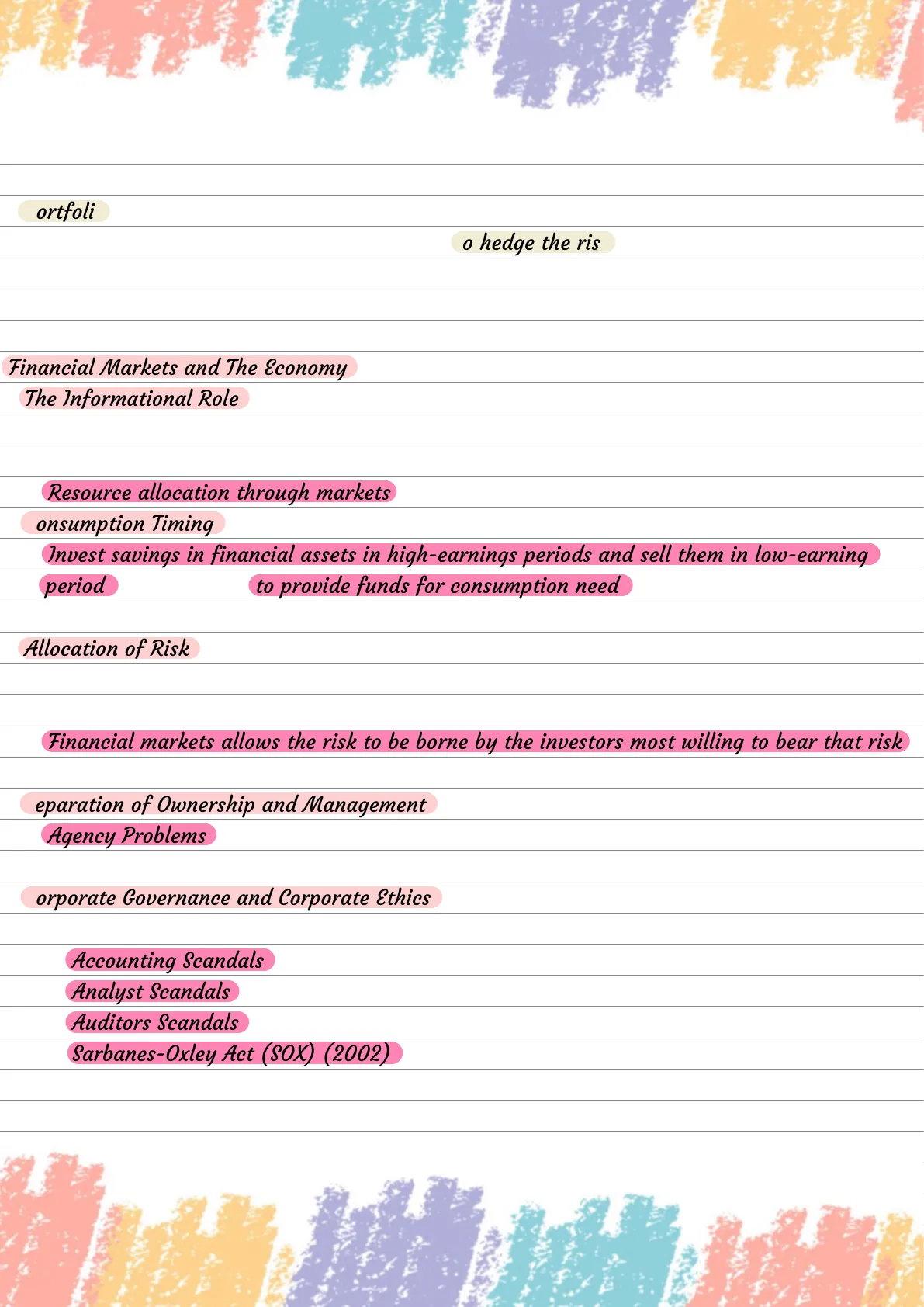
Financial Markets and The Economy
- The Informational Role:
- Stock prices reflect investors' collective judgement
- Capital flows to companies with best prospects
- Resource allocation through markets
- Consumption Timing:
- Invest savings in financial assets in high-earnings periods and sell them in low-earnings periods (e.g. retirees) to provide funds for consumption needs
- Use securities to store wealth and transfer consumption in the future
- Allocation of Risk:
- Investors can select securities consistent with their tastes for risk (e.g. risk-tolerant buying stocks and more conservatives buying bonds, etc)
- Financial markets allows the risk to be borne by the investors most willing to bear that risk
- Also benefits firms that need to raise capital, as security can be sold for best possible price
- Separation of Ownership and Management:
- Agency Problems: arise when managers start pursuing their own interests instead of maximising the firm's value
- Corporate Governance and Corporate Ethics:
- Jf firms can mislead the public about their prospects, then much can go wrong
-Accounting Scandals: e.g. Enron and WorldCom - Analyst Scandals: misleading and overly optimistic research reports - Auditors Scandals: e.g. Enron's auditor Arthur Andersen - Sarbanes-Oxley Act (SOX) (2002): tighten the rules of corporate governance e.g. increase independent directors
Mechanisms to Mitigate Agency Problems
- Managers' income to firm success (e.g. share options to give managers a stake in equity)
- Monitoring from board of directors
- Monitoring from large outside investors (e.g. mutual or pension funds) and security analysts
- Takeover threat
The Investment Process - Portfolio
The Investment Process - Portfolio: collection of investment assets
Building A Portfolio
- Asset Allocation: choice among broad asset classes, e.g. equities, bonds, real estate, etc
- Security Selection: choice of securities within each asset class
Competitive Markets
- Risk-Return Trade-Off: higher-risk assets are priced to offer higher expected returns than lower-risk assets
- Efficient Markets: in fully efficient markets where prices quickly adjust to all relevant information, there should be neither underpriced nor overpriced securities
The Players in Financial Markets
The Players - The Major Ones: Demanders of Capital (Firms) - Suppliers of Capital (Households) - Governments (Can Be Borrowers or Lenders)
Financial Intermediaries
The Players: - Financial Intermediaries: bring suppliers of capital together with demanders e.g. banks, investment companies, insurance companies, credit union
Investment Bankers
- Investment Bankers (Instead of In-House Security Issuance Divisions of Firms): · Newly issued securities to public in the primary market · Investors trade previously issued securities in the secondary markets
Venture Capital and Private Equity
- Venture Capital and Private Equity: investors for start up
Fintech and Financial Innovation
- Fintech and Financial Innovation: · Financial Disintermediation: peer-to-peer lending (no commercial bank) (e.g. LendingClub) · Cryptocurrencies: the block chain technology
How Securities Are Traded
How Firms Issue Securities
How Firms Issue Securities: - Primary Market: market for the sale of newly issued securities by firms - Secondary Market: market in which previously issued securities are traded among investors - Stock Exchange (E.g. NySE and LSE): · Public companies or listed companies · Initial Public Offering: 1st issue of shares to general public · Seasoned Equity Offering: sale of additional shares of firms that are already publicity listed · Firms issue stocks through underwriters (investment banks)
Types of Markets and Liquidity
How Securities Are Traded - Types of Markets - Increasing Liquidity (From Top to Bottom): - Direct Search Markets: least organised market - buyers and sellers seek each other - Brokered Markets: brokers search out buyers and sellers (e.g. real estate market, the primary market from investment bankers) - Dealer Markets: dealer have inventories of assets from which they buy and sell (e.g. bond market, foreign exchange trade) - Auction Markets: most integrated market - trader converge at one place to trade (e.g. NySE)
Bid Price
Bid Price: · Bids are offers to buy - in dealer markets, bid price = price at which dealer is willing to buy · Investors 'sell to the bid'
Ask/Asked Price
Ask/Asked Price: - Represent offers to sell - in dealer markets, ask price = price at which dealer is willing to sell - Investors must pay the ask price to buy the securities
Bid-Ask Spread
Bid-Ask Spread: profit for the dealer
Types of Orders
2 Types of Order: 1) Market Order: executed immediately - trader receives current market price -'At Best' market order gives the best price available 2) Price-Contingent Order: traders specify buying or selling price - limit orders and stop orders
Limit Order
Limit Order: allows you to buy or sell at a determined limit price, or better
Limit Buy Order
Limit Buy Order: an order to purchase a security at or below a specified price, meaning investor doesn't overpay (price certainty), but the order may not be fulfilled (execution uncertainty)
Limit Sell Order
Limit Sell Order: an order to sell a security at or above a specified price, meaning investors doesn't sell at a loss (price certainty), but the order may not fulfilled (execution uncertainty)
Stop Orders
Stop Orders: · Stop Loss Order: - Designed to protect profits and minimise losses for a stock you already own - you can generally set a lower limit - Stock is sold if the price falls below a specified price - Stops further losses from accumulating · Stop Buy Order: - Is an order to purchase a security at or above a specified price - Often used to limit losses on short sales
Market Order Example
What Type of Trading Order Would you Give your Broker - 'At Best' Market Order: · Buy shares of FedEx to diversify your portfolio · Current market share price is fair and you want to trade quickly . It will be executed immediately at best possible price - however, the actual price paid will depend on the size of the order and the market conditions at the time
Limit Buy Order Example
What Type of Trading Order Would you Give your Broker - Limit Buy Order: - Buy shares in FedEx but think that the current market price is too high - If shares could be bought at a price 5% < current value, you would like to purchase the shares - It will be executed only if the price falls to the specified price - however, this may not happen so the order may not be executed
New Trading Strategies
- Algorithmic Trading: the use of computer programs to make trading decisions (more than half of all equity volume in the US)
- High-Frequency Trading: special class of algorithms trading with very short order execution time
- Dark Pools:
- Trading systems that preserve anonymity
- Mainly relevant in block trading
- Many large traders seek anonymity
- Somewhat controversial because they contribute to the fragmentation of markets - reduce price informativeness
Trading Costs
- Broker: a person who acts as an intermediary between buyers and sellers
- Discount Broker: buy and sell securities, hold them for safekeeping, offer margin loans and facilitate short sales
- Full-Service Brokers: employ research staff and provide investment advice, e.g. buy and sell recommendations
- Trading Costs:
- Explicit Cost of Trading: brokerage commission
- Implicit Cost of Trading: bid-ask spread
- Buying On Margin: borrowing part of total purchase price using loan from broker - securities purchased on margin must be maintained with the brokerage firm, i.e. collateral for loan
Margin Definition
Margin: refers to the percentage or amount contributed by the investor
Effect of Buying On Margin
Effect of Buying On Margin: · you increase profits when the share price rises . But you also magnify losses when the share price falls · Buying on margin is a practical example of homemade leverage · Leverage increases the variation in outcomes, i.e. it increases risk
Types of Margin
- Initial Margin:
- % of the purchase price that the investor must pay for using their own cash
- In US, minimum initial margin is set by Federal Reserve Board ('the Fed') - currently 50%
- Margin:
- % of equity in the margin account at a specified point in time
- Varies depending on the value of the account
- Margin = Equity = Stock Value
- Maintenance Margin:
- Minimum % of equity that must be kept in the margin account
- In this US, the minimum maintenance margin is set by the Fed - currency 25%
- Margin Percentage = Equity = Value of The Investment
Margin Call
Margin Call: - If value of securities falls too much, equity needs 'topping up' to maintain maintenance margin - Occurs when the account falls below the minimum maintenance margin - A demand from the broker for additional assets so that the margin account is brought up to the minimum maintenance margin
Rate of Return Calculation
Rate of Return On The Investment Over The year = [(Ending Equity In The Account - Initial Equity) = Initial Equity] X 100
Short Sales
- Purpose: to profit from a decline in the price of a stock or security
- Mechanics:
- Borrow stock through a broker
- Sell it and deposit proceeds and margin in an account
- Closing Out The Position: buy the stock and return to the party from which it was borrowed
- Pay the lender the dividends
- Profit = Decline In Share Price X Number of Shares Sold Short
- Short sale the percentage margin is calculated by reference to the liabilities, NOT assets
Can’t find what you’re looking for?
Explore more topics in the Algor library or create your own materials with AI.
