Urea Cycle & Amino Acid Metabolism: Oxidative Deamination of Glutamate
Slides about Urea Cycle & Amino Acid Metabolism. The Pdf covers the urea cycle and amino acid metabolism, with learning objectives, multiple-choice questions, and detailed explanations on glutamate's oxidative deamination for university Biology students.
See more61 Pages


Unlock the full PDF for free
Sign up to get full access to the document and start transforming it with AI.
Preview
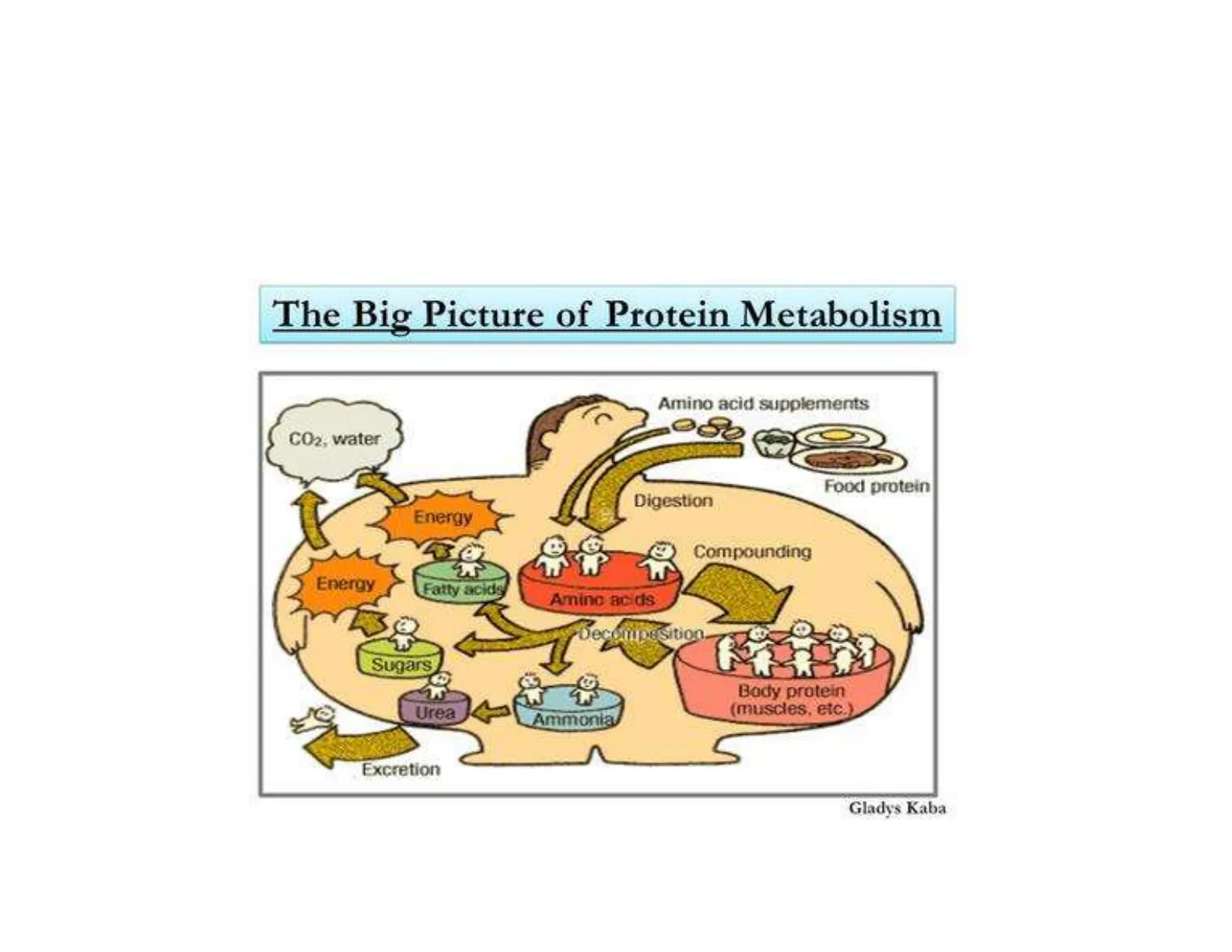
The Big Picture of Protein Metabolism
Lecture 16 Urea Cycle & Amino Acid Metabolism The Big Picture of Protein Metabolism Amino acid supplements CO2 water Food protein Digestion Energy Compounding Energy Fatty acids Amino Acids Decomposition Sugars Body protein (muscles, etc.) Urea Ammonta Excretion Gladys KabaLEARNING OBJECTIVES
- Understand the metabolism of proteins and amino acids
- Describe how nitrogen is removed from amino acids with reference to:
- Toxicity of ammonia (hyperammonemia, its cause and effects)
- Transamination reactions
- Role of glutamate and a-ketoglutarate in ammonia transfer
- Role of glutamate, glutamine and alanine in carrying nitrogen to the liver
- Deamination of glutamate and glutamine in the liver and in the kidneys
- Understand the reactions of urea cycle and the enzymes involved in the cycle
- Know the different fates of amino acids; understand which amino acids are glucogenic, ketogenic, or both glucogenic and ketogenic
- Learn the causes and symptoms of disorders related to amino acid metabolism
Protein Degradation Pathways
Cellular Protein Degradation
- ATP-dependent ubiquitin-proteasome system: Degrades mainly intracellular proteins (-> MHC I)
- ATP-independent degradation in the lysosome: Degrades mainly endocytosed plasma proteins and cell- surface membrane proteins (> MHC II)
Dietary Protein Digestion
- Stomach: Hydrochloric acid, pepsin
- Intestine: Enterokinase, trypsin, chymotrypsin, elastase, carboxypeptidases
ATP-Dependent Ubiquitin-Proteasome System
Protein Degradation ATP-dependent ubiquitin-proteasome system:
- Proteins selected for degradation are attached to ubiquitin, a small protein (ATP-dependent process)
- Ubiquitin-tagged proteins are recognized by the proteasome, a large barrel-shaped proteolytic complex
- Proteins are unfolded, the ubiquitin is remove and recycled, the unfolded protein is cleaved and further degraded to amino acids which enter the amino acid pool
1 Protein selected for degradation is tagged with molecules of ubiquitin. 2 Ubiquitinated proteins are recognized by the cytosolic proteasome, which unfolds, de- ubiquitinates, and transports the protein to its proteolytic core (an ATP-dependent process). Tandemly linked molecules of ubiquitin Cellular protein Ubiquitin ATP AMP + PP Proteasome Recycled Ubiquitin Non-specific proteases Amino acids 3 Peptide fragments produced by the proteasome are degraded to amino acids in the cytosol. Ferrier, D. R. Lippincott's illustrated reviews Biochemistry
Chemical Signals for Protein Degradation
- Proteins have different half-lives so protein degradation cannot be random
- Influenced by structure and sequence
- Structure: Proteins chemically altered by oxidation or tagged with ubiquitin are preferentially degraded
- Sequence:
- N-terminal residue:
- Serine confers a long half life (20 h)
- Aspartate confers a very short half life (3 min)
- Specific sequences:
- Proteins with many sequences containing proline, glutamate, serine, and threonine (PEST sequence) are rapidly degraded
Digestion of Dietary Proteins
Gastric Secretion Digestion
- A typical diet contains about 100g of protein, has to be digested to be absorbed
- 1. Digestion by gastric secretion:
- Hydrochloric acid: Too dilute (pH 2-3) to directly hydrolyze proteins but denatures them making digestion by proteases easier
- Pepsin:
- An acid-stable endopeptidase (cleaves internal peptide bonds)
- Secreted as a zymogen (proenzyme) pepsinogen
- Pepsinogen is activated by HCI and by pepsin
Dietary protein Pepsin STOMACH Polypeptides and amino acids TO LIVER PANCREAS Trypsin Chymotrypsin Elastase Carboxy- peptidase Oligopeptides and amino acids SMALL INTESTINE Amino- peptidases Di- and tri- peptidases Amino acids Ferrier, D. R. Lippincott's illustrated reviews Biochemistry
Pancreatic Enzymes in Protein Digestion
Digestion of Dietary Proteins II. Digestion by pancreatic enzymes:
- Pancreatic proteases have different specificities, cleave at different sites in a protein
- Secreted as zymogens (proenzymes); release is triggered by cholecystokinin, and secretin, polypeptide hormones of the digestive tract
- Enteropeptidase/enterokinase, an enzyme present on the luminal side of intestinal mucosal cells converts trypsinogen to trypsin
- Trypsin then activates other trypsinogens and the other zymogens
SMALL INTESTINE Trp Ty Phe Met Leu Ala Gly Ser A B Arg Lys R R R R +H3N 11 H Ö =O -I -I -I Dietary protein Trypsin Chymotrypsin Elastase Carboxypeptidase A Carboxypeptidase B Enteropeptidase Trypsinogen Chymotrypsinogen Proelastase Procarboxypeptidase A Procarboxypeptidase B 1 . - C-C-NH-C-CINH-C-C-NH-C-CINH-C-C-NH-C-CINH-C-C"NH-C-C-O" HO = O = - HO ö Ala Ile Leu Val or Arg Lys Ferrier, D. R. Lippincott's illustrated reviews Biochemistry
Abnormalities in Protein Digestion
Exocrine Pancreatic Insufficiency
- Deficiency in pancreatic secretion due to chronic pancreatitis, cystic fibrosis, or surgical removal of the pancreas results in incomplete digestion of fats and protein
- Results in steatorrhea, voluminous, intensely foul-smelling oily diarrhea that is difficult to flush; also causes abdominal discomfort, bloating, and weight loss; leads to malnutrition and vitamin deficiencies
- Treated with supplementation of pancreatic digestive enzymes (pancrelipase/Creon®)
Signs and symptoms of EPI Malnutrition Weak bones Vision problems Easy bruising Skin rashes Difficulty gaining or maintaining weight C 2013 Mechanisms in Medicine Inc http://www.animatedpancreaspatient.com/en-pancreas/view/m501-s4-exocrine-pancreatic-insufficiency-epi-slide-show
Protease Degradation Question
Which of the following proteases degrades dietary proteins in the stomach? A. Trypsin B. Elastase C. Carboxypeptidase D. Enterokinase E. Pepsin
Protein Half-Life Features
Which of the following features confer a long half-life to proteins? A. A PEST sequence B. N-terminal serine C. Chemical alteration by oxidation D. Ubiquitination E. N-terminal aspartate
Transport of Amino Acids Into Cells
Amino Acid Uptake Mechanisms
- Concentration of amino acids is significantly lower in the extracellular fluids than inside the cells
- Cellular uptake of amino acids is driven by ATP-mediated transport systems with overlapping specificity for different amino acids
- One system is responsible for uptake of cystine (two cross-linked cysteines) and dibasic amino acids (ornithine, arginine, and lysine) into the small intestine and the proximal tubules of the kidneys
Cystine OH NH2 H S S H O H2N OH https://en.wikipedia.org/wiki/Cystinosis
Cystinuria Condition
Transport of Amino Acids Into Cells
- Cystinuria affects about 1/7000 individuals
- Reduction in intestinal absorption and proximal tubular reabsorption of dibasic amino acids (transporter malfunction) including cystine (cross- linked cysteine)
- Autosomal recessive
- Cystine is not reabsorbed in the kidneys and accumulates in the urine forming kidney stones which are invisible on X-ray imaging
- Can cause progressive kidney damage
Cystinuria Treatment
- Adequate hydration
- Restriction of dietary methionine (used to synthesize cysteine)
- Alkalization of the urine to increase solubility of cystine
OH NH2 H S $ H -O H2N OH https://en.wikipedia.org/wiki/Cystinosis http://www.goldbamboo.com/pictures-tl9474-tr10331.html
Amino Acid Pool Dynamics
- Amino acids are present throughout the body but there is no particular protein that stores them so they are constantly replenished and depleted
- The total amount of amino acids, termed the amino acid pool, is about 90- 100g (compared to about 12 kg of total protein in the body)
Amino Acid Pool Replenishment
- Degradation of body protein
- Dietary amino acids/proteins
- Synthesis of non-essential amino acids from intermediates of metabolism
Amino Acid Pool Depletion
- Protein synthesis
- Use of amino acids for synthesis of nitrogen-containing compounds
- Conversion to glucose, glycogen, fatty acids, and ketone bodies
- In well-fed, healthy individuals the input to the amino acid pool is balanced by the output and the individual is said to be in nitrogen balance
TURNOVER Protein turnover results from the simultaneous synthesis and degradation of protein molecules. In healthy, fed adults the total amount of protein in the body remains constant because the rate of protein synthesis is just sufficient to replace the protein that is degraded. Dietary protein Can vary from none (for example, fasting) to over 600 g/day (high protein diets); 100 g/day is typical of the U.S. diet. Body protein ~400 g/day Synthesis of nonessential amino acids Varies Amino acid pool ~30 g/day Body protein -400 g/day Synthesis of: . Porphyrins · Creatine · Neurotransmitters . Purines . Pyrimidines . Other nitrogen- containing compounds Varies Glucose, glycogen Ketone bodies, fatty acids, steroids CO2 + H2O The amino acids not used in biosynthetic reactions are burned as a fuel.
Nitrogen Balance States
- In healthy individuals: Amount of nitrogen excreted = amount of nitrogen in protein ingested (neutral nitrogen balance)
- In growing child or trauma recovery, pregnancy: Amount of nitrogen excreted < amount consumed (positive nitrogen balance)
- Malnourished: Amount of nitrogen excreted > amount of protein consumed (negative nitrogen balance)
Positive Nitrogen Balance Nitrogen intake Nitrogen excretion" Nitrogen Equilibrium Nitrogen intake Nitrogen excretion* Negative Nitrogen Balance Nitrogen excretion" Nitrogen intake
Kidney Stone Identification
A 34-year old man comes into the ER in with severe, sharp, stabbing pain in the right side of his back. He has blood in his urine and the initial diagnosis is kidney stones so he is sent for X-ray imaging for confirmation. What type of kidney stones are often invisible on X-ray imaging? A. Uric acid B. Calcium oxalate C. Cystine D. Calcium phosphate E. Struvite
Positive Nitrogen Balance Individuals
Which of the following individuals has/have a positive nitrogen balance? A. A pregnant woman B. A growing child C. A recovering trauma patient D. A + B E. A + C F. B + C G. A + B + C
Amino Acid Metabolism Overview
- Since they can't be stored, amino acids are rapidly metabolized
- Amino acids cannot be used for metabolism until the amino group has been removed
- The a-amino group can be removed through transamination (all tissues) or oxidative deamination (liver and kidneys)
- The remaining a-keto acid, the "carbon skeleton" can be metabolized to CO2 and water, glucose, fatty acids, or ketone bodies
- The amino group forms ammonia which can be excreted in the urine (by the kidneys), most of it, however, is used for synthesis of urea (in the liver), the most important route for disposing of nitrogen
Amino acid NH3 Carbon skeleton CO2 + H2O Glucose Acetyl-CoA Ketone bodies Urea · 2008 John Wiley & Sons, Inc. All rights reserved.
Can’t find what you’re looking for?
Explore more topics in the Algor library or create your own materials with AI.
