Microbial Symbioses with Microbes, Plants, and Animal Presentation
Slides about Microbial Symbioses with Microbes, Plants, and Animal. The Pdf explores microbial symbioses, classifying them into mutualism, commensalism, and parasitism, and details vertebrate digestive architecture, distinguishing foregut and hindgut fermenters for university Biology students.
See more65 Pages


Unlock the full PDF for free
Sign up to get full access to the document and start transforming it with AI.
Preview
Microbial Symbioses Overview
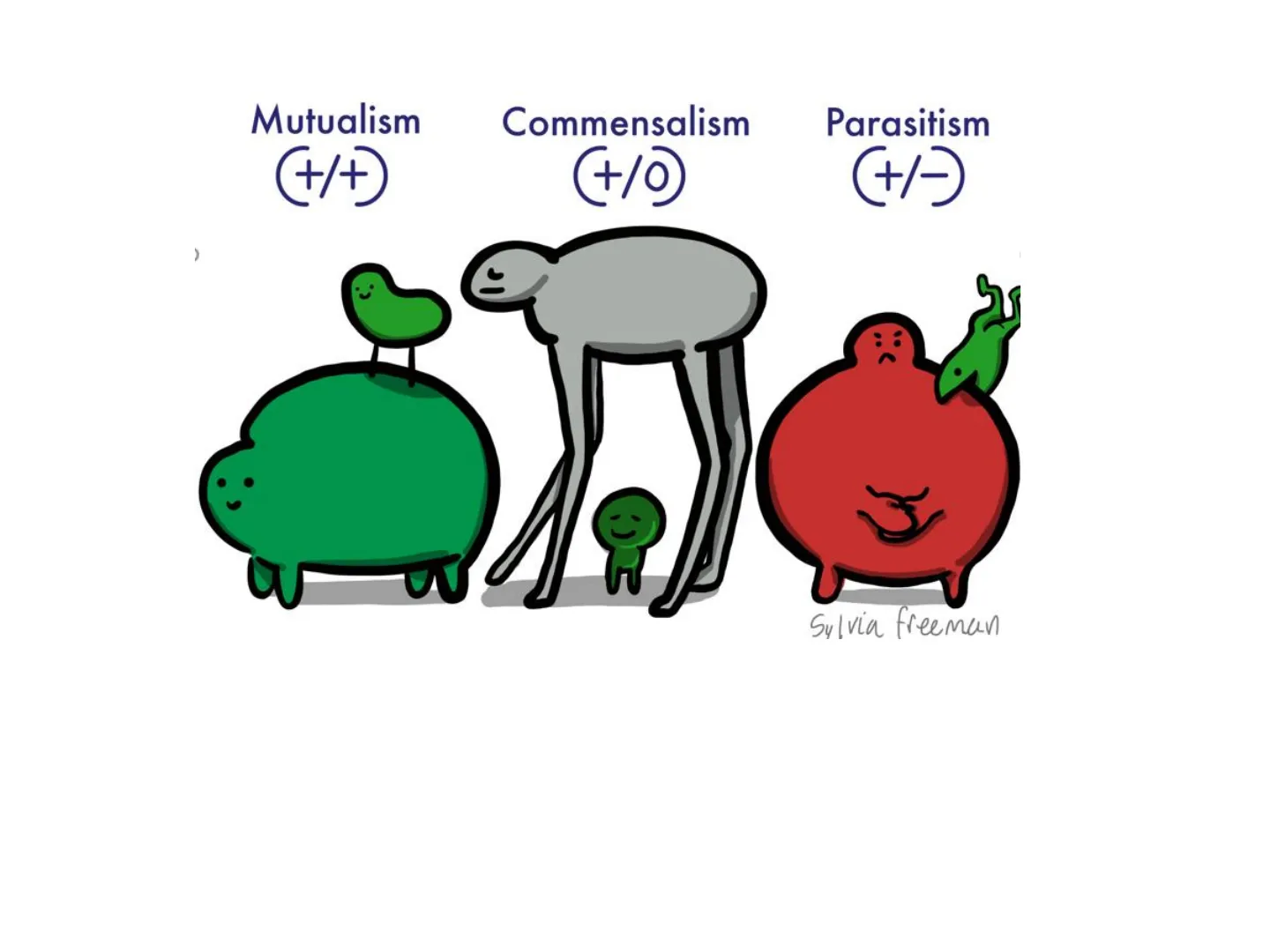
fungi plants protoctists animals bacteria Dovilė Vasiliauskienė, 2025Symbioses Mutualism (+ / +) Commensalism (+/0 Parasitism (+/-) , Sylvia freeman . Mutualism is a symbiotic relationship in which both species benefit. · Commensalism is a symbiotic relationship in which one species benefits while the other species is not affected. · Parasitism is a symbiotic relationship in which one species (the parasite) benefits while the other species (the host) is harmed.
Mutualism Symbiosis Examples
2Mutualism symbiosis . Insects drink nectar and pollinate plants at the same time. . Symbioses typically develop through prolonged association and coevolution of the partners, evolution that proceeds jointly in a pair of intimately associated species owing to the effects each has on the other
Symbioses Between Microorganisms: Lichens
3Symbioses Between Microorganisms Lichens . Two type of microorganisms . A fungus, usually an ascomycete and either an algae or a cyanobacterium. . Variation in the lichen physical structure is primarily determined by the fungus, and more than 18,000 species of fungi are able to form lichen associations with a variety of photobionts. . Cells of the phototroph (also called the photobiont) are embedded in defined layers or clumps among cells of the fungus, together forming the thallus and are protected from erosion by rain or wind. . Growth rates varying from 1 mm or less per year to over 3 cm per year.Liches structure Algal layer Fungal hyphae Rootlike connection to substrate T. D. Brock . The fungus releases lichen acids that promote the dissolution and chelation of inorganic nutrients from the rock or other surface that are needed by the phototroph. . The fungus facilitates the uptake of water and sequesters some for the phototroph, a characteristic that enables lichens to colonize almost all terrestrial environments, includingdeserts and other arid environments
Consortia of Microbial Mutualisms
· Microbial mutualisms called consortia form in freshwater environments. A commonly observed consortium develops between nonmotile green sulfur bacteria (phototrophs that are colored either green or brown) and certain motile, nonphototrophic bacteria. . The consortium generally consists of 13-69 green sulfur bacteria, called epibionts, surrounding and attached to a central, colorless, flagellated, rod-shaped bacterium (a) (b) (c) (d) Figure 23.3 Drawings of some motile phototrophic green bacterial consortia found in freshwater lakes. Green epibionts: (a) "Chlorochromatium aggre- gatum,“ (b) "C. glebulum," (c) "C. magnum," (d)"C. lunatum." Brown epibionts: (a)"Pelochromatium roseum," (d) "P. selenoides." The epibionts are 0.5-0.6 pm in diameter. Adapted from Overmann, J., and H. van Gemerden. 2000. FEMS Microbiol. Rev. 24: 591.
Phylogeny and Metabolism of a Consortium
6Phylogeny and Metabolism of a Consortium J. Overmann, with permission from J. Bacteriol J. Overmann, with permission from J. Bacteriol (a) (b) . The epibiont of "Chlorochromatium aggregatum" has been isolated and grown in pure culture. Although this green sulfur bacterium, named Chlorobium chlorochromatii, can be grown in pure culture, no naturally free-living variant has been observed, supporting the view that in nature a symbiotic lifestyle is obligate for epibionts. The central bacterium of "Chlorochromatium aggregatum" is a species of Betaproteobacteria and requires a-ketoglutarate for growth, and this is presumably supplied to it by the epibiont. . The central cell only assimilates fixed carbon in the presence of light and sulfide- conditions in which the epibionts are active and can transfer nutrients to the central bacterium. Genomic analysis of the central bacterium of one consortium revealed massive gene loss, indicating that this organism is unable to grow independently of the green sulfur bacterium. Most of approximately 350 differentially regulated genes are repressed, whereas only 19 genes are more highly expressed.
Methanotrophic Consortia: Direct Interspecies Electron Transfer
.Subsequent culture-independent studies showed that specific methane-oxidizing (methanotrophic) Archaea form intimate associations with sulfate-reducing bacteria. . The methanotrophic Archaea comprise three different groups of anaerobic methane (ANME)-oxidizing Euryarchaeota. · Members of the ANME-1 cluster belong to the Methanomicrobia, ANME-2 Methanosarcinales, and ANME-3 to Methanococcoides sp. All ANME Archaea employ part of the metabolic pathway used by methanogens to generate methane, but ANME run the pathway in the opposite direction. (a) A H (b) Figure 23.6 Anaerobic methane-oxidizing consortia. (a) A methanotrophic consortia enriched from geothermally heated sediments (Guaymas Basin, Gulf of California, Mexico) by cultivation with methane as sole electron donor and stained by CARD-FISH (< Section 19.5) using probes selective for the ANME methanotroph (red fluorescence) and its sulfate-reducing bacterial partner (green fluorescence). (b) Electron micrograph of a thin section through the consortia, showing the electri- cally conductive "nanowires" produced by the sulfate reducer (H), connecting it elec- trically to cytochrome-rich proteins on the surface of the ANME methanotroph (A). Viola Krukenberg, Karin Knittel, and Gunther Wegener
Plants as Microbial Habitats
Plants as Microbial Habitatss Symbiotic associations between microorganisms and plants can be mutualistic, where the microbe and the plant: a) exchange nutrients b) increase nutrient availability to the plants, c) defend them against pathogens, d) Or parasitic, where the plant produces nutrients only for the bacterium. Cellular defense Cell death Systemic resistance Chemical defense Local resistance Foliar fungal pathogen Beneficial insect Insect pests Mycorrihza Root pathogen Plant growth-promoting bacterium
The Legume-Root Nodule Symbiosis
9The Legume-Root Nodule Symbiosis be Burton .A plant-bacterial mutualism of great importance to humans is that of leguminous plants and nitrogen-fixing bacteria. Legumes are flowering plants that bear their seeds in pods and include such agriculturally important members as soybeans, clover, alfalfa, beans, and peas. . These crops are key commodities for the food and agricultural industries, and the ability of legumes to grow without added nitrogen saves farmers millions of dollars in fertilizer costs yearly and reduces the polluting effects of fertilizer runoff.
Rhizobia and Other Bacteria
Rhizobia and others bacterias Rhodopseudomonas Rickettsia Neisseria Bradyrhizobium/Caulobacter Bordetella Methylobacterium Azorhizobium Burkholderia Cupriavidus B 0 Ralstonia Bartonella Brucella Y Ochrobactrum Rhizobium Sinorhizobium Phyllobacterium Mesorhizobium Xanthomonas Pseudomonas Shinella Devosia Agrobacterium More than 70 species of rhizobia are found in 12 genera of Alpha and Betaproteobacteria.
Leghemoglobin and Cross-Inoculation Groups
Leghemoglobin and Cross-Inoculation Groups Joe Burton Figure 23.10 Root nodule structure. Sections of root nodules from the legume Coronilla varia, showing the reddish pigment leghemoglobin. The legume cannot fix N2. Rhizobia, on the other hand, can fix N2 when grown in pure culture under microaerophilic conditions. In the nodule, O2 levels are precisely controlled by the O2-binding protein leghemoglobin. Production of this iron-containing protein in healthy N2-fixing nodules is induced through the interaction of the plant and bacterial partners. Leghemoglobin functions as an "oxygen buffer," cycling between the oxidized and reduced forms of iron to supply sufficient O2 for bacterial respiration while keeping unbound O2 within the nodule low. The ratio of leghemoglobinbound O2 to free O2 in the root nodule is thus maintained on theorder of 10,000:1.
Effect of Nodulation on Plant Growth
Effect of nodulation on plant growth Ben B. Bohlool Figure 23.9 Effect of nodulation on plant growth. A field of unnodulated (left) and nodulated (right) soybean plants growing in nitrogen-poor soil. The yellow color is typical of chlorosis, the result of nitrogen starvation. Nitrogen fixation in root nodules accounts for a fourth of the N2 fixed annually on Earth and is of enormous agricultural importance, as it increases the fixed nitrogen content of soil. Nodulated legumes can grow well on unfertilized bare soils that are nitrogen deficient, while other plants grow only poorly on them.
Bakterijos, užkrečiančios ankštinius augalus
Major Cross-Inoculation Groups of Leguminous Plants
Bakterijos, užkrečiančios ankštinius augalus TABLE 23.1 Major cross-inoculation groups of leguminous plants
| Host plant group | Nodulated by |
|---|---|
| Pea | Rhizobium leguminosarum biovar viciaeª |
| Bean | Rhizobium leguminosarum biovar phaseoliª |
| Bean | Rhizobium tropici |
| Lotus | Mesorhizobium loti |
| Clover | Rhizobium leguminosarum biovar trifolija |
| Alfalfa | Sinorhizobium meliloti |
| Soybean | Bradyrhizobium japonicum |
| Soybean | Bradyrhizobium elkanii |
| Soybean | Sinorhizobium fredii |
| Sesbania rostrata (a tropical legume) | Azorhizobium caulinodans |
aSeveral varieties (biovars) of Rhizobium leguminosarum exist, each capable of nodulating a different legume. A particular rhizobial species is able to infect certain species of legumes but not others. A group of related legumes that can be infected by a particular rhizobial species is called a cross-inoculation group. Each group consists of all the legume species that will develop nodules when inoculated with rhizobia obtained from any other legume of the group.
Steps in Root Nodule Formation
Steps in Root Nodule Formation Root hair Rhizobial cell Invaded plant cells and those nearby are stimulated to divide Infection thread Root hair Soil 5. Formation of bacteroid state within plant root cells. 4. Bacteria in infection thread grow toward root cell. O 6. Continued plant and bacterial cell division leads to nodules. 1. Recognition and attachment (rhicadhesin- mediated). 2. Bacterium secretes Nod factors causing root hair curling. 3. Invasion. Rhizobia penetrate root hair and multiply within an "infection thread." Nodules 1. Recognition of the correct partner by both plant and bacterium and attachment of the bacterium to the root hairs 2. Secretion of oligosaccharide signaling molecules (Nod factors) by the bacterium 3. Bacterial invasion of the root hair 4. Movement of bacteria to the main root by way of the infection thread 5. Formation of modified bacterial cells (bacteroids) within the plant cells, development of the N2-fixing state, and continued plant and bacterial cell division forming the mature root nodule
Can’t find what you’re looking for?
Explore more topics in the Algor library or create your own materials with AI.
