Medical Technologies and Patenting: Intellectual Property Rights
Slides from University of Bologna about Medical Technologies and Patenting. The Pdf explores medical technologies and the patenting process, detailing various intellectual property rights. This material is suitable for university students studying Law, providing detailed explanations on different types of intellectual protection.
See more66 Pages

Unlock the full PDF for free
Sign up to get full access to the document and start transforming it with AI.
Preview
Medical Technologies and Patenting
Medical technologies and patenting Emanuela Marcelli University of Bologna eDIMES Lab TER STU MOR 40. 1085 ALMA MATER STUDIORUM UNIVERSITÀ DI BOLOGNA
Patents and Other Intellectual Property Rights
1 Patents and other intellectual property rights Patents are concerned with the technical and functional aspects of inventions. Patent rights may last up to 20 years from the date of filing of the application. Other ways to achieve a form of protection are also available.
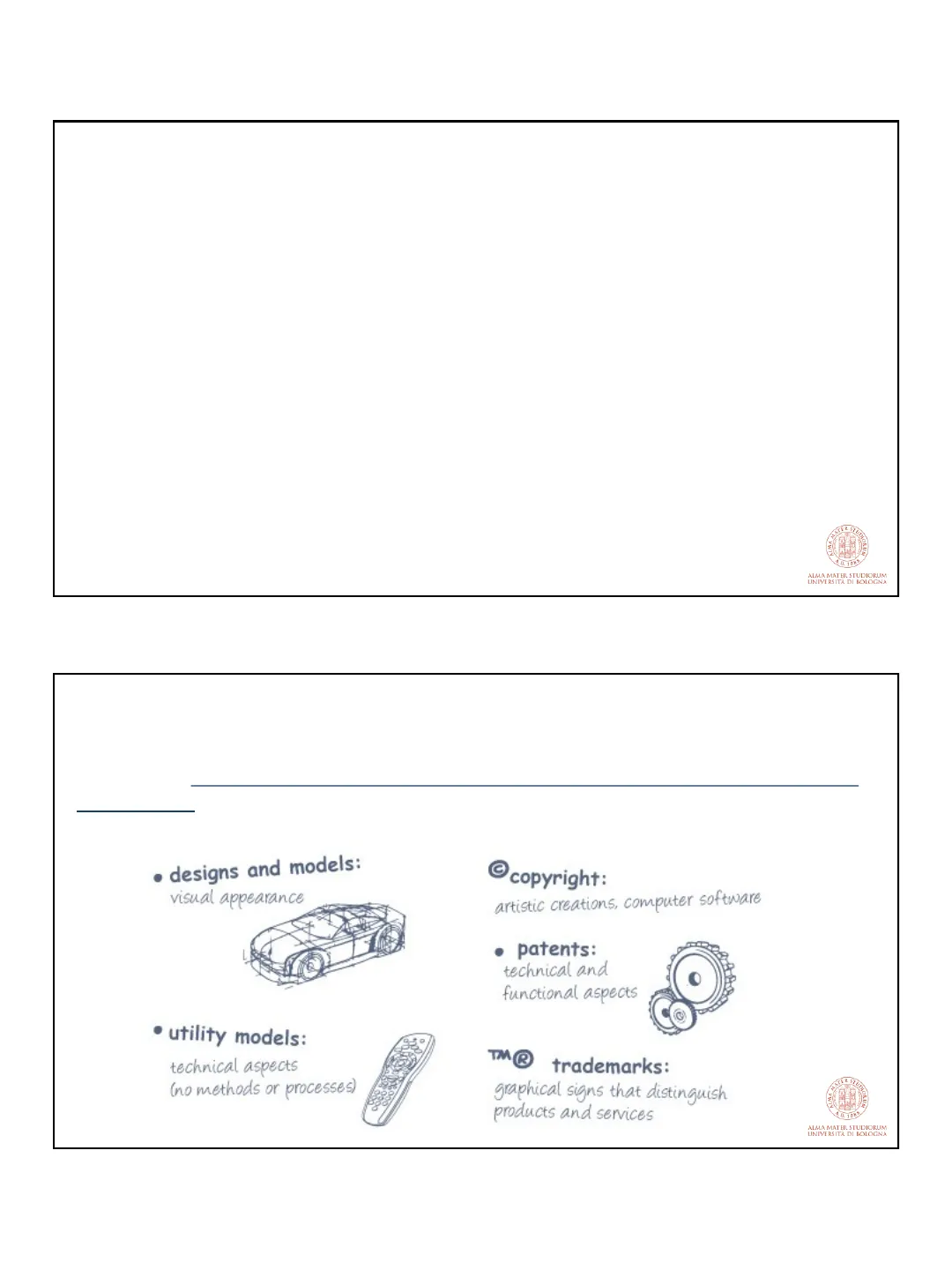
- designs and models: visual appearance
- copyright: artistic creations , computer software
- patents: technical and functional aspects
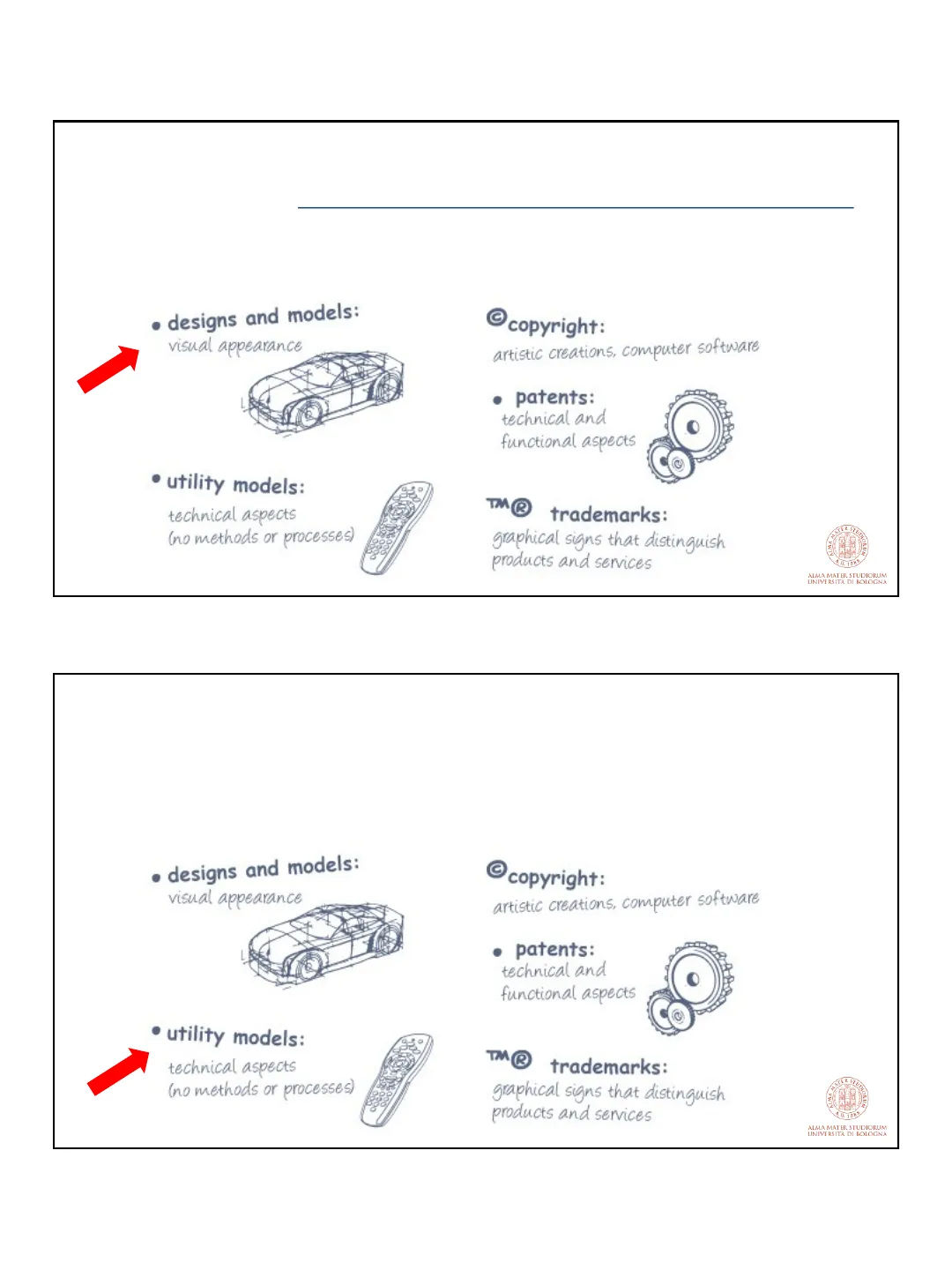
- utility models: technical aspects ( no methods or processes )
TM ® trademarks: graphical signs that distinguish products and services TER STU ALMA AS HIORD 40. 1088 ALMA MATER STUDIORUM UNIVERSITÀ DI BOLOGNA
Designs and Models Protection
2 1Patents and other intellectual property rights Designs and models protect the visual appearance of industrial products, i.e. their shape and colour, but not their functional aspects. The period for which they are protected depends on whether they are registered or unregistered.
- designs and models: visual appearance artistic creations , computer software
- patents: technical and functional aspects
- utility models: technical aspects ( no methods or processes)
TMR trademarks: graphical signs that distinguish products and services TER STU MOR ALMA 40. 1085 ALMA MATER STUDIORUM UNIVERSITÀ DI BOLOGNA
Utility Models for Technical Innovations
3 Patents and other intellectual property rights Simpler protection and for a shorter period of time is afforded by utility models. Utility models protect technical innovations which might not qualify for a patent. They can be protected in some countries by means of registration.
- designs and models: visual appearance
- utility models: technical aspects ( no methods or processes)
@copyright: artistic creations , computer software
- patents: technical and functional aspects
TM ® trademarks: graphical signs that distinguish products and services TER STU ALMA HIORD 40. 1088 ALMA MATER STUDIORUM UNIVERSITÀ DI BOLOGNA
Copyright Protection
4 copyright: 2Patents and other intellectual property rights Then there is copyright, which protects creations such as literary texts, musical compositions, works of art, broadcasts and computer software against unauthorised copying and certain other uses. The duration of a copyright can extend over the life of the author plus another 50 or 70 years, depending on the case and the country.
- designs and models: visual appearance
C copyright: artistic creations, computer software
- patents: technical and functional aspects
- utility models: technical aspects ( no methods or processes)
TMR trademarks: graphical signs that distinguish products and services TER STU MOR ALMA 40. 1085 ALMA MATER STUDIORUM UNIVERSITÀ DI BOLOGNA
Trademarks for Products and Services
5 Patents and other intellectual property rights Trademarks are signs that distinguish brands of products or services. They may be made up of two- or three-dimensional signs such as letters, numbers, words, shapes, logos, pictures or even sounds.
- designs and models: visual appearance
- utility models: technical aspects ( no methods or processes)
C copyright: artistic creations , computer software
- patents: technical and functional aspects
TM ® trademarks: graphical signs that distinguish products and services TER STU ALMA ORI 20. 1088 ALMA MATER STUDIORUM UNIVERSITÀ DI BOLOGNA
One Product - Many IP Rights
6 3One product - many IP rights All the IP rights described so far can be used in combination to help inventors protect their innovations. For example, a company might use a patent in order to ensure that it is the only one that offers a particular technical feature, and registered or unregistered designs to protect the features relating to the appearance of the product. It can also use trade marks to communicate the source of the product. It might also choose to keep some aspects of the production process secret. If it makes serious efforts to maintain secrecy then it can enjoy the protection of trade secrets. TER S ALMA ORU 40. 1085 ALMA MATER STUDIORUM UNIVERSITÀ DI BOLOGNA
Intellectual Property in Mobile Phones
7 One product - many IP rights Trade marks
- NOKIA
- Product "208"
- Operating system
- Start-up tone
- Operation of user interface Copyright
- Software
- User manuals
- Ringtones
- Images Patents and utility models
- Data-processing methods Designs
- Form of overall phone
- Arrangement and shape of buttons
- Position and shape of screen Trade secrets Some technical know-how kept "in-house" and not published
This slide shows the wide range of intellectual property that can be involved in protecting a single product, in this case a mobile phone. TER ST ALMA A OR 10. 1080 ALMA MATER STUDIORUM UNIVERSITÀ DI BOLOGNA
Alternatives to Patenting
8 4Alternatives to patenting Alternatives Secrecy Open Source software Licence of right
- restricted public knowledge gain
- collective process . enhanced diffusion of technology
- innovation is borrowed on a payment -based system
A first alternative to take into account would be secrecy. Technical inventions can be kept secret in areas where it is not easy to reverse- engineer a product. However, technical information might leak out, destroying the basis for the monopoly. One drawback of secrecy is that, since the invention is not publicly disclosed, the knowledge gained by the public is restricted and hence the amount of new knowledge fed into R&D activities is reduced. D. 108 ALMA MATER STUDIORUM UNIVERSITÀ DI BOLOGNA
Open Source Software and Copyright
9 Alternatives to patenting Alternatives Secrecy Open Source software Licence of right
- restricted public knowledge gain
- collective process . enhanced diffusion of technology
- innovation is borrowed on a payment-based system
Open Source software relies on copyright to enforce license conditions set by its creators. In the Open Source model, no IP protection is claimed. Reward comes from peer recognition. Open Source is a collective process, so the diffusion of technology is enhanced while profits are reduced as they are shared by many participants. TER ST SIMA OR 10. 1088 ALMA MATER STUDIORUM UNIVERSITÀ DI BOLOGNA
Licence of Right and Patent Pools
10 5Alternatives to patenting Alternatives Secrecy Open Source software Licence of right
- restricted public knowledge gain . collective process . enhanced diffusion of technology
- innovation is borrowed on a payment- based system
Another option would be a licence of right (liability regime). This allows companies to borrow one another's innovations for a defined period of time, provided that they contribute to the costs of development. It is not an exclusion right but a payment-based system. An example of a contractually constructed liability regime is a patent pool, which replaces the monopoly conferred by patents (effectively an exclusion right) with a license. In this case, the level of information diffusion and knowledge gained by the public is higher than with patents. 40. 1085 ALMA MATER STUDIORUM UNIVERSITÀ DI BOLOGNA
Importance of Intellectual Property
11 The importance of intellectual property Innovation is one of the areas covered by the five key targets set in "Europe 2020", the ten-year growth strategy adopted by the European Union with a view to creating a more competitive economy with higher employment. It has never been so important to foster the "virtuous circle" leading from Research and Development (R&D) investment to jobs - via innovation, competitive advantage and economic success - as in today's world of increasingly globalised markets and the knowledge economy. This process depends on several different factors, but an efficient system of intellectual property rights (IPR) undoubtedly ranks among the most important, given IP's capacity to encourage creativity and innovation, in all its various forms, throughout the economy. TER ST DIORD IMA 40. 1088 ALMA MATER STUDIORUM UNIVERSITÀ DI BOLOGNA
IP in the Knowledge-Based Economy
12 6The importance of intellectual property IP plays a very important role in today's knowledge-based economy. Start-up companies use IP to prevent large industrial competitors copying their products. Large companies use IP to reap the benefits of their investments. Even seemingly "traditional" sectors such as the steel industry use IP to protect their intangible assets. Most technical inventions require substantial investment before they can be produced and used. In order to attract funding, inventions must offer the potential to generate income. This perspective is greatly enhanced if IP protection is available. TER STU HOR ALMA 40. 1085 ALMA MATER STUDIORUM UNIVERSITÀ DI BOLOGNA
IP Protection and Licensing
13 The importance of intellectual property If there were no IP protection, competitors could offer the same products or services at a lower price because they have not had to invest in research and development themselves. IP laws allow owners to transfer the right to use the IP to another party, in other words to grant them a licence. The conditions under which the licence is granted can be determined by the owner of the IP. For this reason, buying a film on DVD almost never means actually buying the IP. Rather, it means that the owner of the film sold a licence to use the film. TER ST LMA DIORD 20. 1085 ALMA MATER STUDIORUM UNIVERSITÀ DI BOLOGNA
Role of the Patent System
14 7The role of the patent system
- To encourage technological innovation
- To promote competition and investment
- To provide information on the latest technical developments
- To promote technology transfer TER STUD ALMA 40. 1085 ALMA MATER STUDIORUM UNIVERSITÀ DI BOLOGNA
Encouraging Technological Innovation
15 The role of the patent system The role of the patent system is to encourage technological innovation by rewarding intellectual creativity. In providing protection for their inventions, patents provide incentives to patent owners by offering them recognition for their creativity and the possibility of obtaining financial rewards if they commercialise or exploit their inventions. 1 TERSTU ALMA AS OR 40. 1088 ALMA MATER STUDIORUM UNIVERSITÀ DI BOLOGNA
Promoting Competition and Investment
16 8The role of the patent system The patent system also promotes dynamic competition by encouraging investment in the development of new or improved products or processes, and by encouraging research and development. Investors are more likely to provide financial backing if there is the potential for a return on their investment from inventions that can be patented, then commercialised and exploited. lle TER STUD ALMA 40. 1085 ALMA MATER STUDIORUM UNIVERSITÀ DI BOLOGNA
Dissemination of Information
17 The role of the patent system The patent system can also encourage the dissemination of information about new inventions that may be of benefit to society, because the information disclosed in patents is published. The invention described in a patent document will ultimately be available for anyone to use once the patent has expired. 1 1 \ TERSTU ALMA AS OR 40. 1088 ALMA MATER STUDIORUM UNIVERSITÀ DI BOLOGNA 9
Can’t find what you’re looking for?
Explore more topics in the Algor library or create your own materials with AI.
