Jonathan Swift and Gulliver's Travels: Misantropy and Satire in Literature
Slides about Jonathan Swift and his work "Gulliver's Travels". The Pdf, suitable for high school Literature, explores Swift's biography, misanthropy, satire, and main works, focusing on "Gulliver's Travels" as a realistic and satirical narrative.
See more8 Pages


Unlock the full PDF for free
Sign up to get full access to the document and start transforming it with AI.
Preview
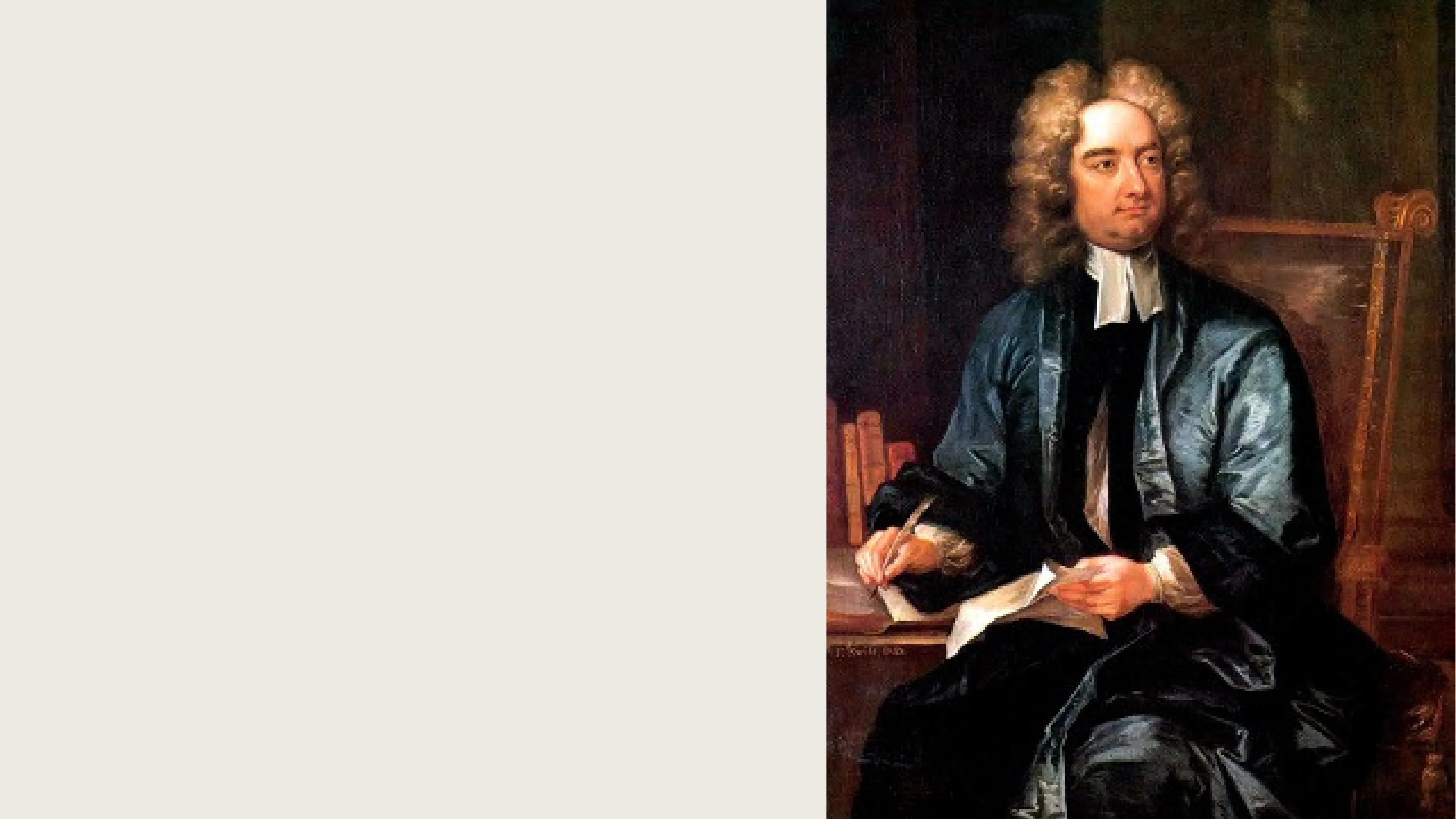
Jonathan Swift's Biography
- He was born in Dublin to English parents in 1667.
- He studied at Trinity College, Dublin.
- He moved to England after the Glorious Revolution in 1688, hoping to start a brilliant career.
- He worked as a secretary to an English statesman, William Temple, for ten years.
- He became an Anglican minister in 1695.
- He accepted a modest post as an Anglican minister near Dublin.
- In 1713 he became dean of St Patrick's Cathedral in Dublin.
- In 1742 he had a stroke and lost the ability to speak.
- He died in Dublin in 1745, he was buried in St Patrick's Cathedral.
Misanthropy and Satire
"Principally I hate and detest that animal called man; although I heartily love John, Peter, Thomas, and so forth."
- Disappointed and embittered by his failure to achieve a brilliant career in London.
- Hated 'mankind' but loved individuals.
- Satirised conditions and institutions of his time: Religion: Catholicism and Presbyterianism; The contrast between wealth and abject poverty in Ireland; English politics.
Main Literary Works
- A Tale of a Tub (1704): satirising religion
- A Modest Proposal (1729): criticising poverty in Ireland
- Gulliver's Travels (1726): four fantasy journeys satirising mankind, England and English politics
GRILL: PAWNBRONTE
Gulliver's Travels Overview
1726
- Considered a "realistic" narration, . Gulliver's Travels is told through the eyes of Lemuel Gulliver, a wise, middle-class English surgeon who is a reliable narrator.
- tales can be taken as 'true' or 'verisimilar'
- first-person narrative typical of travel writing
- biting satire of western values and hypocrisy
- direct relationship with the reader
- travel descriptions
The Plot of Gulliver's Travels
Four voyages made by an English surgeon, Lemuel Gulliver.
Voyage 1: Lilliput
- brings him to LILLIPUT whose inhabitants are tiny people.
- Gulliver overcomes the initial suspicion of the Lilliputians, is accepted as a friend and defends them against attack.
Voyage 2: Brobdingnag
- brings him to BROBDINGNAG whose inhabitants are giants.
- 'Tiny' Gulliver is treated as a freak and cannot maintain his dignity.
Voyage 3: Laputa
- brings him to the floating island of LAPUTA,
- The inhabitants are obsessed with abstract scientific theories and are incapable of dealing with everyday life.
Voyage 4: Houyhnhmns
- brings him to the land of the HOUYHNHMNS, a race of noble horses who control a race of dirty, degenerate humans known as Yahoos.
Interpretation of Gulliver's Travels
Gulliver's Travels can be read in several different ways.
- A book for children: fantastic adventures with incredible creatures and strange people.
- A philosophical tale: the author's reflections on the relativity of English values and the impossibility of a utopian society.
- A satire of western-centrism and its religious, social and cultural 'truths'.
- A warning against fundamentalism, extremism and uncontrolled scientific speculations.
Other Works: A Modest Proposal
A Modest Proposal (1729) Attack on the injustice of the terrible poverty of Dublin.
Satirical Proposal Details
- Poor Irish families can sell their babies as meat for gentlemen.
- reduce poverty;
- reduce the excessive number of poor Catholic children in Dublin.
- Polemic, satirical work
- Expressed in mock serious tone with great detail
- Misunderstood by many
Can’t find what you’re looking for?
Explore more topics in the Algor library or create your own materials with AI.