ELT Concourse teacher training: Noticing in language learning
Slides from Elt Concourse about ELT Concourse teacher training. The Pdf explores the concept of 'noticing' in language learning, distinguishing between explicit and implicit knowledge. It covers four key theories: acquisition vs. learning, Input + 1, ZPD, and guided discovery, relevant for University students of Languages.
See more9 Pages

Unlock the full PDF for free
Sign up to get full access to the document and start transforming it with AI.
Preview
Noticing in Language Learning
There's nothing particularly new about the concept of noticing. Teachers have long developed ways to draw their learners' attention to particular aspects of grammar, lexis, meaning, style, register, notion, communicative function and so on on which they want them to focus.
Types of Noticing
There are two:
- Noticing aspects of the language to which you are attending - noticing the language.
- Noticing the difference between what you hear or read and what you produce - noticing the gap.
CASES
AMERCE
MARITA
II
IV
1
Types of Knowledge
4
198
198
There are two types of this, too:
- Explicit knowledge is shown when a learners can apply the rule and can also state the rule they are applying.
For example a learner says:
The window was broken by one of the girls
and not only constructs a correct sentence but can explain how a passive is formed with the verb be, where the agent comes in the sentence and how it is introduced by the preposition by. - Implicit knowledge is knowledge of the correct form without the ability (without conscious effort) to state what the rule is.
For example, a learner may be able to produce something like:
I'll come if you like
without being able to explain why the first verb phrase is formed with will and the infinitive and the second is a simple present tense of a stative use of the verb like.
One purpose of raising learners' ability to notice language is to make the implicit explicit and the explicit automatic.
The reason for the first part of this is that the ability to articulate a rule allows a learner to be able to construct an almost infinite number of parallel utterances because, as the term rule implies, the structure is regular and predictable.
The reason for the second part is that once a rule has been acquired, it can be applied almost without conscious thought because it has been internalised. That makes the learner more fluent, more able and more natural.
Some Theory
Learning vs. Acquisition
Input + 1
The ZPD
Guided Discovery / Discovery learning
As the headings suggest, there are four theories underlying the encouragement of noticing in the classroom.
Theory #1: Acquisition vs. Learning
A central tenet of Krashen's view is that there is a distinction between learning (a conscious process of rule gathering) and acquisition (an unconscious, natural process of learning which comes almost without effort). For more, see the guide to Krashen and The Natural Approach, linked in the list of related guides at the end.
There are many, however, who do not agree and take the view that learning a language is a conscious process and noticing is part of that.
Theory #2: Input + 1
Another of Krashen's hypotheses concerns the nature of the input to which a learner is exposed.
The argument here is that, for optimum effect, the input a learner receives should be a) comprehensible and b) just above the level of the learner. This is sometimes abbreviated to INPUT + 1 or just i + 1. Many see this as an intuitively correct hypothesis for if the input is incomprehensible, no sense can be made of it and no learning can take place but if the input is below the learners competence, they are not challenged to improve, given the opportunity to acquire new language or notice the gap between his / her own production and the heard / read models.
Theory #3: The Zone of Proximal Development
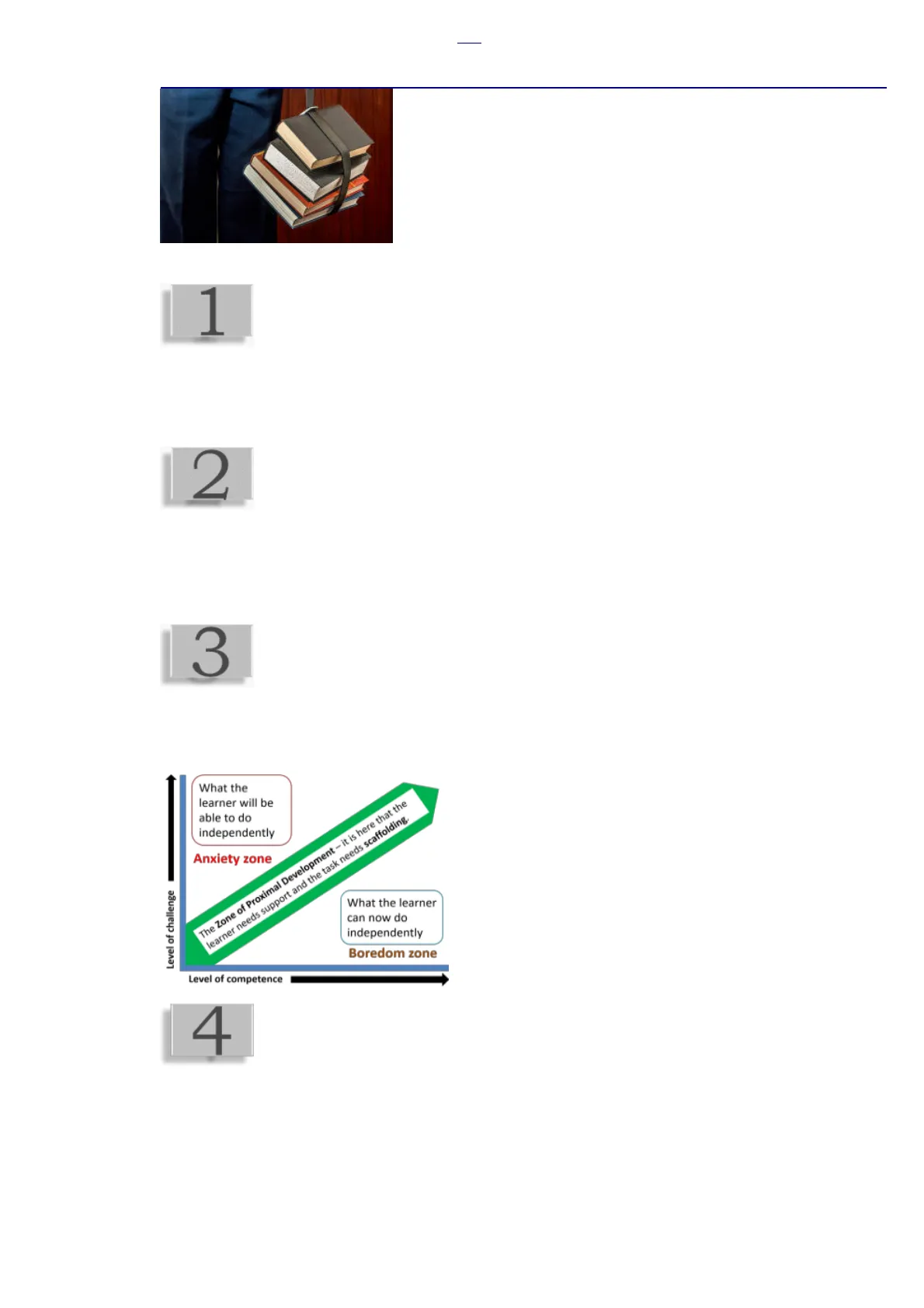
The ZPD is a construct developed by Vygotsky and concerns the optimum place in which learning happens. It may be defined as a task or challenge which the learner can successfully complete with only a small input from a more knowledgeable other.
Below this zone, the learner is not challenged, learning little or nothing and becoming bored.
Above this zone, the learner is over-challenged, learning little or nothing and becoming anxious and frustrated.
It looks like this:
What the
learner will be
able to do
independently
Anxiety zone
The Zone of Proximal Development - it is here that the
learner needs support and the task needs scaffolding.
Level of challenge
What the learner
can now do
independently
Boredom zone
Level of competence
Theory #4: Guided Discovery / Discovery Learning
Later theorists have tied the idea to scaffolding which is the process by which a teacher (or other more-knowledgeable other) may lead a learner to a new skill or new knowledge by filling in a small gap in the learner's ability.
For example, there is little point in presenting a very low-level learner with a complex third conditional form such as:
If I hadn't invited her she would have been upset
and hoping that she or he will magically absorb the structural nature of the clauses by noticing how they are constructed. That will not happen. However, if we present a learner who can already form a correct sentence in this style with something like:
If I hadn't invited her she MIGHT have been upset
then there is a good chance that the learner will not only notice how the modal auxiliary verb is used but also how it affects the overall meaning of the sentence.
This is because the learner is operating in the Zone of Proximal Development and the task is not too easy (so the learner will not benefit or get bored) and not too difficult (so the learner will be overwhelmed by the data and become anxious).Guided discovery, incidentally, also applies in mainstream non-language-teaching methodology and refers to asking learners to do their own research to discover what it is they need to know. The term 'guided' refers to the fact that the teacher's responsibility is to direct learners to the most useful sources of information rather than making them find their own way.
Also slightly incidentally, we should distinguish between independent discovery learning in which the learners are left alone to complete a task and find the data they need until it is time for feedback and assisted discovery learning, which is what most people understand by the term guided discovery, where the teacher is involved throughout the process.
Noticing, then, is often a form of scaffolding of the learners' efforts to help them move forward, incrementally, from the known to the unknown.
There is a fuller guide to scaffolding and the ZPD linked in the list at the end.
Input vs. Intake
Underlying all the following is the distinction between input (the information the learner is exposed to) and intake (the information the learner actually assimilates). The argument is that without conscious noticing of language, intake simply doesn't happen. In other words, it is not possible to learn a language unconsciously.
Overall, Ellis sums up the arguments like this and suggests that:
the distinction between conscious 'learning' and subconscious' acquisition' is overly simplistic. It is clear that 'acquisition', in the sense intended by Krashen, can involve some degree of consciousness (in noticing and noticing the gap).
Ellis 1994:363
He goes on to say that one possibility
is that explicit knowledge functions as a facilitator, helping learners to notice features in the input which they would otherwise miss and also to compare what they notice with what they produce.
Ibid
What learners are becoming aware of in this analysis is the possible affordances that the language input offers. By affordances is meant the possible uses one sees in the phenomena one experiences and the input one perceives. Just as we may see more than one affordance of a fist-sized rock (paper weight, weapon, hammer etc.) so we may see uses in the language we are exposed to.
For example, if a learner notices on one occasion that the adjective bored forms the comparative and superlative forms with more and most rather than adding -er or -est to the stem as most single-syllable adjectives do and then notes the same phenomenon with the adjective tired, he or she may latch on to an affordance and hypothesise, correctly, that all adjectives, regardless of length which are formed from the past participles of verbs will follow the same rule. Then the noticing will have the effect of allowing the learner accurately to produce
They became even more lost
rather than
*They became even loster
Salience
It is not certain, of course, that any two learners will notice the same things. What is noticed depends on the direction of attention and the salience of the information: its usefulness to the learner as an affordance. For example, from a piece of language such as:
Peter, being in charge for the moment, decided that this was the most important job
a learner who is focused on syntax may extract the fact that a relative clause containing the verb be may be reduced by ellipting both the relative pronoun (who) and the verb (was) without affecting the meaning. To do that, she has to reconstruct the sentence mentally as:
Peter, who was in charge for the moment, decided ...
She may also notice, if primed to do so, that this is different from the way her language does things and the way she uses relative clauses in her own output. She has noticed the gap.
Another learner, whose attention is on meaning, may note that the non-finite verb form (being) may be used to provide background information to the verb decide.
Yet another may notice that the verb be can, in fact be used in the progressive form and that contradicts information already given by a teacher that we do not use the verb in the continuous or progressive aspect. Another gap has been noticed.
What is noticed depends on two things;
- The affordance (i.e., usefulness that the learner perceives in the information)
- The direction of attention (on forms, meaning, aspect and so on)
The first of these can be estimated from experience, the second can be exploited deliberately.
What is noticed will depend to a large extent on what philosophers of language (and other things) call the learner's Umwelt which means the set of affordances (potentialities) that is perceived. In Dennet's terms, these are:
the things [the] agent should have in its ontology, the things that should be attended to, tracked, distinguished, studied. The rest of the real patterns in the flux are just noise
(Dennett, 2017:128 [emphasis in the original])
The trick to using noticing, if there is one, is to filter out the noise and leave the potentially useful information in focus.
Another Way to Understand Noticing
There is one theory of learning that neatly combines the ideas of subconscious and conscious learning with notions of implicit and explicit knowledge as well as showing the relationship between learning and acquisition. It looks like this (from Bialystok 1978:71). Look at the model and try to figure out what is going on. When you have some answers, click on the diagram for an explanation.
Input
Language
exposure
Functional
practising
Formal
practising
Formal
practising
Inferencing
Knowledge
Other
knowledge
Explicit
linguistic
knowledge
Implicit
linguistic
knowledge
Inferencing
Type I
Output
Inferencing
R
Monitoring
Type II
Processes
----- > Strategies
Can’t find what you’re looking for?
Explore more topics in the Algor library or create your own materials with AI.
