The Status of the Individual in International Law
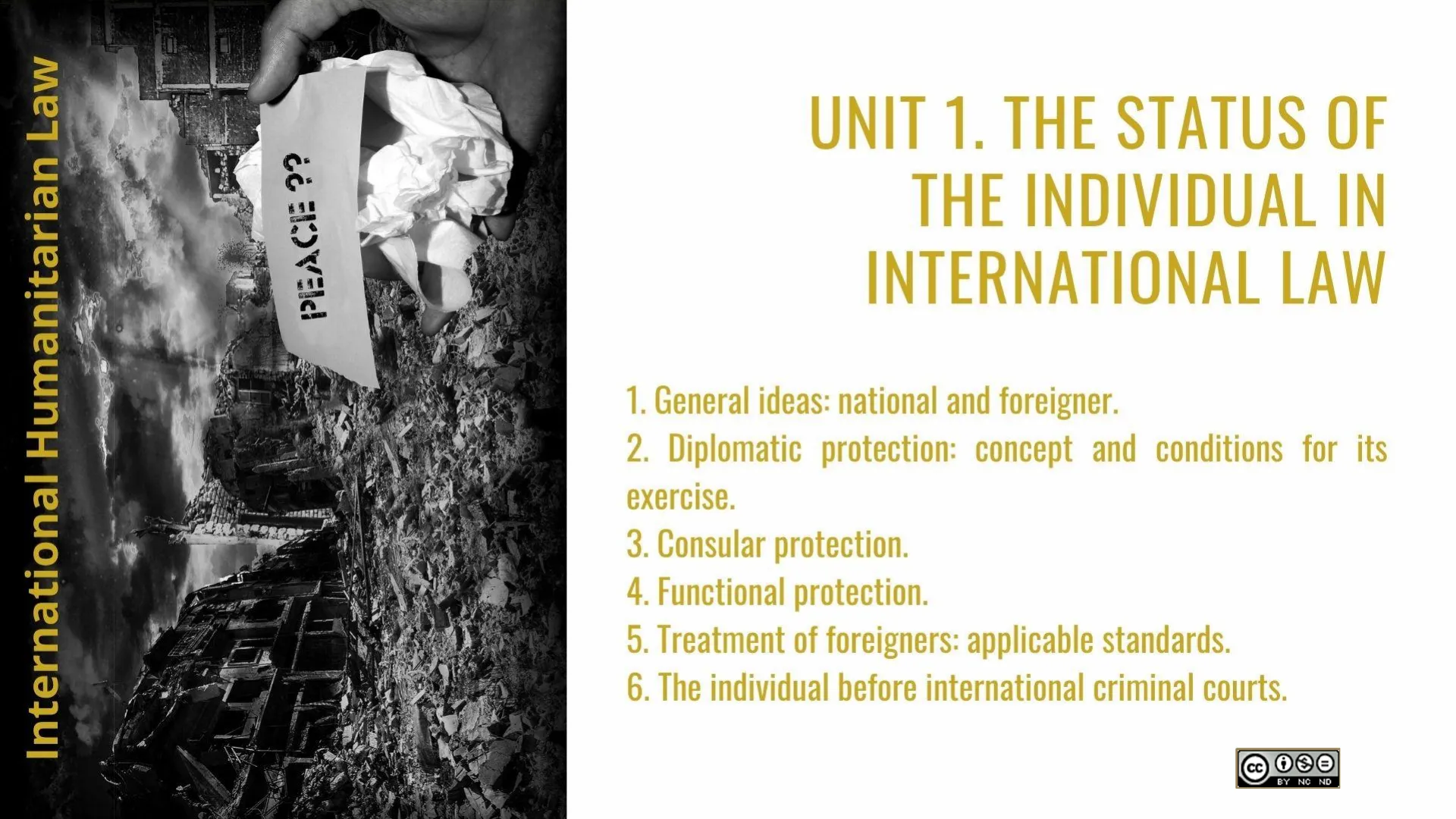
Slides about the status of the individual in international law. The Pdf, a university-level Law document, explores diplomatic and consular protection, treatment of foreigners, and international criminal courts. It is a schematic and well-organized resource for self-study.
See more10 Pages


Unlock the full PDF for free
Sign up to get full access to the document and start transforming it with AI.
Preview
The Individual in International Law
General Ideas: National and Foreigner
The individual in IL is a mediatized being; only affected through the State, true subject. Classic IL: State by State Relations. Treatment of individuals: iron cage. The treatment of nationals by the State was not a matter of IL (exclusive competence of the State). The individual is part of one of the elements of the State (the population). Evolution of International relations: States start to diferenciate through the legal bond of nationality: foreigners/nationals. Two types of foreigners: v nationals of other State (origin of international rules on the treatment of foreigners and diplomatic protection). Aliens as "representatives" of the treatment of another State. V Foreigners without a nationality: stateless individuals Lately: true holder of rights and obligations. Manifestations (examples)
Diplomatic Protection: Concept and Conditions for its Exercise
Matter of Mavrommatis Concessions in Palestine, PCIJ Arret No. 2 of 30/8/1924 (Greece v. United Kingdom) It is an elementary principle of international law that a State is entitled to protect its subjects, when injured by acts contrary to international law committed by another State, from whom they have been unable to obtain satisfaction through the ordinary channels. By taking up the case of one of its subjects and by resorting to diplomatic action or international judicial proceedings on his behalf, a State is in reality asserting its own rights - its right to ensure, in the person of its subjects, respect for the rules of international law. ILC Project on Diplomatic Protection: Definition of diplomatic protection.➢ Characters of the Diplomatic Protection: S-S relationship, effective by various means (diplomatic/judicial). Right of the State. ICJ Barcelona Traction, Light and Power Company, Limited Belgium v. Spain) 5/2/1970. ➢ Conditions for its exercise: customary rules
- Nationality of the claim: close and effective link between State and national. Arrêt Nottebohm (Liechtenstein v. Guatemala), 6/4/1955. Individuals: individual and E linkage in accordance with IL. : Legal entities: State of incorporation and State of domicile.
- Exhaustion of domestic remedies: all procedural means, except if unreasonably prolonged. Case of the Mavrommatis Concessions in Palestine, CPJI Arrêt No. 2 of 30/8/1924 (Greece v. United Kingdom) In Spanish Law: LO of the Council of State (LO 3/1980, April 22nd + RD 1881/1996 Basic Organic Structure of the MFA. State Law -- Administrative Procedure Law: possibility of compensation for inactivity of the State. Case Family of J. Couso v. MFA.And if a State does not want to protect a citizen? The right of the State to protect individuals in situations of danger to their life and liberty: asylum.
- Asylum means the protection that a State offers to non-nationals whose life or freedom is endangered by acts, threats or persecution by the authorities of another State or even by persons or crowds that have escaped the control of those authorities. Traditionally, two main types of asylum: : Territorial asylum. GA UN Declaration 2312 (XXII). : Diplomatic asylum: is granted in the diplomatic headquarters of the State, in the territory of another State. : Neutral asylum: protection granted by a neutral State in time of war to members of the armed forces of belligerent States who seek refuge in its territory.
Consular Protection
➢ Convention on Consular Relations of 24/4/1963 functions of consular offices and therefore consular protection is the generic protection provided by them. ➢ Basic principle: Communication and access rights, as an individual right LaGrand (Federal Republic of Germany v. USA), 27 June 2001 and Avena and Other Mexican Nationals (Mexico v. USA) 2009, exercised in accordance with laws and regulations of the receiving State. ➢ It is a State Law that can be invoked internationally. ➢ Special features of EU citizenship.
Functional Protection
IO protection for its employees. Opinion on Certain damages suffered in the service of the UN, ICJ 11 April 1949 and Opinion on the Dispute concerning the immunity from jurisdiction of a special rapporteur of the Commission on Human Rights, 29 April 1999. Implicit competencies to achieve an IO objective:
- Only in favor of IO officials.
- No nationality requirement.
Treatment of Foreigners: Applicable Standards
➢ Resolution 40/144 AG 13 December 1985 Declaration on the Human Rights of Individuals Who are not Nationals of the Country in which They Live ➢ Control over foreigners: Territorial sovereignty. Once in the territory:
- Limit of sovereignty "protection of the law" "Standards": a set of rights that make up the condition of foreigner. . National standard: same treatment as your own nationals . Standard of reciprocity: same treatment as their country treats your nationals · Minimum or international standard. Minimum set of rules. · Others: most favoured nation, European Union.Stateless individuals: in 1954, the United Nations General Assembly drew up the Convention relating to the Status of Stateless Persons+1961 the Convention on the Reduction of Statelessness: Definition: "stateless person" as any person "who is not considered by any State as its national under its law". Basic standards of treatment. Refugees: Office of the United Nations High Commissioner for Refugees (UNHCR)
Individuals Before International Criminal Tribunals
➢ Obligations imposed by IL: rules addressed not only to States but also to individuals.
- Piracy
- Illicit international navigation
- International Humanitarian Law. Development of the principle of International criminal responsibility for the commission of certain International crimes such as agression, war crimes, crimes against humanity and genocide.
Can’t find what you’re looking for?
Explore more topics in the Algor library or create your own materials with AI.
