HL IB Business Management: Market Research and Sampling Methods
Document from Savemyexams about HL IB Business Management. The Pdf provides a comprehensive overview of market research, including its types, reasons for conducting it, and sampling methodologies. This University-level material in Economics is structured to facilitate understanding and learning, analyzing the advantages and disadvantages of secondary research and the limitations of quantitative and qualitative data.
See more11 Pages

Unlock the full PDF for free
Sign up to get full access to the document and start transforming it with AI.
Preview
Market Research
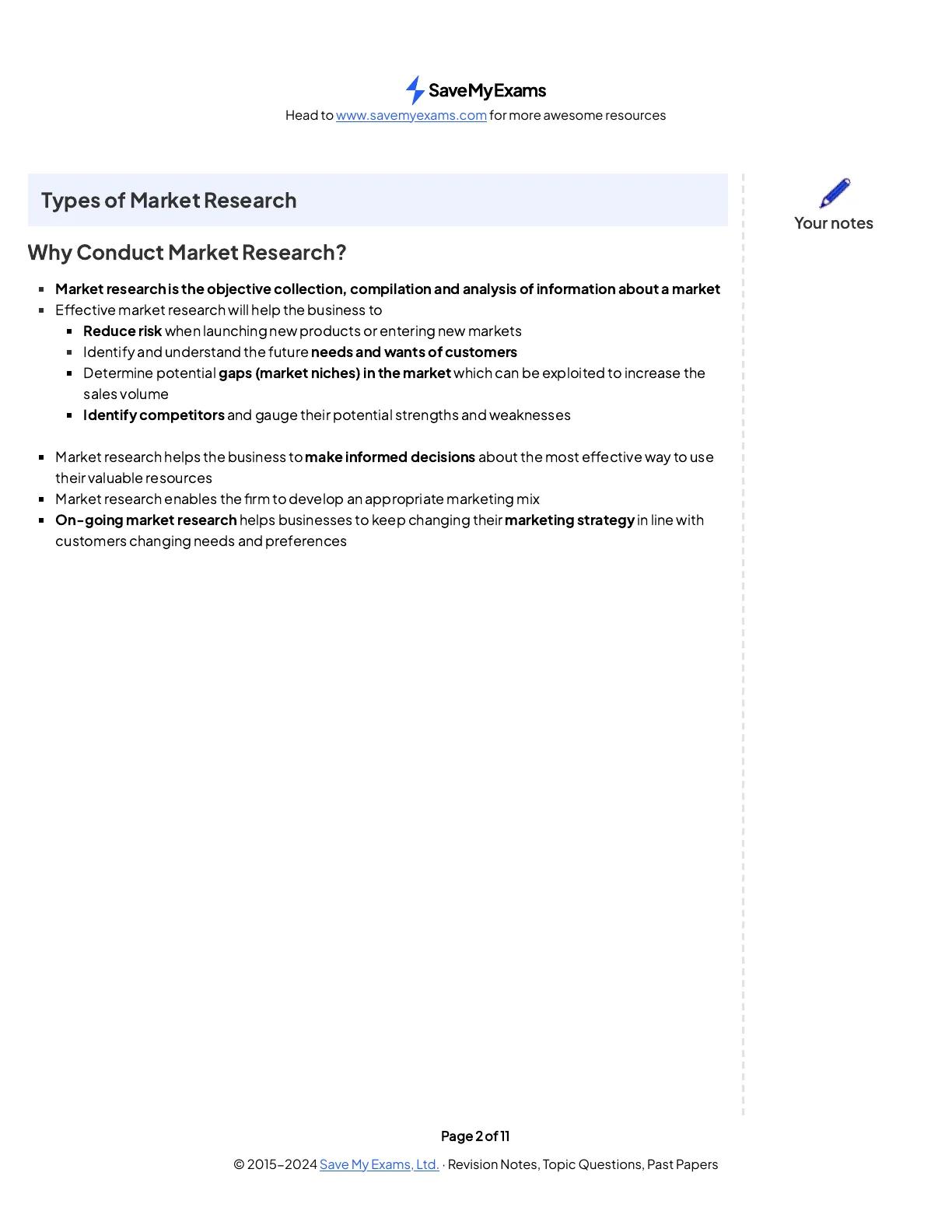
Types of Market Research
Market research is the objective collection, compilation and analysis of information about a market Effective market research will help the business to
- Reduce risk when launching new products or entering new markets
- Identify and understand the future needs and wants of customers
- Determine potential gaps (market niches) in the market which can be exploited to increase the sales volume
- Identify competitors and gauge their potential strengths and weaknesses
Market research helps the business to make informed decisions about the most effective way to use their valuable resources Market research enables the firm to develop an appropriate marketing mix
- On-going market research helps businesses to keep changing their marketing strategy in line with customers changing needs and preferences
Primary Market Research
Primary research is the process of gathering information directly from consumers in the target market using field research methods such as surveys or interviews This gathers information that is new and does not necessarily exist in any format
Primary research methods
Businesses can choose from a range of primary market research methods and may combine a selection of methods to obtain comprehensive first-hand data
Primary Market Research Methods
Method Explanation Advantages Disadvantages Surveys
- The most widely used method of gathering primary research is to conduct surveys
- A large amount of data can be collected relatively quickly
- Poorly-designed and conducted surveys will result in poor results
- This is where you would ask a series of questions to a certain number of people (respondents)
- Well-designed surveys can be completed easily by the respondents, especially online surveys
- Poor response rates are typical, especially when a random sampling method is used
The results from the 'sample' are used to make inferences in which the results of the sample are extrapolated to be true for the wider population
- A wide range of respondents can be reached using online survey tools such as Survey Monkey
Observation
- This involves hiring someone to stand in an appropriate location and study consumer behaviour in a store or perhaps judge the potential consumer traffic at a particular location
- Researchers may observe the impact of packaging
- Auseful method to capture data on human behaviour
- Large numbers can be observed in a short period of time
- Observation needs to be combined with other primary research methods to understand the causes of behaviour
on consumer choice, or the impact that the particular placement of a product in a store may have on consumer choice
Interviews
- The questions may be set up in a very similar way to a survey, however, an interviewer asks the questions
In-depth question provides detailed opinions and perceptions from participants
- Atime-consuming process as interviews are carried out one-to- one
- This method takes longer but does allow the interviewee to ask follow-up questions and gather the information that can easily be missed when conducting surveys
- High response rates can be achieved
- Interviewer bias can affect the validity of results
Test marketing
- Free samples are provided for a limited period to the target market to gauge their response to the product
- Perceptions and opinions can be gathered prior to a full product launch
- Producing and distributing free samples can be expensive
Adjustments to the product or other elements of the marketing mix can be made following feedback
Can attract early attention from potential customers
- Competitors may become aware of new products to be launched
Focus groups
- Free range discussions led by a marketing specialist to collect detailed feedback on all aspects of the marketing mix from the target market
Detailed information on opinions and perceptions can be gathered
- Participants may be reluctant to share their true opinions in a group situation
- Usually limited to a small group of 12-15 people
- The group typically meets for 90 minutes to 3 hours
- Small groups make focus groups relatively easy and inexpensive to organise
- Rewards for participation make focus groups more expensive than other methods such as surveys or observation
Pros and Cons of Primary Market Research
Traditionally, primary research has been relatively difficult and expensive for businesses to gather The rise of social media platforms such as Facebook, Twitter, Instagram and TikTok has changed this and now provides businesses with incredible primary research opportunities
- The speed of communication between businesses and customers can be almost instantaneous e.g. by using online polls thousands of responses can potentially be received in several hours
- The cost of gathering this information can be very low e.g. Online polls take a few minutes to set up and software automatically gathers and analyses the results
- Social media helps businesses to generate an interactive relationship with their customers which helps to strengthen brand loyalty
Customers are also able to feedback quickly on products - or to express innovative ideas about how they want the products to be changed
- This feedback may help the firm to develop extension strategies in their product life cycle
Businesses need to take care to choose a method of primary market research that allows them to capture the correct form of data that can support decision-making Analysing the advantages and disadvantages of primary research improves decision making
Advantages & Disadvantages of Primary Market Research
Advantages Disadvantages Information gathering is focused on the needs of the business and will not be available to its rivals
- The sample size may be too small and unrepresentative of all of the customers leading to unreliable results
The business can get in-depth information from respondents, for example, reasons behind certain behaviour
Bias may mean that researchers can guide respondents to answer questions in a particular way Similarly, respondents may be influenced by the responses of others, or not provide accurate information
Primary market research is more up-to-date and can be used to ask specific questions and so will be more relevant
A business may need to hire a specialist market research agency to help and the process can be expensive and time-consuming
Secondary Market Research
- Secondary research involves the collection, compilation, and analysis of data that already exists
Sources of Secondary Research
Businesses can consult a wide range of secondary sources to gather market research data
- Government Publications: National governments and trading blocs such as the EU publish reports and statistics on topics such as the economy, demographics, industry trends and consumer behaviour
- Academic Institutions: Universities and research institutions conduct studies and publish research papers which provide valuable insights and data on specific industries, consumer behaviour and market trends
For example, Stanford University is a globally significant research centre for engineering and medicine
Industry Associations: Trade associations and industry-specific organisations provide detailed information about specific sectors, including market size, growth rates and industry benchmarks
- E.g. The International Organisation of Motor Vehicle Manufacturers conducts and collates research on production and sales statistics
- Specialist Market Research Reports: Companies specialising in market research produce and sell in- depth reports on various industries, markets and consumer trends
E.g. Mintel is one of the leading private companies supplying market research infromation
- Financial Reports: Public limited companies are required to publish financial reports, including annual reports which can provide valuable information about a company's performance, market position, and future plans
Online Databases: There are various online databases and research platforms that provide access to a wide range of secondary market research E.g. Statista and Euromonitor International
- Media Sources: Newspapers, magazines and online publications often contain articles, opinion pieces and investigative reports that can offer insights into market trends, consumer behaviour and industry developments
E.g. The Financial Times and the Wall Street Journal Businesses must weigh up the reliability of secondary market research and aspects such as cost, relevance and availability of data should also be carefully considered
Advantages & Disadvantages of Secondary Market Research
Advantages Disadvantages Information is already available and so is quicker to collect than primary research thereby saving time
- Information has been collected for other purposes and so may lack relevance or may not be factually correct e.g. Wikipedia
- Information is often free (e.g. government websites and internet sources such as Statista) and is cheaper to collect leading to lower costs compared to primary research
- Can be expensive to purchase market specific secondary data from specialist companies e.g. MINTEL reports
Suitable for a small business that lacks a large marketing budget and/or expertise
- Information may be out-of-date, especially in dynamic markets
Can’t find what you’re looking for?
Explore more topics in the Algor library or create your own materials with AI.