Key principles of project management, governance, and negotiation
Slides about project management, governance, and negotiation. The Pdf provides a clear and structured overview of these topics, including strategy, performance indicators, organizational structures, and negotiation techniques like the Harvard model, suitable for University students in Economics.
See more12 Pages
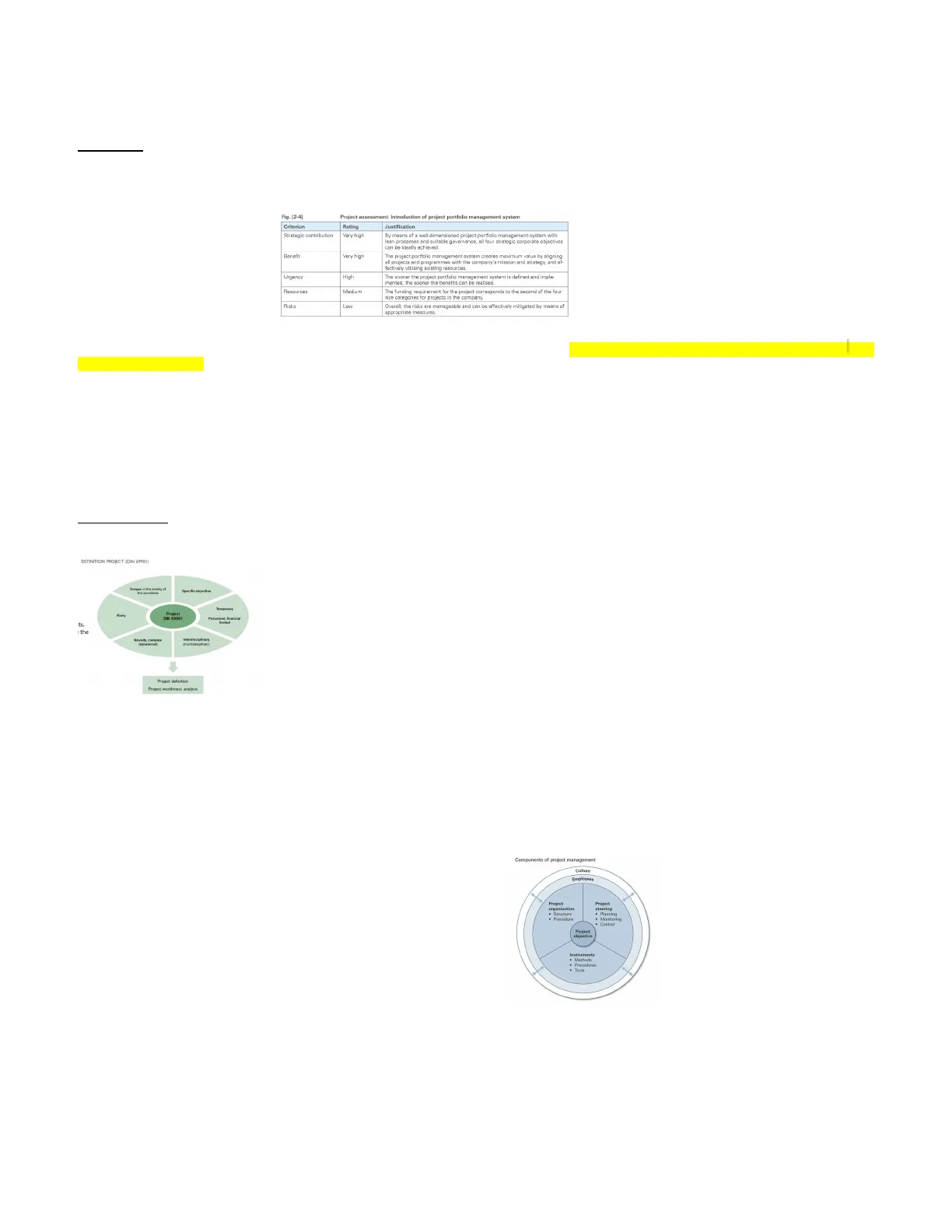
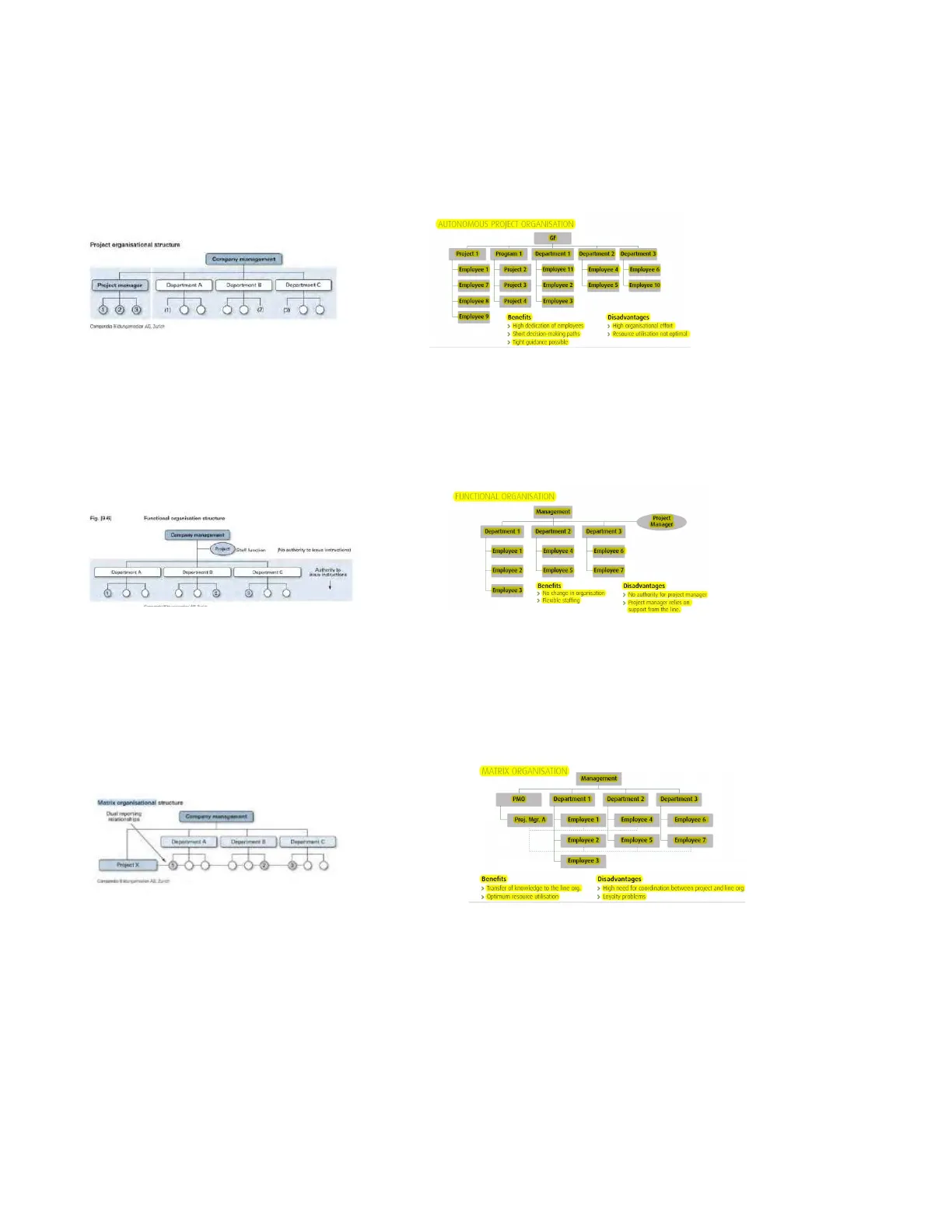

Unlock the full PDF for free
Sign up to get full access to the document and start transforming it with AI.
Preview
Resumen
jueves, 15 de febrero de 2024 9:21
STRATEGY
VISION: Presenting future ideals. MISSION: Description of porpoise, direction and performance of an organization as part of the overall economy. STRATEGY: Long term (3-5 years) framework planification to achieve the mission, taking into account the vision.
Criteria for project Assessment
Risk Strategic Contribution Benefit Urgency Resources Fig. [2-4]
Project assessment: Introduction of project portfolio management system
| Criterion | Rating | Justification |
|---|---|---|
| Strategic contribution | Very high | By means of a well-dimensioned project portfolio management system with lean processes and suitable governance, all four strategic corporate objectives can be ideally achieved. |
| Benefit | Very high | The project portfolio management system creates maximum value by aligning all projects and programmes with the company's mission and strategy, and ef- fectively utilising existing resources. |
| Urgency | High | The sooner the project portfolio management system is defined and imple- mented, the sooner the benefits can be realised. |
| Resources | Medium | The funding requirement for the project corresponds to the second of the four size categories for projects in the company. |
| Risks | Low | Overall, the risks are manageable and can be effectively mitigated by means of appropriate measures. |
Critical Success Factor, Success Factor is a condition that increases the probability of success. If the success factor is also critical, this is a requirement that contributes significantly to the success of the project. Critical success factors are therefore also called key factors. In a project is a valid circumstance (requirement) of particular importance to the project.
Project analysis and project environment analysis
The project analysis and project environment analysis help to identify CSFs and are carried out in the following steps:
- Peripheral conditions
- Stakeholders
- Risks and opportunities
- Derive CSFs
Key Performance Indicator, is an indicator can be used to measure or/and determine the progress or extent of which objective is achieved.
GOVERNANCE
PROJECT, is an Unique, Temporal, Multidisciplinary and Organized endeavour to realise the agreed deliverables within a predefined requirements and constrains.
DEFINITION PROJECT (DIN 69901)
Inique in the totality of the condition Specific objective Temporary Risky Project DIN 69901 Personnel, financial limited . the Novelty, complex (dynamical) Interdisciplinary |multidisciplinary) Project definition Project worthiness analysis
PROGRAMME, set up to achieve strategic goals. It is a temporal organisation of interrelated projects managed in a coordinated way to enable the implementation of change and the realisation of benefits. A programme combines a number of projects which serve a common strategic goal. One characteristic is a very high level of complexity which demands to allow mainly independent projects to execute the tasks to lower that level of complexity.
PORTFOLIO, is a set of projects and/or programmes, which not necessarily related, brought together to provide optimum use of organization's resources and to achieve the organisation strategic goals minimizing the portfolio risk.
Project Management Object
Project management system consists of the following elements:
- Project objective: agreed project results which must be fulfilled for a project to be considered successfully completed.
- Project organization: structural and procedural organization.
- Project steering: planning, monitoring, steering.
- Instruments: methods, procedures, tools
- Employees
- Culture
Components of project management
Culture Employees Project organisation . Structure · Procedure Project steering . Planning Monitoring Control Project objective Instruments Methods Procedures . Tools
Governance provides the framework for decision-making and reporting structures:
- Decision-making structures define which organizational units, stakeholders as well as processes a project has to consider and which results it has to produce in order to bring about project relevant decisions.
- Reporting structures define which specifications (processes, addresses, contents, time periods) exist for the flow of information from the projects into the organization or the company.
- Quality requirements define what organizational requirements exist that a project must meet.
Aligning decision-making and reporting functions
As a project manager, give examples (at least 3) how you would align the decision-making and reporting functions of Project with line organisation?
Decision-making and reporting:
- Identify decision making and reporting needs within line. Resumen Page 12. Co-ordinate with all relevant reporting departments within Line
- Align in content and format with those
- Define relevant data to be exchanged between project and line organization
Reporting requirements for a project manager within a programme
Name three reporting requirements for a project manager who works within a programme.
Requirements are e.g .:
- Reporting of the current situation of the own project towards the Program manager.
- Reporting of any deviations (esp. with effect to the due dates) to affected other project managers within the programme.
- Reporting to his own PTM about the current situation in other projects within the programme, if that might or does impact their work execution
PROJECT ORGANISATION STRUCTURE
Project organisational structure
Company management Project manager Department A Depertment B Department C (3) Compendio BISungonoden AG, Zuder
AUTONOMOUS PROJECT ORGANISATION
GF Project 1 Program 1 Department 1 Department 2 Department 3 Employee 1 Project 2 Employee 11 Employee 4 Employee 6 Employee 7 Project 3 Employee 2 Employee 5 Employee 10 Employee 8 Project 4 Employee 3 Employee 9
Benefits and Disadvantages of Autonomous Project Organisation
Benefits > High dedication of employees > Short decision-making paths > Tight guidance possible
Disadvantages High organisational effort > Resource utilisation not optimal
Advantages,
- Better expertise in the project in terms of implementation, communication, conflict resolution and decision making.
- All project team member report directly to the project manager.
- Faster, mutual identity of the team members within the project.
Disadvantages,
- Reduced career opportunities and workplace security of project members.
- Cross-department expertise is lacking.
- Higher costs possible due to employees who are not completely utilised in the project.
PROJECT FUNCTIONAL ORGANISATION
Fig. 19-65]
Functional organisation structure
Company management Projet Stall function (No authority to issue instructions) Department A Depertment 8 Department C Authorey lo lasun instructions
FUNCTIONAL ORGANISATION
Management Project Department 1 Department 2 Department 3 Employee 1 Employee 4 Employee 6 Employee 2 Employee 5 Employee 7 Employee 3
Benefits and Disadvantages of Functional Organisation
Benefits > No change in organisation > Flexible staffing
Disadvantages > No authority for project manager > Project manager relies on support from the linc.
Advantages,
- Integration of the line requires an objective-oriented and helpful work environment.
- Expertise from the line is integrated directly into the project.
- Communication and decisions can be encouraged by using the line.
Disadvantages,
- Intersections and duplications are possible
- Lack of support for the project from the line hierarchy
- Larger (Technical) investments are more difficulty to make.
PROJECT MATRIX ORGANIZATIONAL STRUCTURE
Matrix organisational structure
Dual reporting relationships Company management Depertment A Deperiment 5 Deperment C Project X
Advantages of Matrix Organisational Structure
Advantages,
- Required expertise can be distributed to different projects as required.
- Integrating the line increase the agreement for project cooperation
- Rapid compilation of project team (large resources pools in the line).
Disadvantages,
- Longer team building phase at project start.
- Dual supervision creates conflict in coordination and instructions.
- Restricted concentration of individual team members with several tasks to the project.
Embedding Project in Line Organisation
How can the Project be embedded in line organisation?
The following aspects have to be considered:
- Org. form within the line organisation (influential, matrix, autonomous)
- Project Owner set-up (Single person or Steering Committee)
- Permitted support claims towards the line functions (level of project-oriented organisation)
MATRIX ORGANISATION
Management PMO Department 1 Department 2 Department 3 Proj. Mgr. A Employee 1 Employee 4 Employee 6 Employee 2 Employee 5 Employee 7 Employee 3
Benefits and Disadvantages of Matrix Organisation
Benefits > Transfer of knowledge to the line org. > Optimum resource utilisation
Disadvantages > High need for coordination between project and line org. > Loyalty problems Resumen Page 2
Objectives of project management, programme management and portfolio management
| Project management | Programme management | Portfolio management |
|---|---|---|
| · Efficient implementation of projects and programmes: · Realistic planning | · Optimisation with regard to strategic and economic benefit · Optimised utilisation of internal resources | · Transparency of all projects including their interdependencies · Consistent basis for decisions · Optimisation of corporate development as a whole |
| "Doing things right" | "Doing the right things" |
Project management office (PMO) is a permanent organizational unit responsible for the creation, implementation and further development of a company's project management system.
Advantages of a certified project manager and standard pm-methodology
- Name four advantages of having a certified project manager and standard pm-methodology.
- Common standards (e.g. ICB, ISO norm)
- Proven design of methods
- Experience of PJM appraised by a third party
- Harmonized understanding of terms
Typical support measures of a PMO
Typical support measures of a PMO could be:
- Advice regarding the structural set-up of the project
- Support in resource allocation
- Provide adequate planning, controlling and reporting tools and techniques
- Support in defining project-specific roles and responsibilities
- Help meet the reporting needs of the management (e.g. Steering Committee)
Program Management Office (PMO) Responsibilities
The PMO is responsible for developing the tools and resources within an organization to properly execute project management. A PMO provides guidance and direction to Program Managers and develops the standards to which they work. There are a few areas of responsibilities they focus on:
- Leadership: Provide leadership across the organization to maintain standards
- Develop Program Management Tools: These can be templates, databases, training, software, and much more
- Develop Strategic Guidance: Provide guidance on how to execute a program in a organization
- Best Practices: Maintains a standard list of the best ways to conduct project management
- Maintain Corporate Culture: Makes sure the culture of the organization is productive.
- Creates Project Archives: Good source of information for future projects; lessons learned.
- Resource Management: Makes sure resources across an organization are properly managed.
Competence classes of IPMA Delta
... competence classes of IPMA Delta
| Development of an organization in terms of PM | Optimising | Managed |
|---|---|---|
| There are fully defined PP& P standards, structures and processes in place which are tully applied throughout the organisation, which the Management actively controls | There are fully defined PPS.P standards, structures and processes In place which are fully applied throughout the organisation, which the Management actively controls and continuously improves. | Standardised There are fully defined PP&P standards, structures and processes in place which are mostly applied throughout the organisation |
| Defined There are partially defined PP& P standarks structures and processes in place which are partially applied in the organisation | applied Management system The achievements of Project Management are at a pocona level. There are individuals who perform well, but PP&P performance is coincidental | The organisation hasno formal PP&P standards, structures and processes in place Mostly not in time, budget, scope |
PP&P: Projects, Programs and Portfolios IPMAKorea OCB Training 2018 59 IPMA. KOREA
Typical product life cycle stages
The typical product life cycle stages are (main process steps in brackets):
- Introduction (Initiation, definition, development, production)
- Growth (Marketing, sales)
- Maturity (Marketing, sales)
- Decline (Obsolescence)
HR department support for talent acquisition
HR department support you in finding the right talent for your team
Important aspects are:
- hiring new staff upon your demand,
- Analysing knowledge gaps within the existing staff
- training of existing staff according to your defined needs,
- identification of existing skills and knowledge you might not know about
Financial control mechanisms for project management
financial control mechanisms support you in staying on top of your project
Supportive means are:
- Evaluating various cost figures,
- Utilizing the existing ERP-System,
- Providing financial control (e.g. EVA figures) and reporting
COMPLIANCE
Resumen Page 3
- Effective implementation of projects and programmes:
- Transparency with regard to budget, deadline, risks and completion
- Early warning system
- Better quality
- Improved performance of individual projects and programmes
Governance and Initial Time, Buget, Scope kept
Can’t find what you’re looking for?
Explore more topics in the Algor library or create your own materials with AI.
