New Word and Grammatical Change: English Language Evolution in Renaissance
Document from University about New Word and Grammatical Change. The Pdf explores the evolution of the English language in the Renaissance, with a focus on grammatical changes and Shakespeare's influence, including Hamlet and his sonnets. This University Literature material is well-structured for learning.
See more13 Pages

Unlock the full PDF for free
Sign up to get full access to the document and start transforming it with AI.
Preview
English Language Evolution in Renaissance
New Words and Grammatical Changes
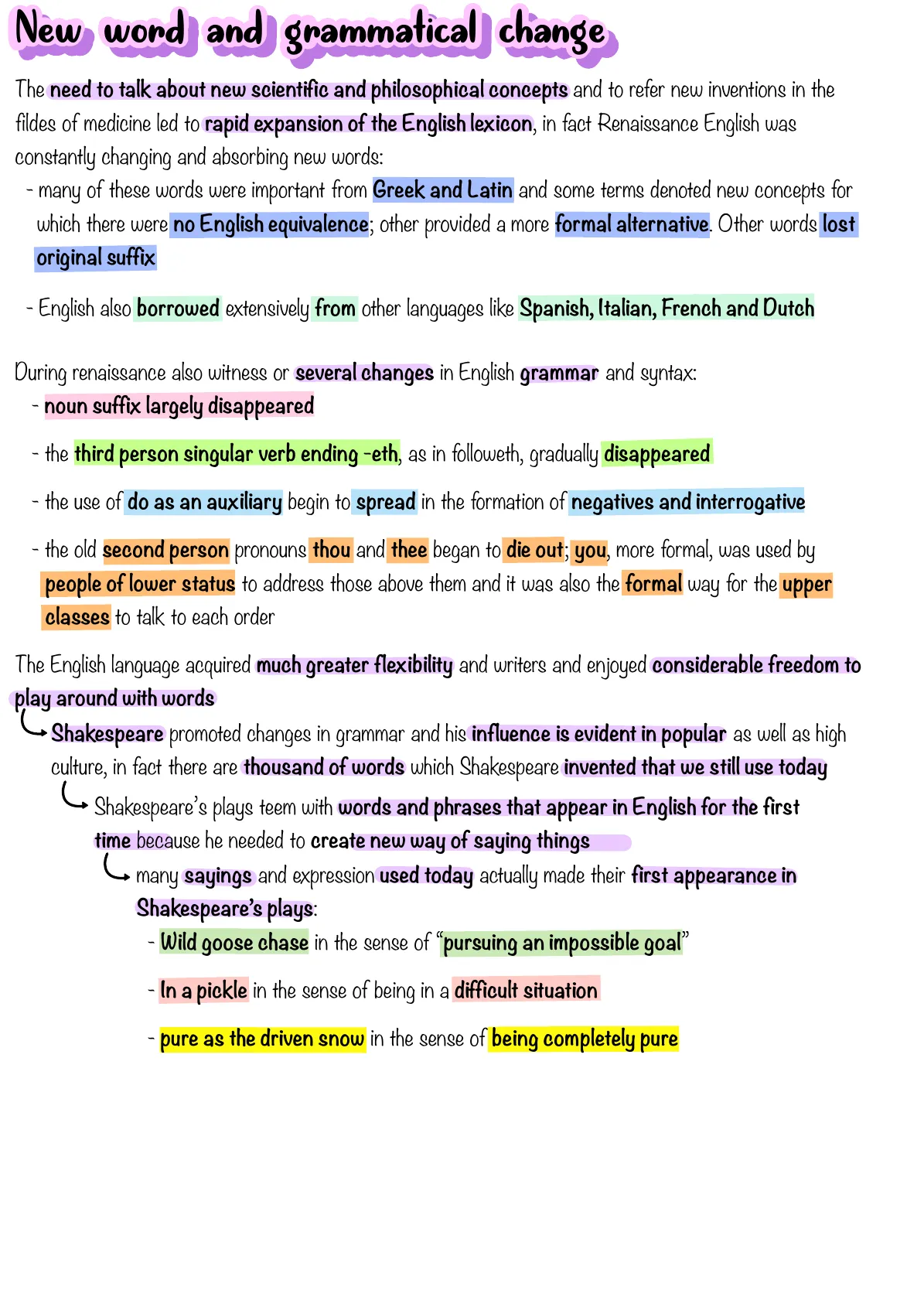
New word and grammatical change The need to talk about new scientific and philosophical concepts and to refer new inventions in the fildes of medicine led to rapid expansion of the English lexicon, in fact Renaissance English was constantly changing and absorbing new words:
- many of these words were important from Greek and Latin and some terms denoted new concepts for which there were no English equivalence; other provided a more formal alternative. Other words lost original suffix
- English also borrowed extensively from other languages like Spanish, Italian, French and Dutch During renaissance also witness or several changes in English grammar and syntax:
- noun suffix largely disappeared
- the third person singular verb ending -eth, as in followeth, gradually disappeared
- the use of do as an auxiliary begin to spread in the formation of negatives and interrogative
- the old second person pronouns thou and thee began to die out; you, more formal, was used by people of lower status to address those above them and it was also the formal way for the upper classes to talk to each order
The English language acquired much greater flexibility and writers and enjoyed considerable freedom to play around with words
Shakespeare's Influence on Language
Shakespeare promoted changes in grammar and his influence is evident in popular as well as high culture, in fact there are thousand of words which Shakespeare invented that we still use today Shakespeare's plays teem with words and phrases that appear in English for the first time because he needed to create new way of saying things . many sayings and expression used today actually made their first appearance in Shakespeare's plays:
- Wild goose chase in the sense of "pursuing an impossible goal"
- In a pickle in the sense of being in a difficult situation
- pure as the driven snow in the sense of being completely pure
William Shakespeare's Life
Early Life and Marriage
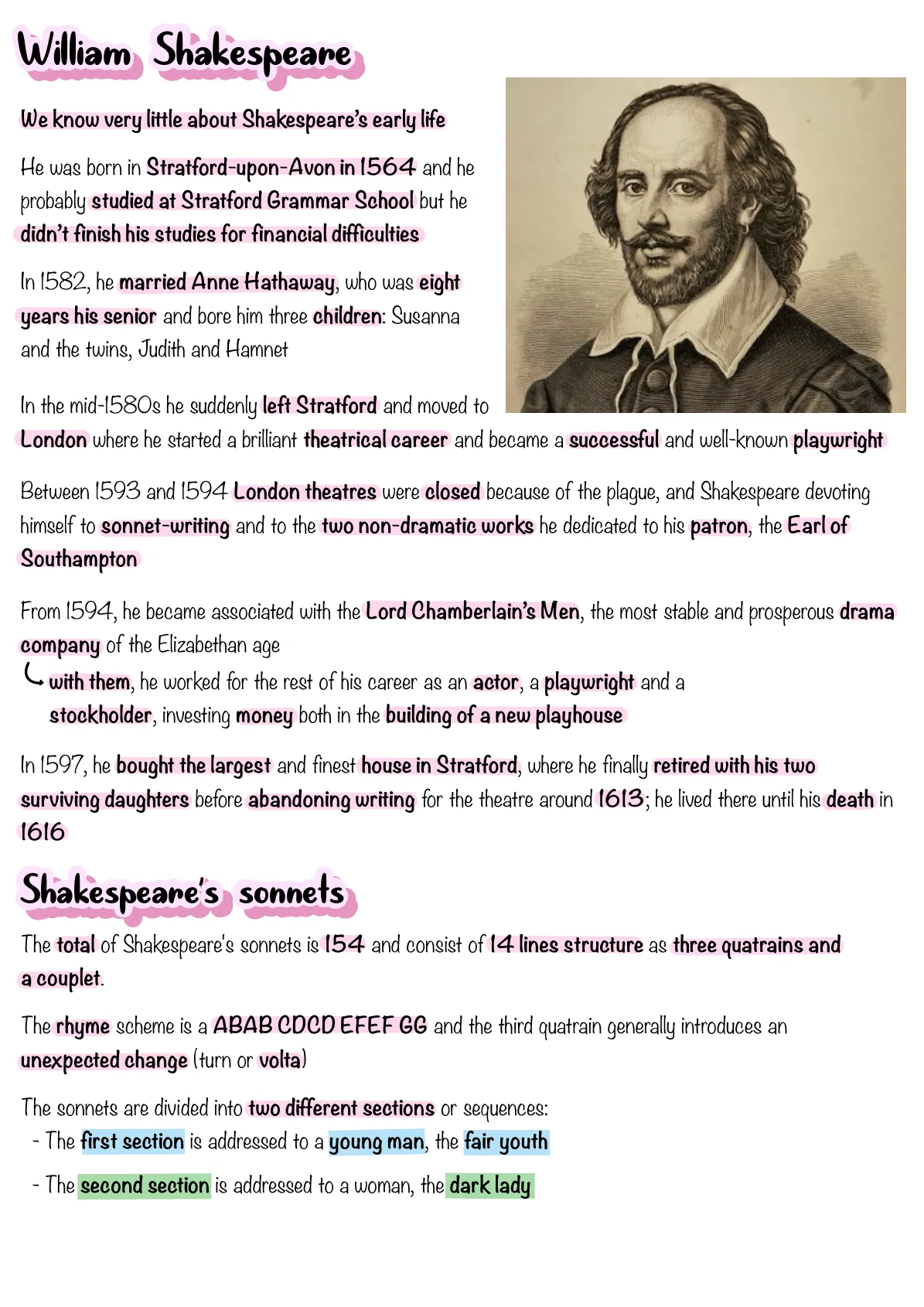
We know very little about Shakespeare's early life He was born in Stratford-upon-Avon in 1564 and he probably studied at Stratford Grammar School but he didn't finish his studies for financial difficulties In 1582, he married Anne Hathaway, who was eight years his senior and bore him three children: Susanna and the twins, Judith and Hamnet
Theatrical Career and Retirement
In the mid-1580s he suddenly left Stratford and moved to London where he started a brilliant theatrical career and became a successful and well-known playwright Between 1593 and 1594 London theatres were closed because of the plague, and Shakespeare devoting himself to sonnet-writing and to the two non-dramatic works he dedicated to his patron, the Earl of Southampton From 1594, he became associated with the Lord Chamberlain's Men, the most stable and prosperous drama company of the Elizabethan age with them, he worked for the rest of his career as an actor, a playwright and a stockholder, investing money both in the building of a new playhouse In 1597, he bought the largest and finest house in Stratford, where he finally retired with his two surviving daughters before abandoning writing for the theatre around 1613; he lived there until his death in 1616
Shakespeare's Sonnets
Structure and Divisions
The total of Shakespeare's sonnets is 154 and consist of 14 lines structure as three quatrains and a couplet. The rhyme scheme is a ABAB CDCD EFEF GG and the third quatrain generally introduces an unexpected change (turn or volta) The sonnets are divided into two different sections or sequences:
- The first section is addressed to a young man, the fair youth
- The second section is addressed to a woman, the dark lady
Themes in Sonnets
Shakespeare explore the feeling of love in all its various manifestation:
- the first 17 poems called the procreation sonnets, urge the young man to marry and have children in order to ensure that his beauty will remain immortal
- the second revolves around the relationship with the dark lady, so called because the poem make it clear that she has black hair and dun-coloured skin ( the dark lady section is overtly sexual in ) its passion and the lady is depicted as very attractive and seductive several sonnets speculate about the unpleasant sensation caused by love, such as fear, alienation and physical discomfort
Time is another recurring theme and is depicted like an enemy of love it destroys love because it causes beauty to fade, people to age and life to end; however decaying and dying are inevitable aspect of the human condition Shakespeare's sonnets subvert the classic and traditional themes typical of the Petrarchan tradition Shakespeare built his images and meanings through a number of recurring symbols like flowers, plants and trees to illustrate the passage of time; stars influence the destiny of human beings; weather and the season mark the ages of men
"Shall I Compare Thee..." Sonnet
Shall I compare thee ... Shall I compare thee to a summer's day? similitudione Thou art more lovely and more temperate: Rough winds do shake the darling buds'of May, And summer's lease hath all too short a date: Sometime too hot the eye of heaven shines, metafora per il sole (God) And often is his gold complexion dimm'd ;- > personificazione per il sole And every fair from fair'sometime declines, By chance, or nature's changing course, untrimm'd; But thy eternal summer shall not fade'-+ svanire Nor lose possession of that fair thou ow'st" Nor shall Death brag"thou wander'st in his shade, neanche la morte ti avrà When in eternal lines to time thou grow'st; So long as men can breathe or eyes can see, So long lives this and this gives life to thee. la poesia rende immortali 1 temperate: garbato, dolce, mite 2 Rough: Violenti, tempestosi 3 buds: gemme, boccioli 4 And summer's ... a date: E l'estate è troppo breve; lease: (termine legale) contratto di proprietà temporaneo 5 complexion: colorito, carnagione 6 dimm'd: offuscato/a 7 fair: cosa bella, bellezza 8 untrimm'd: resa irregolare, disordinata (non potato) 9 shall not fade: non sbiadirà, non svanirà 10 ow'st = ownest: possiedi 11 shall ... brag: si vanterà 12 So long as: Per tutto il tempo che
Shakespeare's Plays
The First Folio and Play Groupings
The First Folio is the first collected edition of the plays and was published posthumously in 1623 by Shakespeare's friends
- no division into acts and scenes existed but only an approximate chronological order of composition has been established
- the plays were simply grouped as: -Comedies -* * their usual dramatic devices are mistaken identities, disguises, cross-dressing, lucky coincidences * plots often mix romantic love with poetic humour and the central characters overcoming difficulties and securing a happy ending to their story *marriages are finally celebrated and wrongs are redressed Histories -* Shakespeare mainly focused on moments of English history when a sense of national consciousness was growing so this also gave Shakespeare the opportunity to investigate the nature of monarchic power *he also explored the painful conflict between private feelings and public duties in key historical figures in his three Roman plays · Tragedies- the challenge will prove fatal to the hero *the focus is on a single, isolated individual of high rank in opposition to his family or social group
Romances and Enduring Legacy
Shakespeare's romances borrowed the musical and spectacular elements typical of court masques such as magic, mythology and the intervention of supernatural beings generally dealing with themes such as guilt and atonement The timelessness of the themes he explored in his plays, he is best known for the memorable characters he left us He had a striking knowledge of human virtues and weaknesses and was able to investigate the depths of the human psyche He is also universally acknowledged for his mastery of language, characterised not only by its musicality and vividness, but also by its allusive Shakespeare loved to mix local sayings with Greek and Latinate words, and coined an incredible amount of phrases, idioms and metaphors
Romeo and Juliet
Storyline and Plot
Its main source was probably Arthur Brooke's 1562 poem, The Tragical History of Romeus and Juliet, whose storyline came to England from Italy through France STORY Count Paris, who's a relative of the Prince of Verona, want to marriage Juliet Capulet so her father organises a party to celebrate the event Romeo Montague, an enemy of the Capulets, goes to the party and meet Juliet: they fall in love at first sight After the party, Romeo enters the Capulets' garden unseen and watches Juliet on her balcony C he hears her confess that she loves him so Romeo leaps out from his hiding place and the two exchange vows of love and the following day they are secretly married by their confessor, Friar Lawrence Unfortunately, Romeo's best friend Mercutio is involved in a fight with Tybalt, Juliet's fiery cousin, who kills him Romeo challenges Tybalt and kills him, but the Prince of Verona learns of the deaths and banishes Romeo from town Che flees to Mantua, but meanwhile, Lady Capulet announces that the wedding between Julieet and Count Paris is being arranged for the next day Juliet talk with Friar Lawrence for help and he gives to her a potion that will make her fall into a deep sleep, similar to death, for about two days Juliet drink the potion but her affectionate Nurse discovers her apparently dead, the next morning ( the Friar will send a letter to Romeo to let him know what is happening but the message does not arrive on time and Romeo learns about Juliet's death from a servant he kills himself with a potion near Juliet but waking up, Juliet realises Romeo has killed himself; she takes his dagger and stabs herself The two powerful families eventually decide to reconcile their houses over their two children's dead bodies.
Themes and Style in Romeo and Juliet
THEMES & STYLE The love is the principal theme and in the play 'romantic love' is portrayed as an overwhelming, overpowering and ecstatic force that apparently resists any standard definition This closely follows Romeo and Juliet's own psychological development during the tragedy
- at the start Romeo is characterised by youthful bravado and he has a teenager's infatuation for Rosaline
- Juliet appears obedient and accepting but immature 1 when they fall in love every changes projecting them into the world of adulthood and maturity
The struggle between the individual and society is another important theme in the play is another important theme The importance given to honour and loyalty to one's clan often results in street fights that disturb the public peace Nobody, especially women, really has a choice in the patriarchal structure of Renaissance families but has to behave according to the pater familias' wishes Their appreciation of the secrecy and privacy of night-time and their wished-for renunciation of their own names are just two ways in which they try to rebel Final act can be read as their ultimate assertion of free will and independence infact the suicide is the highest and strongest expression of their love Romeo and Juliet's struggle to be together does not help them escape their destiny Unlike Shakespeare's later great tragedies, there is a cruel, destructive fate which works against its victims The language is rich and Shakespeare employed varied vocabulary and sophisticated references to history, science and religion as well as powerful tropes and imagery Thanks to the evocative power of words he also suited different literary forms and styles to the different moods and characters.
Can’t find what you’re looking for?
Explore more topics in the Algor library or create your own materials with AI.
