Freedom of Establishment and Services in EU Law: Key Cases and Principles
Document from University about Part 2: Freedom of Establishment. The Pdf explores the freedom of establishment and the freedom to provide services within the EU, analyzing key directives and principles from CJEU case law, including cases like Daily Mail and Gebhard, relevant for University Law students.
See more13 Pages


Unlock the full PDF for free
Sign up to get full access to the document and start transforming it with AI.
Preview
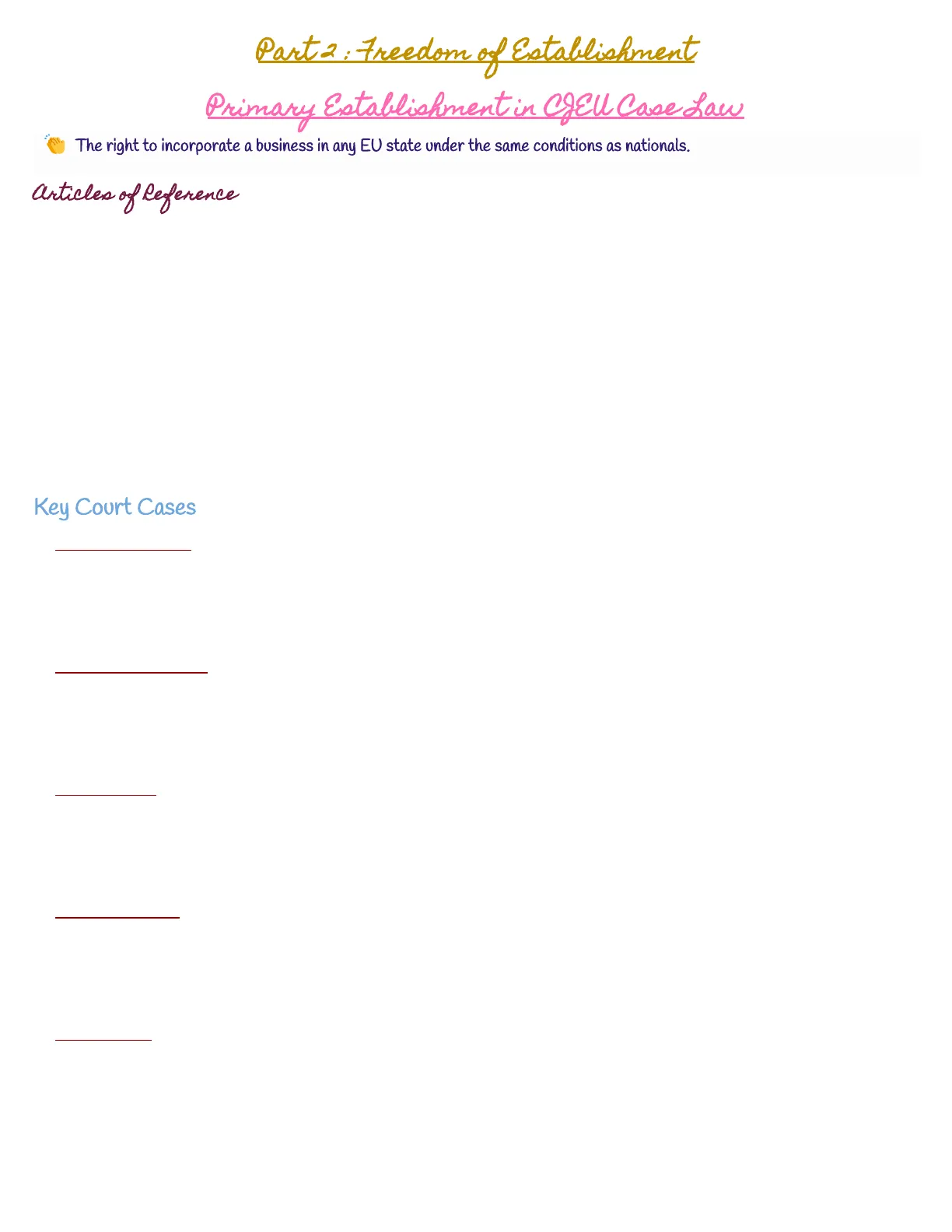
Freedom of Establishment
Primary Establishment in CHEUl Case Law
The right to incorporate a business in any EU state under the same conditions as nationals.
Articles of Reference
- Primary Articles:
- Article 49 TFEU: Prohibits restrictions on the establishment of nationals and businesses from one EU state in another.
- Article 54 TFEU: Defines companies as entities treated equally to natural persons, ensuring their rights to establishment.
- Supporting Provisions:
- Directive 2019/2121/EU: Governs cross-border conversions, mergers, and divisions.
- Directive 2005/56/EC: Addresses cross-border mergers for limited liability companies.
- 11th Council Directive (89/666/EEC): Disclosure requirements for branches of companies established in other member states.
Key Court Cases
A. Daily Mail Case
- Facts: A UK company, Daily Mail, wanted to move its central management to the Netherlands to avoid capital gains tax. UK law required consent for such a move.
- Ruling: The CJEU held that the right of establishment does not include the right to transfer a company's central management and control without following national law. The UK could deny the move under its laws.
B. Überseering Case
- Facts: A Dutch company, Überseering, conducted business entirely in Germany. When it sought to sue a German company, the German court ruled that the Dutch company lacked legal capacity under German law.
- Ruling: The CJEU held that Germany must recognize the legal capacity of the company under Dutch law. Denying legal capacity would invalidate the right of establishment.
C. Sevic Case
- Facts: A German company, Sevic, attempted to register a merger with a Luxembourg company. German law did not permit cross-border mergers.
- Ruling: The CJEU ruled that the right of establishment includes the right to engage in cross-border mergers, provided both companies comply with the laws of their respective member states.
D. Cartesio Case
- Facts: A Hungarian company, Cartesio, wanted to move its central management to Italy while remaining a Hungarian-registered company. Hungarian law did not allow such a transfer without re-incorporation.
- Ruling: The CJEU upheld Hungarian law, stating that each member state can determine its own rules for incorporation and connecting factors. This case reaffirmed the Daily Mail doctrine.
E. VALE Case
- Facts: An Italian company sought to convert into a Hungarian company without dissolution and re-incorporation. Hungary denied the registration, arguing that only Hungarian companies could be converted.
Downloaded by Filippo Casali (c.filippo.f@gmail.com) 10
- Ruling: The CJEU ruled that Hungary could not deny cross-border conversion if it allowed conversions for domestic companies. This established that member states must treat foreign companies equally in such matters.
F. Polbud Case
- Facts: A Polish company, Polbud, wanted to transfer only its registered office to Luxembourg while keeping its head office in Poland. Polish law required the company to undergo liquidation before deregistration.
- Ruling: The CJEU held that the freedom of establishment includes the right to transfer the registered office to another state without requiring liquidation. However, the host state must recognize the transfer if it meets its national legal requirements.
Key Principles Established by the CJEU
A. Host State Obligations
- The host state cannot impose additional requirements on a foreign company transferring its registered office beyond those required for domestic companies (VALE case).
- The host state must recognize the legal capacity of a company formed in another member state if it moves its center of administration there (Überseering case).
B. Cross-Border Mergers and Conversions
- The right of establishment includes cross-border mergers, but the CJEU has been less consistent regarding cross-border conversions.
- National laws govern cross-border conversions, but discriminatory treatment of foreign companies is not allowed (Polbud case).
C. Connecting Factors
- The treaties equate the connecting factors of registered office, central administration, and principal place of business. States can decide which connecting factor determines the applicable national law, but they cannot discriminate against foreign companies (Cartesio case).
Secondary Establishment in CHEUl Case Law
Secondary establishment involves a company operating through branches, agencies, or subsidiaries in Member States other than its primary registration state.
Segers Case (Case C-79/85)
. A Dutch national incorporated a company in the UK, taking advantage of the UK's lenient rules, and operated entirely in the Netherlands through a branch. . Dutch authorities questioned the legitimacy of the setup, citing stricter national laws.
- CJEU Ruling:
- Principle: A company legally established in one Member State can conduct business solely through a branch in another Member State.
- Reasoning: Restricting such operations would violate Articles 49 and 54 TFEU. Member States cannot impose stricter requirements on foreign branches than those applicable to domestic companies.
- Impact: Affirmed the principle of regulatory arbitrage within the EU single market.
This document is available on studocu Downloaded by Filippo Casali (c.filippo.f@gmail.com) 11
Centros Case (Case C-212/97)
- Danish nationals incorporated a company in the UK to avoid Denmark's minimum capital requirements and operated solely through a Danish branch.
- Danish authorities accused them of abusing EU law.
- CJEU Ruling:
- Principle: Freedom of establishment includes the right to choose the most favorable Member State for incorporation.
- Reasoning: Regulatory arbitrage is a legitimate exercise of EU freedoms. + Denying branch registration violates Articles 49 and 54 TFEU. . National authorities cannot label such arrangements as abusive if they comply with EU law.
Inspire Art Case (Case C-167/01)
- A Dutch entrepreneur incorporated Inspire Art Ltd in the UK, avoiding stricter Dutch company law requirements, and operated through a branch in the Netherlands.
- Dutch authorities demanded compliance with domestic minimum capital and liability disclosure rules.
- CJEU Ruling:
- Principle: Secondary establishments cannot be subject to discriminatory or overly restrictive rules by host states.
- Reasoning: Dutch rules imposed additional burdens on foreign branches, contravening Articles 49 and 54 TFEU+ Member States cannot penalize companies for choosing a more favorable incorporation regime.
- Impact: Strengthened the Centros doctrine, reaffirming the right of companies to benefit from regulatory differences within the EU.
Cross-Border Mobility
This refers to a company being able to move, merge, or split its business operations between different EU countries without losing its legal identity.
- Cross-Border Transfer of Seat:
- A company can move its registered office to another EU country but remain the same company = This is useful when businesses want to take advantage of different regulations or tax benefits in other countries.
- Cross-Border Mergers:
- Two companies from different EU countries can merge into one entity, and both companies keep their legal personality during the process.
- Cross-Border Divisions:
- A company in one EU country can split into multiple companies in different EU countries while maintaining its legal identity.
- Cross-Border Conversion:
- A company can change its legal form (e.g., from a limited liability company to a joint-stock company) while keeping its same identity.
Downloaded by Filippo Casali (c.filippo.f@gmail.com) 12
EU Directives Involved
Directive 2019/2121/EU: Harmonizes processes for mergers, conversions, and divisions across EU countries. Regulation 2137/85 (EEIG): Allows EEIG to move its office across countries without dissolving.
Rules and Safeguards
Gebhard Test (1995)
The Test is named after the case Gebhard (1995), in which the ECJ ruled on the legality of national restrictions that hindered cross-border activities within the European Union. In this case, Dr. Gebhard, a German lawyer, was subject to Italian regulations that restricted foreign lawyers from providing services in Italy. The ECJ established the Gebhard Test as a way to determine whether such national rules violated the EU's principle of free movement and non-discrimination. The test set out that restrictions on cross-border activities must:
- Be applied equally to both domestic and foreign entities (non-discrimination).
- Serve essential public interests (imperative requirements).
- Not go beyond what is necessary (proportionality).
Protections
- Creditor Protection: To prevent risky financial moves like asset stripping.
- Minority Shareholder Rights: Ensures that smaller shareholders are treated fairly during mergers, conversions, etc.
- Employee Rights: Workers must be consulted when major changes (like mergers) happen.
Freedom to Provide Services
Under Article 56 TFEU, EU nationals can provide services across all member states without being required to set up a branch or agency. This freedom applies broadly but excludes certain sectors like transport, which is governed by Article 58 TFEU, allowing national regulation.
Key Case on Freedom to Provide Services
1. Uber Case
Facts: In Barcelona, taxi drivers sued Uber, claiming unfair competition, as Uber drivers lacked the necessary licenses. Uber argued it was an information society service under EU law, facilitating the connection between drivers and passengers. Ruling: The CJEU acknowledged that while Uber met the definition of an information society service (i.e., a digital platform providing services for remuneration), it also controlled key aspects of the transport service (e.g., pricing, service conditions). Therefore, Uber was classified as a transportation service, subject to national regulations under Article 58 TFEU.
This document is available on studocu Downloaded by Filippo Casali (c.filippo.f@gmail.com) 13
Can’t find what you’re looking for?
Explore more topics in the Algor library or create your own materials with AI.
