Liver and Basic Drug Metabolism, University of Portsmouth Presentation
Slides from University of Portsmouth about Liver and Basic Drug Metabolism. The Pdf, a presentation for University Biology students, details phase I reactions and the role of P450 cytochromes in converting lipophilic substances for excretion, as outlined in Neuroscience, Endocrine & Gastrointestinal Pharmacology.
See more19 Pages


Unlock the full PDF for free
Sign up to get full access to the document and start transforming it with AI.
Preview
Role of Metabolism
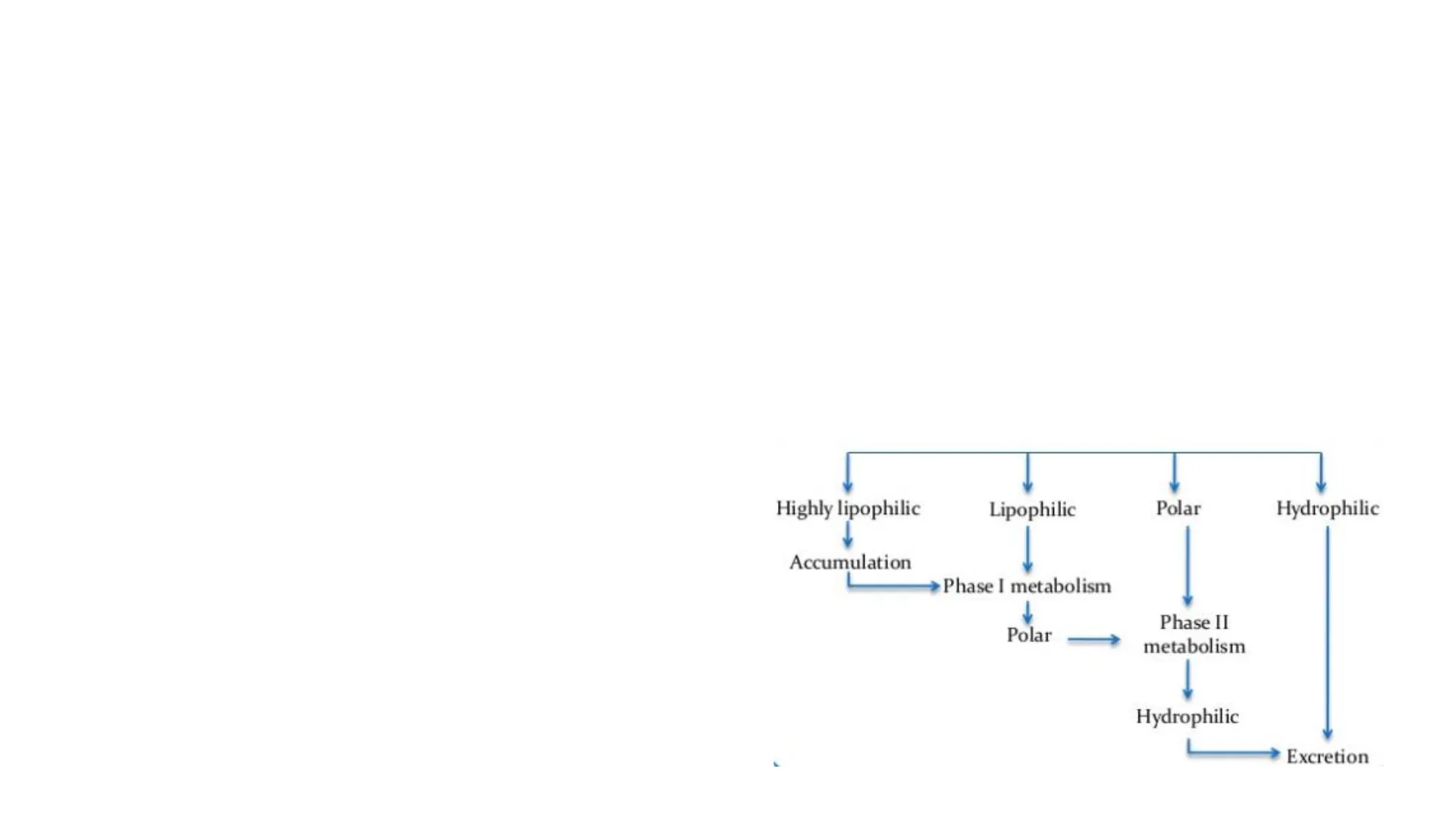
· Ultimate goal is to convert lipophilic substances into more polar and hence more excretable metabolites. . This reduces exposure to potential toxicity. Results of transformation :-
- More polar metabolite created - ionisable group added
- Mol. wt and size often increased
- Excretion facilitated
- Elimination increased
Highly lipophilic Lipophilic Polar Hydrophilic Accumulation 1 Phase I metabolism Polar Phase II metabolism 1 Hydrophilic L Excretion
Consequences of Drug Metabolism
. The liver - primary importance for most drugs because :- - Compounds absorbed from the GIT pass through the liver before entering the circulation - High levels of drug metabolising enzymes · Biological half-life is decreased · Duration of exposure is reduced . Accumulation in the body is avoided · Biological activity may be changed . Duration of the biological activity may be affected
Drug Oxidation (Cytochrome P450's) Conjugation (Glucuronidation etc.) Conjugation Metabolite Stable Adducts Polar Species Non-polar Species Renal Elimination (Urine) Biliary Elimination (Stool)
Steps of Metabolism
· Phase I - Introduction of a functional group · Increases polarity · Creates site for conjugation reaction · Phase II - Conjugation of a hydrophilic group . Increases solubility · Enhances elimination Excretion to bile or plasma ConjugationPhase 2 Transferase A B Phase 1 Oxidation P-450 B C
Enzymes Involved in Phase I
. Hepatic mixed function oxygenase (MFO) system :- Cytochrome P450, FMO. . Other phase I enzyme system :- alcohol dehydrogenase, xanthine oxidase (uric acid synthesis), monoamine oxidase (5-HT, noradrenaline) . For drug metabolism, cytochrome P450 families 1-4 are the most important - CYP1; CYP2; CYP3; CYP4 . Remember that MFOs have endogenous substrates as well!
Role in Steroidogenesis
cholesterol 1 CYP11A1 CYP21A2 CYP11B2 pregnenolone progesterone +11-deoxycorticosterone - ++ aldosterone CYP17A1 CYP17A1 CYP21A2 CYP11B1 17OH-pregnenolone - 17OH-progesterone 11-deoxycortisol + cortisol CYP17A1 CYB5 CYP19A1 DHEA androstenedione testosterone estradiol · CYP17A1 - 17,20 desmolase - Prostate target · CYP19A1 - aromatase - Breast target
Cytochrome P450 Structure and Function
· Haemoproteins - (apoprotein with a heme prosthetic group) . Located in the membrane of the endoplasmic reticulum · Act in concert with electron donors · NADPH reductase · Cytochrome b5 reductase · Movement of charge and electrons across the complex is vital for the catalytic site to function.
Cytochrome P450 NADPH PO P450 NADP+ + ++ Fe F+ FAD FMN POR CYBS Reductase Cytochrome P450 NADPH+H+ FAD FMNH2 Heme R-OH O2 NADP+ 4 FADH2 FMN H2O Heme -O. R-H ER membrane
P450 Catalytic Cycle
NADPH -> FAD -> FMN CPR H2O 1 e RH III III II Fe Fe 1 1 2 Cys S S S ROH* 3 0 2H+ (2-) 0 RH IV + 5 Fe Fe 1 S S e H2O NADPH -> FAD -> FMN CPR O2 6 O-OH RH RH III III Fe S RH RH Fe -Cytochromes P450 · Different enzymes have different substrate specificities
CYP2E1 and Substrate Specificity
CYP2E1 Ethanol Acetaldehdye CYP2E1 Paracetamol Hepatotoxic metabolite CYP2C10 Tolbutamide Excreted metabolites · Substrate specificity is determined by access to the catalytic site
Cytochrome P450 3A4
· Most abundant P450 in human liver . >50% of drugs in clinical usage today, that are oxidised, are substrates
CYP3A4 Substrates, Inhibitors, and Inducers
Substrates Inhibitors Inducers CYP3A4 Midazolam Atorvastatin Felodipine Ritonavir Ketoconazole Grapefruit juice Rifampin Carbamazepine Phenytoin varies H2O H2O CHCH2 co1 (CH ) CH3 CO2(M2); CHCH 2 0=umm 5-0-2mm S THIOLATE Na
Phase I Reactions
· RH + O2 + NADPH + H+ -+ ROH + H20 + NADP+ · CH3CH2OH - CH3CHO - CH3COOH . Oxidation - the most common metabolic reaction, including hydroxylation and dealkylation.
OH 1 OH N. R N R R R R R R OH HO R R- -R ROR R R para position usually favoured OH OH R -= R R R' O R R R R R R R CYP450 enzymes R- 4 - R OH 'R' R S
Codeine Metabolism by CYP3A4 and CYP2D6
CYP3A4 Codeine CYP3A4 CYP2D6 5-15% Morphine* UGT2B7 UGT2B7 60% UGT1A1 50-70% Morphine-3-glucuronide UGT2B7 5-10% UGT1A1 Morphine-6-glucuronide* Normorphine CHON 3 6 C CH3O OH 1 Codeine CH3N 3 6 HO OH Morphine 10-15% Norcodeine Codeine-6-glucuronide Codeine metabolism CYP2D6 P450 (2D6)
Phase I Reduction Reactions
. Reduction - less common than oxide reactions - microsomal enzyme system reactions. · Warfarin - ketone gp to a hydroxyl gp · Chloramphenicol - nitro gp to amine gp
O HO H OH HỌC CH3 OH H2C CH3 H H + O O R(+)-Warfarin R,S (*)-Warfarin R.R(+)-Warfarin NO2 NH2 [+H] HOCH O I HOCH2CHNHCCHCI2 HOCH O 1 HOCH2CHNHCCHCI2 Chloramphenicol Chloramphenicol reduction product H OH OH H2C H 0
Phase II Enzymes and Conjugation
· Conjugation reaction relying on a 'handle' i.e. a reactive group to form a inactive and readily excretable compound · Addition of a conjugate increases hydrophillicity
- Glucuronic Acid
- Sulphate
- Amino acids (Gly)
- Glutathione (Glu-Gly-Cys)
- Acetylation
· Multiple different enzymes involved · Drug metabolite should now be polar enough to be excreted via urine/faeces
Phase II Metabolism Substrates and Products
· Wide range of substrates and end- products
Phenols Alcohols Hydroxylamines O-glucuronides Hydroxamic acids Carbamoyls Carboxylic acids Electrophilic carbon atoms Glutathione Thiophenols S-glucuronides Thiols Carboxylic acids Carbamic acids Amino acid Glucuronidation Aromatic amines Catechols Aromatic amides Amines Methylation N-glucuronides Thiols Conjugation Sulphonamides Amines Carbamates Hydroxylamines Acetylation Ethynillic carbons C-Glucuronides C2 carbon of 1,3-dicarbonyl compounds Phenols Amines Alcohols Sulphation Hydroxylamines Hydroxylamines Thiocarbamates
Phase II Reactions: Glucuronidation
· Glucuronidation - common conjugation reaction for a wide range of substrates. Involves transfer of activated form of glucuronic acid - paracetamol
COCH2 HN 19029160 0 O 0 OH HO HO H HO D Active site - M D Phospholipid bilayer D = Drug M M D in cytosol D in cytosol M MS MS = Metabolite-sulfate conjugate COCH3 HN P450 UPDGT Cytochrome P450 Active site MGA Paracetamol (4.142) M = Metabolite MGA = Metabolite-glucuronide conjugate UDPGT - Uridine Diphosphate Glucuronosyltransferase MS
Glucuronidation Reaction Mechanisms
· Glucuronidation reactions
COOH RJ R R. CH RFC-CH,-C H R .- C-OH CH, R R R. R-C-OH -OH ØN-OH H Uridine-5 -diphospho-D-glucuronic acid UDP-Glucuronosyltransferases COOH Gluc-O- Gluc-O-N. NO-C-R. CH, R2 H Gluc-S-R Gluc-N-CH: Ra R.C-CH-C-R2 OH OH H R, CH, Gluc-O-C-R Gluc Gluc-N OH R-SH R _N-H CH-N R .- 0 R- OH R- = H R Gluc - NER, H Uridine diphosphate
Sulphation and Glutathione S-transferase
· Sulphotransferase
NH 3'-Phosphoadenosine a) R b) R1 c) R d} R1. 5 -phosphosulfate (PAPS) N OH CH-OH R > N- H R2" 0 0 0 "O-S-O-P-O Sulfotransferases 0 0- 0 OH NH, R R1 HO -o-so; EN-so, Y R1. 0-P-O SCH-O-SO; R2 0 OH Adenosine 3", 5'-bisphosphate HO
· Glutathione S-transferase
SH S-R -R S-R HẸN NH COOH H.N NH COOH (2), (3) (4) NH + R-X (1) OH 0 COOH 0 COOH Electrophilic substrate 0 Glutathione Glutathione S-conjugate Cysteine S-conjugate Mercapturic acid excretion into bile H,N H.C WH 1 R3- R2 RI EN-O-SO3 OH O N EN-OH R2
Sequential Reactions in Drug Metabolism
. Many drugs undergo sequential phase I and then phase II e.g. - Aspirin - salicylic acid - glucuronide conjugate
UDP-glucuronide COOH COOH OCOCH3 OH Phase 1 Aspirin Salicylic acid Phase 2 COOH UDP Glucuronide phase 1 metabolism phase 2 metabolism H3C CYP HO glucuronidation R. O epoxide hydrolase HO R OH CYP R R S-G GSH R GST OH
Can’t find what you’re looking for?
Explore more topics in the Algor library or create your own materials with AI.
