Alkanes: Structure, Properties, and Environmental Impact of Combustion
Document from University about Alkanes. The Pdf explores alkanes, saturated hydrocarbons, detailing their structure, properties, and combustion reactions, including environmental impacts. This Pdf, useful for University-level Chemistry, includes explanatory diagrams and comparative tables.
See more15 Pages

Unlock the full PDF for free
Sign up to get full access to the document and start transforming it with AI.
Preview
Alkanes
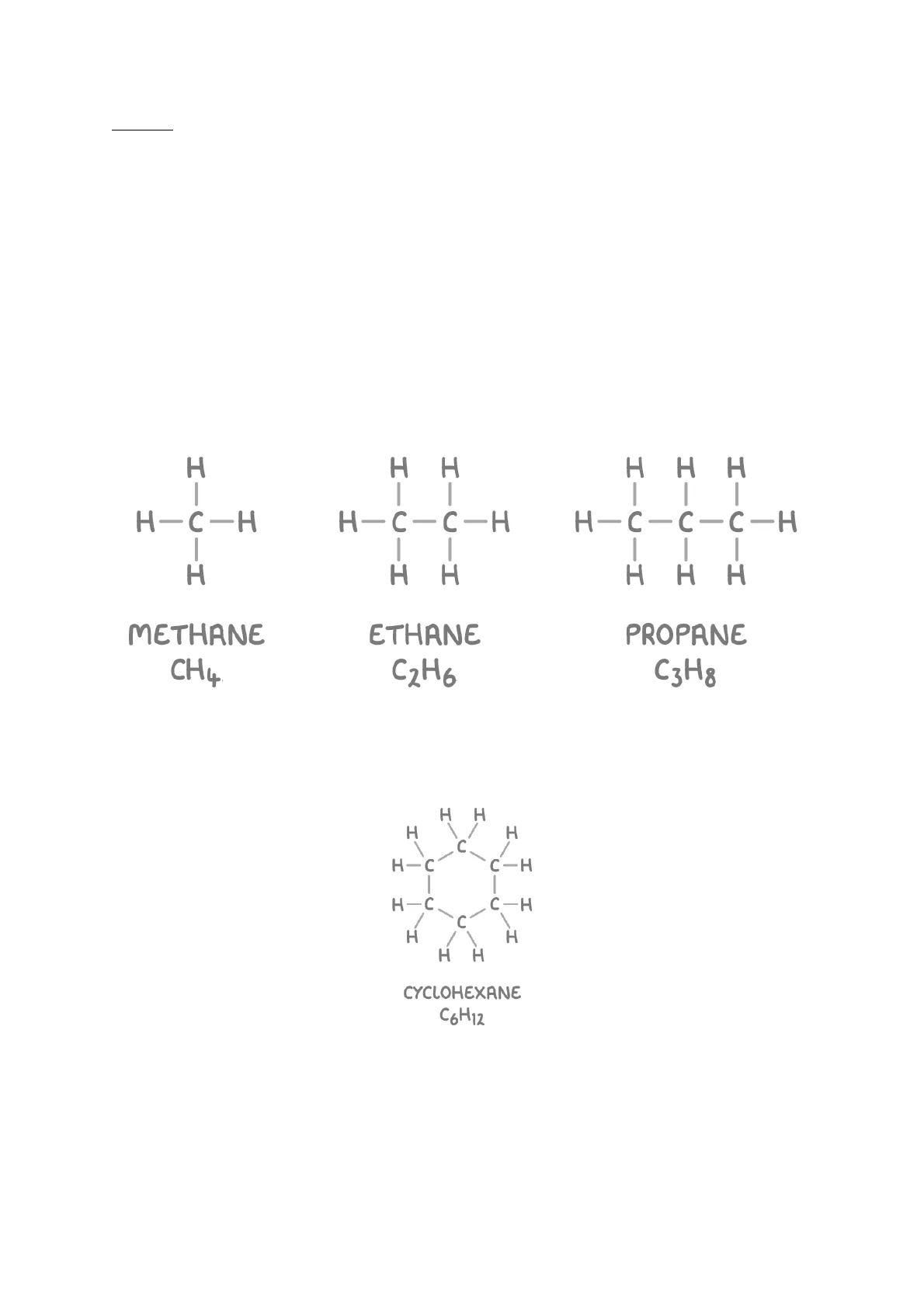
Alkanes are saturated hydrocarbons Alkanes are a class of hydrocarbons that have the general formula CnH2n+2, where 'n' represents the number of carbon atoms.
Key Features of Alkanes
- They consist solely of carbon and hydrogen atoms (thus called hydrocarbons).
- Each carbon atom forms four single bonds.
- They are fully "saturated" with hydrogen, meaning they contain no double or triple bonds.
Examples of Alkanes
H-C-H I HH I-U-I HH -U- I METHANE CH4 ETHANE C2H6 HHH H-C-C-C-H HHH PROPANE C3H8
Cycloalkanes
Cycloalkanes are a type of alkane in which the carbon atoms form a ring structure. Their general formula is CnH2n, where 'n' is the number of carbon atoms in the ring. Despite the ring structure, cycloalkanes remain saturated.
H H 1 / H 1 C / H-C -C-H I H-C. C-H C H 1 H H H CYCLOHEXANE C6H12
Tetrahedral Geometry of Carbon
In alkanes, each carbon atom has:
- Four bonding pairs of electrons.
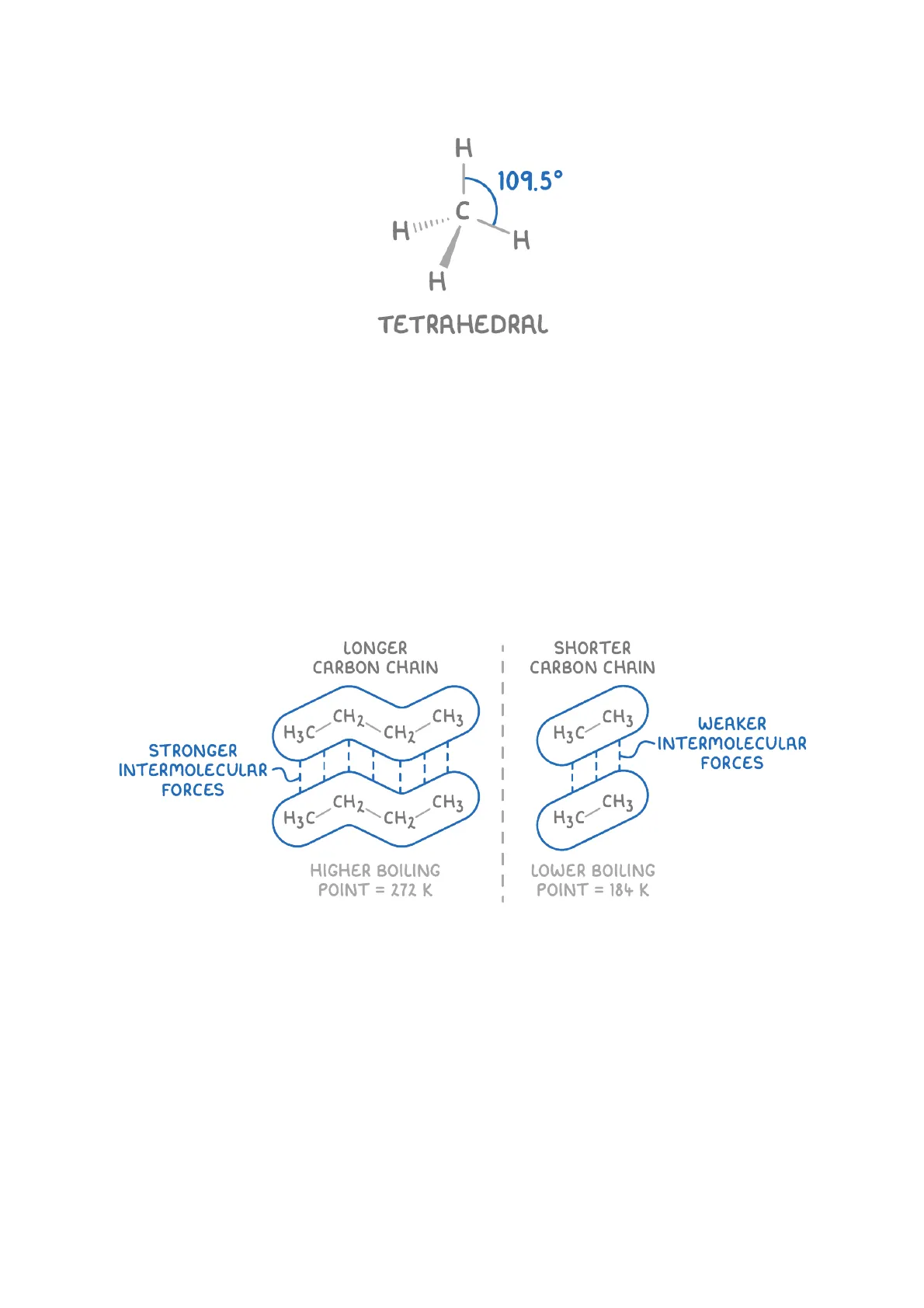
- These electron pairs are arranged in a tetrahedral geometry due to the equal repulsion the electron pairs.
H I H H· The bond angles are approximately 109.5°. H 109.5° H H H TETRAHEDRAL Methane (CH4) is a prime example, forming a perfect tetrahedral shape.
How Structure Affects Boiling Points
The boiling point of an alkane is influenced by the strength of its intermolecular induced dipole- dipole forces, which vary based on the length of the carbon chain and the extent of branching.
1. Carbon Chain Length
- A longer carbon chain means more electrons are present, creating stronger temporary inducible dipoles.
- These stronger dipoles result in stronger induced dipole-dipole forces between molecules.
- Consequently, more energy is needed to overcome these forces and boil the alkane.
LONGER CARBON CHAIN CH3 1 H3C STRONGER INTERMOLECULAR FORCES CH3 H3C- CH2-CH2 HIGHER BOILING POINT = 272 K SHORTER CARBON CHAIN H3C-CH3 WEAKER INTERMOLECULAR FORCES 1 H3C-CH3 LOWER BOILING POINT = 184 K The example above shows that butane (C4H10) has a higher boiling point than ethane (C2H6) due to butane's longer chain which contains more electrons, creating stronger intermolecular forces.
2. Branching
- Straight chain alkanes can pack together more closely, maximising interaction between their electron clouds. Conversely, branched alkanes have a less efficient packing, reducing electron cloud contact.
- This leads to stronger induced dipole-dipole forces in straight chain alkanes.
- Therefore, more energy is required to separate these molecules.
CH2- CH2STRAIGHT CHAIN BRANCHED CHAIN GREATER SURFACE CONTACT - CH3 SMALLER SURFACE CONTACT CH H3C CH3 WERKER INTERMOLECULAR FORCES CH3 1 CH H3C CH3 HIGHER BOILING POINT = 272 K CH3 H3C- CH2-CH2 STRONGER INTERMOLECULAR FORCES CH3 H3C- CH2- CH2 LOWER BOILING POINT = 261 K The example above shows that butane has a higher boiling point than its branched isomer, methylpropane due to butane's straight chain, which allows for greater surface contact between molecules, creating stronger intermolecular forces.
Fractional Distillation of Crude Oil
Crude Oil is a Mixture of Hydrocarbons
Crude oil, also known as petroleum, is a complex mixture of hydrocarbons extracted from underground oil reservoirs. The main components are alkanes, which are saturated hydrocarbons consisting of carbon and hydrogen atoms in straight chains. Crude oil contains alkanes ranging from small molecules like pentane (C5H12) to larger alkanes over 50 carbons long. The varying lengths of the alkane chains result in a broad range of boiling points in crude oil, from 162℃ to more than 350℃. This range of boiling points is crucial for the separation of crude oil into different components by fractional distillation.
Fractional Distillation Process
Fractional distillation is a technique used to separate hydrocarbon components of crude oil based on their boiling points. The process involves heating crude oil to about 350℃ in a furnace, causing it to vaporise. The vaporised components are then separated by their ability to condense at different temperatures in a tall column known as a fractionating column.
FRACTIONATING COLUMN TRAY FURNANCE 350℃ CRUDE OIL This technique is effective because the various hydrocarbon components have different boiling points related to their chain lengths. As the vapour mixture rises and cools in the column, fractions with higher boiling points condense first, while heavier residues remain at the bottom.
How Fractional Distillation Works
The key steps in fractional distillation are:
- Crude oil is heated to above 350℃ in a furnace to vaporise the hydrocarbon mixture.
- These vapours enter a fractionating column that has higher temperatures at the bottom (~350℃) and lower temperatures near the top (~40℃).
- As the hot vapours rise through the column, they cool down. When the vapour temperature drops below the boiling point of a hydrocarbon in the mixture, it condenses from gas to liquid on the tray surface.
- The condensed hydrocarbon liquids that accumulate on each tray are drawn off at specific intervals as fractions (mixtures of hydrocarbons with similar boiling points).
3. VAPOURS COOL AND CONDENSE COOLER 4. FRACTIONS DRAWN OFF HOTTER 1. CRUDE OIL VAPORISED 2. VAPOURS ENTER AND RISE UP COLUMN The smallest hydrocarbons, with the lowest boiling points, do not condense at all and remain as gases at the top. Larger molecules, over 50 carbons, have the highest boiling points and condense near the bottom of the comumn to form a tar-like residue.
Key Properties of Fractions
The separated fractions exhibit consistent trends in key properties as you move down the fractionating column, which makes them suitable for specific uses.
- LOW BOILING POINT
- LOW VISCOSITY
- HIGH FLAMMABILITY
- HIGH BOILING POINT
- HIGH VISCOSITY
- LOW FLAMMABILITY
Boiling point - The boiling point increases progressively down the column as the alkane chain length increases in each successive fraction. The lightest gases boil below 0℃, while the undistillable residue requires temperatures over 500°C. Viscosity - Viscosity steadily increases as you move down the column. Very light distillates, like gasoline or jet fuel, flow freely. Heavier fractions collected towards the bottom demonstrate progressively higher viscosities. Flammability - Flammability decreases down the fractionating column. Light gases and short- chain hydrocarbons at the top ignite readily, making them excellent fuels due to their high flammability and volatility. In contrast, heavy fractions and long-chain hydrocarbons at the bottom are less flammable and volatile, making them harder to combust and less suitable as fuels.
Main Fractions and Uses
The table below summarises the main fractions obtained from crude oil and their uses:
Fraction Number of carbon atoms Uses Gases 1 - 4 Liquefied petroleum gas (LPG), camping gas Petrol (gasoline) 5 - 12 Fuel for vehicles Naphtha 7 - 14 Petrochemical feedstock
Fraction Number of carbon atoms Uses Kerosene (paraffin) 11 - 15 Jet fuel, heating fuel Gas Oil (diesel) 15 - 19 Diesel engines, heating Mineral Oil 20 - 30 Lubricants Fuel Oil 30 - 40 Ships, power stations Wax, Grease 40 - 50 Candles, lubricants Bitumen 50+ Roofing, roads
Industrial Cracking
Meeting Demand Through Cracking
The process of refining crude oil by fractional distillation yields varying amounts of hydrocarbons. This produces larger quantities of long-chain hydrocarbons like bitumen, and smaller quantities of short-chain hydrocarbons, such as petrol, diesel, and naphtha. There is a higher demand for short-chain hydrocarbons than for long-chain hydrocarbons. This is because they are more efficient as fuels and serve as crucial chemical feedstocks for producing in-demand consumer products, including plastics, fabrics, and packaging materials. To balance this demand, the heavier, less useful fractions are converted into smaller, more valuable molecules through a process called cracking.
Cracking Breaks Long-Chain Alkanes Down
Cracking is a key process that involves breaking the carbon-carbon bonds in larger alkane chains to form smaller alkenes and alkanes. It is a type of thermal decomposition reaction. For instance: Decane -> octane + ethene C10H22 -> C8H18 + C2H4
Key Points of Cracking
- Cracking transforms less useful long-chain alkanes into more valuable smaller hydrocarbons.
- The point at which the chain breaks is random, leading to a variety of product combinations.
- Cracking is also essential for producing alkenes, which are used in manufacturing plastics and polymers.
Thermal and Catalytic Cracking
Two principal methods of cracking exist:
- Thermal cracking
- Catalytic cracking
1. Thermal Cracking
- Thermal cracking operates at very high temperatures (approximately 1,000℃) and pressures (about 70 atm).
- This process generates a high yield of alkenes, which are vital for creating numerous valuable products.
- For example, ethene, a common product of thermal cracking, can be polymerised to manufacture polyethene, a widely-used plastic.
2. Catalytic Cracking
- Catalytic cracking employs a zeolite catalyst (a hydrated aluminosilicate mineral) and requires moderate temperatures (around 450℃) and pressures than thermal cracking.
- This process primarily produces aromatic hydrocarbons and fuels for vehicles. Aromatic hydrocarbons contain highly stable benzene rings with delocalised electrons.
Catalyst Efficiency in Cracking
Catalysts enhance the efficiency of the cracking process in two ways:
- They allow for lower temperatures and pressures, reducing energy consumption and production costs.
- They increase the rate of reaction, enabling faster production of desired products.
Comparison of Cracking Methods
The table below compares the conditions and products of thermal and catalytic cracking:
Thermal cracking Catalytic cracking Conditions High temperature (around 1,000℃) / High pressure (up to 70 atm) Moderate temperature (around 450°℃) / Slightly above atmospheric pressure Products Primarily alkenes / Used in polymer production Aromatic hydrocarbons / Fuels for transportation
Combustion of Alkanes
Alkanes are Generally Unreactive
Alkanes are relatively unreactive due to their non-polar nature and their strong covalent bonds. The electronegativity difference between carbon and hydrogen in alkanes is minimal, leading to an almost equal sharing of electrons and no significant partial charges. This makes it difficult for alkanes to attract nucleophiles or electrophiles. However, alkanes do undergo certain reactions, including:
- Combustion - The reaction of alkanes with oxygen to release energy.
- Substitution - The replacing of H atoms with halogens in the presence of light.
Combustion Reactions of Alkanes
Alkanes serve as efficient fuels, releasing a significant amount of energy when burnt. They are used in various applications such as power generation, heating, and transportation due to this property. Alkanes can undergo two types of combustion reactions: complete and incomplete, depending on the oxygen availability.
Complete Combustion of Alkanes
When there is an ample supply of oxygen, alkanes combust completely, forming carbon dioxide and water vapour as products. For instance, the complete combustion of methane (CH4) is represented by the following equation: CH4(g) + 202(g) => CO2(g) + 2H20(g)
Key Points of Complete Combustion
- Alkanes in their liquid state must be vaporised before combustion.
- Smaller alkanes, due to their lower boiling points, vaporise and thus combust more readily.
- Larger alkanes have more chemical bonds, hence when combusted, they release more energy per mole, making them better fuels.
Incomplete Combustion of Alkanes
When the oxygen supply is limited, alkanes undergo incomplete combustion, leading to the formation of carbon monoxide and water vapour. For example, incomplete combustion of methane (CH4) can be represented by the following equation: CH4(g) + 3/202(g) => CO(g) + 2H20(g) Incomplete combustion may also lead to the production of solid carbon (soot) and the release of unburnt hydrocarbons into the atmosphere.
Can’t find what you’re looking for?
Explore more topics in the Algor library or create your own materials with AI.
