Pain: Perception, Sensation, and Neural Pathways
Slides from Professor Arthur Butt about Pain. The Pdf explores the perception and neural transmission of pain, covering sensory receptors, pain types, and spinal cord mechanisms. This University Biology material, produced by Professor Arthur Butt, is a valuable resource for understanding pain control circuits and opioid action.
See more23 Pages

Unlock the full PDF for free
Sign up to get full access to the document and start transforming it with AI.
Preview
Professor Arthur Butt
Structure of Lecture
- Introduction
- Pain: Perception and Sensation
- The Pain Pathway
- The Analgesic Ladder
- Opioid Analgesics
Sensory system
Discussion Point: Nervous System Reactions to Pain
Discussion Point: Consider the following and explain the reactions of the nervous system to the sensations of pain.
Man gets out of a car. As he placed his foot down on a sharp object, he shrieked with pain and moved his foot up reflexively.
Consider the Following
- the concept of action potential and the negative charge on the inside of the membrane.
- how this electrical impulse is distinguished as painful, compared to, for example, normal pressure.
- the frequency and pattern of action potentials constitute a code for information transfer by neurons.
Sensory Receptors
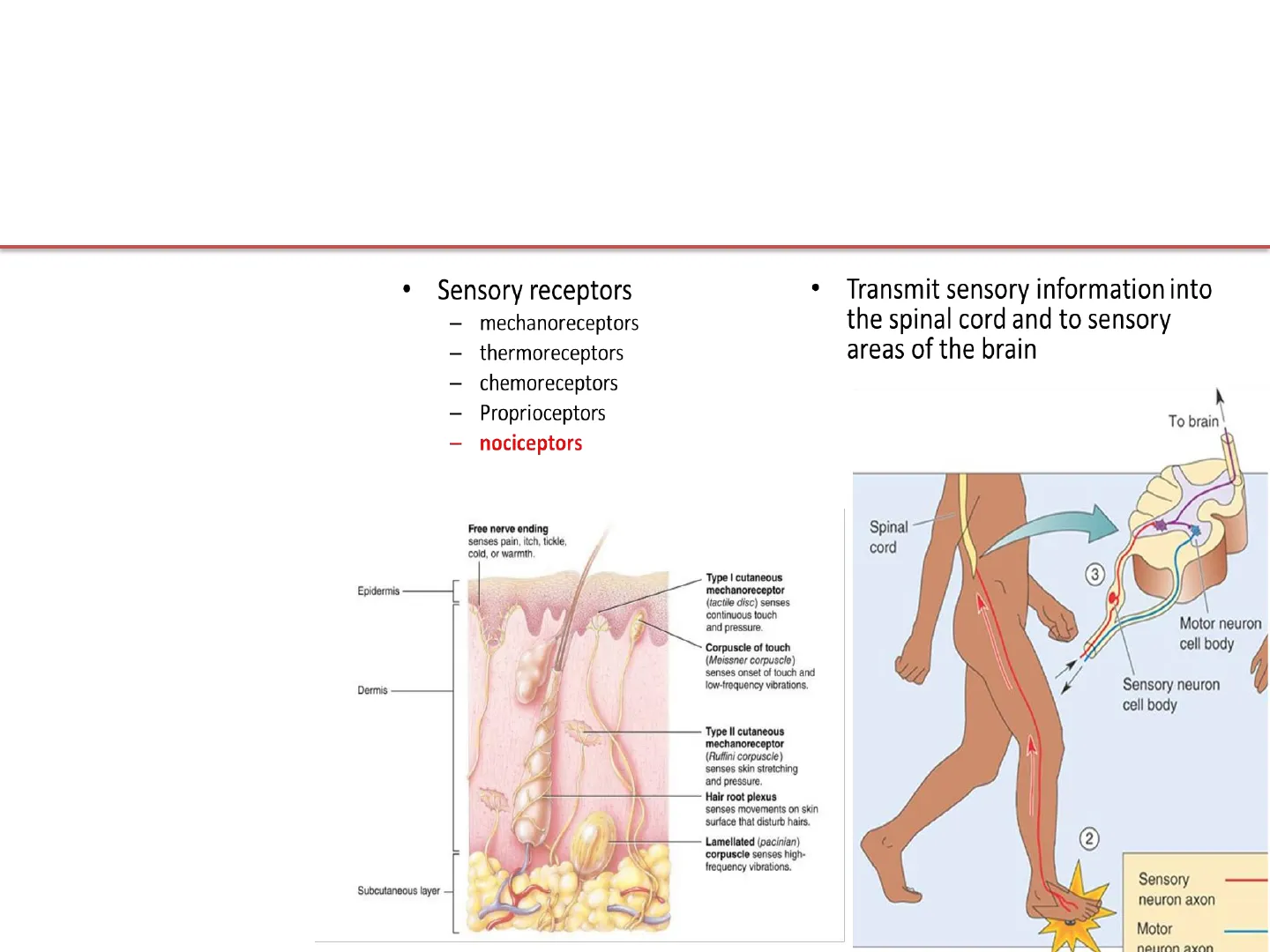
- Sensory receptors
- mechanoreceptors
- thermoreceptors
- chemoreceptors
- Proprioceptors
- nociceptors
Free nerve ending senses pain, itch, tickle, cold, or warmth.
Epidermis
Type I cutaneous mechanoreceptor (tactile disc) senses continuous touch and pressure.
Dermis
Corpuscle of touch (Meissner corpuscle) senses onset of touch and low-frequency vibrations.
Sensory neuron cell body 2
Subcutaneous layer
Type II cutaneous mechanoreceptor (Ruffini corpuscle) senses skin stretching and pressure.
Hair root plexus senses movements on skin surface that disturb hairs.
Lamellated (pacinian) corpuscle senses high- frequency vibrations.
- Transmit sensory information into the spinal cord and to sensory areas of the brain
To brain Spinal cord 3
Motor neuron cell body
Sensory neuron axon
Motor neuron axon
Pain: Perception & Sensation
- Pain = perception
- subjective response
- to a noxious stimulus
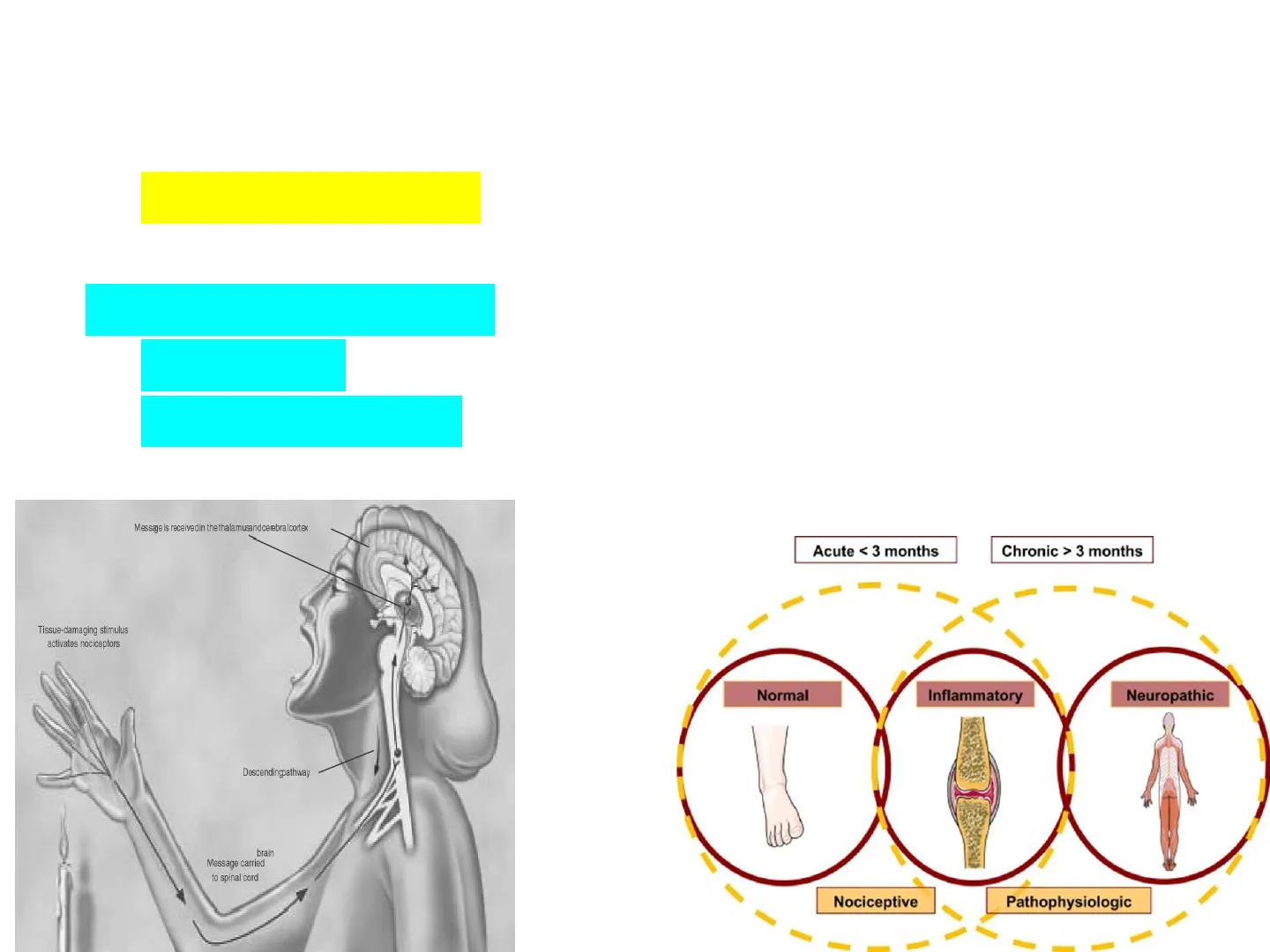
- Sensation = nociception
- Nociceptors
- free nerve endings
Message is receivedin the thalamusandcerebralcortex
Tissue-damaging stimulus activates nociceptors
Descendingpathway brain
Message carried to spinal cord
Different Kinds of Pain
- DIFFERENT KINDS OF PAIN:
- Acute (physiological)
- Inflammatory (pathological)
- Neuropathic
Acute < 3 months Chronic > 3 months
Normal Inflammatory Neuropathic Nociceptive Pathophysiologic
Acute (Physiological) Pain
- Acute pain is a physiological response that warns us of danger.
- Nociception - normal processing of pain and the responses to noxious stimuli that are damaging or potentially damaging to normal tissue.
To brain Spinal cord 3
Motor neuron cell body
Sensory neuron cell body 2
Sensory neuron axon
Motor neuron axon
Inflammatory Pain
Inflammatory Pain
Tissue damage release of inflammatory mediators such as prostaglandins and bradykinin increase the sensitivity of nocipetors to noxious stimuli
Sensitization in the pain pathway hyperalgesia - hypersensitivity to a noxious stimulus (hypersensitive nociceptors) allodynia - pain that results from a non-noxious stimulus (low-threshold mechanoreceptors and thermoreceptors)
NSAIDs reduce production of prostaglandins
Mas cell
Substance P Histamine
Ventral
Promotes swelling
Dorsal root ganglion
Serotonin K+
Action potential
Prostaglandins Leukotrienes
Action potential
Dorsal
Spinal cord
Skin
Blood vessel
Substance P
Damaged cells release substances that excite nerve endings.
Action potentials can reflexively excite blood vessels and other cells to produce inflammation.
Information enters spinal cord.
Pain fibers release substance P and glutamate.
Neuropathic Pain
Peripheral neuropathic pain Postamputation pain (stump and phantom pain) Trigeminal neuralgia Painful radiculopathy Postherpetic neuralgia Painful polyneuropathy Peripheral nerve injury pain
Central neuropathic pain Central post-stroke pain
Neuropathic Pain is caused by damage or injury to the nociceptive nerves - peripherally or centrally.
The pain is usually described as a burning sensation and affected areas are often sensitive to the touch.
Spinal cord injury neuropathic pain (at- and below level pain)
Central pain in multiple sclerosis
Nociceptors
- Nociceptors are free nerve endings in the ski
- Many stimuli have been found to activate ion channels present on nociceptor terminals
- Act as molecular transducers to depolarize these neurons
- Thereby setting off nociceptive impulses along the pain pathway:
- Blocked by local anaesthetics, e.g. lidocaine
Nociceptors in Skin
Ventral
Epidermis
Free nerve endings
Dermis
Dorsal
Dorsal Spinal cord
root ganglion
Receptor activated
Peak ~+40
Membrane Voltage (mV)
0
Rising Phase Falling Phase
Threshold ~- 55
Failed Initiations
Resting Potential ~- 70
Undershoot
Stimulus
0 1 2 3 4 5 Time (ms)
TOvershoot!
-
Na Na Na Na
Sodium channels OPEN
Na
TRPVI A A C N A
TRPV1 transient receptor potential cation channel vanilloid 1 (TRPV1) receptor - cation channel, activation results in sodium influx - activated by noxious heat, also low pH - leads to painful, burning sensation - sensitised by inflammatory agents
Clinical Significance of TRPV1 Antagonists
- Antagonists block TRPV1 activity, thus reducing pain
- TRPV1 antagonists have been developed - efficacy in reducing nociception from inflammatory and neuropathic pain models in rats
- In humans, major side-effect is hyperthermia restricted usefulness of these drugs
? N C No C
TRPV1 - noxious heat
TRPM8 (CMR1) - cold - TRP subfamily M member 8 (TRPM8) - cation channel - sodium influx in response to cold
Clinical Significance of TRPM8
- upregulated in patients with painful bladder syndrome
- may be a target in prostate cancer
ENaC/Degenerin family - mechanical stimuli - activated by mechanical stimuli
ASIC - acid sensing ion channel - belongs to the same family as ENaC - sodium channel activated by protons - acid
ASIC TRPM8 ENaC/DEG
Signal transductic nociceptors
CMRIASICS - Mamba Venom
Black mamba venom is 'better painkiller' than morphine
- Mamba venom is made up mostly of dendrotoxins (dendrotoxin-k, -1, - 3, and -7, among others)
- mambalgins - potent analgesic as strong as morphine - without most of the side-effects. - Block acid-sensing ion channels
a Venom
b C
Nter ASIC1a PH 5 Cter 200 nA Loop III 25 Å 60 s Loop Il Mambalgin-1
TTOGATO
Tech, Gadgets and Toys
Take two of these and call me in the morning.
Black mamba venom peptides target acid-sensing ion channels to abolish pain
Diochot et al. (2012) Nature
Students, explain your understanding of synapses. Discuss the direction of information flow between the presynaptic and postsynaptic neuron. At the end of the lecture. Is your understanding and knowledge of the process increased?
Loop |
The Pain Pathway
Frontal cortex
Cingulate cortex is especially activated by pain information.
Thalamic nuclei (e.g., ventral posterior, intralaminar, and parafascicular)
Forebrain
Pain information is distributed to many thalamic and cortical areas.
Periaqueductal gray
Midbrain
Reticular formation
Reticular formation
Brain stem sites control pain-related behavior such as vocalization.
Pons
Medulla
Pain information enters.
Anterolateral system: Neospinothalamic Paleospinothalamic
A8 and C fibers
Spinal cord
Perception of pain throughout the body arises when neural signals transmitted to specific higher order brain areas
- Cingulate Cortex mediates the emotional component of pain
SMA aMCC PAG
Descending Pain Control Circuit
Opiates decrease pain by modulating the descending pain pathway in a complex manner
SMA aMCC PAG
Opioids
Periaqueductal gray Nucleus raphe magnus Lateral tegmental nucleus
- Inhibitory synapse
- Excitatory synapse
Ad fiber
Serotonergic irenergic neuron
Enkephalin
S rgic neuron
E
Opioids
To spinothalamic tract
Pain Transmission in the Spinal Cord
Nociceptive axons synapse with second order neurons in lamina I, II, and V of the dorsal horn in the spinal cord
Transmission
- for moderate pain axons release glutamate, with fast action
- stronger pain: axons release glutamate and substance P (and ATP), with slower sustained actions
To brain Spinal cord 3
Motor neuron sell body
Sensory neuron cell body VII VII 2
Com
Sensory neuron axon
Motor nairon ayon
Na+ Channel TTX sensitive
Na+ Channel TTX resistant
G: glutamate SP: substance P ATP
SP ATP
G G
Ca2+ voltage gated Ca2+ channel
Glutamate NMDA AMPA
Pain Transmission in the Spinal Cord - Second Order Neurons
Nociceptive axons synapse with second order neurons in lamina I, II, and V of the dorsal horn in the spinal cord
Transmission
- for moderate pain axons release glutamate, with fast action
- stronger pain: axons release glutamate and substance P (and ATP), with slower sustained actions
Na+ Channel TTX sensitive
Na+ Channel TTX resistant
G: glutamate SP: substance P ATP
carbamazepine - NaCh
SP ATP
Ziconotide - conotoxin from cone snail
G G
Ca2+ voltage gated Ca2+ channel
Glutamate ketamine NMDA AMPA
Pain Transmission in the Spinal Cord - Inhibitory Interneurons
Nociceptive axons synapse with second order neurons in lamina I, II, and V of the dorsal horn in the spinal cord
Transmission
- for moderate pain axons release glutamate, with fast action
- stronger pain: axons release glutamate and substance P (and ATP), with slower sustained actions
Local inhibitory interneurons release GABA and glycine
Na+ Channel TTX sensitive
Na+ Channel TTX resistant
G: glutamate SP: substance P ATP
SP ATP
GABA Gly
G G
Ca2+ voltage gated Ca2+ channel
gabapentin
Glutamate pregabalin NMDA AMPA
Pain Transmission in the Spinal Cord - Descending Control
Nociceptive axons synapse with second order neurons in lamina I, II, and V of the dorsal horn in the spinal cord
Transmission
- for moderate pain axons release glutamate, with fast action
- stronger pain: axons release glutamate and substance P (and ATP), with slower sustained actions
Local inhibitory interneurons release GABA and glycine
Na+ Channel TTX sensitive
Na+ Channel TTX resistant
G: glutamate SP: substance P ATP
Descending pain control fibres release opioids to inhibit pain
SP ATP
GABA Gly
G G
Ca2+
Glutamate Encephalins NMDA AMPA
Descending Pain Control Circuit - Antidepressants
- Opiates decrease pain by modulating the descending pain pathway in a complex manner
Noradrenergic and Serotonergic Antidepressants - Tricyclics
- Treatment of neuropathic pain
- e.g. amitriptyline, doxepin, imipramine) inhibit reuptake of norepinephrine and serotonin
Periaqueductal gray Nucleus raphe magnus Lateral tegmental nucleus
- Inhibitory synapse
- Excitatory synapse
Ad fiber
Serotonergic renergic neuron
Enkephalin
S ergic neuron
E
To spinothalamic tract
Can’t find what you’re looking for?
Explore more topics in the Algor library or create your own materials with AI.
