Lecture 7: Inter-Korean Relations and North Korean Nuclear Crisis
Slides about Lecture 7, Post Midterm. The Pdf, a university-level document on History, delves into inter-Korean relations, North Korea's nuclear crisis, and its authoritarian control mechanisms, offering a comprehensive overview of the subject.
See more15 Pages

Unlock the full PDF for free
Sign up to get full access to the document and start transforming it with AI.
Preview
Moon Jae-in Administration and Inter-Korean Relations
Lecture 7, post midterm Moon Jae-in administration
- NK's 6th nuclear test
- Inter-Korean summit (April, 27 2018): "South and North Korea confirmed the common goal of realizing, through complete denuclearization, a nuclear-free Korean peninsula (not only from NK, actually SK doesn't have weapons but until the 90s there were few weapons in SK's territory, but they were American). South and North shared the view that the measures being initiated by NK are very meaningful and crucial for the nuclearization of the Korean Peninsula and agreed to carry out their respective roles and responsibilities in this regard. South and North Korea agreed to actively seek the support and cooperation of the international community for the denuclearization of the Korean Peninsula."
- Blowing up the NK nuclear test site on May 24, 2018, inviting CNN and BCC to report the event.
Moon's Pyongyang Speech
- Moon's Pyongyang Speech
Yoon Seokyul Administration and Inter-Korean Relations
- Yoon Seokyul administration
- Confrontation again
- Inter-Korean relations under New Cold War?
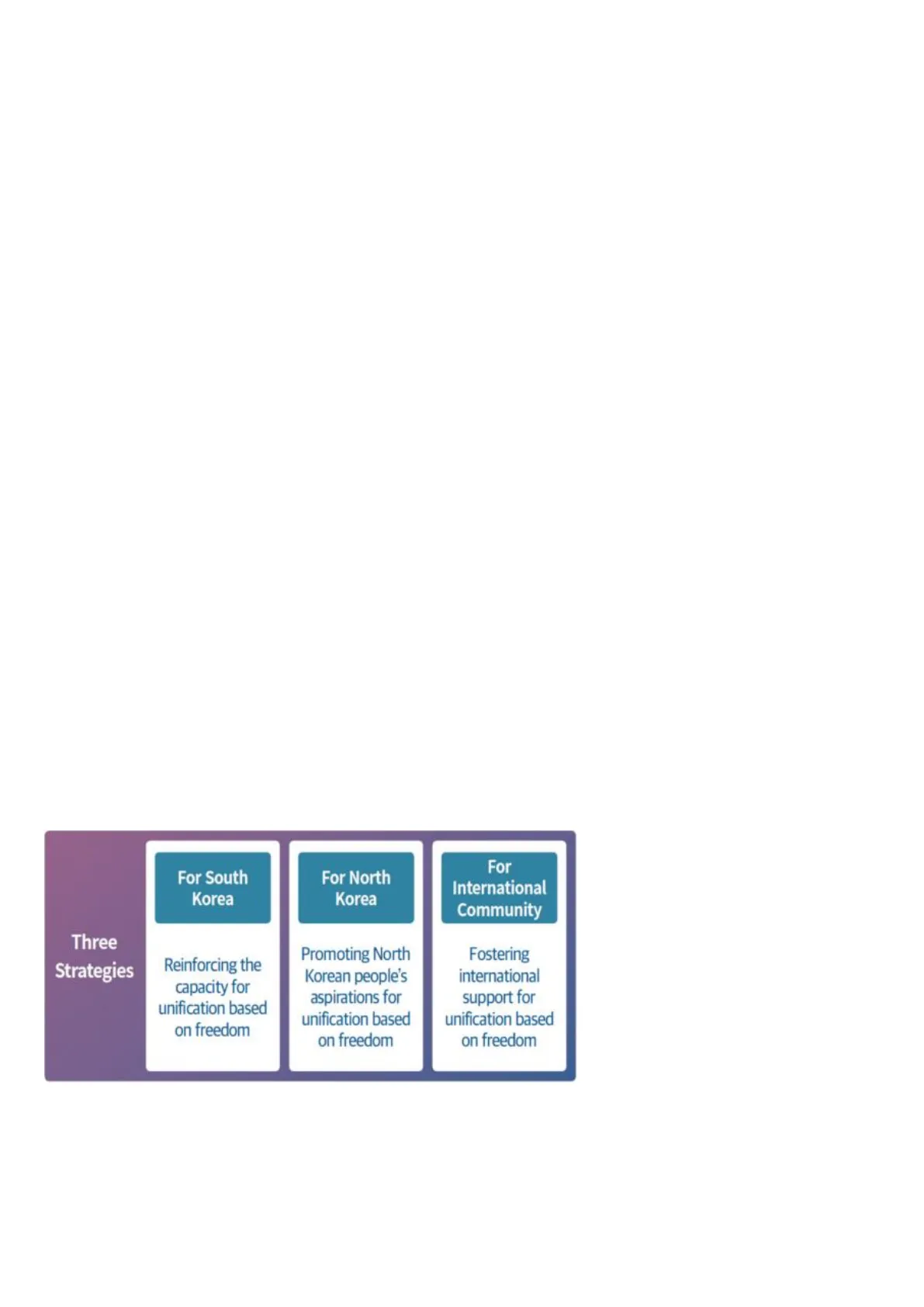
- 8.15 unification doctrine: a unified Korea based on freedom, peace and prosperity.
o o For South Korea: reinforcing the capacity for unification based on freedom. For North Korea: promoting North Korean people's aspirations for unification based on freedom. o For international community: fostering international support for unification based on freedom.
Panmunjom Declaration of April 27
South and North Korea confirmed the common goal of realizing, through complete denuclearization, a nuclear-free Korean Peninsula. South and North Korea shared the view that the measures being initiated by North Korea are very meaningful and crucial for the denuclearization of the Korean Peninsula and agreed to carry out their respective roles and responsibilities in this regard. South and North Korea agreed to actively seek the support and cooperation of the international community for the denuclearization of the Korean Peninsula.
8.15 Unification Doctrine (2024.8.15)
A Unified Korea based on Freedom, Peace, and Prosperity
- Announced on the 79th National liberation day
- Yoon administration emphasizes the key values of "freedom, peace, and prosperity"
- Emphasizes leading role of SK
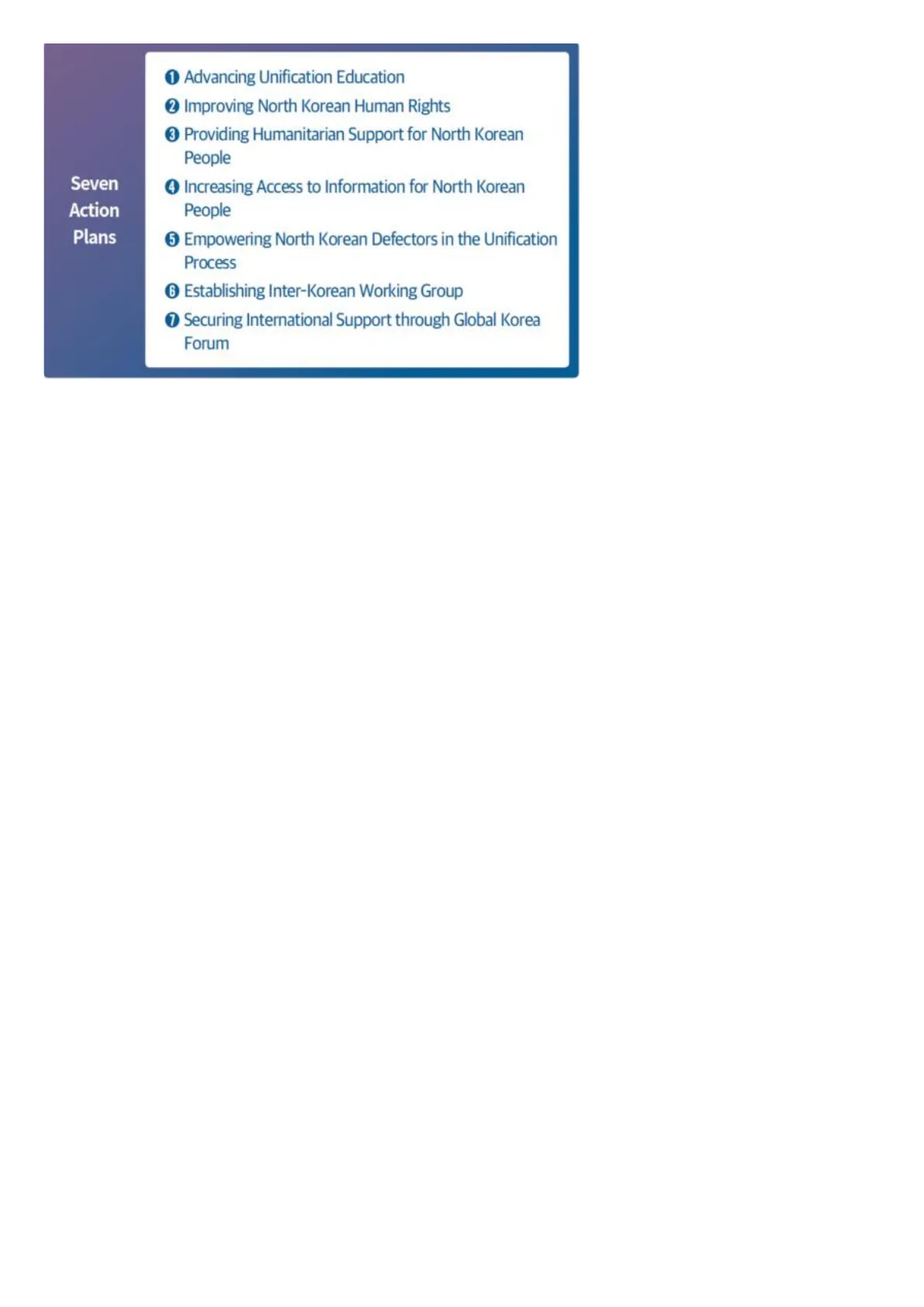
For South Korea For North Korea For International Community Three Strategies
Reinforcing the capacity for unification based on freedom Promoting North Korean people's aspirations for unification based on freedom Fostering international support for unification based on freedom1 Advancing Unification Education 2 Improving North Korean Human Rights 3 Providing Humanitarian Support for North Korean People Seven Action Plans 4 Increasing Access to Information for North Korean People 5 Empowering North Korean Defectors in the Unification Process 6 Establishing Inter-Korean Working Group 1 Securing International Support through Global Korea Forum
Inside North Korea
North Korea and the Korean War
Following World War II, Korea was split in 1945 with the northern half under Soviet-sponsored communist control. North Korea (DPRK) was established under the leadership of KIM Il-sung in 1948. North Korea invaded South Korea in 1950, but failed in the Korean War to conquer the US-backed South Korea. The Korean peninsula has been divided on the Military Demarcation Line (MDL) since the end of the Korean War in 1953. ( 휴 전 선 , Ceasefire Line). There is a Joint Security Area (JSA), a portion of the Demilitarized Zone (DMZ) where two Korean forces stand face-to- face.
North Korea in 1960s
North Korea adopted a policy of ostensible diplomatic and economic "Self-Reliance"(*|) as a check against outside influence by the Soviet Union and China. The policy of "Self-Reliance" started especially after the breakout of the Soviet-Chinese dispute since the mid-1950s. Kim Il-sung sought to consolidate its social system through the state-funded propaganda and dictator's control toolbox. North Korea was richer than South Korea until the late 1960s. However, decades of economic mismanagement and resource misallocation, particularly focus on the military industry had put its economy in trouble.
Kim Jong-Il and North Korea
Kim Jong-il was officially designated as his father's successor in 1980. Kim Jong-il had assumed a growing political and managerial role until his father's death in 1994. North Korea had gone through the period of "Arduous March" ( 고 난 의 행 군 ) in the second half of the 1990s. It was mainly due to the repeated floods and drought in addition to the mismanagement of the socialist economy. Since the "Arduous March", North Korea had faced chronic food shortages. More than 1 million people were reported to have starved to death.
North Korea in 2000s and Kim Jong-Un
North Korea began to ease restrictions to allow semi-private market, starting in 2002. (" 장 마 당 " , farmers' market) The North Korean economy has reportedly recovered since the early 2000s but still suffers from chronic food shortages. Kim Jong-un was publicly unveiled as his father's successor in 2010. After Kim Jong Il's death in 2011, Kim Jong-un quickly assumed power.
How to control the regime?
In the early 1990s, many observers predicted that Kim Ilsung's regime would not survive. When Kim Il-sung died, they also speculated that the regime would collapse soon. During the period of "Arduous March" in the mid-1990s, many predicted that the regime would not survive. After Kim Jong-il died in 2011, they believed that Kim Jong-un, 27 years-old leader, would not be able to save the regime. Many unification scenarios by the U.S. and South Korea are based on the regime collapse. The North Korean regime might have been threatened by popular revolution or by a military coup.
Pyongyang's Toolbox of Authoritarian Control
- Preventing revolution in North Korea: The North Korea regime rely heavily on security forces to prevent people's revolution.
- restrictive social policies: it prevent potentially hostile social classes from forming and create society's dependence on the state
- manipulation of ideas and information: it increases the regime's legitimacy and weaken that of potential opponents
- the heavy use of force: it deters or crushs potential resistance.
- Preventing coups against the Kim regime: Authoritarian regimes may be unseated in coup d'etat by members of the military or the government. To defuse the threat of coups d'etat, the North Korean leaders rely not only on those three tools, but also employ.
- Co-optation: the regime distributes political and economic rewards to the elites
- The manipulation of foreign governments: the regime uses external threats as a mean to legitimize the regime
- Institutional coup-proofing: the regime design institutions to reduce the chances of a successful coup
The North Korean Economy
North Korea is one of the world's most centrally directed and least open economies, facing chronic economic problems. Frequent weather-related crop failures aggravated chronic food shortages caused by on-going systemic problems. Infrastructure is nearly beyond repair as a result of years of underinvestment, shortages of spare parts, and poor maintenance. Large-scale military spending and development of its nuclear and missile program severely draws off resources needed for investment and civilian consumption. Industrial and power outputs have stagnated for years at a fraction of pre-1990 levels. Its agricultural problems include the shortage of arable land, collective farming practices, poor soil quality, insufficient fertilization, etc. The mid-1990s were marked by severe famine and widespread starvation.("Arduous March", 고 난 의 행 군 ) Significant food aid was provided by the international community through 2009. Since that time, food assistance has declined significantly, mainly due to the lack of transparency and the nuclear and missile provocations. A large portion of the population continues to suffer from prolonged malnutrition and poor living conditions. Since 2002, the government has allowed semi-private markets to begin selling a wider range of goods (0}}). It allowed North Koreans to partially make up for diminished public distribution system rations. It also implemented changes in the management process of communal farms in an effort to boost agricultural output. North Korea carried out a redenomination of its currency in December 2009. It capped the amount of North Korean won that could be exchanged for the new notes, and limiting the exchange to a one-week window. A concurrent crackdown on markets and foreign currency use yielded severe shortages and inflation. The North Korean government continues to stress its goal of improving the overall standard of living. However, it has taken few steps to make that goal a reality for its populace. The North's domestic agricultural production still falls far short of producing sufficient food to provide for its entire population.Firm political control remains the government's overriding concern. It likely will inhibit formal changes to North Korea's current economic system. The Kim family's regime survival is more important than economic development. During the Covid-19, since it didn't have the vaccine, it just decided to close the borders.
The North Korean Nuclear Crisis
Lecture 8 (ONLINE) The NK Nuclear Crisis
Deterrence by defense/denial: traditionally, states deterred attack by threatening to defeat the adversary's military forces, or by making attack to military costly. Deterrence by punishment: nuclear weapons make deterrence possible by threatening to inflict pain on the adversary's society. Few aggressors are willing to risk the costs of suffering nuclear strikes on their cities. Conventional defense becomes less important for deterrence.
- What happens when both sides have nuclear weapons?
- Second-strike capability: ability to retaliate with nuclear weapons even after absorbing nuclear first strike. Once a state possesses secure 2nd strike, it doesn't need to build up its nuclear arsenal. Mutual assured destruction (MAD): when both states secure 2nd strike capacity. How to get secure second-strike capability? Numbers, dispersal across multiple locations, create 'hard' targets.
States with Nuclear Capacity
31 States With the Capacity to Build Nuclear Weapons, but only 10 have done so
- Argentina
- Netherlands
- Austria . North Korea
- Belgium
- Norway
- Brazil
- Pakistan
- Canada
- Romania
- China
- Russia
- Czech Republic
- Serbia
- Denmark
- Slovakia
- Finland . South Africa
- France . South Korea
- Germany
- Spain
- Hungary
- Switzerland
- India
- Ukraine . Israel . United Kingdom
- Japan
- Latvia . United States
Timeline of the North Korean Nuclear Crisis
- 1989 Detection of DPRK nuclear program
- 1992 IAEA inspection and the issue of cheating
- Mar. 1993 DPRK withdrew from NPT (1st nuclear crisis)
- June 1994 Carter-Kim Il Sung's Pyongyang Deal
- Oct. 1994 Agreed Framework (Geneva)
- Oct. 2002 HEU program/The collapse of AF (2nd nuclear crisis)
- Jan. 2003 DPRK withdrew from NPT
- Sep. 2005 Six-party talks and 9.19 Joint Statement (Beijing)
- Oct. 2006 1st Nuclear test (UNSCR 1718)
- May 2009 2nd Nuclear test (UNSCR 1874)
- Feb. 2013 3rd Nuclear test (UNSCR 2094)
- Jan. 2016 4th Nuclear test (UNSCR 2270)
- Sep. 2016 5th Nuclear test (UNSCR 2321)
- Sep. 2017 6th Nuclear test (UNSCR 2375)
Can’t find what you’re looking for?
Explore more topics in the Algor library or create your own materials with AI.
