Human Pappiloma Virus (HPV): features, prevention, and STDs
Document from University about Human Papillomavirus (HPV). The Pdf explores HPV, its viral characteristics, and its link to cervical cancer, along with prevention strategies like vaccination and screening. It also analyzes the increase in STDs in Western Europe, focusing on risk factors and transmission modes, and describes Gonorrhea as a bacterial STD.
See more26 Pages


Unlock the full PDF for free
Sign up to get full access to the document and start transforming it with AI.
Preview
Human Papillomavirus (HPV) Overview
Lezione 12/12/2024 HUMAN PAPPILMA VIRUS (HPV) Human papillomavirus (HPV) is a group of viruses that are extremely common worldwide. There are more than 200 types of HPV, of which at least 14 are cancer-causing (also known as high- risk type). You consider that around 90-95% of people are positive to almost one strain of HPV because are very common and easily to spread. HPV is mainly transmitted through sexual contact and most people are infected with HPV shortly after the onset of sexual activity. The symptomatology potentially starts shortly, but in some cases the pathology is asymptomatic and this is the why the pathology spread easily.
Cervical Cancer and HPV Types
Cervical cancer is caused by sexually acquired infection with certain types of HPV. Two HPV types (16 and 18) cause 70% of cervical cancers and pre-cancerous cervical lesions. There is also evidence linking HPV with cancers of the anus, vulva, vagina, penis and oropharynx. Cervical cancer is the fourth most common cancer among women globally, with an estimated 570,000 new cases in 2018, but unfortunately the situation is increasing worldwide. Nearly 90% of the 311,000 deaths worldwide in 2018 occurred in low and medium-income countries (LMICs).
Cervical Cancer Control and Prevention
Comprehensive cervical cancer control includes primary prevention (vaccination against HPV), secondary prevention (screening and treatment of pre-cancerous lesions), tertiary prevention (diagnosis and treatment of invasive cervical cancer) and palliative care. The screening is the best way to prevent the consequences of the tumour. Vaccines that protect against HPV 16 and 18 are recommended by WHO and have been approved for use in many countries. Clinical trials and post-marketing surveillance have shown that HPV vaccines are safe and effective in preventing infections with HPV infections. Screening and treatment of pre- cancer lesions in women is a cost-effective way to prevent cervical cancer. Cervical cancer can be cured if diagnosed at an early stage and treated promptly.
Virus Characteristics
Virus features:
- Family > Papillomaviridae
- Genus > Papillomavirus
- Genome made with circular dsDNA, that is very small 8,000 bp
- Capsid > icosahedral, diameter 52-55 nm, made with two different structural proteins L1 and L2. L1 capsidic protein with a higher molecular weight of 55 kd represents 80% of the capsid proteins, while L2 capsidic protein minor molecular weight of 70 kd represents the remaining 20% of the capsid proteins. (vaccine against HPV - recombinant protein L1). Composed by 72 capsomers, 60 hexavalents - 12 pentavalents
- Species-specific
- Tissue tropism > epithelial cells, the virus infects only the epithelial cells that are present, for example, at the level of vagina mucosa
- Oncogenic viruses
- No envelop
- More than 200 HPV, 80 are able to infect human, 40 infect the genital, of those, 13-15 high risk (HR) HPV types are known to be carcinogenic. To be classified as a new genotype of HPV, a new isolate must have a homology lower than 90% in the nucleotide sequence of region L1 with respect to the corresponding sequence of the genome of known species.
Genome Organization
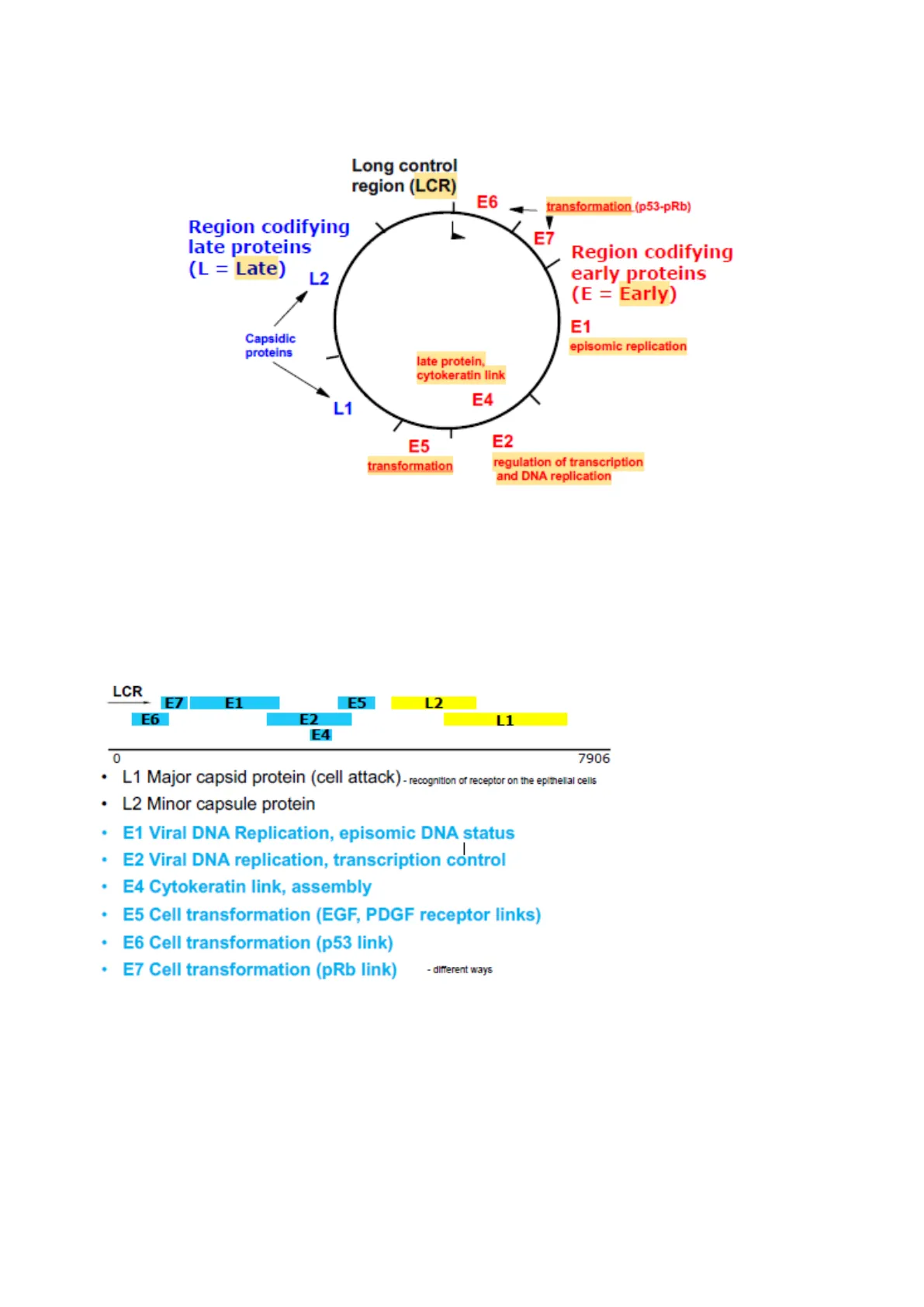
Organization of the genome Long control region (LCR) E6 transformation (p53-pRb) Region codifying late proteins (L = Late) L2 E7 Region codifying early proteins (E = Early) E1 Capsidic proteins episomic replication late protein, cytokeratin link E4 L1 E5 E2 transformation regulation of transcription and DNA replication
- LCR > able to control the expression of all the regions that codifying for the genome of the virus
- E > means early genes. Genes that are immediately transcribed when the virus enters the epithelial cells.
- L> means late genes. Genes that are transcribed during the process of replication of the virus.
Protein Functions
Functions of the proteins: LCR E7 E1 E5 L2 E6 E2 L1 E4 0 7906 . L1 Major capsid protein (cell attack) - recognition of receptor on the epithelial cells · L2 Minor capsule protein · E1 Viral DNA Replication, episomic DNA status · E2 Viral DNA replication, transcription control · E4 Cytokeratin link, assembly · E5 Cell transformation (EGF, PDGF receptor links) · E6 Cell transformation (p53 link) · E7 Cell transformation (pRb link) - different ways ! E1 > the virus replicates within the cytosol of the host cells without integration in the genome of the host cells. This is very important, because if the virus integrates in the genome of the host cells it means the beginning of the cancer. ! E5, E6 and E7 are important for the development of the cancer with different mechanisms.
Viral Lifecycle Activities and Target Factors
Function in viral lifecycle Activities Target factor E1 Replication of viral genome DNA-binding activity, helicase activity, ATPase RPA, topoisomerase, polymerase alpha-primase E2 Transcription of viral genes Replication of viral genome Maintenance of viral genome Transactivation/transrepression, DNA-binding Brd4, ChIR1 activity, DNA segregation in mitotic cell E6 Reactivation of cellular replication mechanisms Proliferation, immortalization, inhibition of apoptosis Maintenance of viral genome Interaction with various cellular proteins p53, ADA3, p300/CBP, E6AP, SP1, c-Myc, NFX1- 91, TERT, FAK, FADD, Caspase 8, BAX, BAK, IRF3, PDZ domain proteins E7 Reactivation of cellular replication mechanisms Proliferation, genomic instability, inhibition of apoptosis Maintenance of viral genome Interaction with various cellular proteins RB, p107, p130, HDAC, E2F6, p21, p27, CDK/cyclin, ATM, ATR, gamma-tubulin E4 Unknown Destruction of keratin network, induction of G2M arrest of cell cycle Cytokeratin 8/18 E5 Possibly involved in proliferation and/or inhibition of apoptosis Affection of cellular signaling pathway EGFR, PDGFR, V-ATPase, MHC1, TRAIL receptor, FAS receptor L1 Major capsid protein L2 Minor capsid protein
Lifecycle of HPV
Lifecycle of HPV
- We have got different layers in our derma, going from the bottom to the external layer. The replication of the virus is different and it is controlled by the host cell. So, we have got different faces in each layer, starting from the basal one that is directly attach by the virus because of some lesions at the level of our membrane. Then, the virus enters in the epithelial Cornified layer Granular layer Spinous layer Basal layer Basal membrane Dermis Normal epithelium HPV-infected epithelium Virion assembly cells and starts to express different types of genes (vedi foto). Expression of E4, E5, L1, L2 Viral genome amplification
- In the last layer, the cornified layer, there is the assembly of the virus. Expression of E1, E2, E6, E7
- Thanks to the desquamation of our skin, the virus can spread and infect other people. The transmission is possible by contact.
HPV Infection and Transformation
- HPVs infect specifically the cells in the basal layer of the stratified epithelium through lesions. Viral genomes are maintained as episomal DNA in the nuclei of infected cells. The viral lifecycle is strictly controlled by host cell differentiation, and the late lifecycle (productive lifecycle) occurs in upper layers of the epithelia that are terminally differentiated, and the progenitor virions are released from the cornified keratinocytes. Infection and transformation Inhibition of E6/E7 transcription Integration LCR E6/E7 E1/E2 E4 E5 L1 L2 1 Cellular factors - E1 and E2 lInhibit the expression of oncogenes Transformation and immortalization DNA replication Infection Fall of the epithelial cells that contain the virus - break of the genom eat the level of E1 and E2 means e xpression of oncogenes - tumour Viral DNA in the nucleus of the infected cell as episome Stratum corneum Viral assembly Accelerated replication of viral DNA in more differentiated cells Normal basal keratinocytes Episome Basal layer
- The expression of E1 and E2 is crucial because the expression of these two genes inhibit the expression of the oncogenic genes E6 and E7.
- If E1 and E2 are not expressed, the virus is integrated in the genome of the host cells.
- What happened for a circular genome, to be able to integrate in the host genome? The viral genome has to break and if the break happened at the level of El and E2, we don't have the expression of E1 and E2 and this means the integration of the viral genome in the host genome. Usually, the virus replicates in the episome, sometimes, when the break of the viral genome happened at the level of E1 and E2, the viral genome integrates in the host cell genome and in this way start the tumoral process.
Interaction of HPV E7 Protein with pRB
-INTERACTION OF HPV E7 PROTEIN WITH pRB E7 E2F-1 PRB E7 + PRB Inactive complex Repression of transcription E2F-1 G1 E2F-1 Activation of transcription and passage in S-phase ppRB M S PPRB inactive inactive G2 E2F: transcription factor; E7: 90 AA nuclear phosphoprotein
- The tumoral cells, compared to the normal cells, are characterised by an uncontrolled replication and the replication of the cells is regulated by the cell cycle. E6 and E7, they are going to act on the cell cycle. The E7 in particular is able to bind to the retinoblastoma proteins, usually in the normal cells the retinoblastoma protein is linked to a transcription factor that is E2F-1. All the transcription factors are present in inactivated form in the cytoplasm, while when they are in the nucleus are responsible for the activation of the oncogenes. In normal condition the E2F-1 transcription factor is linked to the retinoblastoma protein and it is present at the level of the cytosol. But when E7 is produced as a consequence of a viral infection, it links the retinoblastoma protein and the transcription factor is free to enter in the nucleus of the cell and start the expression of some genes. E2F-1 specifically is responsible for the activation of transcription and passage from G1-phase to S-phase. The cells are going to remain constantly in the S phase. This means that the cell is able to proliferate without any kind of control.
Interaction of HPV E6 Protein with p53
INTERACTION OF HPV E6 PROTEIN WITH p53 Viral infection DNA damage Cellular stress + E6 HPV (ubiquitin-dependent degradation of p53) p53 low levels p53 high levels p53 low levels (passage in S-phase and accumulation of mutations) G1 cycle stop in G1 M S G2
- E6 acts on the cell cycle but a different level. Usually, the E6 is able to induce the ubiquitin- dependent degradation of p53. In normal cells, the level of p53 is quite high and this is
Can’t find what you’re looking for?
Explore more topics in the Algor library or create your own materials with AI.
